Unit 9: Extraction, Expression and Adsorption
GIFSQ ID: FTN-0121
Unit 9 of 12 in Unit Operations. This page is one unit of the Unit Operations notes.
All units in Unit Operations:
- Unit 1: Introduction to Unit Operations, Units and Material and Energy Balances
- Unit 2: Fluid Flow, Pumps and Piping
- Unit 3: Heat Transfer and Heat Exchangers
- Unit 4: Thermal Processing, Refrigeration and Freezing
- Unit 5: Mass Transfer and Contact-Equilibrium Separations
- Unit 6: Drying and Dehydration
- Unit 7: Evaporation
- Unit 8: Distillation
- Unit 9: Extraction, Expression and Adsorption
- Unit 10: Membrane Separation
- Unit 11: Mechanical Separations: Filtration, Centrifugation, Sedimentation and Fluidization
- Unit 12: Size Reduction, Mixing and Emulsification
Previous unit: Unit 8: Distillation | Next unit: Unit 10: Membrane Separation
Unit 9: Extraction, Expression and Adsorption
Note
A spoonful of ground coffee meets hot water, and a few minutes later the water is brown, fragrant and full of flavour, while the grounds left behind are pale and spent. Nothing was cut, nothing was burned, and no new chemical was made. A liquid simply carried something out of a solid. The same quiet move, repeated on a factory scale, gives us cooking oil from seed, sugar from beet, and the clear juice in a bottle. How does a liquid pull one thing out of a solid and leave the rest behind, and how does a maker get almost all of it out without drowning the factory in solvent? This unit follows that question from a single coffee ground to a countercurrent extractor.
Questions to think about
- What is the difference between the solid that is left behind, the liquid that does the work, and the liquid that comes out carrying the goods?
- Why does crushing the solid, heating the liquid and stirring the mixture all speed up an extraction?
- How can a triangular diagram show three things at once, and what does the curve inside it mean?
- Why does a maker use several stages instead of one big tank, and why does the solvent run the opposite way to the solid?
- When is it better to squeeze a solid than to wash it with a solvent?
- How does a bed of black granules take the bitter taste out of orange juice without taking the juice itself?
9.1 What extraction is: a liquid that carries one thing away
Solid-liquid extraction is the transfer of a soluble part, the solute, from a solid into a liquid, the solvent. The solid that stays behind is called the inert solid, because it does not dissolve. The liquid that comes out, carrying the solute, is the extract, also called the overflow or the miscella. The wet solid that is left, still holding some solution in its pores, is the underflow, also called the exhausted solid or the raffinate in some books.
The books use several names for the same move. Lixiviation, washing, percolation and leaching all describe a solvent passing over or through a solid and carrying a solute away. Washing is the name used when the solid is the product and the solute is an impurity to be removed, as in washing lactose out of cheese curd. Extraction is the name used when the solute is the product, as in taking oil out of seed. The engineering is the same in both cases.
Food gives plenty of examples. Vegetable and animal oils are taken from seed, nut and fish tissue. Sugar is taken from beet and cane. Tea and coffee give their soluble solids to hot water. Fruit and spice extracts, pectin from exhausted fruit pulp, and the bitter compound limonene taken out of orange juice all use the same idea. In every case the maker wants the same three things: get as much solute out as possible, use as little solvent as possible, and keep the extract as strong as possible.
Quick check
Name the three streams that leave an extraction stage, and say which one carries the solute out as product.
Check your answer
The overflow (extract or miscella) carries the solute out as product, the underflow is the exhausted wet solid, and the solvent is the liquid fed in to do the work.
9.2 The three stages inside every extraction, and which one is slowest
Ibarz describes extraction as three stages that follow one another. First, the solute dissolves the moment the solvent touches it: an instantaneous dissolution at the solid surface. Second, the dissolved solute diffuses through the pores of the solid toward the outside, following Fick law in the form N_S = -D_L dC/dz, where N_S is the solute flux, D_L is the diffusivity in the liquid, and dC/dz is the concentration gradient inside the pore. Third, the solute crosses from the particle surface into the bulk liquid, at a rate N_S = (1/A) dM/dt = K_L (C_S - C), where A is the particle surface, M is the mass transferred, K_L is the mass transfer coefficient, C_S is the concentration at the surface, and C is the concentration in the bulk liquid.
The slowest stage controls the whole operation, and in most food extractions that stage is the diffusion inside the pores. That is why the practical rules of extraction all point the same way. Crush the solid into smaller particles, and the diffusion path gets shorter. Raise the temperature, and the diffusivity rises while the viscosity falls. Stir the mixture, and the transfer coefficient K_L at the surface rises. Use a solvent that likes the solute and flows easily, and the solute moves faster. None of these changes the chemistry: they all shorten the slowest step.
The solvent itself must be chosen with care. It should dissolve the solute well and leave the rest of the solid alone, so the extraction is selective. It should have a low viscosity, so it flows through the solid bed and drains away cleanly. It should be easy to take away from the extract afterwards, usually by evaporation, and it must be safe in food use. Ibarz lists hexane, heptane, cyclohexane, benzene, trichloroethylene and carbon disulfide as solvents named in the older literature for vegetable oils. The book itself notes the limits: trichloroethylene is toxic and its use is limited, and benzene brings health problems. In modern food practice the common choice for oilseeds is hexane, used with care and removed afterwards, and the book gives a paprika example in which the final oleoresin holds less than 10 ppm of hexane.
Quick check
A maker grinds the feed finer and the extraction speeds up. Which stage did the grinding shorten, and why?
Check your answer
It shortened the diffusion of solute through the pores of the solid, because the distance the solute must travel to reach the particle surface is smaller.
9.3 Overflow, underflow and retention: the triangular diagram
To design an extraction, the maker needs to know how much solution the exhausted solid holds on to. That quantity is the retention, r, in kg of solution retained per kg of inert solid. The underflow leaving a stage is a mixture of inert solid and retained solution, and the solution it retains has the same composition as the overflow leaving that stage, because the two streams are in equilibrium. The inert solid itself never appears in the overflow, so the mass fraction of inert solid in the overflow, Y_I, is 0.
Ibarz plots these mixtures on a triangular diagram, a right triangle in which the vertex of the right angle is the inert component I, and the other two vertices are the solvent D and the solute S. The mass fraction of solute is read on the horizontal axis, X_S, and the mass fraction of solvent on the vertical axis, X_D. The mass fraction of inert solid follows from the difference of one minus the sum of the other two. The hypotenuse of the triangle is the overflow, because every point on it holds no inert solid. The underflow points sit on a curve inside the triangle, the retention curve, which runs from a point G on the vertical axis to a point K near the base.
Three lines in the diagram carry the whole design. Curve (a) is the retention curve itself, the real behaviour of the solid. Line (b) is the line of constant retention of solution: it runs from G to a point H on the base, and it says the solid always holds the same total mass of solution, whatever the solute concentration. Line (c) is the line of constant retention of solvent: it runs from G to the vertex S, and it says the solid always holds the same mass of solvent. A real solid may follow either line, or a curve between them, and the book gives the equations for both. For constant retention of solution, X_D = r/(r + 1) - X_S. For constant retention of solvent, X_D = r/(r + 1) (1 - X_S). The tie lines that join an overflow point on the hypotenuse to its underflow point on the retention curve all pass through the inert vertex I, which is how the diagram is read in practice.
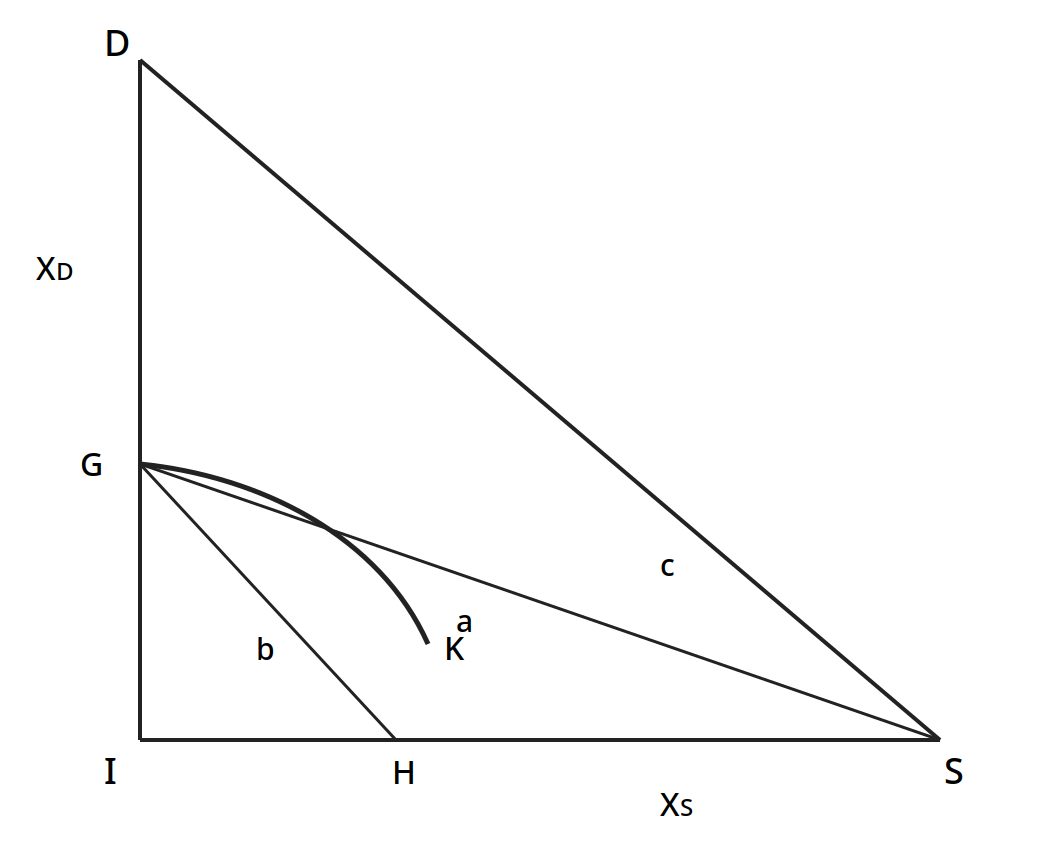
Right triangle with the inert component I at the right angle, solvent D at the top and solute S at the bottom right. Curve (a) is the retention curve from G to K, line (b) is constant retention of solution from G to H, line (c) is constant retention of solvent from G to S. The hypotenuse D to S is the overflow.
Figure 9.1: Triangular diagram for solid-liquid extraction: (a) retention curve, (b) constant retention of solution, (c) constant retention of solvent. (Ibarz, Fig. 21.1, p. 777.) The retention curve carries no numeric coordinates in the book, so its path in this drawing follows the printed shape; all vertices, axes, points G, H and K, and lines (a), (b) and (c) are as the book gives them.
Quick check
A point sits on the hypotenuse of the triangular diagram. How much inert solid does that stream hold, and what is it called?
Check your answer
None: the mass fraction of inert solid is 0 on the hypotenuse, and the stream is the overflow, or extract.
9.4 The rectangular diagram: the same facts without the inert solid
When the inert solid is left out of the picture, the same mixtures can be plotted on a rectangular diagram, with the axes free of inert solid. Ibarz defines N = X_I / (X_S + X_D), the inert solid per unit of solution, and X' = X_S / (X_S + X_D), the solute fraction in the solution on an inert-free basis, with Y' = Y_S / (Y_S + Y_D) for the overflow. On this diagram the overflow line is the abscissa itself, because N = 0 for the overflow, and the underflow points sit on a curve above it. The two diagrams say the same thing in different shapes: the triangular diagram keeps the inert solid in view, the rectangular diagram hides it so the solution compositions are easier to read. A maker uses whichever one suits the calculation at hand.
9.5 One stage: balances, the pole, and the least solvent that can work
A single stage is a box with four streams: the feed R_A comes in, fresh solvent D comes in, the underflow R_1 goes out, and the overflow E_1 goes out. The overall balance is R_A + D = R_1 + E_1 = M, where M is the pole, the mixture point of feed and solvent. The solute and solvent balances fix where M sits, and the tie line through M gives the compositions of R_1 and E_1. The book gives the pole coordinates as X_SM = (R_A X_SRA + D Y_SD) / (R_A + D) and X_DM = (R_A X_DRA + D Y_DD) / (R_A + D).
There is a smallest amount of solvent that can do the job at all, D_MIN. It is found when the pole M sits exactly on the retention curve. In that case the underflow R_1 coincides with M, the distance R_1M is 0, and the overflow E_1 is 0: no extract comes out. So a real plant must always work with more solvent than the minimum, and the minimum is a limit to design against, not a flow to run at.
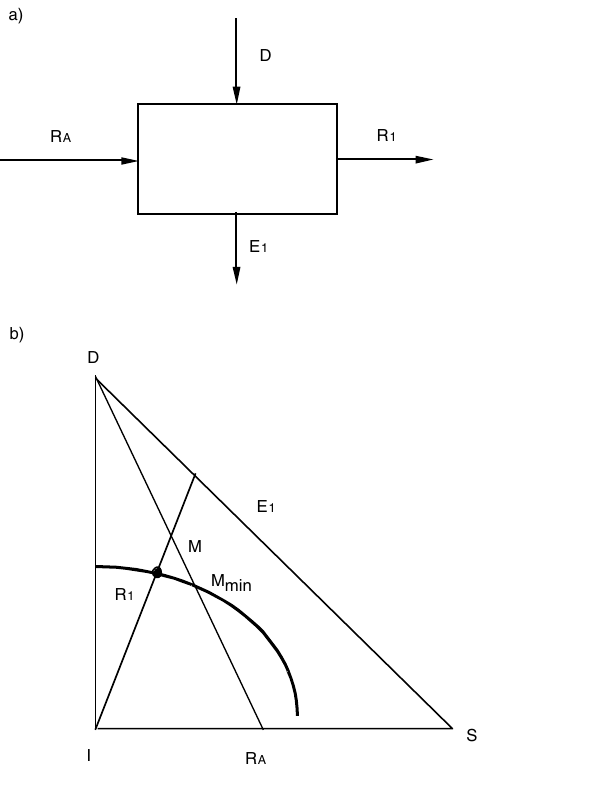
Figure 9.2: Single-stage system: (a) scheme of the contact, (b) operation on the triangular diagram. (Ibarz, Fig. 21.5, p. 783.) The retention curve in (b) carries no numeric coordinates in the book, so its path follows the printed shape; all points, lines and labels are as the book gives them.
9.6 Several stages: running the streams against each other
One stage rarely gets enough solute out, so plants use several stages. In a concurrent system the fresh solvent is split between the stages, and Ibarz shows the best yield comes when the solvent is split equally, D_i = D_T / n, where D_T is the total solvent and n is the number of stages. In a countercurrent system the solid and the solvent move in opposite directions: fresh solvent meets the most exhausted solid last, and the strongest extract leaves beside the fresh feed. The overall balance is R_A + E_{n+1} = R_n + E_1 = M, and the stages are stepped off with a pole P given by R_A - E_1 = R_i - E_{i+1} = P. The minimum solvent in a countercurrent system is found when the final overflow is in equilibrium with the feed, or when the final underflow is in equilibrium with the solvent, whichever comes first.
Countercurrent working is the reason a factory extractor can be both strong and thrifty. The fresh solvent, which has the most power to dissolve, meets the solid that has the least solute left, so it squeezes out the last of it. The strong extract, already carrying solute, meets the fresh feed, which has plenty of solute to give, so the extract leaves as strong as the feed can make it. The solvent use stays low and the extract stays strong, which is the pair of aims set out in section 9.1.
Quick check
In a countercurrent extractor, which stream does the fresh solvent meet first: the fresh feed or the most exhausted solid?
Check your answer
The most exhausted solid. Fresh solvent meets the solid with the least solute left, and the strongest extract leaves beside the fresh feed.
9.7 Worked examples from Earle: oil from soya, and washing curd
Example 9.6: oil from soya beans. Oil is to be extracted from soya beans in a countercurrent stage-contact apparatus using hexane. The initial oil content of the beans is 18%, the final extract solution is to contain 40% of oil, and 90% of the total oil is to be extracted. The oil is extracted from the beans in the first mixer, equilibrium is reached in each stage, and the crushed bean solids in the underflow retain half their weight of solution after each settling stage. How many contact stages are necessary?
Basis: 100 kg of raw beans. In 100 kg there are 82 kg of bean solids and 18 kg of oil. In the final underflow, 82 kg of beans retain 41 kg of solution, and that solution holds 10% of the oil, that is 1.8 kg, so 16.2 kg of oil go into the final overflow. The extract holds 16.2 kg of oil and 24.3 kg of solvent, a total of 40.5 kg, and the total solvent entering is 63.5 kg.
Working stage by stage from the balances, with x as the oil fraction in the underflow and y as the oil fraction in the overflow, the book finds x_1 = 0.4 and y_2 = 0.23 after the first stage, y_4 = 0.049 after the third stage, and y_5 = 0.00315 after the fourth stage. The required terminal condition is that the underflow from the final stage holds less than 1.8 kg of oil, that is x_n less than 1.8 / 41 = 0.044. Since y_5 = 0.00315 is less than 0.044, four stages of contact are sufficient.
The same result comes from the McCabe-Thiele graphical method. For all stages after the first, the operating line is y_{n+1} = 0.646 x_n - 0.028, and the equilibrium line is y_n = x_n, because the retained solution has the same concentration as the overflow. Stepping off between the two lines from the entry conditions gives the same answer: three steps are not sufficient, four are.
Example 9.7: washing lactose out of casein curd. Washing is almost identical to extraction, except the solid is the product and the solute is an impurity to be removed, and the solvent is water, which is cheap and readily available. A curd has a liquid content of 66% and that liquid holds 4.5% lactose. Calculate the residual lactose in the casein after drying if the curd is washed three times with 194 kg of fresh water each time, and calculate the water that would be needed in a single wash to reach the same lactose content. Assume perfect washing and draining of the curd to 66% moisture each time.
100 kg of curd hold 66 kg of solution, and the 66 kg hold 4.5%, that is 3 kg of lactose. In the first wash, (194 + 66) = 260 kg of solution hold 3 kg of lactose, so the 66 kg of solution left after draining hold (66 / 260) x 3 = 0.76 kg. After the second wash the lactose left is (66 / 260) x 0.76 = 0.19 kg. After the third wash it is (66 / 260) x 0.19 = 0.048 kg. After washing and drying, 0.048 kg of lactose remain with 34 kg of dry casein, so the lactose content of the product is 0.048 / 34.05 = 0.14%, using 3 x 194 = 582 kg of wash water.
To reach 0.048 kg in one wash would need x kg of water, where (3 x 66) / (x + 66) = 0.048, giving x = 4060 kg. Three small washes use 582 kg of water to do what one big wash would need 4060 kg to do. That is the whole case for staging, in one pair of numbers.
The general rules behind the example are the washing equations. After n washings, x_n = x [1 / (1 + y)]^n, equation 9.11. If the same total quantity of water is used all in one stage, the impurity content is x = x [1 / (n y + 1)], equation 9.12. Splitting the water always wins.
Quick check
A curd is washed twice with the same water each time. Does the second wash remove the same mass of lactose as the first?
Check your answer
No. Each wash removes the same fraction of what is left, so the mass removed falls each time: 3 kg falls to 0.76 kg, then to 0.19 kg in this example.
9.8 The Ibarz chapter problems: the same method, worked through
Ibarz gives no worked examples inside the text of Chapter 21. It gives end-of-chapter problems with solutions, and this section states their results plainly as chapter problems, not as worked examples from the text.
Problem 21.1: flour and oil, one stage. 500 kg of flour holding 10% oil are treated with 3000 kg of solvent in a single stage, with a retention of 0.8 kg of solution per kg of inert solid. The retention line is X_D = 0.444 - X_S, the pole M sits at X_SM = 0.014 and X_DM = 0.857, the underflow leaves at X_S = 0.007 and X_D = 0.437, and the overflow leaves at Y_S = 0.016 and Y_D = 0.984. The underflow is R_1 = 813.2 kg and the overflow is E_1 = 2686.8 kg. The oil extracted is 44.1 kg, which is 88% of the oil in the flour.
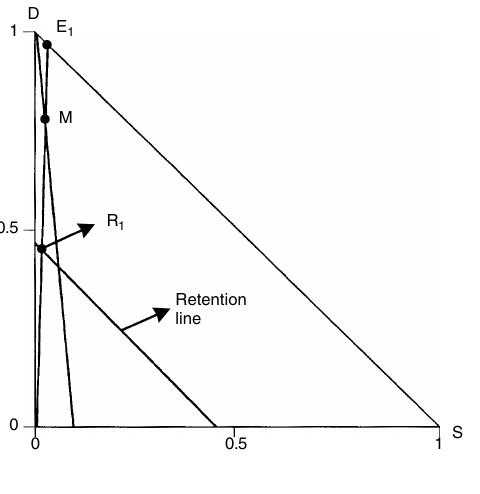
Figure 9.5: Graphical method to obtain underflow and overflow concentrations (Ibarz Fig. 21.P1, p. 812), for Problem 21.1.
Problem 21.2: fish flour, three concurrent stages. Fish flour holding 38% oil is treated at 1000 kg/h with 750 kg of ether per stage in three concurrent stages, with a retention that rises with the oil fraction in the overflow, r = 0.6 + 0.3 y_S + 7 y_S^2. The book reads the stage compositions from the triangular diagram: stage 1 gives underflow X_SR1 = 0.21 and overflow Y_SE1 = 0.34, with E_1 = 96.2 kg/h and R_1 = 1653.8 kg/h; stage 2 gives X_SR2 = 0.10 and Y_SE2 = 0.20, with E_2 = 1069.2 kg/h and R_2 = 1334.6 kg/h; stage 3 gives X_SR3 = 0.04 and Y_SE3 = 0.10, with E_3 = 834.6 kg/h and R_3 = 1250 kg/h. The combined extract holds Y_SE = 0.165, the oil recovered is 330 kg/h, and the yield is 86.84%.
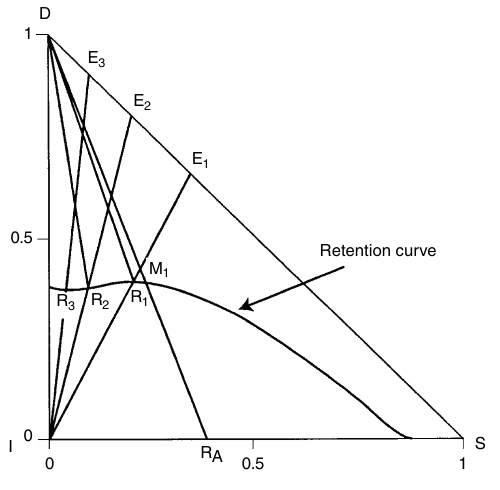
Figure 9.6: Graphical solution of Problem 21.2 (Ibarz Fig. 21.P2, p. 815).
Problem 21.3: cod liver oil, countercurrent. Cod liver oil is extracted so that 90% is recovered and the overflow holds 60% oil, with a retention r = 2 / 3.2 = 0.625. On a basis of 100 kg, the feed holds X_SRA = 0.251 and X_IRA = 0.749, the final underflow is R_n = 121.85 kg at X_SRn = 0.021, X_DRn = 0.364 and X_IRn = 0.615, the first overflow is E_1 = 37.65 kg, and the solvent feed is E_{n+1} = 59.5 kg. The retention line is X_D = 0.385 - X_S, the pole P sits at (0.04, -0.242), and the graphical construction gives 6 theoretical stages.
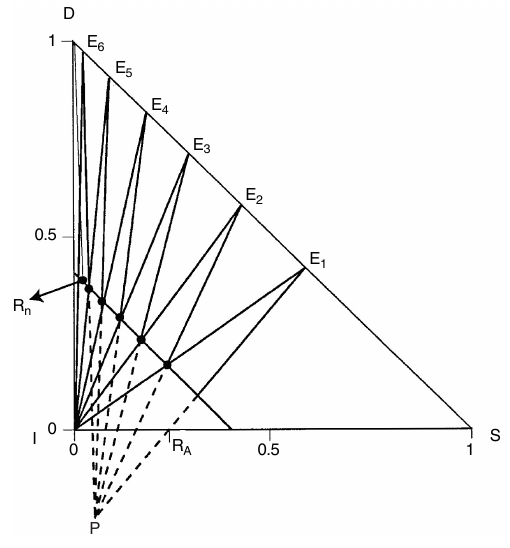
Figure 9.7: Graphical calculation of theoretical stages (Ibarz Fig. 21.P3, p. 818), for Problem 21.3.
Problem 21.4: soluble coffee, countercurrent. Soluble coffee is made at 3000 kg/h from beans holding 24% soluble solids, with 5% of the solute left in the final underflow, an overflow of 35% solids, and a retention of 1.6 kg of solution per kg of inert solid. The book finds E_1 = 1954.3 kg/h, R_n = 5928 kg/h, and a water requirement of E_{n+1} = 4882.3 kg/h. The retention line is X_D = 0.615 - X_S, the pole P sits at (0.034, -1.215), and the construction gives 9 theoretical stages, or 12 real stages at 75% stage efficiency.
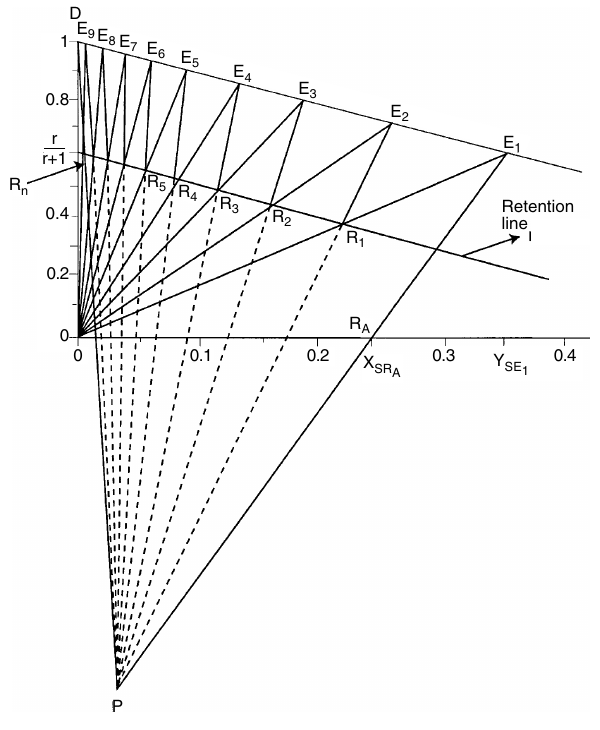
Figure 9.8: Graphical calculation of theoretical stages (Ibarz Fig. 21.P4, p. 821), for Problem 21.4.
9.9 Equipment: from a laboratory flask to a factory extractor
Batch percolators are the simplest factory form: a vessel with a false bottom, filled with the solid, through which solvent is passed until the extract is strong enough, then drained. A diffusion battery is a set of such vessels connected so the solvent passes from one to the next, and the freshest solvent always meets the most exhausted solid: a countercurrent system built from batch vessels. The Robert diffusion battery works this way for sugar beet.
Continuous extractors move the solid instead of the solvent. The Bollman extractor, also called the Hansa-Muehle extractor, is a tall vertical bucket elevator: perforated buckets carry the solid up one side and down the other, fresh solvent sprays on the solid near the top, half miscella is collected part way down and sprayed again, and the final miscella leaves at the bottom.
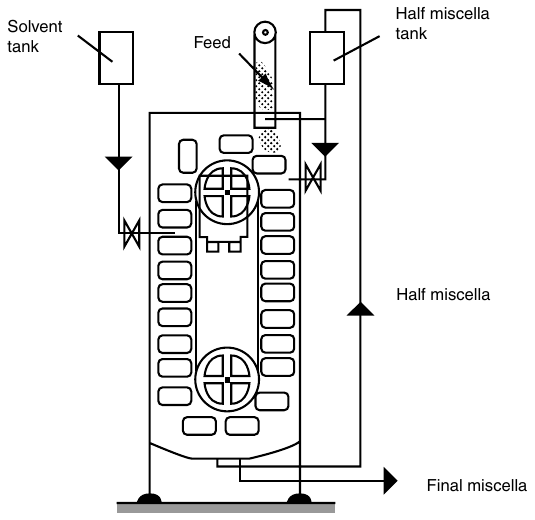
Figure 9.3: Bollman extractor. (Ibarz, Fig. 21.11, p. 802.) All tanks, streams and labels are as the book gives them.
Other continuous forms named in the book are the Hildebrandt U immersion extractor, in which a screw carries the solid up one leg while solvent flows the other way; the Bonotto vertical column; the Rotocel, a rotating carousel of cells; the vertical immersion column; and the C.M.B. percolation extractor and the De Smet extractor. The choice between them turns on the solid: how it flows, how it packs, how fine it is, and how much solvent it holds.
The Soxhlet extractor is the laboratory form, and it shows the idea in its purest shape. Solvent boils in the cauldron, condenses in the condenser, drips onto the solid in the extractor, and when the extractor fills to the top of the siphon, the whole charge siphons back into the cauldron. The same solvent is used again and again, each time carrying a little more solute into the cauldron, until the solid is exhausted. It is slow and small, but it is the standard way to measure how much extractable matter a solid holds.
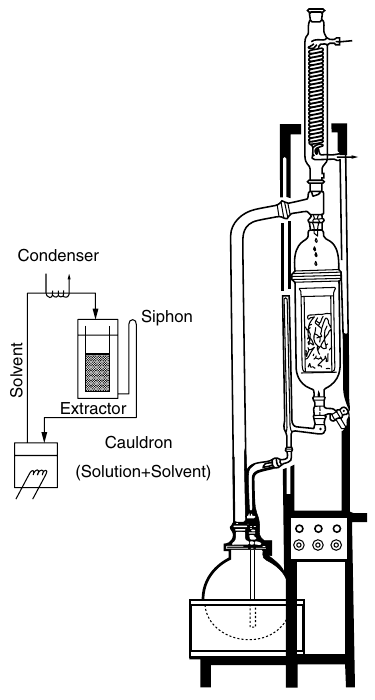
Figure 9.4: Soxhlet extractor. (Ibarz, Fig. 21.17, p. 807.) The left half is the book's labelled scheme; the right half is the book's detailed drawing of the glass apparatus.
9.10 Expression: squeezing instead of dissolving
Expression takes the liquid out by pressure instead of by a solvent. The liquid is pressed out of the solid matrix, and the solid left behind is a cake. Brennan gives the presses used in food plants. A hydraulic plate press works at 2 to 4 tons per square inch, in thin layers, with the pressure raised gradually so the liquid has time to escape. A cage press holds the material in a perforated cylinder with drainage strings that give the liquid a path out. A roller press, with grooved rollers, is the form used for sugar cane. A screw press, or expeller, drives the material along a shaft turning at 5 to 500 rpm, building barrel pressures of 20,000 to 40,000 psi, with throughputs up to 200 tons in 24 hours and a residual cake holding 4 to 5% liquid.
How well expression works turns on four things: the yield stress of the solid, the porosity of the cake, the viscosity of the liquid, and the compressive force applied. A soft fruit pulp gives up its juice under a gentle press. An oilseed needs an expeller. A material that forms a tight, low-porosity cake holds its liquid back whatever the pressure. Expression is the right choice where the liquid is already there and only needs to be pushed out; extraction is the right choice where the solute is locked inside the solid and a solvent must go in and fetch it. Many plants use both: press first to take the free liquid, then extract the pressed cake to take the rest.
Quick check
A maker presses an oilseed and the cake still holds 5% liquid. Would a second press, or a solvent extraction of the cake, recover more of that liquid?
Check your answer
A solvent extraction of the cake. Pressing has reached its limit for that cake, and a solvent can dissolve out the oil that pressure alone cannot push out.
9.11 Adsorption and ion exchange: catching molecules on a surface
Adsorption is the catching of a substance, the adsorbate, on the surface of a solid, the adsorbent. The adsorbent is usually a porous solid with a very large internal surface: activated carbon and molecular sieves are the common examples. In physical adsorption the molecules are held by Van der Waals forces, the binding is weak, and the process is reversible: the adsorbate can be taken off again. In chemisorption the binding happens at active points on the surface and is stronger. Electric forces can also play a part. Ion exchange is a related operation in which ions in a liquid are swapped for ions held on a resin: cationic resins swap cations and anionic resins swap anions, and the uses include desalination and water conditioning.
Food uses are mostly about taking something unwanted out of a liquid. The bitter compound limonene is taken out of orange juice on polymer adsorbents. Brown colour compounds, melanins and melanoidins, are taken out of clarified juice on activated carbon. The adsorbent must catch the unwanted molecule and let the wanted ones pass, which is why the choice of adsorbent and the isotherm matter so much.
The equilibrium between a liquid and an adsorbent is described by an isotherm, a curve of the amount adsorbed against the concentration left in the liquid. The Langmuir isotherm is m_A / m_0 = K C_A / (1 + K C_A), where m_A is the mass adsorbed, m_0 is the saturation mass, C_A is the concentration in the liquid, and K is a constant. The Freundlich isotherm is m_A = K (C_A)^n. The BET isotherm extends the idea to several layers of molecules. The ion exchange separation factor is K = (1 - Y) X / [Y (1 - X)], with Y = C_A / C_A0 and X = E_A / E_M, where E_A is the amount of ion A on the resin and E_M is the total exchange capacity.
Kinetics follow the same pattern as extraction: transfer from the bulk liquid to the surface, N = k_F (C - C_i), then diffusion inside the particle, then the adsorption step itself. In most cases the first stage, the transfer to the surface, controls the rate.
Stage operation is drawn on an m-C diagram, amount adsorbed against concentration. For a single contact the operating line is m_S = -(F/S) C_S + (m_E + (F/S) C_E), with a slope of -F/S, where F is the liquid flow and S is the adsorbent flow. Repeated simple contact steps down the isotherm stage by stage. In a countercurrent moving bed the operating line has slope F/S, and there is a maximum (F/S)_MAX, found by the tangent to the isotherm: past it, the operating line crosses the isotherm and the separation fails. A fixed-bed column is described by a moving exchange zone: the breakpoint is taken at 5% of the inlet concentration and saturation at 95%, the zone height is z_C, the column volume to the breakpoint is V_C = V_T - V_R, the mass retained is M_R = V_R C_0, and the times are t_C = V_C / q and t_T = V_T / q. For a symmetrical breakthrough curve the factor i is 0.5 and the formation time is t_F = 0.5 t_C. For adsorption the zone height is z_C = (F A / (K' k_F a_S)) ln 19 for C_1 = 0.05 C_0 and C_2 = 0.95 C_0, and for ion exchange z_C = (F A / (k_F a_S)) ((K + 1) / (K - 1)) ln 19. Wilke gives the empirical form z_C = b v^0.51, with b = 37.4 for Ca2+ and Mg2+ exchanged by Na+.
9.12 Adsorption worked examples from the Ibarz chapter problems
These are end-of-chapter problems with book solutions, stated plainly as such.
Problem 22.1: taking the brown colour out of clarified juice. A clarified juice has a browning value A420 of 0.646, and activated carbon is dosed at b = 0 to 0.26 kg of carbon per kg of solution, with equilibrium m values of 11.4, 7.75, 4.35, 2.98 and 1.79. In repeated contact with 0.025 kg of carbon per kg of juice, the operating line has slope -L/S = -40, and five stages bring the juice from A420 0.646 down to 0.200, through stage values 0.470, 0.365, 0.285, 0.225 and 0.180. In a countercurrent moving bed, (L/S)_MAX = 25.11, so the minimum carbon is 39.82 kg, and the operating carbon for 1000 kg/h of juice is 79.64 kg.
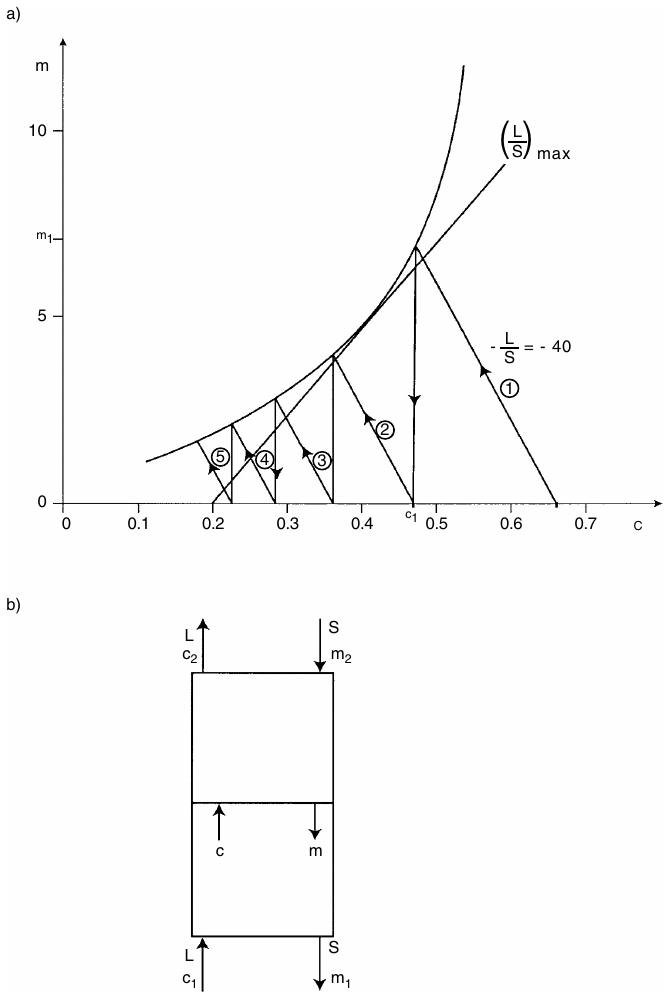
Figure 9.9: Graphical calculation of the stages and maximum slope, and the movable column (Ibarz Fig. 22.P1, p. 848), for Problem 22.1.
Problem 22.2: limonene out of orange juice. Orange juice holds 110 ppm of limonene and flows at 100 kg/h through a column of 0.15 m2 cross section, with adsorbent of density 950 kg/m3, a transfer coefficient of 1.5 x 10^2 h-1, a capacity of 10 mg/kg, and an isotherm m = 0.12 C, with symmetrical breakthrough. The book finds the exchange zone height z_C = 0.0646 m, the bed height 3.12 m, and the breakpoint at 25 min.
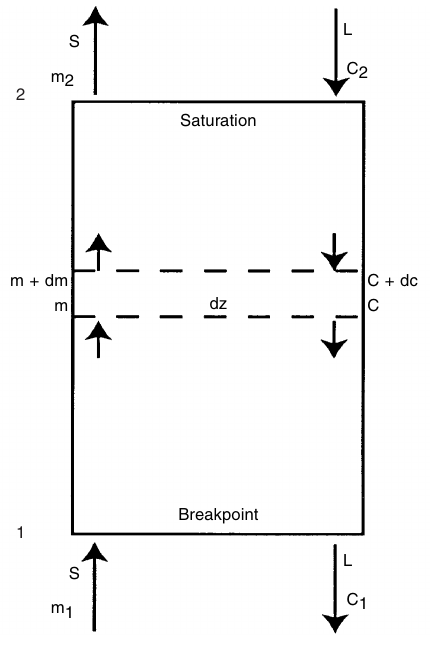
Figure 9.10: Conditions of an exchange zone (Ibarz Fig. 22.P2, p. 850), for Problem 22.2.
Problem 22.3: softening water by ion exchange. Water flows at 8000 kg/h holding magnesium salts at 40 meq/kg, through a resin of capacity 15 eq/kg, a separation factor of 50, an apparent density of 550 kg/m3, and a column 30 cm in diameter, with K_L a_S = 2.5 x 10^6 l/(h.m3) = 2500 h-1, and symmetrical breakthrough. The book gives z_C = 0.139 m, V_C = 0.00981 m3, a breakpoint of 1.046 h, which is 63 min, a saturation time of 1.298 h, which is 78 min, and a magnesium content of 32 meq/kg after 75 min of operation.
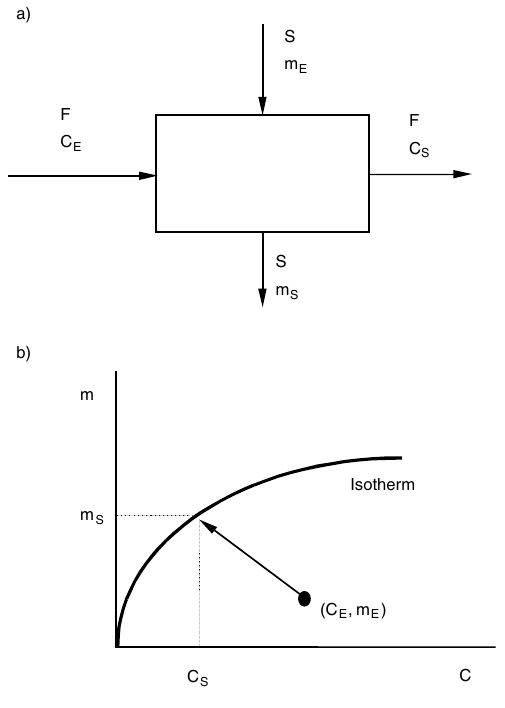
Figure 9.11: Single contact: (a) operation sketch; (b) operation in the equilibrium diagram (Ibarz Fig. 22.2, p. 830), for Problem 22.3.
One inconsistency in the book must be stated plainly. The problem statement says the column contains 110 kg of resin, but the calculation that follows uses 25 kg: V_RESIN = 25 kg / 550 kg/m3 = 0.04546 m3, giving a total column height of z = 0.643 m and a saturation volume V_S = V - V_C = 0.03565 m3. Every downstream number follows from 25 kg, so the 110 kg in the statement reads as a misprint, and this unit follows the calculation as printed.
Quick check
A fixed-bed column is run until the outlet reaches 5% of the inlet concentration. What is that moment called, and what does it mean for the bed?
Check your answer
It is the breakpoint. It means the exchange zone has reached the end of the bed and the unwanted substance is starting to escape, so the bed is nearly spent.
9.13 Food applications: sugar, coffee, tea, oils and juice
Sugar beet is washed and sliced, then extracted with hot water in a diffusion battery to give an extract holding about 15% dissolved solids. The extract is purified by sedimentation and filtration, concentrated, and the sugar is crystallised out by centrifuge. The same countercurrent idea, water running against the solid, serves a commodity made in millions of tonnes.
Instant coffee is roasted and crushed beans extracted with water. The final solution holds 25 to 30% solids, and it is then atomised to give instant coffee grains. The solid just charged is extracted with water at 100 C, and as the process goes on the temperature of the water is increased. High temperatures favour the hydrolysis of insoluble carbohydrates, which become soluble and raise the soluble solids content of the final solution. But very high temperatures can hydrolyse substances that give undesirable aromas and flavours to the extract, so the temperature is a balance between yield and quality.
Instant tea is extracted with water at 70 C in the first stages, rising to 90 C in the last, giving an extract of 2.5 to 5% solids. The volatile aroma compounds are distilled off first, the extract is vacuum evaporated to 25 to 50% soluble solids, the aroma is added back, and the concentrate is freeze dried or atomised.
Vegetable oils are extracted with solvents, then the solvent is evaporated off and the oil refined. Paprika oleoresin is extracted to 99.25% oleoresin, and the final product holds less than 10 ppm of hexane, using a volume of solvent of 5 to 10% of the paprika. Fish oil and fish flour, pectin from exhausted fruit pulp, and flavour liquors made with ethanol all use the same operations at different scales.
9.14 What the books do not give
The books used for this unit give no table specific to extraction, so this unit invents none. Ibarz gives no worked examples inside the text of Chapters 21 and 22, only end-of-chapter problems, and those are labelled as such wherever they appear above. Earle gives two worked extraction examples, 9.6 and 9.7, and two worked membrane examples in Unit 10. The FPE proceedings papers listed in the outline for this unit, Emch on extraction of fruit and vegetables and Schwartzberg and colleagues on expression of water and juices in plants, are supplementary papers, and no numbers from them are quoted here because the chapter text already carries the design material. The Desai and Schwartzberg paper on mathematical modelling of leaching processes is listed in the outline with its PDF page not yet located, so it is not cited here.
Try it yourself: Make a cup of tea with one tea bag and a fixed amount of hot water, and time how long the colour takes to reach a shade you like. Then make a second cup with the same bag cut open and the leaves spread loose in the water. Compare the two cups at the same time. The loose leaves colour the water faster, because the diffusion path is shorter and the surface is larger. Then pour a third cup through the used leaves with fresh hot water: the second wash is paler, because each wash takes the same fraction of what is left. That is sections 9.2 and 9.7, in a kitchen.
Key ideas to carry forward
- Extraction moves a solute from a solid into a solvent. The overflow, or miscella, carries the product out, and the underflow is the exhausted solid holding retained solution.
- The slowest stage usually controls the rate, and it is usually diffusion inside the pores, so crushing, heating and stirring all speed the work up.
- Retention, r, is the kg of solution held per kg of inert solid, and the triangular diagram plots the underflow on its retention curve and the overflow on its hypotenuse.
- The pole M fixes a single stage, and the minimum solvent is found when M sits on the retention curve, at which point no overflow comes out.
- Countercurrent stages run the solvent against the solid, so fresh solvent meets the most exhausted solid and the strongest extract leaves beside the fresh feed.
- Three small washes beat one big wash: 582 kg of water in three washes does the work of 4060 kg in one, for the casein curd in Example 9.7.
- Four stages of countercurrent contact take 90% of the oil from soya beans at 40% extract strength, in Example 9.6.
- The Bollman extractor is a bucket elevator that carries the solid past the solvent, and the Soxhlet extractor reuses the same solvent through boiling, condensing and siphoning.
- Expression squeezes the liquid out by pressure. A screw press can reach 20,000 to 40,000 psi and leave a cake holding 4 to 5% liquid.
- Adsorption catches unwanted molecules on a porous solid. Activated carbon takes brown colour from juice, and polymers take bitter limonene from orange juice.
- Adsorption equilibrium follows Langmuir, Freundlich or BET isotherms, and a fixed bed is judged by its breakpoint at 5% of the inlet concentration and its saturation at 95%.
- In Ibarz Problem 22.3 the statement says 110 kg of resin while the calculation uses 25 kg, and this unit follows the calculation as printed.
Glossary
Extraction
The transfer of a soluble part from a solid into a liquid solvent. Food tech example: taking oil out of soya beans with hexane in a countercurrent extractor.
Solute
The soluble part that is taken out of the solid. Food tech example: the oil dissolved out of soya beans, or the soluble solids dissolved out of roasted coffee beans.
Solvent
The liquid that dissolves the solute and carries it out of the solid. Food tech example: hot water as the solvent for instant coffee, or hexane as the solvent for vegetable oil.
Inert solid
The part of the solid that does not dissolve and stays behind. Food tech example: the bean solids left after the oil has been extracted from soya beans.
Overflow
The liquid stream leaving an extraction stage carrying the solute, also called the extract or the miscella. Food tech example: the 40% oil extract leaving the first stage of the soya bean plant.
Underflow
The wet solid leaving an extraction stage, holding retained solution in its pores. Food tech example: the exhausted beet pulp leaving a diffusion battery.
Miscella
The mixture of solvent and dissolved solute that is the product of an extraction, especially in oilseed work. Food tech example: the half miscella collected part way down a Bollman extractor and sprayed again.
Retention
The mass of solution held by the exhausted solid, in kg of solution per kg of inert solid. Food tech example: a retention of 0.8 kg per kg for flour in Ibarz Problem 21.1.
Triangular diagram
A right-angled diagram that plots the solute, solvent and inert solid fractions of extraction mixtures, with the overflow on the hypotenuse and the underflow on the retention curve. Food tech example: reading the underflow and overflow compositions for a single stage from Figure 9.1.
Pole
The mixture point of two streams on a triangular diagram, used to step off the stages of an extraction. Food tech example: the pole M of feed and solvent in a single stage, or the pole P of a countercurrent system.
Countercurrent
An arrangement in which two streams flow in opposite directions, so the freshest of one meets the most exhausted of the other. Food tech example: fresh water meeting the most exhausted beet pulp in a diffusion battery.
Percolation
Passing a solvent down through a bed of solid so it trickles through and extracts as it goes. Food tech example: solvent percolating through a bed of crushed oilseed in a batch percolator.
Expression
Taking liquid out of a solid by pressure instead of by a solvent. Food tech example: a screw press taking oil from seed and leaving a cake holding 4 to 5% liquid.
Expeller
A screw press that drives material along a shaft and squeezes the liquid out under high pressure. Food tech example: an expeller running at up to 200 tons of seed in 24 hours.
Adsorption
The catching of molecules from a liquid or gas on the surface of a porous solid. Food tech example: activated carbon catching brown colour compounds from clarified juice.
Adsorbate
The substance caught on the surface of an adsorbent. Food tech example: limonene caught on a polymer adsorbent from orange juice.
Adsorbent
The porous solid that catches molecules on its surface. Food tech example: activated carbon used to decolourise juice.
Isotherm
A curve showing how much is adsorbed at equilibrium for each concentration left in the liquid, at a fixed temperature. Food tech example: the Langmuir isotherm for a solute on activated carbon.
Ion exchange
Swapping ions between a liquid and a resin that holds ions on its surface. Food tech example: swapping magnesium and calcium ions for sodium ions to soften water.
Breakpoint
The moment when the outlet of a fixed-bed column reaches 5% of the inlet concentration, showing the bed is nearly spent. Food tech example: the 63 minute breakpoint in the water softening column of Ibarz Problem 22.3.
Exchange zone
The band inside a fixed-bed column where the transfer is actually happening, between the saturated part above and the fresh part below. Food tech example: the 0.139 m exchange zone in the water softening column.
References
- Ibarz, A., and Barbosa-Canovas, G. V., Unit Operations in Food Engineering, CRC Press, 2003. Chapter 21, Solid-Liquid Extraction, including Figures 21.1, 21.5, 21.11 and 21.17 and Problems 21.1 to 21.4; Chapter 22, Adsorption and Ionic Exchange, including Problems 22.1 to 22.3.
- Earle, R. L., Unit Operations in Food Processing, 2nd edition, Pergamon Press, 1983. Chapter 9, Contact-Equilibrium Separation Processes, extraction and washing section, including Examples 9.6 and 9.7 and equations 9.11 and 9.12.
- Brennan, J. G., Butters, J. R., Cowell, N. D., and Lilly, A. E. V., Food Engineering Operations, Elsevier, 1969. Chapter 6, Filtration and Expression, Section 6.4, Expression.
