Unit 12: Size Reduction, Mixing and Emulsification
GIFSQ ID: FTN-0124
Unit 12 of 12 in Unit Operations. This page is one unit of the Unit Operations notes.
All units in Unit Operations:
- Unit 1: Introduction to Unit Operations, Units and Material and Energy Balances
- Unit 2: Fluid Flow, Pumps and Piping
- Unit 3: Heat Transfer and Heat Exchangers
- Unit 4: Thermal Processing, Refrigeration and Freezing
- Unit 5: Mass Transfer and Contact-Equilibrium Separations
- Unit 6: Drying and Dehydration
- Unit 7: Evaporation
- Unit 8: Distillation
- Unit 9: Extraction, Expression and Adsorption
- Unit 10: Membrane Separation
- Unit 11: Mechanical Separations: Filtration, Centrifugation, Sedimentation and Fluidization
- Unit 12: Size Reduction, Mixing and Emulsification
Previous unit: Unit 11: Mechanical Separations: Filtration, Centrifugation, Sedimentation and Fluidization
Unit 12: Size Reduction, Mixing and Emulsification
Note
A wheat kernel becomes flour, a spice berry becomes a powder that colours a whole pot, and a spoonful of oil and a spoonful of water that would never mix become mayonnaise that holds together for weeks. Three different moves, one thread: the size of the pieces and the evenness of the mixture decide how a food behaves, how it flows, how it dissolves, and how long it keeps. How much power does it take to make things smaller, how do you know when a mixture is mixed enough, and how do you keep two liquids that hate each other together? This unit follows those three questions from the mill to the mixer to the homogenizer.
Questions to think about
- Why does grinding a powder finer take so much more power than grinding it coarse?
- How can a maker tell, with numbers, whether a powder mixture is well mixed or still patchy?
- Why does a tiny pinch of vitamin powder need five stages of mixing to reach a tonne of cereal evenly?
- Why does a mixing tank need baffles, and what goes wrong when a vortex forms?
- How does a homogenizer break fat into droplets so small that cream stops rising in milk?
- What turns cream into butter, and why is that the same science as making mayonnaise, in reverse?
12.1 Why make things smaller
Size reduction has four reasons in a food plant. It makes a material easier to handle and to pack. It opens up surface so that later steps, such as extraction, drying and cooking, work faster. It makes a mixture more even, because small pieces blend better than large ones. And it makes a product of the size the customer wants, from a coarse cracker crumb to a fine flour.
The forces are three: compression, as in crushing rolls and jaw crushers; impact, as in hammer mills; and shear, as in disc attrition mills. Brennan's table of forces puts crushing rolls under compression, hammer mills under impact, and disc attrition mills under shear. The reduction ratio is the average size of the feed over the average size of the product: coarse crushers work below 8 to 1, and fine grinding reaches up to 100 to 1. Hardness, fibrous structure and moisture all shape the choice. Moisture above 2% to 3% causes clogging and balling in a mill. Dust brings two hazards: inhalation and explosion, because a fine powder in air can burn fast. Grinding also makes heat, and heat can damage flavour and nutrients, so mills are often cooled or run in short passes.
Gould's plant chapters add the gentler end of the same work. Disintegration with little change in form is husking, pitting, coring, shelling and snipping: the food keeps its shape and loses only a part. Disintegration with considerable change in form is cutting, shredding, crushing, comminuting, homogenizing and juicing: the food is broken down into a new form. The two chapters sit at the front of the factory, where the raw material is prepared for the operations this unit describes.
Quick check
A mill feed is wet, above 3% moisture, and the mill keeps clogging. Is the answer more power, or drier feed?
Check your answer
Drier feed. Moisture above 2% to 3% causes clogging and balling, and more power only makes more heat and more paste.
12.2 How much power: Kick, Rittinger and Bond
The energy of grinding follows a general form, dE/dL = K L^n, equation 11.1, where dE is the differential energy required, dL is the change in a typical dimension, L is the magnitude of that dimension, and K and n are constants. Three laws come from three values of n.
Kick assumed the energy was directly proportional to the size reduction ratio, dL/L, so n is -1, and the energy is E = K_K f_c log_e(L_1 / L_2), equation 11.2, where K_K is Kick's constant and f_c is the crushing strength of the material. The same specific energy crushes a material from 10 cm to 5 cm as from 5 mm to 2.5 mm. Kick's law fits coarse grinding, where the increase in surface area per unit mass is relatively small.
Rittinger assumed the energy was directly proportional to the change in surface area, not to the change in length, so n is -2, and E = K_R f_c (1/L_2 - 1/L_1), equation 11.3, where K_R is Rittinger's constant. The same energy that reduces particles from 10 cm to 5 cm would reduce the same mass of 5 mm particles down to 4.7 mm: a very much smaller reduction, because the smaller particles already carry so much surface. Rittinger's law fits fine powders, where large areas of new surface are being created.
Bond suggested an intermediate course, with n = -3/2, giving E = E_i (100/L_2)^(1/2) (1 - 1/q^(1/2)), equation 11.4, where q = L_1/L_2 is the reduction ratio, L is in microns, and E_i is the work index: the energy required to reduce unit mass from an infinitely large particle size down to a particle size of 100 micrometre. All three equations are dimensional equations, so the quoted values must be used with the dimensions expressed in appropriate units: in Bond's equation, if L is expressed in microns, the equation defines E_i. Less than 2% of the input energy appears as increased surface energy: the rest becomes heat, noise and motion, which is why grinding is expensive and hot.
Example 11.1: sugar, and the motor that was just enough. Sugar is ground from crystals of which 80% pass a 500 micrometre sieve, down to a size in which 80% passes an 88 micrometre sieve, and a 5 horsepower motor is found just sufficient for the required throughput. If the requirements are changed so that the grinding is only down to 80% through a 125 micrometre sieve, but the throughput is to be increased by 50%, would the existing motor have sufficient power to operate the grinder? Assume Bond's equation.
Using the subscripts 1 for the first condition and 2 for the second, and letting W kg/h be the initial throughput, with x the required power: E_1 = 5/W = E_i (100 / 88 x 10^-6)^(1/2) [1 - (88/500)^(1/2)], and E_2 = x / 1.5W = E_i (100 / 125 x 10^-6)^(1/2) [1 - (125/500)^(1/2)]. Dividing, E_2/E_1 = x / (1.5 x 5) = (88 x 10^-6)^(1/2) [1 - (125/500)^(1/2)] / (125 x 10^-6)^(1/2) [1 - (88/500)^(1/2)]. So x / 7.5 = 0.84 x 0.500 / 0.58 = 0.72, and x = 5.4 horsepower. The motor would have insufficient power to pass the 50% increased throughput, though it should be able to handle an increase of 40%. A coarser grind does not save enough power to pay for half as much more material.
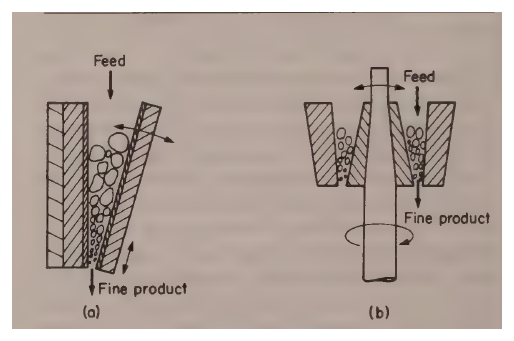
Figure 12.1, shown again beside Example 11.1: the jaw and gyratory crushers that grind the sugar.
12.3 The new surface: why fine powders behave differently
When a uniform particle is crushed, the sizes produced vary a great deal at first, from relatively coarse to fine dust. As grinding goes on, the coarser particles are further reduced while the fine ones change less, and a certain size tends to increase in its relative proportions and soon becomes the predominant size fraction. Wheat after first crushing gives a wide range of particle sizes in the coarse flour, but after further grinding the predominant fraction soon becomes that passing a 250 micrometre sieve and being retained on a 125 micrometre sieve, and this fraction tends to build up however long the grinding continues, so long as the same type of machinery is used.
The surface area of a fine powder is large and it matters. Most reactions are related to the surface area available, so the surface area can have a considerable bearing on the properties of the material. Wheat in the form of grains is relatively stable so long as it is kept dry, but ground to a fine flour it has such a large surface per unit mass that it becomes liable to explosive oxidation, as is all too well known in the milling industry.
The surface area to volume ratio of a particle is A_s/V_s = 6 lambda / D_s, equation 11.5, where lambda is a shape factor, about 1.75 for ground materials and 1 for a cube or a sphere. The total area of a mass w of particles of density rho_p is A_s = 6 lambda w / (rho_p D_s), equation 11.6. Combined with the results of a sieve analysis, that equation estimates the total surface area of a powder.
Example 11.2: the surface area of ground salt. In an analysis of ground salt using Tyler sieves, it was found that 38% of the total salt passed through a 7-mesh sieve but was caught on a 9-mesh sieve. For one of the finer fractions, 5% passed an 80-mesh sieve but was retained on a 115-mesh sieve. Estimate the surface areas of these two fractions in a 5 kg sample of the salt, if the density of salt is 1050 kg/m3 and the shape factor is 1.75.
The aperture of Tyler sieves is 7 mesh = 2.83 mm, 9 mesh = 2.00 mm, 80 mesh = 0.177 mm, and 115 mesh = 0.125 mm. The mean aperture of 7 and 9 mesh is 2.41 mm, and the mean aperture of 80 and 115 mesh is 0.151 mm. So A_1 = (6 x 1.75 x 0.38 x 5) / (1050 x 2.41 x 10^-3) = 7.88 m2, and A_2 = (6 x 1.75 x 0.05 x 5) / (1050 x 1.51 x 10^-4) = 16.6 m2. The fine fraction is only 5% of the mass but carries more than twice the surface of the coarse fraction that holds 38% of the mass. That is why a little fine dust changes a powder so much: it brings the surface with it.
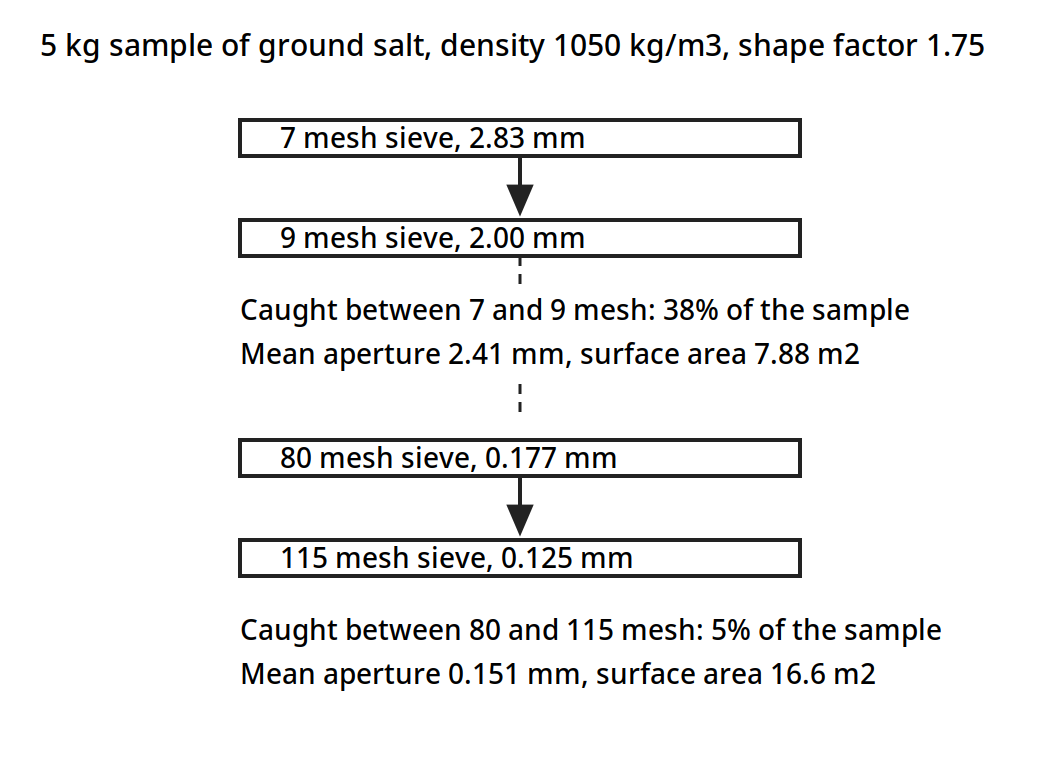
Two fractions of the same 5 kg of ground salt. The coarse fraction holds 38% of the mass and carries 7.88 m2 of surface; the fine fraction holds only 5% of the mass and carries 16.6 m2.
Diagram for Example 11.2: sieve stack for ground salt, drawn from the book data.
Quick check
A powder has 5% of its mass in a fine fraction and 38% in a coarse fraction. Which fraction carries more surface area, and why?
Check your answer
The fine fraction: 16.6 m2 against 7.88 m2 in Example 11.2, because surface area per unit mass grows as the particle size falls.
12.4 Grinding equipment: crushers, mills and screens
Grinding equipment divides into two classes: crushers, where the major action is compressive, and grinders, which combine shear and impact with compressive forces. Jaw and gyratory crushers are heavy equipment and are not used extensively in the food industry, but they show the principle clearly. In a jaw crusher the material is fed between two heavy jaws, one fixed and the other reciprocating, working the material down into a narrower space and crushing it as it goes. The gyratory crusher is a truncated conical casing inside which a crushing head rotates eccentrically: the head is shaped as an inverted cone, and the material is trapped between the outer fixed cone and the inner gyrating cone and forced into a narrower space, where it is crushed.
Figure 12.1: Crushers: (a) jaw, (b) gyratory. (Earle, Fig. 11.1, p. 162.)
Crushing rolls are two heavy cylinders mounted parallel and close together, rotating in the same direction, trapping the material in the nip and crushing it as it passes through. They may be driven at the same speed or at differential speeds, and a major application is in the cane-sugar industry, where several stages of rolls crush the cane. The angle of nip follows cos(A/2) = (D_r + D_p) / (D_r + D_f), where D_r is the roll diameter, D_p is the nip opening, and D_f is the feed size, and the limiting case is tan(A/2) = mu, where mu is the coefficient of friction. The theoretical capacity is Q = 60 pi N D_r D_p l ft3/hr, for a roll diameter D_r in feet, a length of face l in feet, and a speed N in rev/min, and the actual capacity is 0.1 to 0.3 of the theoretical. Rolls run at 50 to 300 rev/min, and the reduction ratio is usually below 5.
The hammer mill is the common fine grinder of the food industry. Swinging hammer heads are attached to a rotor turning at high speed inside a hardened casing, and the material is crushed and pulverized between the hammers and the casing, remaining in the mill until it is fine enough to pass through a screen forming the bottom of the casing. Both brittle and fibrous materials can be handled in hammer mills, though with fibrous material, projecting sections on the casing may be used to give a cutting action.
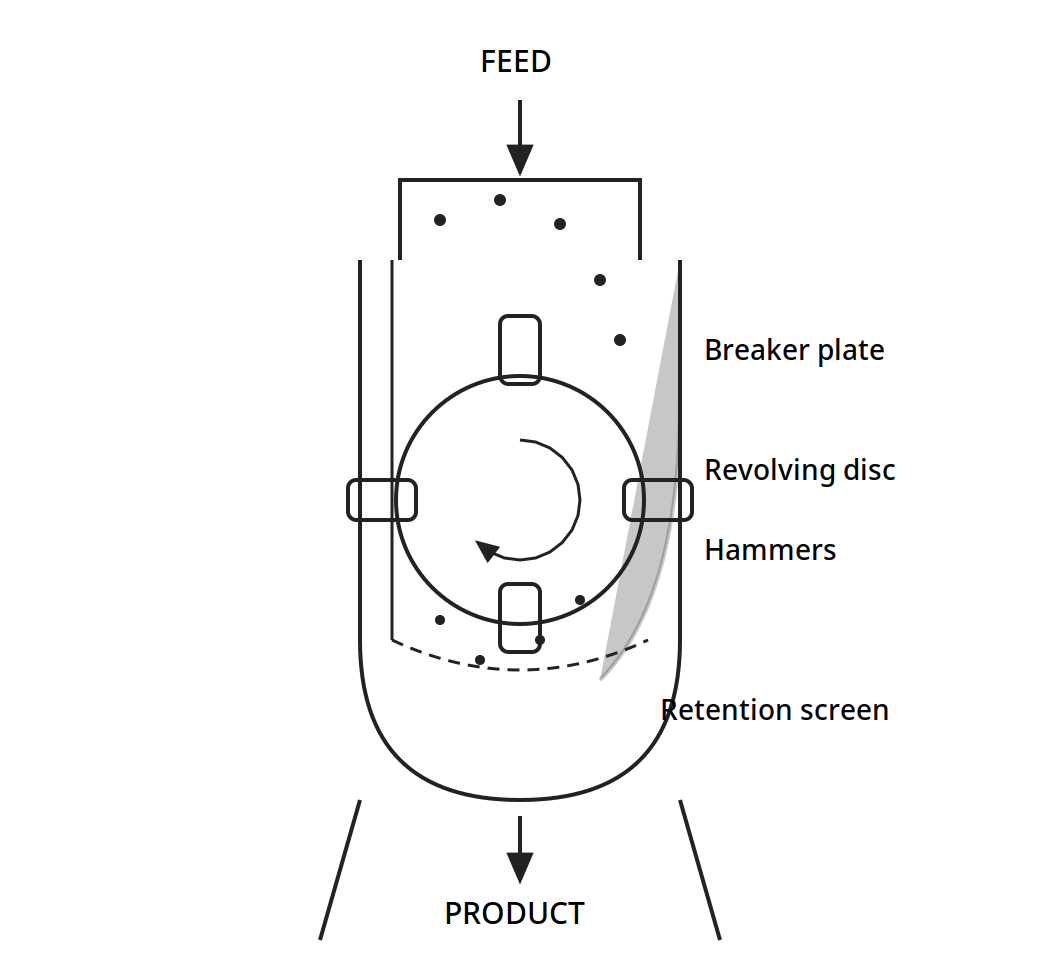
Feed drops onto the revolving disc, the hammers throw the pieces against the breaker plate and the casing, and only particles fine enough to pass the retention screen leave as product.
Figure 12.2: A hammer mill. (Brennan, Fig. 4.3, p. 51.)
Other mills in the books are the disc attrition mill, single and double, the Buhr mill, and the ball mill, in which the material is ground by tumbling balls inside a rotating cylinder. The critical speed of a ball mill is N_c = 76.6 / sqrt(2R) rev/min, with R in feet, and the optimum speed is about 75% of the critical: too slow and the balls slide, too fast and they centrifuge to the wall and stop grinding. Mills run in open circuit, in free crushing, in choke feeding, or in closed circuit with a screen returning the oversize. Wet milling is used where a slurry suits the later steps.
Screening sorts the product after grinding. The undersize that passes is the fines or minus, the oversize that stays is the tails or plus. The mesh number counts the openings per inch, and the Tyler ratio of the square root of 2 sets the steps of the series. A trommel, a rotating cylindrical screen, has the same critical speed formula as a ball mill. Screening efficiency turns on the feed rate, the particle size and alignment, the moisture, worn screens, and blinding, where near-size particles plug the openings.
12.5 Rheology: how the food flows decides how it mixes
Mixing is governed by how the material flows, and Ibarz Chapter 6 gives the rheology that a mixer designer needs. A Newtonian liquid has a viscosity that does not change with the rate of shear: water, milk, filtered juices and honey behave this way over the usual range. A non-Newtonian liquid changes its apparent viscosity as it is sheared. Most foods are non-Newtonian: ketchup and mustard flow more easily the harder they are pushed, which is pseudoplastic flow, and some pastes need a push to start flowing at all, which is a yield stress.
The power law describes the common case, with a consistency coefficient m and a flow index n. When n is below 1, the fluid is pseudoplastic; when n is 1, it is Newtonian; and the Bird-Leider model extends the power law to long times, converging to the power law and describing the shear stress overshoot peaks. Some semiliquid products are viscoelastic, showing the properties of a viscous liquid and an elastic solid together: a Newtonian liquid squirted through a pipe contracts as it leaves, while a viscoelastic fluid widens markedly, the Barus effect, and a viscoelastic fluid stirred with a small rod climbs up the rod, the Weissenberg effect, instead of forming a vortex that dips down.
Table 12.1 shows how fast viscosity rises with sugar concentration: a sucrose solution at 20% holds a viscosity of 2.0 mPa.s at 20 C, and at 75% it holds 2344.0 mPa.s. That thousandfold rise is why a syrup and a juice need different mixers, different speeds and different power.
Table 12.1: Viscosity coefficients of sucrose solutions at 20 C (Ibarz Table 6.1, from Muller, 1973)
| Sucrose % | g/100 g water | Viscosity (mPa.s) |
|---|---|---|
| 20 | 25.0 | 2.0 |
| 25 | 33.2 | 2.5 |
| 30 | 42.9 | 3.2 |
| 35 | 53.8 | 4.4 |
| 40 | 66.7 | 6.2 |
| 45 | 81.8 | 9.5 |
| 50 | 100.0 | 15.5 |
| 55 | 122.2 | 28.3 |
| 60 | 150.0 | 58.9 |
| 65 | 185.7 | 148.2 |
| 70 | 233.3 | 485.0 |
| 75 | 300.0 | 2344.0 |
Table 12.1: Viscosity coefficients of sucrose solutions at 20 C. (Ibarz, Table 6.1, p. 117.)
Table 12.2 gives the power law and Bird-Leider parameters for fifteen foods, from Kokini (1992). Honey is nearly Newtonian, with n = 0.989. Ketchup, mayonnaise, mustard and peanut butter are strongly pseudoplastic, with n from 0.065 to 0.196, so they flow far more easily once they are moving. Peanut butter carries the largest consistency coefficient in the table, m = 501.13 Pa.s^n, and the longest relaxation time, lambda = 1.86 x 10^5 s.
Table 12.2: Rheological parameters of foods (Ibarz Table 6.3, from Kokini, 1992)
| Food | m (Pa.s^n) | n | m' (Pa.s^n') | n' | lambda (s) |
|---|---|---|---|---|---|
| Apple marmalade | 222.90 | 0.145 | 156.03 | 0.566 | 8.21 x 10^-2 |
| Canned candied products | 355.84 | 0.117 | 816.11 | 0.244 | 2.90 x 10^0 |
| Honey | 15.39 | 0.989 | |||
| Ketchup | 29.10 | 0.136 | 39.47 | 0.258 | 4.70 x 10^-2 |
| "Acalia" cream | 563.10 | 0.379 | 185.45 | 0.127 | 1.27 x 10^3 |
| Mayonnaise | 100.13 | 0.131 | 256.40 | 0.048 | 2.51 x 10^-1 |
| Mustard | 35.05 | 0.196 | 65.69 | 0.136 | 2.90 x 10^0 |
| Peanut butter | 501.13 | 0.065 | 3785.00 | 0.175 | 1.86 x 10^5 |
| Butter bar | 199.28 | 0.085 | 3403.00 | 0.398 | 1.06 x 10^3 |
| Margarine bar | 297.58 | 0.074 | 3010.13 | 0.299 | 1.34 x 10^3 |
| Pressed margarine | 8.68 | 0.124 | 15.70 | 0.168 | 9.93 x 10^-2 |
| Margarine in tube | 106.68 | 0.077 | 177.20 | 0.353 | 5.16 x 10^-1 |
| Whipped butter | 312.30 | 0.057 | 110.76 | 0.476 | 1.61 x 10^-2 |
| Whipped cheese cream | 422.30 | 0.058 | 363.70 | 0.418 | 8.60 x 10^-2 |
| Whipped dessert garnish | 35.98 | 0.120 | 138.00 | 0.309 | 3.09 x 10^1 |
Table 12.2: Rheological parameters of foods. (Ibarz, Table 6.3, p. 126. Honey is given in the book with m and n only, and no m', n' or lambda, so those cells are left blank here as in the book.)
Quick check
Ketchup has a flow index n of 0.136 and honey has n of 0.989. Which one pours more easily once it is moving, and why?
Check your answer
Ketchup. Its flow index is far below 1, so it is strongly pseudoplastic: its apparent viscosity falls sharply as the shear rate rises, while honey stays nearly Newtonian.
12.6 Mixing solids: measuring how mixed is mixed
Mixing is the uniform combination of two or more materials, and Earle measures it with the variance of samples. Take n samples, measure the fraction x_i of one component in each, and the variance is s^2 = (1/n) sum (x_i - x bar)^2, equation 12.1. A high variance means a patchy mixture; a low variance means an even one.
Example 12.1: salt and magnesium carbonate. Salt, 99 kg, and magnesium carbonate, 1 kg, are mixed, and ten 20 g samples are taken. The fractions of magnesium carbonate are 0.0115, 0.0086, 0.0082, 0.0087, 0.0105, 0.0091, 0.0116, 0.0110, 0.0105 and 0.0107, with a mean of 0.01. The variance is s^2 = 1.51 x 10^-7. Later samples give s^2 = 3.7 x 10^-7, a higher variance, showing the mixture had become less even, not more: mixing can go backwards if the mixer segregates as well as it blends.
No diagram is possible for Example 12.1: it is sample statistics, with no equipment, streams or geometry to draw.
For particles, the starting variance of a fully unmixed pair is s_0^2 = p (1 - p), equation 12.2, where p is the fraction of one component, and the variance of a perfectly random mixture is s_r^2 = p (1 - p) / N, equation 12.3, where N is the number of particles in a sample. The mixing index is M = (s_0^2 - s^2) / (s_0^2 - s_r^2), equation 12.4. It runs from 0, unmixed, to 1, randomly mixed. No real mixer reaches 1 in a practical time, and the index is the honest measure of where the mixture stands.
Example 12.2: dough and yeast. In a dough of 95 kg with 5 kg of yeast, the mixing index is 0.93 after 5 minutes and 0.99 after 10 minutes. The first five minutes do most of the work, and the second five minutes buy only 0.06 more. That shape, fast at first and slow at the end, runs through all of mixing: the last part of evenness costs the most time.
No diagram is possible for Example 12.2: it gives index values only, with no equipment named and no calculation shown.
Very small additions need staged dilution, because a spoonful cannot be spread evenly through a tonne in one step. Example 12.3: vitamin powder into cereal. Vitamin powder at 10^-4 % by weight is to go into 1 tonne of cereal, which is 10 g in total. The 10 g are split into two 5 g portions, and each 5 g portion is built up in stages: hand blend 5 g with 50 g, then with 945 g, then with 9 kg, then with 90 kg, then with 400 kg, in double-cone blenders of 100 to 500 kg and 10 to 50 kg, for 10 minutes each, if the minor constituent is not less than 10% at each step. The rule behind it is simple: never add a small amount to a large amount in one step, always build the mixture up through steps where the small part is at least a tenth of the whole.
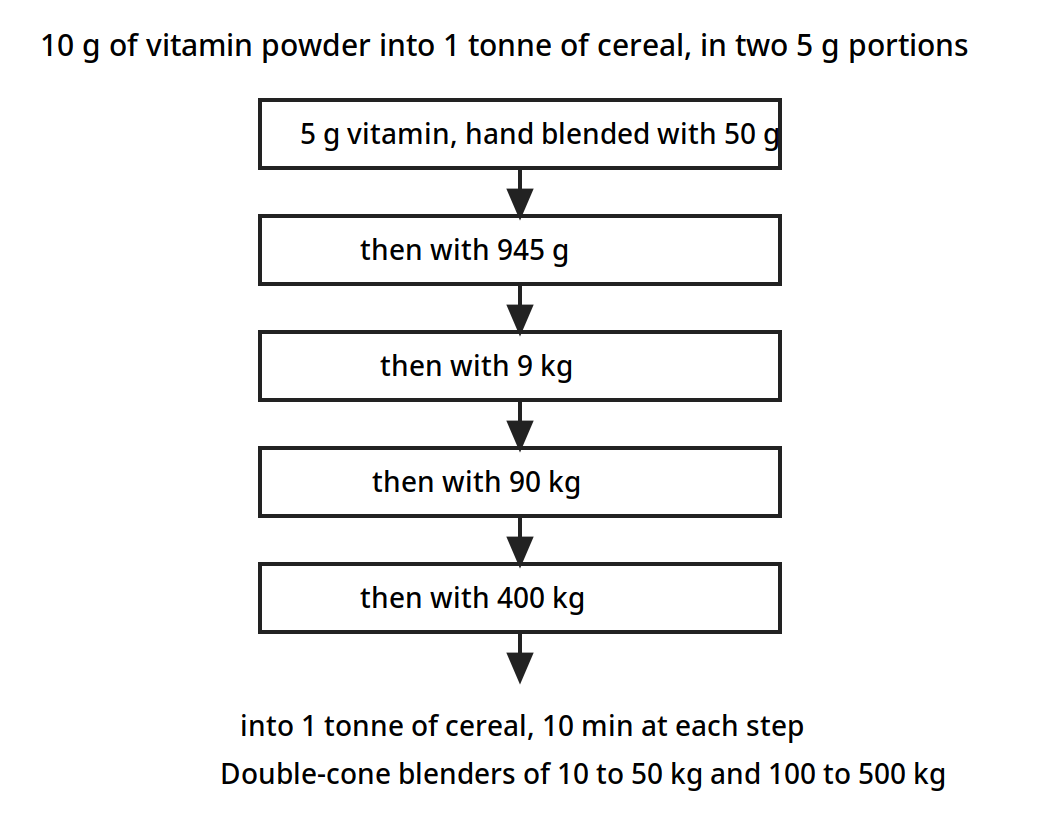
Each 5 g portion is built up step by step so the small part is never less than a tenth of the whole at any step, until it reaches the tonne of cereal.
Diagram for Example 12.3: staged dilution ladder, drawn from the book data.
The rate of mixing follows dM/d theta = K (1 - M), equation 12.5, so 1 - M = e^(-K theta), equation 12.6. The constant K belongs to the machine and the conditions, and it is found by experiment.
Example 12.4: starch and dried vegetable. In a batch mixer blending starch and dried-powdered vegetables for a soup mixture, the initial proportions of dried vegetable to starch are 40 to 60. The variance of the sample compositions, measured in terms of fractional compositions of starch, is 0.0823 after 300 s of mixing. For how much longer should the mixing continue to reach a specified maximum sample composition variance of 0.02? Assume the starch and vegetable particles are of approximately the same physical size and that a sample holds 24 particles.
Taking the fractional content of dried vegetables as p = 0.4, (1 - p) = 0.6, s_0^2 = 0.4 x 0.6 = 0.24, and s_r^2 = s_0^2 / N = 0.24 / 24 = 0.01. The mixing index is (M) = (s_0^2 - s^2) / (s_0^2 - s_r^2) = (0.24 - 0.0823) / (0.24 - 0.01) = 0.685. From equation 12.6, e^(-300 K) = 1 - 0.685 = 0.315, so 300 K = 1.55, and K = 5.2 x 10^-3. For s^2 = 0.02, (M) = (0.24 - 0.02) / (0.24 - 0.01) = 0.957, so 0.957 = 1 - e^(-5.2 x 10^-3 theta), giving theta = 603 s, say 600 s. The additional mixing time would be 600 s - 300 s = 300 s: as much again as has already been spent, to buy the last part of the evenness.
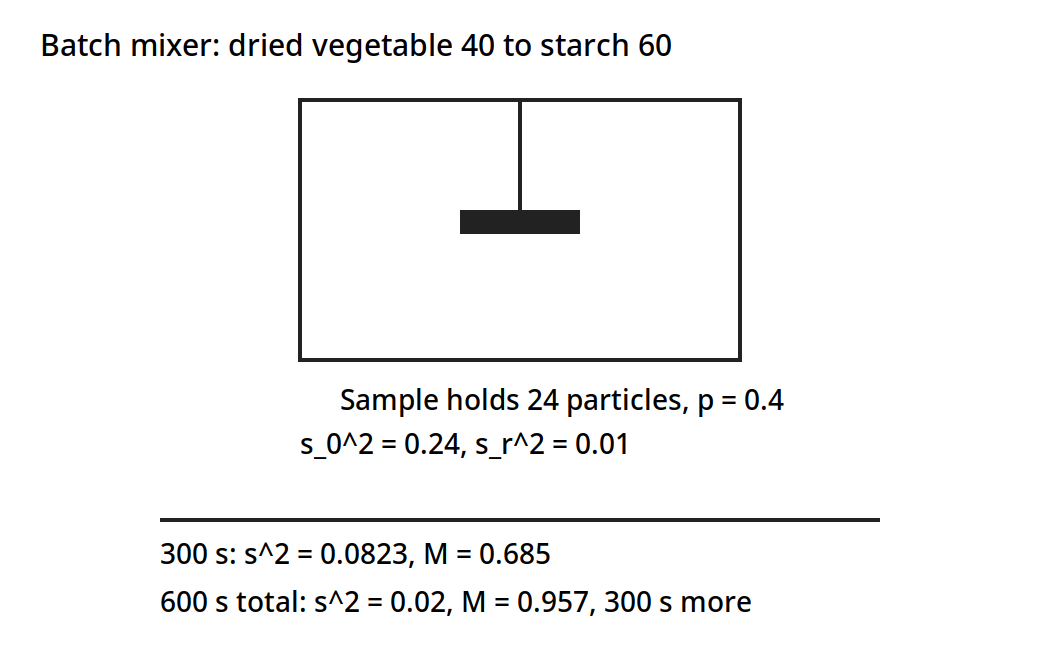
A batch mixer blending starch and dried vegetable, 40 to 60. After 300 s the variance is 0.0823; 300 s more, 600 s in total, brings it to the specified 0.02.
Diagram for Example 12.4: batch mixer, drawn from the book data.
12.7 Energy in mixing: the dough mixer
Quite substantial quantities of energy can be consumed in some types of mixing, such as the mixing of plastic solids. There is no necessary connection between energy consumed and the progress of mixing: shearing along one plane, then recombining to restore the original arrangement, then repeating, would consume energy but accomplish no mixing at all. In well-designed mixers energy input does relate to mixing progress, though the actual relationship has normally to be determined experimentally. In the mixing of flour doughs using high-speed mixers, the energy consumed, or the power input at any particular time, can be used to determine the necessary mixing time, because mixing combines with chemical reaction as the flour oxidizes during mixing, which leads to increasing resistance to shearing and so to increased power being required to operate the mixer.
Example 12.5: a dough mixer. In a particular mixer used for mixing flour doughs for breadmaking, it has been found that mixing can be characterized by the total energy consumed, and that sufficient mixing has been accomplished when 8 watt hours of energy have been consumed by each kg of dough. Such a mixer, handling 2000 kg of dough, is observed just after starting to be consuming 80 amperes per phase, which rises steadily over 10 s to 400 amperes, at which level it then remains effectively constant. The mixer is driven by a 440-volt, 3-phase electric motor with a power factor (cos phi) of 0.89, and the overall mechanical efficiency between motor and mixing blades is 75%. Estimate the necessary mixing time.
Power to the motor is sqrt(3) E I cos phi, where I is the current per phase and E and cos phi are 440 volts and 0.89 respectively. In the first 10 s, I_average = 1/2 (80 + 400) = 240 amperes. The energy consumed in the first 10 s is 130.5 watt hours, which is 130.5 / 2000 = 0.06 Wh/kg. The energy still needed after the first 10 s is (8 - 0.06) = 7.94 Wh/kg. The additional time needed, at steady 400 ampere current, is (7.94 x 2000 x 3600) / (1.73 x 400 x 440 x 0.75 x 0.89) = 281 s. The total time is 281 + 10 = 4.9 min. In actual mixing the power consumed would decrease slowly, by around 10 to 15% over the mixing process.
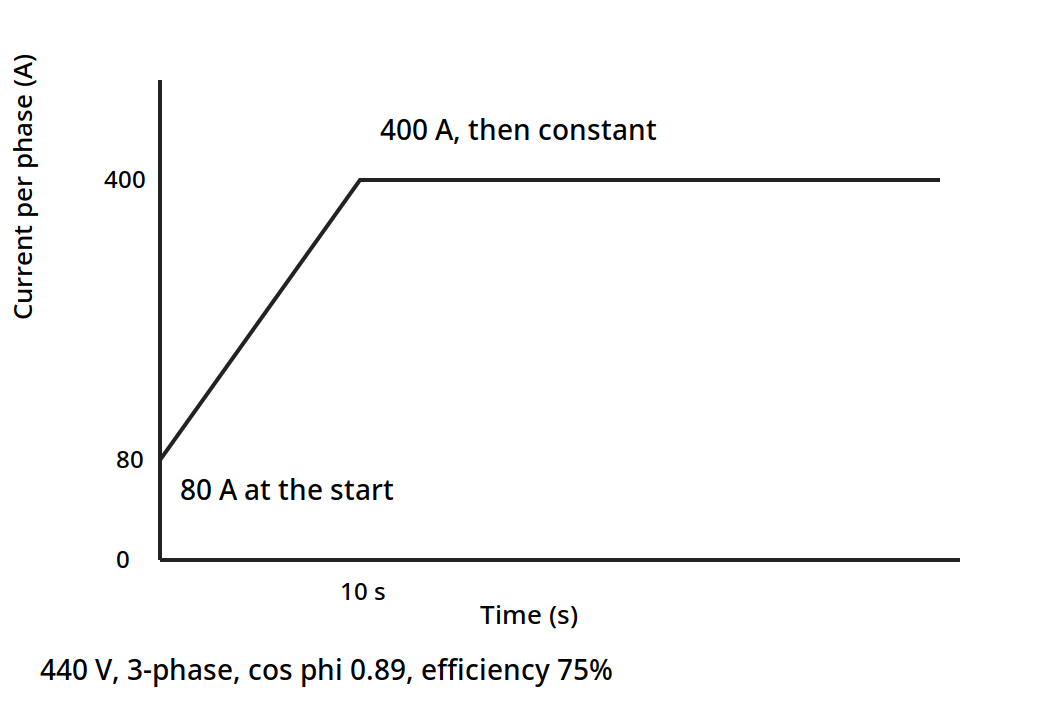
The current rises from 80 A to 400 A in the first 10 s and then stays constant. 8 Wh/kg are needed for 2000 kg of dough: the first 10 s use 130.5 Wh as printed (0.06 Wh/kg), 7.94 Wh/kg are still needed, 281 s more at 400 A, 4.9 min in total.
Diagram for Example 12.5: current against time, drawn from the book data.
One check on the book must be stated plainly. The additional-time line recomputes exactly from the stated current, voltage, power factor and efficiency, giving 281 s. The first-10-seconds line as printed does not: putting I = 240 A, E = 440 V, cos phi = 0.89 and efficiency 0.75 into the stated power formula gives about 339 Wh for 10 s, not the 130.5 Wh the book prints. The book's downstream numbers, 0.06 Wh/kg remaining, 7.94 Wh/kg still needed, 281 s additional and 4.9 min total, all follow from the printed 130.5 Wh, so this unit keeps the book's numbers as printed and flags the discrepancy rather than silently changing any of them.
Quick check
A dough mixer needs 8 Wh per kg, and after 10 s it has used 0.06 Wh per kg. Roughly how much of the job, in energy terms, is still to be done?
Check your answer
Almost all of it: 7.94 of the 8 Wh per kg, about 99%, is still to come. The first 10 seconds barely start the job.
12.8 Liquid mixing: power numbers and scale-up
Food liquid mixtures can be sampled and analysed the same way as solid mixtures, but most of the information available concerns the power requirements for the most commonly used liquid mixer, some form of paddle or propeller stirrer. In these mixers the fluids to be mixed are placed in containers and the stirrer is rotated, and the measurements have been made in terms of dimensionless ratios involving all of the physical factors which influence power consumption. The results are correlated in an equation of the form (Po) = K (Re)^m (Fr)^n, equation 12.7, where (Re) = D^2 N rho / mu, (Po) = P / (D^5 N^3 rho), which is called the Power number, and (Fr) = D N^2 / g, which is called the Froude number. D is the diameter of the propeller, N is the rotational frequency of the propeller in rev/min, rho is the density of the liquid, mu is the viscosity of the liquid, and P is the power consumed by the propeller. The Reynolds number uses the product D N for the velocity, which differs by a factor of pi from the actual velocity at the tip of the propeller.
The Froude number correlates the effects of gravitational forces, and it only becomes important when the liquid surface is disturbed by the propeller. Below Reynolds numbers of about 300 the Froude number is found to have little or no effect, so equation 12.7 becomes (Po) = K (Re)^n, equation 12.8. Experimental results from the work of Rushton are shown plotted in Fig. 12.1. No general formulae have been obtained, so the results are confined to the particular experimental propeller configurations which were used. For a propeller with a pitch equal to the diameter, Rushton gives n = -1 and K = 41. Where experimental results are not already available, the best approach to the prediction of power consumption in propeller mixers is to use physical models, measure the factors, and then use equation 12.7 or equation 12.8 for scaling up the experimental results.
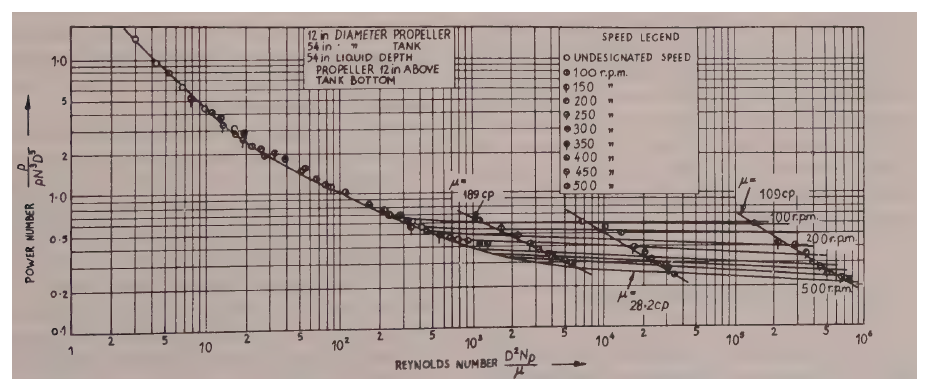
Figure 12.3: Performance of propeller mixers, from Rushton (1950). (Earle, Fig. 12.1, p. 171.) The axes, the box text, the speed legend and the curve pattern follow the book. The chart is a log-log plot of many measured points.
Example 12.6: scaling a propeller mixer up. Vitamin concentrate is being blended into molasses, and satisfactory mixing rates can be obtained in a small tank 0.67 m in diameter with a propeller rotating at 450 rev/min. If a large-scale plant is to be designed which will require a tank 2 m in diameter, what will be suitable values to choose for tank depth, propeller diameter and rotational speed, if it is desired to preserve the same mixing conditions as in the smaller plant? What would be the power requirement for the motor driving the propeller? Assume the viscosity of molasses is 6.6 N s/m2 and its density is 1520 kg/m3.
Use the subscripts S for the small tank and L for the larger one. To preserve geometric similarity the dimensional ratios should be the same in the large tank as in the small. Given that the full-scale tank is three times larger than the model, D_L = 3 D_S, H_L = 3 H_S = 3 x 0.75 = 2.25 m, the depth of the large tank, and the propeller diameter in the large tank is D_L = 3 D_S = 3 x 0.33 = 1 m. For dynamic similarity, (Re)_L = (Re)_S, so D_L^2 N_L = D_S^2 N_S, and N_L = (1/3)^2 x 450 = 50 rev/min = 0.83 rev/sec, the speed of the propeller in the large tank.
Now (Re) = (D_L^2 N_L rho / mu) = (1^2 x 0.83 x 1520) / 6.6 = 191, so equation 12.8 is applicable, and assuming K = 41 and n = -1, (Po) = 41 (Re)^-1 = P / (D^5 N^3 rho), so P = (41 x 1^5 x (0.83)^3 x 1520) / 191 = 186 J/s. A tank three times as wide, turning nine times more slowly, needs only about a quarter of a horsepower to stir the molasses the same way.
12.9 Mixers and baffles: stopping the swirl
An impeller gives the liquid three kinds of flow: radial, longitudinal and rotational. The radial and longitudinal components generally contribute to mixing, but the rotational component may not. An impeller rotating on a vertical shaft mounted centrally in the vessel makes the liquid flow in a circular path around the shaft: the flow is generally laminar, layers form in the liquid, little or no longitudinal flow occurs between the layers, and the vessel contents simply rotate with little mixing. Since the relative velocity between the impeller blade and the liquid is low, the power that can be absorbed by the liquid is limited. The tangential component can also form a vortex at the surface, which deepens as the speed rises; once the vortex reaches the suction of the impeller the power imparted to the liquid is suddenly reduced and air is drawn in. Solid particles may also separate out under centrifugal force.
Vortexing is reduced by positioning the agitator off-centre, or by baffles: vertical strips fixed perpendicular to the wall of the vessel, four of which are generally sufficient. Baffles interrupt the rotational flow and turn it into the radial and longitudinal flow that mixes.
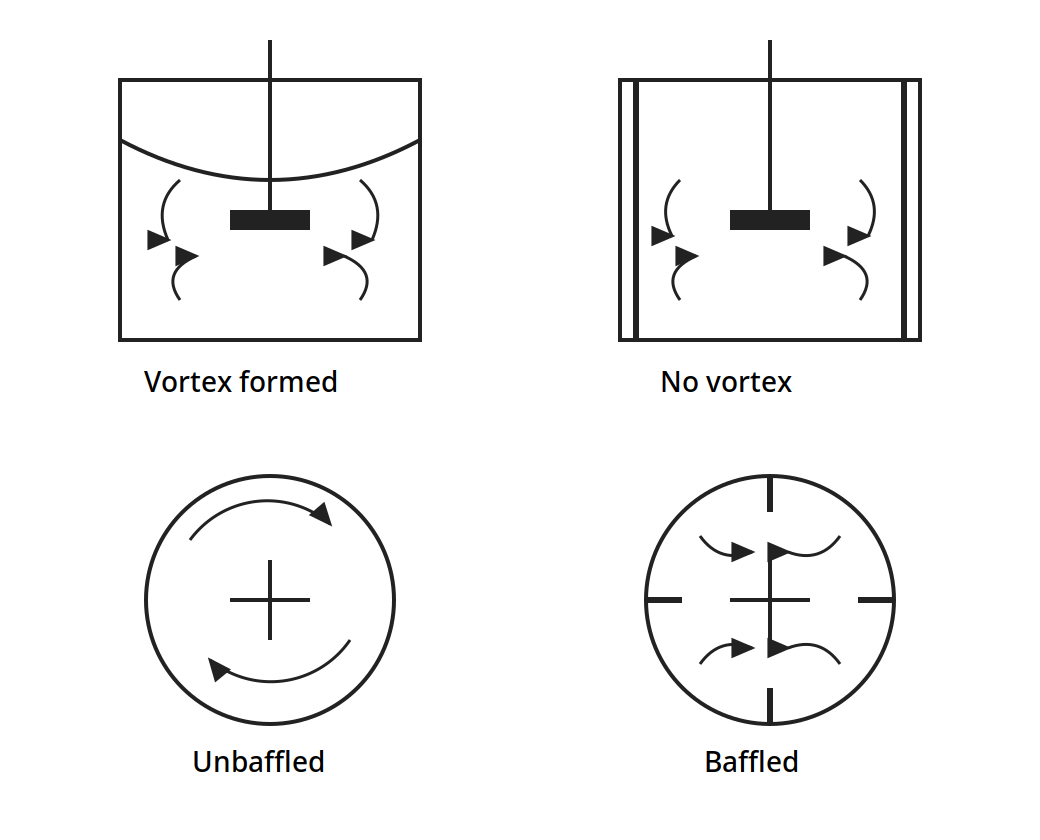
Top: side views. Without baffles the surface dips into a deep vortex; with baffles the surface stays flat and the flow circulates. Bottom: plan views. Without baffles the liquid goes around in a circle; with four baffles it is thrown outward and mixed.
Figure 12.4: Flow patterns in baffled and unbaffled vessels with paddle or turbine agitators. (Brennan, Fig. 5.1, p. 69.)
The agitators themselves are chosen by the job. Paddle agitators run at 20 to 150 rev/min, with blades about one fifth as wide as they are long. Turbine agitators run at 30 to 500 rev/min, at 30 to 50% of the vessel diameter. Propeller agitators run at 500 to several thousand rev/min, at less than one third of the vessel diameter. Vessels are usually vertical cylindrical tanks with dished bottoms, filled so the liquid depth to vessel diameter ratio is usually 0.5 to 1.5, with 1.0 recommended, and one impeller per vessel diameter of height.
Dry solids mix by three mechanisms: convection, the bulk movement of groups of particles; diffusion, the random movement of single particles; and shear, the slipping of layers over one another. They also segregate, by size, shape and density, which is why a mixture that was even can become patchy again. Tumbler mixers, such as double-cone and ribbon mixers, run at 50 to 60% working capacity and up to 100 rev/min. Ribbon mixers and vertical screw mixers suit powders, and fluidized-bed mixers suit free-flowing solids. Pan mixers with planetary motion and trough kneaders with Z-blade or sigma blades suit pastes and doughs. Gould's mixing chapter adds the plant view: jacketed kettles and process tanks, batch and continuous systems, and the same staged care with small additions.
12.10 Emulsification: keeping two liquids together
An emulsion is one liquid dispersed as droplets in another liquid that it does not mix with. Milk is fat in water, butter is water in fat, mayonnaise is fat in water, and ice cream is fat in water, then frozen. The droplets are commonly 1 to 10 micrometre across, and below 0.1 micrometre they are colloidal. Stability follows Stokes law: a droplet rises or falls at v = D^2 g (rho_p - rho_f) / (18 mu), so smaller droplets and a more viscous continuous phase both slow the separation. Homogenizing milk breaks the fat globules small enough that cream stops rising in the bottle.
Emulsifying agents sit at the interface and keep the droplets apart. Brennan lists proteins, phospholipids, sterols, glycerol esters, propylene glycol esters, sorbitan esters, cellulose ethers, carboxymethyl cellulose, bentonite, carbon black, and soaps such as sodium palmitate, whose molecules orient at the interface with one end in the water and one end in the oil. A phase volume ratio above 50% is difficult to hold, because the droplets crowd each other. Temperature matters: up to 160 F for milk products, and lower for egg yolk products, which are heat sensitive.
The machines that make emulsions all break droplets by force. Pressure homogenizers force the liquid through a valve gap a few thousandths of an inch wide at up to 10,000 psi, with velocities of 950 ft/sec reported, giving droplets of 0.1 to 0.2 micrometre, and as low as 0.02 micrometre. A second-stage valve at 400 to 500 psi breaks up clusters, and milk fat globules come out at 1 to 2 micrometre. Earle puts the homogenizer pressures of the order of 7 x 10^3 kPa. Colloid mills pass the liquid through a clearance of 0.002 to 0.05 inch between a rotor and a stator, at 3000 rev/min for a 15 inch rotor to 15,000 rev/min for a 3.5 inch rotor, giving droplets of 1 to 2 micrometre: better than homogenizers above 1000 cP, while homogenizers are better below 200 cP. Ultrasonic homogenizers use a wedge resonator at 18 to 30 kHz with a feed at 50 to 200 psi, giving droplets of 1 to 2 micrometre.
Buttermaking is emulsification in reverse. Cream at 35 to 40% fat is chilled and aged, then churned: the fat globules are broken, the fat comes together, and the emulsion inverts from oil-in-water to water-in-oil, which is butter. The working that follows squeezes out the buttermilk and spreads the remaining water into fine droplets. Continuous methods use the Fritz principle, or a concentrated cream of about 80% fat. Margarine is a water-in-oil emulsion made the other way around, in scraped-surface heat exchangers called votators, which cool the emulsion while scraping it from the wall so it sets evenly.
Quick check
Mayonnaise is fat droplets in water, and butter is water droplets in fat. What is the name for the change from one to the other during churning?
Check your answer
Phase inversion: the emulsion turns inside out, from oil-in-water to water-in-oil.
12.11 What the books do and do not give
Ibarz has no size reduction or mixing chapter, so this unit leans on Earle Chapters 11 and 12 and Brennan Chapters 4 and 5, with Ibarz Chapter 6 rheology only as supporting theory for mixing, as the outline says. Gould Chapters 6, 7 and 12 give the plant practice of disintegration and mixing, with almost no calculations, and they are used here for equipment pictures and plant flow only. Earle gives the worked examples in this unit, 11.1, 11.2, 12.1, 12.2, 12.3, 12.4, 12.5 and 12.6, with the numbers checked twice against the page images, except for the one discrepancy in Example 12.5, which is flagged in section 12.7 rather than hidden. The outline lists Ibarz Problems for this unit, and the book's end-of-chapter problems for Chapter 6 are rheology problems, not mixing design problems, so no Ibarz problem is presented here as a mixing worked example.
Try it yourself: Put a spoonful of oil and a spoonful of water in a small jar and shake it hard. Watch the cloudy mixture clear as the droplets join and rise: that is an emulsion without an emulsifying agent, and it does not last. Now add a drop of dish soap, which is an emulsifying agent like the ones in section 12.10, and shake again: the cloud lasts far longer, and the droplets stay small. Then take a tub of cream and whisk it past the whipped stage: it turns grainy, then yellow, then buttery, and liquid separates out. That is phase inversion, the churning of section 12.10, in a bowl.
Key ideas to carry forward
- Size reduction opens surface so later steps work faster, and the reduction ratio runs below 8 to 1 for coarse crushers and up to 100 to 1 for fine grinding.
- Kick's law fits coarse grinding, Rittinger's law fits fine powders, and Bond's law sits between them with the work index E_i.
- Bond's law says a 5 hp motor grinding sugar to 88 micrometre would need 5.4 hp to grind to 125 micrometre at 50% more throughput, so the motor is not enough.
- Surface area per unit mass grows as particles get smaller: 5% of a salt sample in a fine fraction carries 16.6 m2 of surface against 7.88 m2 for 38% in a coarse fraction.
- A ball mill runs best at about 75% of its critical speed, N_c = 76.6 / sqrt(2R).
- Honey is nearly Newtonian with n = 0.989, while ketchup, mayonnaise and peanut butter are strongly pseudoplastic, with n from 0.065 to 0.196.
- Mixing is measured by the variance of samples, and the mixing index M runs from 0 for unmixed to 1 for randomly mixed.
- A dough reaches M = 0.93 in 5 minutes and 0.99 in 10 minutes: the last part of evenness costs the most time.
- A tiny addition needs staged dilution: 10 g of vitamin powder into a tonne of cereal is built up through steps where it is never less than 10% of the mixture.
- In Example 12.4, starch and vegetable need 600 s in total to reach a variance of 0.02, which is 300 s more than the 300 s already spent.
- A dough mixer needing 8 Wh per kg takes 4.9 minutes for 2000 kg of dough, and the book's first-10-seconds line of 130.5 Wh does not recompute from its own stated current and voltage, so it is flagged, not hidden.
- A propeller mixer scales by keeping the Reynolds number the same: a tank three times as wide needs a propeller three times as wide turning nine times more slowly, and the molasses plant of Example 12.6 needs 186 J/s.
- Baffles turn the useless rotational flow in a tank into the radial and longitudinal flow that mixes, and stop the vortex that draws air in.
- Homogenizers make droplets of 0.1 to 0.2 micrometre at up to 10,000 psi, and churning inverts cream from oil-in-water to water-in-oil to make butter.
Glossary
Size reduction
Making solid pieces smaller by crushing, impact or shear. Food tech example: grinding wheat kernels into flour in a hammer mill.
Reduction ratio
The average size of the feed over the average size of the product. Food tech example: a coarse crusher working at a ratio below 8 to 1.
Kick's law
The grinding law that energy is proportional to the size reduction ratio, fitting coarse grinding. Food tech example: crushing a material from 10 cm to 5 cm for the same energy as from 5 mm to 2.5 mm.
Rittinger's law
The grinding law that energy is proportional to the new surface created, fitting fine powders. Food tech example: the extra energy needed to grind a fine flour, where the new surface is large.
Bond's law
The intermediate grinding law using the work index E_i, the energy to reduce unit mass to 80% passing 100 micrometre. Food tech example: the sugar grinding calculation of Example 11.1.
Work index
The energy needed to reduce unit mass of a material from an infinitely large size to 100 micrometre, in Bond's law. Food tech example: the E_i that fixes the sugar grinding power in Example 11.1.
Shape factor
A number, lambda, that relates a particle's surface to its size, about 1.75 for ground materials and 1 for a cube or a sphere. Food tech example: the 1.75 used for ground salt in Example 11.2.
Specific surface
The surface area per unit mass of a powder. Food tech example: a fine flour with a large specific surface that oxidizes faster than whole grain.
Hammer mill
A mill in which swinging hammers on a fast rotor break material against a casing until it passes a screen. Food tech example: grinding spice or grain to a fine powder.
Ball mill
A rotating cylinder in which tumbling balls grind the material. Food tech example: fine grinding run at about 75% of the critical speed.
Critical speed
The speed at which the balls in a ball mill centrifuge to the wall and stop grinding. Food tech example: N_c = 76.6 / sqrt(2R) rev/min.
Screening
Sorting particles by size on meshes, with the undersize passing and the oversize held back. Food tech example: a Tyler sieve series separating ground salt into fractions.
Rheology
The study of how materials flow and deform. Food tech example: the power law parameters for ketchup and honey in Table 12.2.
Newtonian liquid
A liquid whose viscosity does not change with the rate of shear. Food tech example: honey, with a flow index n of 0.989.
Pseudoplastic
A liquid whose apparent viscosity falls as the shear rate rises, flowing more easily once it is moving. Food tech example: ketchup, with a flow index n of 0.136.
Viscoelastic
A material showing the properties of a viscous liquid and an elastic solid together. Food tech example: a dough that flows under a roller and springs back when the roller lifts.
Mixing index
A number from 0 to 1 that says how mixed a mixture is, from the variance of samples. Food tech example: a dough at M = 0.93 after 5 minutes of mixing.
Variance
A measure of how much sample compositions differ from their mean, used to judge how even a mixture is. Food tech example: s^2 = 1.51 x 10^-7 for the salt and magnesium carbonate mixture.
Staged dilution
Building a tiny addition up through a series of larger mixtures so it spreads evenly. Food tech example: 5 g of vitamin powder blended into 50 g, then 945 g, then 9 kg, then 90 kg, then 400 kg of cereal.
Baffle
A vertical strip fixed to the wall of a mixing vessel to break up rotational flow and stop vortexing. Food tech example: four baffles in a tank holding a paddle agitator.
Vortex
A dip in the surface of a stirred liquid, caused by rotational flow, which can draw air into the mixture. Food tech example: the deep vortex in an unbaffled tank in Figure 12.4.
Power number
A dimensionless number, P / (D^5 N^3 rho), used to predict the power of a propeller mixer. Food tech example: the power number curve for Rushton propellers in Figure 12.3.
Emulsion
One liquid dispersed as droplets in another liquid that it does not mix with. Food tech example: mayonnaise, with fat droplets in water.
Emulsifying agent
A substance that sits at the interface between two liquids and keeps the droplets from joining. Food tech example: egg yolk lecithin holding mayonnaise together.
Homogenizer
A machine that forces a liquid through a narrow valve gap at high pressure to break droplets very small. Food tech example: a homogenizer making milk fat globules 1 to 2 micrometre across so cream stops rising.
Phase inversion
An emulsion turning inside out, so the liquid that was the droplets becomes the continuous phase. Food tech example: cream churning from oil-in-water to water-in-oil to make butter.
References
- Earle, R. L., Unit Operations in Food Processing, 2nd edition, Pergamon Press, 1983. Chapter 11, Size Reduction, including Figures 11.1 and 11.2 and Examples 11.1 and 11.2; Chapter 12, Mixing, including Figure 12.1 and Examples 12.1 to 12.6.
- Brennan, J. G., Butters, J. R., Cowell, N. D., and Lilly, A. E. V., Food Engineering Operations, Elsevier, 1969. Chapter 4, Size Reduction and Screening of Solids, including Figure 4.3; Chapter 5, Mixing and Emulsification, including Figure 5.1.
- Ibarz, A., and Barbosa-Canovas, G. V., Unit Operations in Food Engineering, CRC Press, 2003. Chapter 6, Rheology of Food Products, including Tables 6.1 and 6.3, as supporting theory for mixing.
- Gould, W. A., Unit Operations for the Food Industries, CTI Publications, 1996. Chapter 6, Disintegration, Little Change in Form; Chapter 7, Disintegration, Considerable Change in Form; Chapter 12, Mixing and Blending.
- Kokini, J. L., Rheological properties of foods, in Handbook of Food Engineering, Heldman, D. R., and Lund, D. B., Eds., Marcel Dekker, New York, 1992, as cited in Ibarz, Chapter 6, for Table 6.3.
- Muller, H. G., An Introduction to Food Rheology, Crane, Russak and Co., New York, 1973, as cited in Ibarz, Chapter 6, for Table 6.1.
- Rushton, J. H., 1950, as cited in Earle, Chapter 12, for Figure 12.1.
