Unit 11: Mechanical Separations: Filtration, Centrifugation, Sedimentation and Fluidization
GIFSQ ID: FTN-0123
Unit 11 of 12 in Unit Operations. This page is one unit of the Unit Operations notes.
All units in Unit Operations:
- Unit 1: Introduction to Unit Operations, Units and Material and Energy Balances
- Unit 2: Fluid Flow, Pumps and Piping
- Unit 3: Heat Transfer and Heat Exchangers
- Unit 4: Thermal Processing, Refrigeration and Freezing
- Unit 5: Mass Transfer and Contact-Equilibrium Separations
- Unit 6: Drying and Dehydration
- Unit 7: Evaporation
- Unit 8: Distillation
- Unit 9: Extraction, Expression and Adsorption
- Unit 10: Membrane Separation
- Unit 11: Mechanical Separations: Filtration, Centrifugation, Sedimentation and Fluidization
- Unit 12: Size Reduction, Mixing and Emulsification
Previous unit: Unit 10: Membrane Separation | Next unit: Unit 12: Size Reduction, Mixing and Emulsification
Unit 11: Mechanical Separations: Filtration, Centrifugation, Sedimentation and Fluidization
Note
Leave a glass of fresh milk on the bench and the cream rises to the top by itself. Spin the same milk fast enough and the cream comes off in seconds instead of hours. Pour a muddy liquid through a cloth and the cloth holds the mud while the liquid runs clear. Push air up through a bed of grain and the grain lifts, loosens and flows like a liquid. Four different machines, one idea: a force acts differently on things that differ in size or density, and the difference does the sorting. This unit follows that idea from a settling dust grain to a fluidized bed.
Questions to think about
- Why does a large particle settle faster than a small one, and by how much?
- How does a centrifuge turn a slow settling into a fast one, and what is the neutral zone in a cream separator?
- Why does a filter run slower as the cake grows, and what does washing the cake actually do?
- Why does a cyclone work well for coarse dust and poorly for fine dust?
- What happens when the air pushing up through a bed of particles pushes exactly as hard as gravity pulls down?
11.1 A particle in a fluid: how fast it settles
A particle in a fluid settles, or rises, at a terminal velocity where the driving force and the drag balance. For a sphere in streamline flow, Earle gives v_m = D^2 a (rho_p - rho_f) / (18 mu), equation 10.1, where D is the particle diameter, a is the acceleration, rho_p is the particle density, rho_f is the fluid density, and mu is the fluid viscosity. Under gravity, a = g, giving v_m = D^2 g (rho_p - rho_f) / (18 mu), equation 10.2. The drag coefficient in streamline flow is C = 24 / Re, and the streamline form holds for spheres with Re below 2.
Two things in that equation do most of the work. The velocity grows with the square of the diameter, so a particle twice as wide settles four times as fast. And it grows with the density difference, so a particle only slightly denser than the fluid settles slowly, while a much denser one falls fast. When the particle is less dense than the fluid, the sign flips and the particle rises: that is cream rising in milk, and oil globules rising in water.
Example 10.1: dust settling in air. A dust particle 60 micrometre in diameter, of density 1280 kg/m3, settles in air at 21 C, where the air viscosity is 1.8 x 10^-5 N s/m2 and the air density is 1.2 kg/m3. From equation 10.2 the settling velocity is 0.14 m/s. A particle of 10 micrometre settles at 3.9 x 10^-3 m/s. The Reynolds number for the larger particle is 0.56, so the flow is streamline and Stokes law applies. The small particle falls about 36 times more slowly than the large one, which is why fine dust hangs in the air of a mill long after the coarse dust has settled.
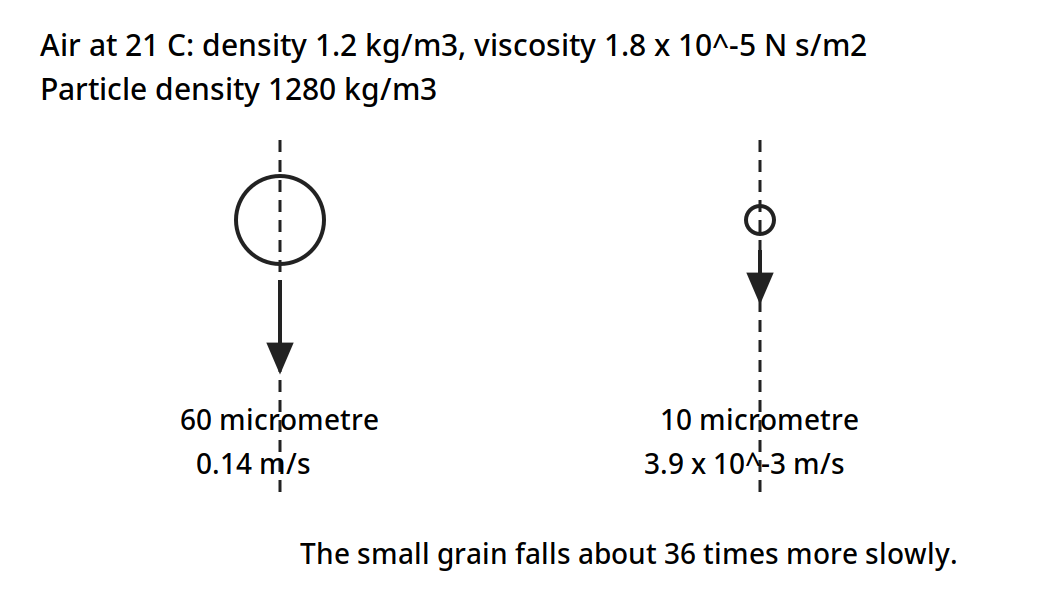
Two dust grains in air at 21 C. The 60 micrometre grain settles at 0.14 m/s and the 10 micrometre grain at 3.9 x 10^-3 m/s, so the fine dust hangs in the air long after the coarse dust has settled.
Diagram for Example 10.1: dust settling in air, drawn from the book data.
Quick check
Two particles of the same density settle in the same liquid. One is 20 micrometre across and the other is 10 micrometre across. How much faster does the larger one settle?
Check your answer
Four times as fast. Settling velocity grows with the square of the diameter, and 2 squared is 4.
11.2 Sedimentation: letting gravity do the work
At low concentration Stokes law applies, but in many practical cases the concentrations are too high. In concentrated suspensions, all particles appear to settle at a uniform velocity once a sufficiently high level of concentration is reached. Where the size range of the particles is not much greater than 10 to 1, all the particles tend to settle at the same rate. That is useful, because a thickener can then be designed on one settling velocity instead of a spread.
In a cylinder of uniform suspension allowed to settle, three zones appear: a zone of clear liquid at the top, a zone of more or less constant composition in the middle, settling at a uniform velocity, and a zone of sediment at the bottom. If the size range is wide, the constant-composition zone near the top will not occur and is replaced by an extended zone of variable composition. In a continuous thickener the same zones occur as the material flows through, with clarified liquid taken from the top and sludge from the bottom. The minimum area for a continuous thickener comes from equating the rate of sedimentation in a zone to the counter-flow velocity of the rising liquid: v_u = (F - L)(dw/d theta) / (A rho), where v_u is the upward velocity of the liquid, F is the mass ratio of liquid to solid in the feed, L is the mass ratio in the underflow, dw/d theta is the mass rate of feed of the solids, rho is the density of the liquid, and A is the settling area. If the settling velocity of the particles is v, then v_u = v, and A = (F - L)(dw/d theta) / (rho v), equation 10.3.
Example 10.2: a separating tank for oil and water. A continuous separating tank is to be designed to follow a water washing plant for a liquid oil. The oil, on leaving the washer, is in the form of globules 5.1 x 10^-5 m in diameter, the feed concentration is 4 kg of water to 1 kg of oil, and the leaving water is effectively oil free. The feed rate is 1000 kg/h, the density of the oil is 894 kg/m3, and the temperature of the oil and the water is 38 C. Assume Stokes law.
The viscosity of water is 0.7 x 10^-3 N s m-2, the density of water is 1000 kg/m3, and the diameter of the globules is 5.1 x 10^-5 m. From equation 10.2, v_m = (5.1 x 10^-5)^2 x 9.81 x (1000 - 894) / (18 x 0.7 x 10^-3) = 2.15 x 10^-4 m s-1 = 0.77 m h-1. Since F = 4 and L = 0, and dw/d theta, the flow of the minor component, is 1000 / 5 = 200 kg h-1, equation 10.3 gives A = 4 x 200 / (0.77 x 1000) = 1.0 m2. A tank of one square metre of settling area does the job, because the globules rise steadily and the water leaves clear.
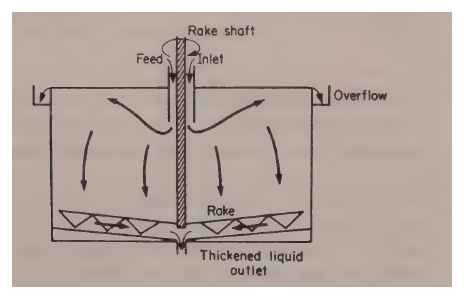
Earle, Fig. 10.1: continuous separating tank, the equipment Example 10.2 sizes (printed p. 146).
Equipment for gravitational sedimentation is built to give the settling time and to let the overflow and the sediment be removed without disturbing the separation. Continuous flow is generally desired, so the flow velocities are kept low, and vessels of various shapes are used, with slow-speed scraper-conveyors and pumps to remove the settled solids. When vertical cylindrical tanks are used, the scrapers generally rotate about an axis in the centre of the tank and the overflow is taken from the rim.
11.3 Cyclones, impingement and classifiers: sorting by inertia
A cyclone spins a gas stream so that centrifugal force throws the particles out of the stream. The force on a particle is F_c = m v^2 / r, equation 10.4, so for a fixed velocity the force rises as the radius falls: the smallest cyclones are the most efficient at removing small particles. The limits on smallness are the capital cost of small-diameter cyclones to provide sufficient output, and the pressure drops. Efficiency falls off for particles below about 10 micrometre in diameter, because the flow is complex and the size cut is not sharp.
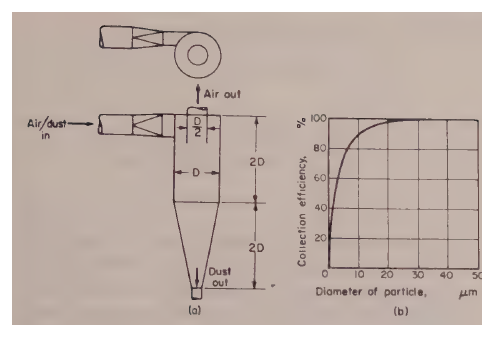
Figure 11.1: Cyclone separator: (a) equipment, (b) efficiency of dust collection. (Earle, Fig. 10.2, p. 147.) The efficiency curve carries no numeric table in the book, so its path follows the printed shape; the axes, the tick labels 0 to 50 micrometre and 0 to 100%, and the proportions D, 2D and 2D are as the book gives them.
The efficient operation of a cyclone depends very much on a smooth double helical flow being produced. Anything that disturbs the flow or makes it depart from this pattern has a considerable adverse effect on efficiency: the air must enter tangentially at the top, and constricting baffles or lids should be avoided at the air outlet. Cyclones can be used for separating particles from liquids as well as from gases, and for separating liquid droplets from gases.
Impingement separators use the same idea in a different shape: deflector plates or rods, set normal to the direction of flow, abruptly change the direction of the gas, and the gas recovers its direction of motion more rapidly than the particles because of its lower inertia. Suitably placed collectors then catch the particles as they are thrown out of the stream. Mesh and fibrous air filters work on this principle. Where particle diameters fall below about 5 micrometre, cloth filters and packed tubular filters are about the only satisfactory equipment.
Classification means sorting particulate material into size ranges, using the different rates of movement of particles of different sizes and densities in a fluid, under gravity or centrifugal force. Rotary mechanical classifiers, combining differential settling with centrifugal action, have come into increasing use in flour milling: because of small differences in sizes, shapes and densities between starch and protein-rich material after crushing, the flour can be classified into protein-rich and starch-rich fractions. Classification is also used in direct air dryers, where the density decrease of material on drying is used to sort dry material out as a product and return wet material for further drying.
11.4 Centrifugation: gravity, multiplied
A centrifuge replaces gravity with centrifugal force. The force on a mass m at radius r turning with angular velocity omega is F_c = m r omega^2, equation 10.5, or F_c = m v^2 / r, equation 10.6. In the workshop form, F_c = 0.011 m r N^2, equation 10.7, with N in rev/min. The separation velocity becomes v_m = D^2 N^2 r (rho_p - rho_f) / (1640 mu), equation 10.8. The factor N^2 r is the whole point: double the speed and the force goes up four times, and a modest bowl at a few thousand rev/min gives hundreds of times gravity.
Example 10.3: how many g. A centrifuge turning at 2000 rev/min with a radius of 10 cm gives a force of 450 g. That single number explains why a centrifuge does in a minute what a settling tank does in an hour.
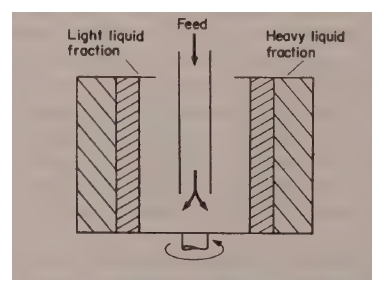
Earle, Fig. 10.3: liquid separation in a centrifuge, the machine of Example 10.3 (printed p. 148).
Example 10.4: oil in water, in a centrifuge. A dispersion of oil in water is to be separated using a centrifuge. The oil is dispersed as spherical globules 5.1 x 10^-6 m in diameter, of density 894 kg/m3. The centrifuge rotates at 1500 rev/min, the effective radius at which the separation occurs is 3.8 cm, the density of water is 1000 kg/m3, and its viscosity is 7 x 10^-4 N s/m2. This separation is the same as in Example 10.2, where the rate of settling under gravity was calculated.
From equation 10.8, v_m = (5.1 x 10^-6)^2 x (1500)^2 x 0.038 x (1000 - 894) / (1640 x 7 x 10^-4) = 0.02 m/s. Checking that Stokes law applies, Re = (5.1 x 10^-6 x 0.02 x 1000) / (7.0 x 10^-4) = 1.5, so the flow is streamline and it should obey Stokes law. Under gravity the same globules rose at 2.15 x 10^-4 m/s. In the centrifuge they move at 0.02 m/s, about 93 times as fast.
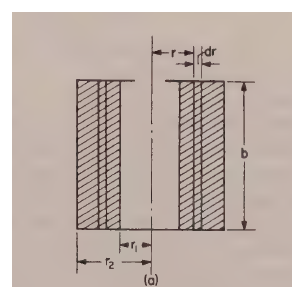
Earle, Fig. 10.4(a): centrifuge bowl geometry, the differential cylinder of Example 10.4 (printed p. 149).
In a liquid separator the two liquids must leave by different outlets, and the boundary between them sits at the neutral zone. For a vertical continuous liquid centrifuge, with the heavier liquid A discharging at radius r_1 and the lighter liquid B at radius r_2, the radius of the neutral zone is r_n^2 = (rho_A r_1^2 - rho_B r_2^2) / (rho_A - rho_B), equation 10.10. As the discharge radius for the heavier liquid is made smaller, the radius of the neutral zone must also decrease. In cream separation as much cream as possible is to be removed, so the neutral radius is kept small, and the feed should enter as nearly as possible into the neutral zone, so it enters with the least disturbance of the system.
Example 10.5: the neutral zone of a cream separator. A cream separator has discharge radii of 5 cm and 7.5 cm, the density of skim milk is 1032 kg/m3, and the density of cream is 865 kg/m3. Calculate the radius of the neutral zone so the feed inlet can be designed. From equation 10.10, r_n^2 = [1032 x (0.075)^2 - 865 x (0.05)^2] / (1032 - 865) = 0.022 m2, so r_n = 0.15 m. The feed should enter at 15 cm from the axis.
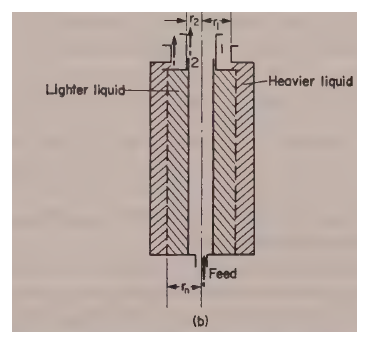
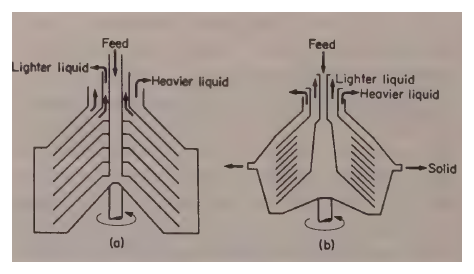
Earle, Fig. 10.4(b): the neutral zone, and Fig. 10.5: the disc-bowl centrifuges of Example 10.5 (printed pp. 149 to 150).
Brennan gives the same theory in the form of the equivalent settling area, Sigma: the flow a centrifuge can clarify is q = 2 v_g Sigma, where v_g is the settling velocity of the particle in a gravitational field and Sigma is characteristic of the centrifuge, equivalent to the area of a gravity settling tank with similar settling characteristics. For a simple cylindrical bowl, Sigma is approximately pi omega^2 b (3 R_2^2 + R_1^2) / (2 g), equation 7.20, and for a disc-bowl centrifuge, Sigma = 2 pi omega^2 (S - 1) (R_x^3 - R_y^3) / (3 g tan Omega), equation 7.21, where S is the number of discs in the stack and R_x and R_y are the outer and inner radius of the stack. Centrifuges of the same type but of different sizes have the same performance when q / Sigma is the same, which is the scale-up rule: keep q / Sigma constant.
The disc-bowl centrifuge is the workhorse of the dairy and the oil industry. Feed enters at the top, the discs rotate with the bowl, the dense phase travels toward the bowl wall and streams down the undersides of the discs, and the light phase, displaced toward the centre, flows over the upper faces of the discs. The liquids are thus divided into thin layers, the distance any drop must travel to be caught is very small, and the shearing at the liquid-liquid interface between the countercurrent streams can help to break up certain types of emulsion and improve separation. One note on the citation: the outline for this subject cites Brennan Fig. 7.5 at PDF page 155, but the page rendered at PDF 155 shows Fig. 7.7, the disc-bowl centrifuge. Fig. 7.5, the principle of the simple centrifugal filter, is on PDF page 152, printed page 136, and that is the page cited below.
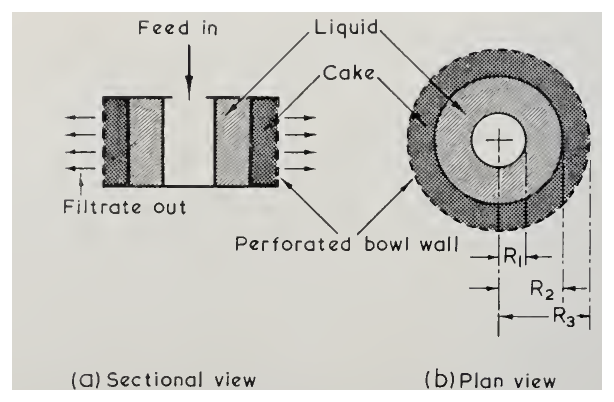
Figure 11.2: Principle of simple centrifugal filter. (Brennan, Fig. 7.5, printed p. 136, PDF p. 152.)
The rate of flow of filtrate through a centrifugal filter, for an incompressible cake and neglecting kinetic energy changes, is given by Brennan equation 7.22, in which q is the volumetric flowrate of filtrate, rho is the filtrate density, omega is the rotational speed, R_1 is the radius of the inner surface of the liquid ring, R_2 is the radius of the inner surface of the cake, R_3 is the radius of the inner surface of the bowl, alpha is the specific cake resistance, M_c is the mass of solid cake in the basket, R_m is the resistance of the filter medium, and b is the height of the basket. Such an equation applies only to cakes of uniform thickness, and in most practical cases cakes are thicker near the base than the top, giving a filtration rate 5 to 20% greater than a cake of constant thickness of similar volume and permeability.
Brennan's equipment survey is worth keeping beside the theory. Tubular-bowl centrifuges are 3 to 6 inches in diameter and up to 5 ft high, with a typical unit 4 inches in diameter and 30 inches high running at 15,000 rev/min, and laboratory models up to 50,000 rev/min. Disc-bowl centrifuges run 8 to 40 inches in diameter, with disc spacing 0.02 to 0.05 inches, and a typical 12-inch bowl at 6,400 rev/min develops 7000 g. Desludging is provided when the solids content is greater than 5% or 6% by weight of feed. Batch filtering centrifugals have bowls 30 to 48 inches in diameter and 18 to 30 inches deep, running up to about 2000 rev/min, with a cycle of 3 to 30 minutes. The applications run through the food industry: tubular bowls for animal fats, vegetable and fish oils, fruit juices, cider and sugar syrup; disc-bowls for cream from milk, oil refining, fruit juices and citrus oils; conveyor-bowls for animal and vegetable protein, cocoa, coffee and tea slurries, fish oils and fish meal; filtering centrifugals for sugar refining, fruit and vegetable juice extraction, vegetable proteins and freeze concentration.
Quick check
A cream separator feed should enter at the neutral zone radius. In Example 10.5 that radius is 0.15 m. What goes wrong if the feed enters far from the neutral zone?
Check your answer
The feed disturbs the flow in the bowl, the two liquids mix again at the inlet, and the separation gets worse.
11.5 Filtration: a cake that grows and slows the flow
Filtration passes a liquid through a porous medium that holds the solids back. The solids build a cake on the medium, and the cake itself becomes the filter, so the flow slows as the cake grows. Earle gives the rate as dV/d theta = A Delta P / (mu r [w V/A + L]), equation 10.12, where V is the filtrate volume, A is the area, Delta P is the pressure drop, mu is the viscosity, r is the specific resistance of the cake, w is the mass of solids per unit volume of filtrate, and L is the equivalent thickness of the medium. At constant pressure this integrates to theta A / V = (mu r w / 2 Delta P)(V/A) + mu r L / Delta P, equation 10.14. A plot of theta A / V against V/A is a straight line, and its slope and intercept give the cake resistance and the medium resistance. Many cakes are compressible, so the resistance rises with pressure: r = r' (Delta P)^s, where s is 0 for an incompressible cake and rises toward 1.0 as compressibility increases.
Ibarz builds the same theory on the cake resistance alpha, in m/kg, and the medium resistance R_f, in m-1. The total rate is set by the pressure drop over the two resistances in series. At constant pressure, t/V = K_1 V + K_2, equation 9.27, with K_1 = eta / (2 A^2 (-Delta P) C), equation 9.25, and K_2 = R_f eta / (A (-Delta P)), equation 9.26. The flow is fastest at the start, q_max = A (-Delta P) / (eta R_f), equation 9.31, when the cake is thinnest. At constant flow, the pressure rises linearly with time, (-Delta P) = K_3 t + K_4, equation 9.36. Compressible cakes follow the Almy and Lewis form, alpha = alpha_0 (-Delta P_c)^n, equation 9.20, with n from 0.1 to 1, and the Ruth form, equation 9.21.
The plate-and-frame press filter is the classic batch filter. Plates and frames alternate in a stack, the feed enters at the bottom, passes through the filtering medium, and the filtrate leaves at the top. The cake builds in the frames, and when the frames are full the press is opened and the cakes are dropped out.
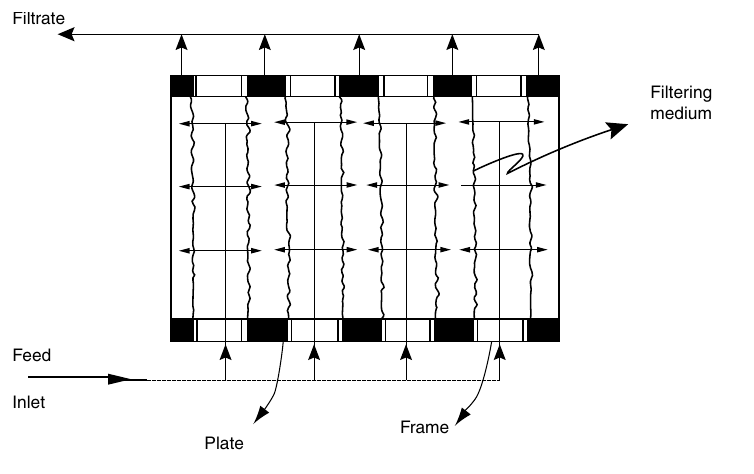
Figure 11.3: Filtration operation in a plate-and-frame press filter. (Ibarz, Fig. 9.3, p. 246.)
Cake washing is where filtration meets the washing of Unit 9. If the wash water follows the same path as the filtrate, it sweeps the soluble matter out fast: up to 90% of the solubles come out in the initial stage. If it follows a different path, the removal is gradual. In a plate-and-frame press the washing area is half the filtration area, the medium is crossed twice, and the washing flow is q_L = 1 / (8 K_1 V + 4 K_2), equation 9.39b, with the washing time t_L = V_L / q_L, equation 9.40.
A filter cycle is filtration plus washing plus the dead time of opening, emptying and closing: t_C = t + t_L + t*, equation 9.42. The capacity is F_c = V / t_CYCLE, equation 9.41. The optimum comes from the Sbarbaugh graphical method, and the book gives the result as t' = K_1 V^2, equation 9.44, with V_OPTIMUM = sqrt(t' / K_1), equation 9.45, and t_OPTIMUM = t' + K_2 sqrt(t' / K_1), equation 9.46.
The rotary vacuum filter runs the same filtration continuously. A drum covered with filter medium turns slowly in a trough of slurry. Vacuum inside the drum pulls filtrate through the medium while the drum is submerged, a cake builds on the outside, wash water sprays on the cake as it rises out of the trough, air dries it, and a scraper peels it off before the drum dips back in. The submerged time for a section is t_S = phi / (2 pi N), equation 9.47, where phi is the immersion angle and N is the rotation velocity.
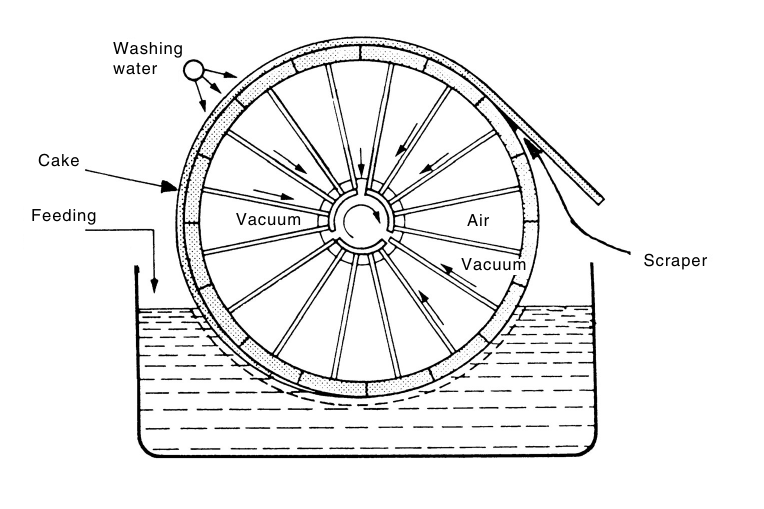
Figure 11.4: Rotary vacuum filter. (Ibarz, Fig. 9.6, p. 251.) The spokes and the drum follow the book's arrangement, and all labels are as the book gives them.
Example 10.6: from a laboratory test to a plant filter. A filtration test was carried out on a laboratory filter press at 340 kPa, with an area of 0.186 m2. The filtrate collected was 20, 40, 60 and 80 kg at 8, 26, 54.5 and 93 minutes. Plotted as theta A / V against V/A, the graph gives a slope of 0.0265 and an intercept of 1.6, so theta / (V/A) = 0.0265 (V/A) + 1.6. For a plant filter at 270 kPa, with a concentration 50% greater, the same form gives theta / (V/A) = 0.0265 (340 / 270) (150 / 100) (V/A) + 1.6 (340 / 270) (150 / 100) (V/A). The plant filter area is 9.3 m2, and at V/A = 250 kg/m2 the total filtrate is 250 x 9.3 = 2325 kg in 1 hour. One small press, four timed weighings, and the size of the plant filter follows.
Other filter forms in the books are the rotary vacuum drum, the centrifugal filter of section 11.4, and air bag filters. Filter aids, including kieselguhr, are added to the feed or precoated on the medium to keep the cake open and the flow up. Brennan lists the applications: sugar cane and beet, starch, gluten, edible oils and their winterisation, breweries, and the clarification of beer, wines, vinegar, fruit juices, yeast and meat extracts, oils, brines, syrups and jellies, and the removal of micro-organisms.
11.6 Sieving: sorting by size alone
Sieving sorts dry particles by size, passing them through a mesh and keeping what is too big. The Tyler series uses a ratio of the square root of 2 between successive sieves, and standard sieves run from 25 mm down to about 0.6 mm, with industrial screening from 50 micrometre upwards. The result is a size distribution: how much of the powder sits between each pair of sieves.
Example 10.7: a powder in fractions. A powder is sieved, and 13% of it sits between 0.300 and 0.350 mm, and 9% sits between 0.350 and 0.400 mm. Those two numbers are the kind of result a sieve analysis gives: not one size, but the share of the powder in each size band. A miller reads that distribution to judge whether the grinding is right, and a food maker reads it to judge whether a powder will flow, dissolve and mix as it should.
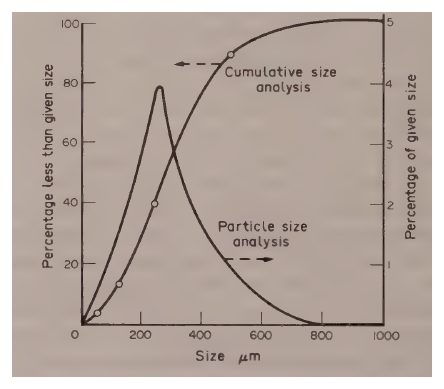
Earle, Fig. 10.9: particle-size analysis, the cumulative and distribution curves Example 10.7 reads (printed p. 156).
11.7 Fluidization: when a bed of solids flows like a liquid
Push a fluid up through a bed of particles and the pressure drop rises with the flow. At first the bed stays fixed. Then the drag on the particles equals their weight, the bed loosens, and the particles hang suspended in the stream: the bed is fluidized. Push harder still and the particles are carried away, which is pneumatic transport. Ibarz draws this as a curve with segments: OA, the fixed bed; AB, the rise to fluidization; BC, the fluidized bed at a steady pressure drop; and D, the transport region. The fluid velocity at the point of fluidization is the minimum fluidization velocity, v_mf, and the velocity at which particles are carried out is the drag velocity, v_D.
Flow through a fixed bed follows Darcy's law, v = K (-Delta P) / L, equation 8.1, or v = (1 / (alpha eta L)) Delta P, equation 8.2, where K is the permeability and alpha is the resistance. The Darcy unit is defined as 1 ml/(s.cm2) of a 1 cP liquid under 1 atm/cm. The bed is described by its specific surface and its porosity, with a_S = a_S0 (1 - epsilon), equation 8.3, where a_S0 is the specific surface of the particles and epsilon is the void fraction, and the equivalent diameter d_P = Gamma d_r, where Gamma is the sphericity factor. For a sphere Gamma is 1, and for other shapes it is lower, as Table 11.1 shows.
The pressure drop through the bed follows the Kozeny-Carman equation for laminar flow, equation 8.8, with K'' = 5 plus or minus 0.5, or 4.8 plus or minus 0.3 for spheres, the Burke-Plummer equation for turbulent flow, equation 8.10, and the Ergun equation for both, equation 8.13: (-Delta P) / L = 150 (1 - epsilon) eta v / (epsilon^3 d_P^2) + 1.75 (1 - epsilon) rho v^2 / (epsilon^3 d_P). The flow is laminar for Re_p below 40 and turbulent above 40. The Chilton-Colburn equation, equation 8.14, gives the mass transfer in the bed.
At the minimum fluidization velocity the drag balances the weight of the bed, equation 8.17, giving v_mf for laminar flow, equation 8.18, for turbulent flow, equation 8.19, and for the transition, equation 8.20. The minimum porosity is epsilon_mf = 1 - 0.356 log(d_P - 1), equation 8.21, with d_P in microns, valid from 50 to 500 micrometre. As the bed expands, the height follows L_1 (1 - epsilon_1) = L_2 (1 - epsilon_2), equation 8.22, because the mass of solids stays the same while the voids grow.
Table 11.1: Sphericity of particles (Ibarz Table 8.1, from Levenspiel, 1993)
| Form of the particle | Sphericity |
|---|---|
| Sphere | 1 |
| Cube | 0.81 |
| Cylinders, h = d | 0.87 |
| Cylinders, h = 5d | 0.70 |
| Cylinders, h = 10d | 0.58 |
| Discs, h = d/3 | 0.76 |
| Discs, h = d/6 | 0.60 |
| Discs, h = d/10 | 0.47 |
| Beach sand | As high as 0.86 |
| River sand | As low as 0.53 |
| Other types of sand | 0.75 |
| Triturated solids | 0.5-0.7 |
| Granulated particles | 0.7-0.8 |
| Wheat | 0.85 |
| Raschig rings | 0.26-0.53 |
| Berl chairs | 0.30-0.37 |
Table 11.1: Sphericity of particles. (Ibarz, Table 8.1, p. 225.)
The Ibarz chapter problems carry the fluidization arithmetic. Problem 8.1, cubic particles of 5 mm side, gives an equivalent diameter of 4.05 mm, a porosity of 0.512, a pressure loss of 2047 Pa/m, and Re_p = 203, which is turbulent. Problem 8.2 gives a pressure drop of 36,762 Pa over 3 m with Re_p = 153. Problem 8.3, peas with air at 5000 m3/h, gives a pressure drop of 50,979 Pa/m, which is 0.52 atm, with Re_p = 795. Problem 8.4, hollow glass rings, gives a mass flux of 2.074 kg/(m2 s), a mass flow of 1.629 x 10^-2 kg/s, a volumetric flow of 16.3 l/s, and Re_p = 988.
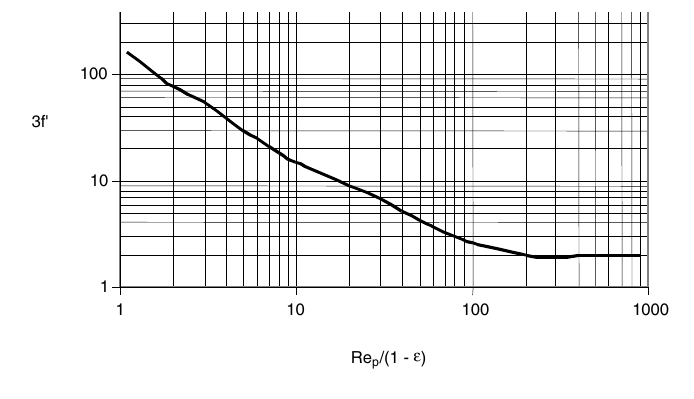
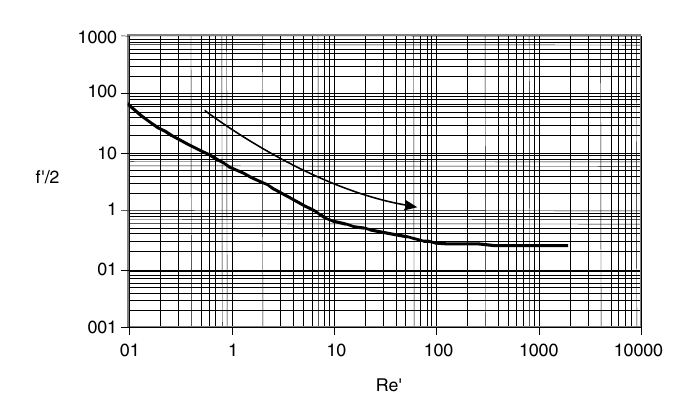
Ibarz, Fig. 8.1 and Fig. 8.2: the friction-factor plots the pressure drop in Problems 8.1 to 8.4 is read from (printed pp. 214 to 215).
Problem 8.5, cylindrical particles, gives a specific surface of 1777.74 m-1, a porosity of 0.6, and a bed specific surface of 711.1 m-1.
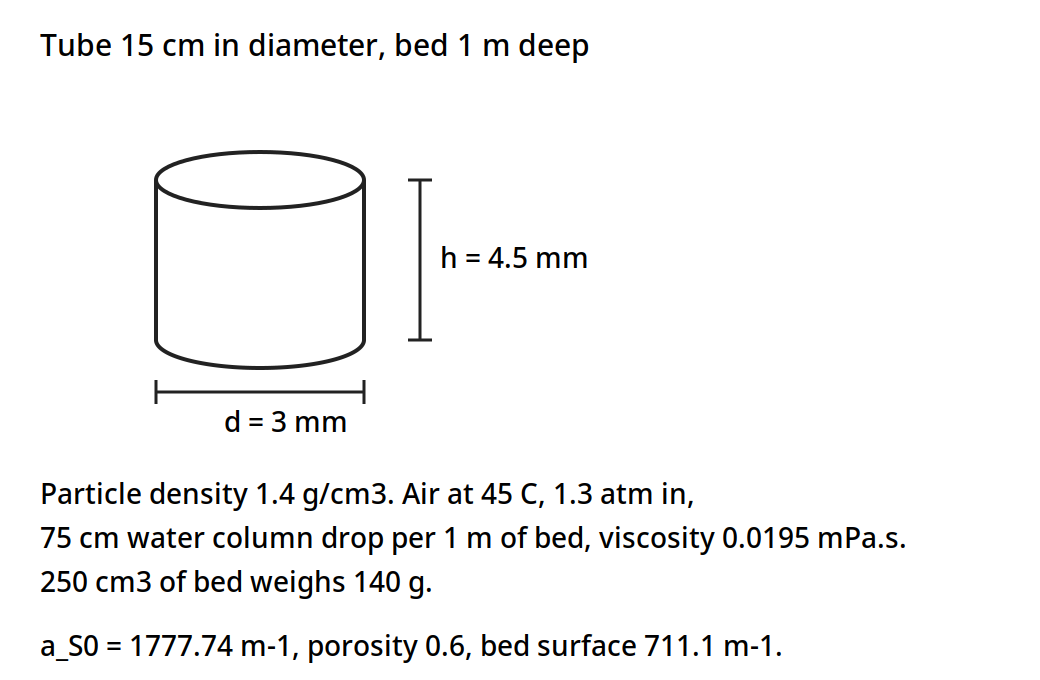
A cylindrical particle 3 mm across and 4.5 mm high, in a 15 cm tube. The book gives a particle specific surface of 1777.74 m-1, a porosity of 0.6 and a bed specific surface of 711.1 m-1.
Diagram for Ibarz Problem 8.5: cylindrical particles, drawn from the book data.
The filtration problems, 9.1 to 9.5, give capacities from 3.91 l/min to 87.42 l/min, cake resistances from 6.07 x 10^9 to 2.75 x 10^10 m/kg, and a rotary drum area of 11.73 m2 with a cake thickness of 18 mm in Problem 9.5.
The book gives each filtration problem its own numbers. Problem 9.1: a plate-and-frame filter under constant pressure needs 1 h to separate 600 l of filtrate of an aqueous suspension, the initial filtration velocity is 60 l/min, 8 l of water are needed to wash the deposited cake, and 35 min are needed to discharge, clean and assemble the filter. Problem 9.2: a plate-and-frame press filter works under constant filtration velocity, 250 l of filtrate are obtained after 45 min, and during this period the pressure drop increases from 0.40 kg/cm2 to 3.5 kg/cm2; the question is what amount of filtrate would be obtained after 45 min at a constant pressure of 3.5 kg/cm2. Problem 9.3: an aqueous suspension that contains 7% of insoluble solids is filtered at a rate of 10 ton/h, using a plate-and-frame press filter under a constant pressure of 3 atm; the deposited cake contains 50% moisture, the density of the dry solids is 3.5 g/cm3, and the equivalent diameter of the deposited particles is 0.002 mm; washing begins after 10,000 kg/h of feeding have been filtered using 150 l of water, while 30 min are used for discharge, cleaning and assembly, and the resistance of the filtering medium is negligible. Problem 9.4: an aqueous solution that contains 10% suspended solids is filtered in a plate-and-frame press filter; the wet cake to dry cake ratio is 2.2, using an incompressible cake with a specific resistance of 2.5 x 10^10 m/kg; filtration runs at a constant pressure of 3 atm, and the filtrate masses recorded are 1600 kg at 8 min, 2700 kg at 18 min, 3720 kg at 31 min, 4900 kg at 49 min, 6000 kg at 70 min and 7125 kg at 95 min. Problem 9.5: 60 l/min of filtrate are wanted from an aqueous suspension that contains 0.25 kg of insoluble solids per kg of water, using a rotary drum filter; the pressure drop is 300 mm of Hg, the cake has 50% moisture, the filtrate has a viscosity of 1.2 mPa.s and a density of 1000 kg/m3, the filter cycle time is 5 min with 30% of the total surface submerged, and the particles are spheres of 6 x 10^-3 mm diameter and 900 kg/m3 density, with the medium resistance negligible and a Kozeny constant of 5.
Figure 11.3, shown again beside Problems 9.1 to 9.4: the plate-and-frame press filter those four problems work on.
Figure 11.4, shown again beside Problem 9.5: the rotary vacuum filter that problem sizes.
Quick check
Air is blown up through a bed of peas, and the pressure drop stops rising as the flow rises. What has happened to the bed?
Check your answer
The bed has fluidized. The drag now balances the weight of the particles, so the pressure drop stays steady while the bed expands.
11.8 What the books do and do not give
Earle gives the worked examples in this unit, 10.1 to 10.7, with the numbers checked twice against the page images. Ibarz gives the theory of porous beds and filtration, with end-of-chapter problems and solutions, and no worked examples inside the text. Brennan gives the centrifuge theory, the Sigma method, and the equipment survey, with the figure citation corrected in section 11.4: Fig. 7.5 is on PDF page 152, printed page 136, not PDF page 155 as the outline says. The outline's Fig. 7.5 citation is the one figure page in this unit that did not match the book, and it is corrected here rather than repeated.
Try it yourself: Stir a spoonful of flour into a tall glass of water and watch it settle. Time how long the cloud takes to clear, then stir in a spoonful of coarse sugar and compare. The sugar clears first, because its particles are larger and denser. Then pour the flour water through a coffee filter and watch the flow slow as the cake builds: that is the filtration of section 11.5, with the flow falling as the cake grows. Wash the cake with a little clean water and see the wash run clearer than the first filtrate.
Key ideas to carry forward
- A particle settles at v_m = D^2 g (rho_p - rho_f) / (18 mu), so doubling the diameter makes it settle four times as fast.
- In concentrated suspensions the particles settle at a uniform velocity, and a thickener is sized on that velocity: the oil-water tank of Example 10.2 needs 1.0 m2.
- A cyclone throws particles out by centrifugal force, F_c = m v^2 / r, and its efficiency falls off below about 10 micrometre.
- A centrifuge multiplies gravity: 2000 rev/min at 10 cm gives 450 g, and the oil globules of Example 10.4 move at 0.02 m/s instead of 2.15 x 10^-4 m/s under gravity.
- The neutral zone of a cream separator sits at r_n = 0.15 m for discharge radii of 5 cm and 7.5 cm, and the feed should enter there.
- A filter slows as its cake grows, and the constant-pressure plot of theta A / V against V/A is a straight line whose slope and intercept give the cake and medium resistances.
- A laboratory test at 340 kPa sizes a plant filter of 9.3 m2 that collects 2325 kg of filtrate in 1 hour, in Example 10.6.
- The rotary vacuum filter runs filtration continuously: vacuum while submerged, wash water, air drying, and a scraper.
- A fluidized bed hangs its particles in the gas stream when the drag balances their weight, and the Ergun equation gives the pressure drop through the bed.
- Sphericity runs from 1 for a sphere to 0.26 for a Raschig ring, and wheat sits at 0.85.
- Brennan Fig. 7.5 is on PDF page 152, printed page 136, not PDF page 155 as the outline says.
Glossary
Terminal velocity
The steady speed a particle reaches when the driving force and the drag on it balance. Food tech example: a 60 micrometre dust grain settling in air at 0.14 m/s.
Stokes law
The law for the settling velocity of a sphere in streamline flow, v_m = D^2 g (rho_p - rho_f) / (18 mu). Food tech example: oil globules rising in water in Example 10.2.
Sedimentation
Separation by letting particles settle, or droplets rise, under gravity. Food tech example: cream rising in milk, or oil globules rising from wash water in a separating tank.
Thickener
A vessel in which a suspension settles continuously, with clear liquid overflowing at the top and thickened sludge leaving at the bottom. Food tech example: the continuous separating tank of Example 10.2.
Cyclone
A separator that spins a gas stream so centrifugal force throws the particles to the wall. Food tech example: a cyclone taking flour dust out of mill air.
Centrifuge
A machine that spins a bowl fast so centrifugal force separates liquids or solids far faster than gravity. Food tech example: a cream separator running at thousands of rev/min.
Neutral zone
The surface inside a liquid centrifuge where the two liquids meet, set by the discharge radii and the densities. Food tech example: the 0.15 m neutral radius in a cream separator.
Sigma
The equivalent settling area of a centrifuge: the area of a gravity settling tank that would do the same work. Food tech example: scaling a centrifuge up by keeping q / Sigma constant.
Disc-bowl centrifuge
A centrifuge whose bowl holds a stack of closely spaced conical discs that split the liquids into thin layers. Food tech example: the standard machine for taking cream from milk.
Filtration
Passing a liquid through a porous medium that holds the solids back. Food tech example: clarifying fruit juice on a plate-and-frame press filter.
Cake
The layer of solids that builds on a filter medium and itself becomes the filter. Food tech example: the cake in the frames of a plate-and-frame press.
Specific cake resistance
A measure of how hard it is to push liquid through a cake, in m/kg. Food tech example: a cake resistance of 6.07 x 10^9 m/kg in Ibarz Problem 9.3.
Filter aid
A porous material added to a feed or precoated on a medium to keep the cake open and the flow up. Food tech example: kieselguhr used in clarifying beer.
Rotary vacuum filter
A drum filter that turns in a trough of slurry, filtering under vacuum while submerged and discharging the cake by a scraper. Food tech example: the drum filter of Figure 11.4.
Sieving
Sorting dry particles by passing them through meshes of known opening. Food tech example: a Tyler sieve series separating a ground spice into size fractions.
Fluidization
Hanging solid particles in an upward stream of fluid so the bed loosens and flows like a liquid. Food tech example: air fluidizing a bed of peas for drying.
Minimum fluidization velocity
The upward fluid velocity at which the drag on the particles just balances their weight and the bed loosens. Food tech example: the velocity v_mf at the top of the fixed-bed curve.
Porosity
The fraction of a bed that is empty space between the particles. Food tech example: a bed porosity of 0.512 for cubic particles in Ibarz Problem 8.1.
Sphericity
A factor from 0 to 1 that says how close a particle is to a sphere, used to find its equivalent diameter. Food tech example: wheat at 0.85, a cube at 0.81, a sphere at 1.
References
- Earle, R. L., Unit Operations in Food Processing, 2nd edition, Pergamon Press, 1983. Chapter 10, Mechanical Separations, including Figure 10.2 and Examples 10.1 to 10.7.
- Ibarz, A., and Barbosa-Canovas, G. V., Unit Operations in Food Engineering, CRC Press, 2003. Chapter 8, Circulation of Fluid through Porous Beds: Fluidization, including Table 8.1 and Problems 8.1 to 8.5; Chapter 9, Filtration, including Figures 9.3 and 9.6 and Problems 9.1 to 9.5.
- Brennan, J. G., Butters, J. R., Cowell, N. D., and Lilly, A. E. V., Food Engineering Operations, Elsevier, 1969. Chapter 6, Filtration and Expression; Chapter 7, Centrifugation, including Figure 7.5 and the Sigma method.
- Levenspiel, O., Flujo de Fluidos: Intercambio de Calor, Reverti, Barcelona, 1993, as cited in Ibarz, Chapter 8, for Table 8.1.
