Unit 4: Thermal Processing, Refrigeration and Freezing
GIFSQ ID: FTN-0116
Unit 4 of 12 in Unit Operations. This page is one unit of the Unit Operations notes.
All units in Unit Operations:
- Unit 1: Introduction to Unit Operations, Units and Material and Energy Balances
- Unit 2: Fluid Flow, Pumps and Piping
- Unit 3: Heat Transfer and Heat Exchangers
- Unit 4: Thermal Processing, Refrigeration and Freezing
- Unit 5: Mass Transfer and Contact-Equilibrium Separations
- Unit 6: Drying and Dehydration
- Unit 7: Evaporation
- Unit 8: Distillation
- Unit 9: Extraction, Expression and Adsorption
- Unit 10: Membrane Separation
- Unit 11: Mechanical Separations: Filtration, Centrifugation, Sedimentation and Fluidization
- Unit 12: Size Reduction, Mixing and Emulsification
Previous unit: Unit 3: Heat Transfer and Heat Exchangers | Next unit: Unit 5: Mass Transfer and Contact-Equilibrium Separations
Unit 4: Thermal Processing, Refrigeration and Freezing
Note
A can of beans sits in a retort at 121 °C, and the heat creeps in from the wall to the centre, minute by minute, while the clock counts the death of spores. A tray of peas rushes through a blast freezer, and the water inside each pea turns to ice so fast the crystals stay small and the peas stay whole. A compressor squeezes a refrigerant gas, the gas gives up its heat in a condenser, and the cold that comes back is what keeps the milk at 2 °C. Three different operations, one thread: moving heat in and out of food, on purpose, with numbers.
Questions to think about
- What is the difference between pasteurization and sterilization, in engineering terms?
- Why does microbial death follow a logarithmic law, and what does that mean for a process?
- What is an F value, and how do you add up lethality across a changing temperature?
- Why is the centre of a can the coldest point, and how do engineers measure its heating?
- What decides whether ice crystals are small or large, and why does it matter?
- How does a refrigeration plant move heat uphill, from cold to hot?
- How long does it take to freeze a slab of food, and what controls that time?
4.1 Pasteurization, sterilization and commercial sterility
Heat processing of foods is done for two reasons: to destroy microorganisms and enzymes that would spoil the food or make it unsafe, and to change the food in ways people want, such as cooking. The engineering question is always the same: how much heat, for how long, at the centre of the product, where the heating is slowest.
Pasteurization is a heat treatment that destroys all pathogenic organisms and some spoilage organisms. It does not make the food stable at room temperature: a pasteurized product is unstable unless it is refrigerated. Sterilization, in the food sense, means commercial sterilization: the destruction of substantially all microorganisms and spores capable of growing under the defined storage conditions. A commercially sterile product is stable without refrigeration. The distinction is an engineering one, about the degree of destruction required, and it is decided by the target organism, the acidity of the food, and the storage conditions.
Acidity decides which treatment is needed, because acid inhibits bacterial spores. Brennan gives the demarcation at pH 4.5: low-acid foods, with pH above 4.5, need sterilization, because the spores of the most resistant organisms can grow there. Acid foods, with pH between 4.5 and 3.7, can be made safe by pasteurization. High-acid foods, below pH 3.7, are self-preserving against bacterial growth, though a mild heat treatment may still be needed to destroy enzymes and yeasts. Acid inhibition starts at about pH 5.3, and the organism of greatest concern in low-acid canning, Clostridium botulinum, is inhibited at pH 4.5. Below pH 3.7 only fungi are likely to grow. Gould gives the dividing line between acid and low-acid foods as pH 4.6, and the two figures reflect different conventions in the two books, not a disagreement about the science: the boundary sits at about pH 4.5 to 4.6, and any product near it must be treated as low-acid.
Quick check
A tomato sauce has pH 4.2 and a can of peas has pH 6.1. Which one needs a full sterilization process, and why?
Check your answer
The peas. At pH 6.1 the food is low-acid, so bacterial spores can grow and a sterilization process is needed. At pH 4.2 the acid inhibits spore growth, so pasteurization is enough.
4.2 First-order death kinetics: D and z values
When a population of microorganisms is held at a constant lethal temperature, the number of survivors falls in a regular way. The rate of death is proportional to the number still alive:
dN/dt = -kN
where N is the number of survivors at time t and k is the death rate constant. Integrating gives N = N₀ exp(-kt), an exponential decay. The death rate constants are about 10¹⁰ min⁻¹ for vegetative forms and about 1 min⁻¹ for spores, which is why spores are the hard part of thermal processing.
Because the decay is exponential, it is more convenient to count in powers of ten. The decimal reduction time, D_T, is the time at temperature T needed to reduce the population by one log cycle, that is, to one tenth of its starting number. It is related to the rate constant by D_T = 2.303/k. The time needed to achieve a given reduction is:
t = D_T log₁₀(N₀/N)
The degree of reduction is n = log₁₀(N₀/N_F), where N_F is the final number. For Clostridium botulinum, the standard is a 12 log cycle reduction, n = 12, which is the basis of the 12D concept in low-acid canning.
The D value falls as temperature rises, and the rate of that fall is measured by the z value: the temperature increase needed to reduce D by a factor of ten. For most bacterial spores the z value is about 10 °C. That single number is what lets an engineer convert a process at one temperature into an equivalent process at another.
Ibarz Figure 15.4 shows how D_T is read from a thermal death time curve. The number of survivors N is plotted on a logarithmic scale against time, giving a straight descending line. A dashed vertical line drops from N = 1000 to the line, and the D_T arrow spans one log cycle, from 1000 down to 100. That span, in minutes, is the decimal reduction time at that temperature.
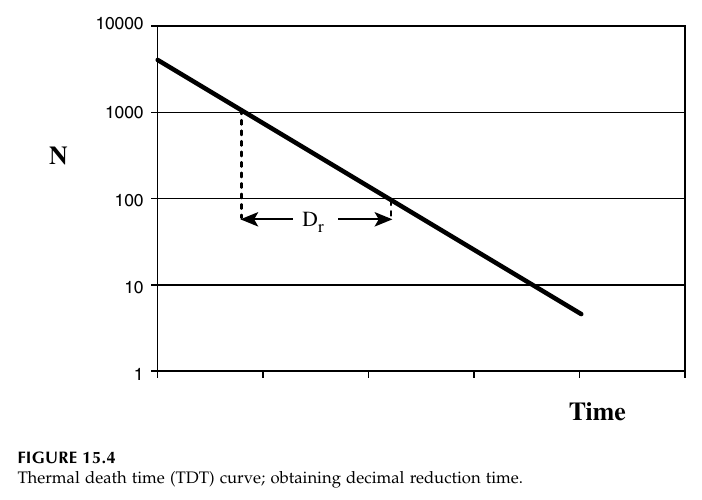
Figure 4.1: Thermal death time (TDT) curve; obtaining decimal reduction time. The number of survivors N falls in a straight line on a logarithmic scale, and D_T is the time for one log cycle of reduction. Reproduced from Ibarz, Fig. 15.4, p. 497.
The companion figure, Ibarz Figure 15.5, plots D_T itself against temperature on a logarithmic scale, giving another straight line. The z value is read from its slope: it is the temperature change that moves D_T by one log cycle. Together the two figures contain the whole kinetics of thermal death: one gives D at a temperature, the other gives how D changes with temperature.
The thermal death time for a process, F_T, is the time at temperature T needed for a given reduction: F_T = n D_T. The reference temperature for low-acid canning is 121.1 °C (250 °F), and the F value at that reference is called F₀. When a process is carried out at a different temperature, its equivalent time at the reference temperature is F_S = n D_R, where D_R is the D value at the reference temperature.
Ibarz Table 15.1 lists destruction times for thermo-sensitive microorganisms, enzymes and nutrients. Selected rows are:
Table 4.1: Destruction and thermal degradation times (Ibarz Table 15.1, selected values)
| Organism or component | Temperature (°C) | D_T (min) | F_R (min) | z (°C) | n |
|---|---|---|---|---|---|
| B. stearothermophilus (low acid, pH above 4.6) | 121 | 4-5 | 15 | 9.5-10 | 5 |
| C. botulinum (low acid, pH above 4.6) | 121 | 0.1-0.3 | 2.5-3 | 10 | 12 |
| C. sporogenes (low acid, pH above 4.6) | 121 | 0.1-1.5 | 5 | 10 | 5 |
| B. coagulans (acid, pH 4-4.6) | 121 | 0.01-0.07 | - | - | - |
| C. pasteurianum (acid, pH 4-4.6) | 93 | 0.1-0.5 | 1.3-10 | 8 | 5 |
| Yeasts and molds (very acid, pH below 4) | - | 5 x 10⁻⁸ | 10⁻⁶ | 5-8 | 20 |
| Peroxidase (sweet corn, green beans) | - | 1.22 | 5.1 | 11-52 | 4 |
| Vitamin B1 (spinach, green beans) | - | 140 | 5.6 | 25 | 0.04 |
| Chlorophyll a | - | 12.8 | 0.50 | 51-87 | 0.04 |
| Chlorophyll b | - | 14.3 | 0.57 | 98-111 | 0.04 |
Table 4.1: Destruction and thermal degradation times of thermo-sensitive microorganisms, enzymes and nutrients, Ibarz Table 15.1, p. 514. Selected rows; the full table in the book also lists other organisms and enzymes.
The table carries a lesson that shapes all of thermal processing. The z value for spores is about 10 °C, but the z value for vitamin B1 is 25 °C and for chlorophyll it is 50 to 110 °C. That means a short, hot process kills spores far more effectively, relative to the damage it does to nutrients and colour, than a long, cool process. High temperature, short time is not just a slogan: it follows directly from the different z values.
Quick check
A process gives a 6 log reduction of an organism with D = 0.5 min. How long must it run at that temperature?
Check your answer
t = n D_T = 6 x 0.5 = 3 minutes.
4.3 Lethality: adding up the F value across a real process
In a real can, the temperature is not constant. It rises during heating, holds near the retort temperature, and falls during cooling, and lethality accumulates during all three stages. The F value of a process is the sum over the whole temperature history, converting each minute at each temperature into its equivalent at the reference temperature of 121 °C:
F = θ₁ x 10^-(121-t₁)/z + θ₂ x 10^-(121-t₂)/z + ...
where θ is the time spent at temperature t, and z is 10 °C for Clostridium botulinum. A minute at 111 °C counts as 10^-1, which is one tenth of a minute at 121 °C. A minute at 101 °C counts as one hundredth. The arithmetic is simple, but it must be done at the coldest point in the can, because that is where the least lethality accumulates.
Worked example: can processing (Earle Example 6.5)
A can is processed in a retort, and the temperature at the centre of the can is recorded against time. The required F value for Clostridium botulinum is 2.8 minutes at 121 °C, with z = 10 °C. The temperature history is broken into steps, and the lethality of each step is calculated. The table below gives the steps.
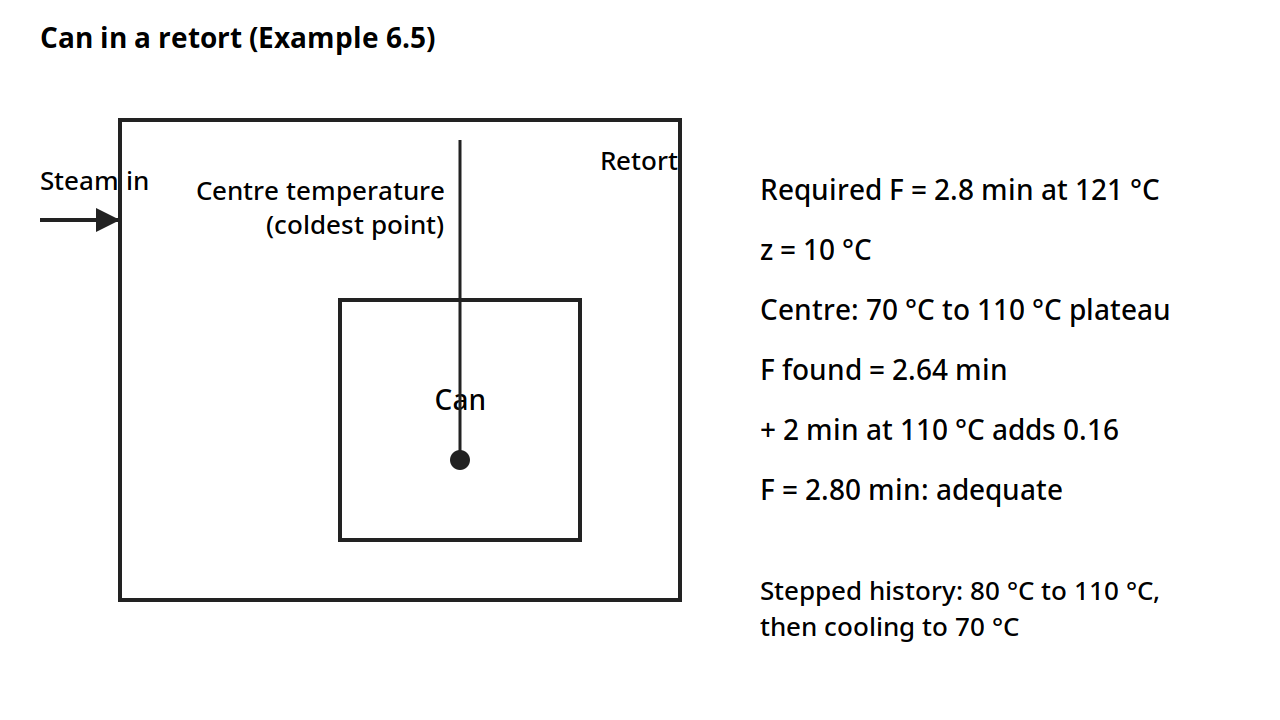
Diagram for Worked example: can processing (Earle Example 6.5). A can in a retort, with the temperature measured at the centre, the coldest point. The required F value is 2.8 minutes at 121 °C with z = 10 °C; the stepped temperature history gives F = 2.64 minutes, and 2 more minutes at 110 °C adds 0.16, making 2.80. Drawn from the book's numbers.
Table 4.2: Lethality calculation for a can process (Earle Table 6.2)
| Temperature (°C) | Time θ (min) | 121 - t | 10^-(121-t)/10 | θ x 10^-(121-t)/10 |
|---|---|---|---|---|
| 80 | 11 | 41 | 7.9 x 10⁻⁵ | 0.00087 |
| 90 | 8 | 31 | 7.9 x 10⁻⁴ | 0.0063 |
| 95 | 6 | 26 | 2.5 x 10⁻³ | 0.015 |
| 100 | 10 | 21 | 7.9 x 10⁻³ | 0.079 |
| 105 | 12 | 16 | 2.5 x 10⁻² | 0.30 |
| 108 | 6 | 13 | 5.0 x 10⁻² | 0.30 |
| 109 | 8 | 12 | 6.3 x 10⁻² | 0.50 |
| 110 | 17 | 11 | 7.9 x 10⁻² | 1.34 |
| 107 | 2 | 14 | 4.0 x 10⁻² | 0.08 |
| 100 | 2 | 21 | 7.9 x 10⁻³ | 0.016 |
| 90 | 2 | 31 | 7.9 x 10⁻⁴ | 0.0016 |
| 80 | 8 | 41 | 7.9 x 10⁻⁵ | 0.0006 |
| 70 | 6 | 51 | 7.9 x 10⁻⁶ | 0.00005 |
| Total F | 2.64 | |||
Table 4.2: Lethality calculation for a can process, Earle Table 6.2, p. 83. The total F value is 2.64 minutes.
The total F value is 2.64 minutes, against a required 2.8 minutes, so the process is not quite adequate. Adding 2 minutes at 110 °C adds 2 x 10^-(121-110)/10 = 2 x 0.079 = 0.16, making 2.80, which meets the requirement. That is how a process is adjusted in practice: a small extension at the holding temperature, where lethality accumulates fastest, rather than a long extension at a low temperature, where it barely counts.
The temperature history behind the table is shown in Earle Figure 6.6: the centre temperature rises from 70 °C to a plateau at 110 °C, holds there for about 60 to 78 minutes, and then drops sharply to 70 °C at about 95 minutes as cooling begins. The stepped approximation on the rising part is the set of steps used in the table.
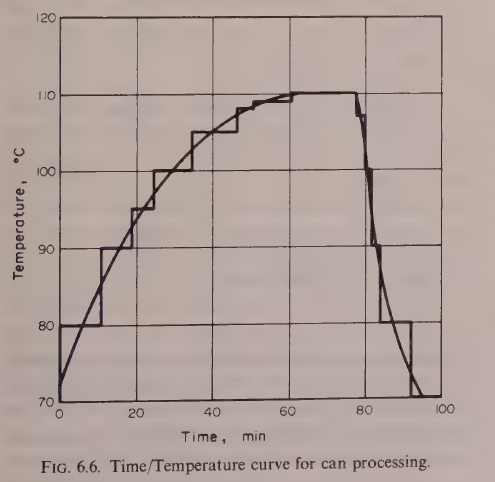
Figure 4.2: Time/temperature curve for can processing. The centre temperature rises from 70 °C to a plateau at 110 °C, holds, and then drops sharply on cooling. Reproduced from Earle, Fig. 6.6, p. 71.
Gould gives a simpler rule for low-acid sterilization: a process is considered satisfactory when the centre temperature reaches 252 °F, which is 122.4 °C, for 0.7 minute, or 42 seconds. That figure is Gould's, and it differs from the Ibarz reference temperature of 121.1 °C used in the F value calculation above. The two books use different reference conventions, and each figure must be kept with its source.
Practical note: the F value is calculated at the coldest point in the can, and the coldest point moves during the process. In a can heated by conduction, the coldest point is near the geometric centre. In a can heated by convection, the coldest point is lower, because the hot liquid rises and the cold liquid sinks. Heat penetration tests locate that point with thermocouples before the process is set.
4.4 Heat penetration: how fast does the centre warm up?
The F value calculation needs the temperature history at the centre of the can, and that history is found by heat penetration testing. A thermocouple is placed at the coldest point of the can, the can is processed in the retort, and the temperature is recorded against time. The resulting heat penetration curve is plotted on semilog paper: the vertical axis is the difference between the retort temperature and the food temperature, T_e - T, on a logarithmic scale, and the horizontal axis is time.
Ibarz Figure 15.6 shows the shape. At first the curve is bent, because the heat is still travelling in from the wall, and then it becomes a straight line. That straight part is the key to the whole method, because it is described by two numbers: f_h, the heating rate index, which is the time needed for the straight line to pass through one log cycle, and j_h, the lag factor, which measures how far the straight line, extended back to zero time, falls below the starting temperature difference. The intercept of the extended line is j_h I_h, where I_h is the initial temperature difference between the retort and the food. The process time, B, needed for the centre to reach a given temperature, is then:
B = f_h log(j_h I_h / g)
where g is the difference between the retort temperature and the final centre temperature. That equation is the formula method of Ball, and it is how a scheduled process is calculated from a heat penetration test.
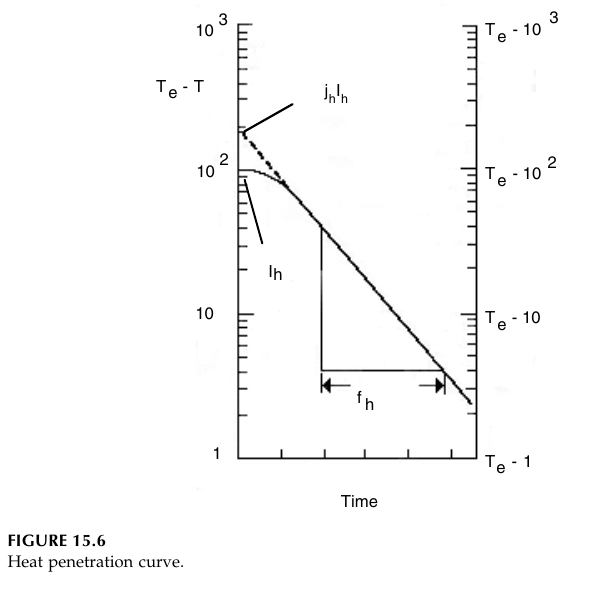
Figure 4.3: Heat penetration curve. The difference between retort temperature and food temperature, T_e - T, is plotted on a logarithmic scale against time. After an initial lag the curve is a straight line, described by the heating rate index f_h and the lag factor j_h, with intercept j_h I_h. Reproduced from Ibarz, Fig. 15.6, p. 503.
Two kinds of heating occur inside a can. In conduction heating, the food is solid or viscous, and heat travels inward by conduction, as in Unit 3. The centre heats slowly, and the temperature gradient inside the can is steep. In convection heating, the food is liquid, and the hot liquid rises and the cold liquid sinks, mixing the contents. The centre heats faster, and the temperature is more uniform. Most real foods are in between: a can of peas in brine heats partly by convection and partly by conduction, and the heating curve can show a break, called broken heating, when the mode changes during the process, for example when starch gelatinizes and the liquid thickens.
Quick check
Two cans of the same size go into the same retort. One holds a thick paste, the other holds a thin soup. Which centre heats faster, and why?
Check your answer
The soup. Its liquid circulates by convection, carrying heat to the centre, while the paste can only conduct heat inward, which is slower.
4.5 Retorts and aseptic processing
The retort is the pressure vessel in which cans are sterilized. Steam is the usual heating medium, and the retort must be vented of air before the process starts, because air in the retort lowers the temperature for a given pressure and gives an uneven heat distribution. During heating, the pressure inside the can rises as the food approaches retort temperature, and the can is under tension; during cooling, the retort pressure must be balanced with air pressure, or the cans will buckle. Batch retorts hold a fixed number of cans and run one process at a time. Continuous retorts move the cans through on a conveyor or in a rotary system, with axial rotary movement of the cans, and they are used where the volume justifies them. Non-agitating batch retorts are used extensively in spite of their slower heating, because they are simple and flexible.
Aseptic processing separates the two steps that canning combines. The food is sterilized first, in a continuous heat exchanger, and then packed in a sterilized container under sterile conditions. Because the food is heated in a thin stream rather than in a can, the heating is fast and uniform, the holding time is short, and the quality is better: less cooked flavour, less colour loss, less nutrient damage, and less energy used. The engineering problem moves from the can to the heat exchanger and the sterile filler, and the process time is calculated from the residence time distribution of the product in the holding tube, because the fastest particle through the tube gets the least treatment.
4.6 Freezing: ice, crystals and freezing time
Freezing is the removal of heat until the water in the food turns to ice. Pure water freezes at 0 °C: on cooling it subcools slightly below 0 °C, then the temperature rises back to 0 °C as ice begins to form, stays constant while all the water turns to ice, and then falls faster, because ice conducts heat better than liquid water. Foods do not behave like pure water, because as ice forms, the solutes left behind become more concentrated, and the freezing temperature falls continuously. A food does not have one freezing temperature: it has a range, and the first ice forms at the initial freezing temperature, which depends on the composition.
Table 4.3: Initial freezing temperature of some foods (Ibarz Table 16.1, selected values)
| Product | Moisture (%) | Initial freezing temperature (°C) |
|---|---|---|
| Meat | 55-70 | -1.0 to -2.2 |
| Fish | 65-81 | -0.6 to -2.0 |
| Egg | 74 | -0.5 |
| Milk | 87 | -0.5 |
| Fruits | 87-95 | -0.9 to -2.7 |
| Strawberry | - | -0.89 |
| Raspberry | - | -1.22 |
| Peach | - | -1.56 |
| Pear | - | -1.61 |
| Plum | - | -2.28 |
| Cranberry | - | -1.11 |
| Vegetables | 78-92 | -0.8 to -2.8 |
| Onion | - | -1.44 |
| Asparagus | - | -0.67 |
| Spinach | - | -0.56 |
| Carrot | - | -1.11 |
| Orange juice | - | -1.17 |
| Tomato pulp | - | -0.72 |
| Apple concentrate | 49.8 | -11.33 |
Table 4.3: Initial freezing temperature of some foods, Ibarz Table 16.1, p. 555. Selected values; the full table in the book also lists other fruits, vegetables and juices.
The rate of freezing decides the quality of the frozen food. Fast freezing gives many nucleation sites and small ice crystals, which form inside the cells and do little damage. Slow freezing gives few nucleation sites and large ice crystals, which grow between the cells, crush the tissue, and on thawing leave a soft, leaky product. That is why quick freezing is the objective of the industry, and why the freezing equipment of section 4.8 is built for speed.
Two definitions of freezing time are used. The effective freezing time is the time for the geometric centre of the food to go from its initial temperature to a given final temperature below freezing. The nominal freezing time is the time from when the surface reaches 0 °C until the centre reaches 10 °C below the initial freezing temperature. The two differ, and the definition in use must be stated whenever a freezing time is quoted.
The freezing time for a simple shape is given by Plank's equation. For an infinite slab of thickness e:
t_F = ρλ_I / (T_F - T_e) x (e²/(8k) + e/(2h))
where ρ is the density, λ_I is the latent heat of the frozen water fraction, T_F is the freezing temperature, T_e is the temperature of the cooling medium, k is the thermal conductivity of the frozen food, and h is the surface coefficient. The equation is valid only for the freezing period, and it assumes the food is initially at its freezing temperature. For a cylinder the 8 and 2 become 16 and 4, and for a sphere they become 24 and 6, with the radius as the characteristic dimension. The generalized form uses parameters P and R, given in Ibarz Table 16.2: an infinite slab has P = 1/2 and R = 1/8 with thickness e; an infinite cylinder has P = 1/4 and R = 1/16 with radius r; a sphere has P = 1/6 and R = 1/24 with radius r. The latent heat of the frozen water is λ_I = x_H λ, where x_H is the mass fraction of water that freezes and λ is the latent heat of water. The Fourier, Biot and Stefan numbers, met in Unit 3, appear in the more refined treatments, and the Cleland and Earle modification of Plank's equation improves the prediction for foods that are not initially at the freezing temperature.
The heat load of freezing is large, because the latent heat of water is large. Earle's bread freezing example in Unit 1 showed the scale: freezing a batch of bread removed a total enthalpy of 1.125 x 10⁶ kJ, at an average rate of 52 kW and a maximum rate of 104 kW. A freezing plant must be sized for that peak, not for the average.
Quick check
Two identical slabs of the same food are frozen, one in still air and one in a fast air blast. Which freezes faster, and which part of Plank's equation explains it?
Check your answer
The one in the air blast. The surface coefficient h is larger, so the term e/(2h) is smaller, and the freezing time falls. The conduction term e²/(8k) is unchanged.
4.7 Refrigeration: moving heat uphill
Refrigeration is the extraction of heat from a cold place and its rejection to a warmer place, which needs work. Gould puts it plainly: cold never moves in, heat moves out. The machine that does it is the vapour compression cycle, shown in Ibarz Figure 16.4. A refrigerant evaporates in the evaporator, taking heat from the food or the cold room. The vapour is compressed in the compressor, which raises its temperature and pressure. The hot vapour condenses in the condenser, giving up its heat to cooling water or air. The liquid then passes through the expansion valve, where its pressure and temperature fall, and returns to the evaporator.
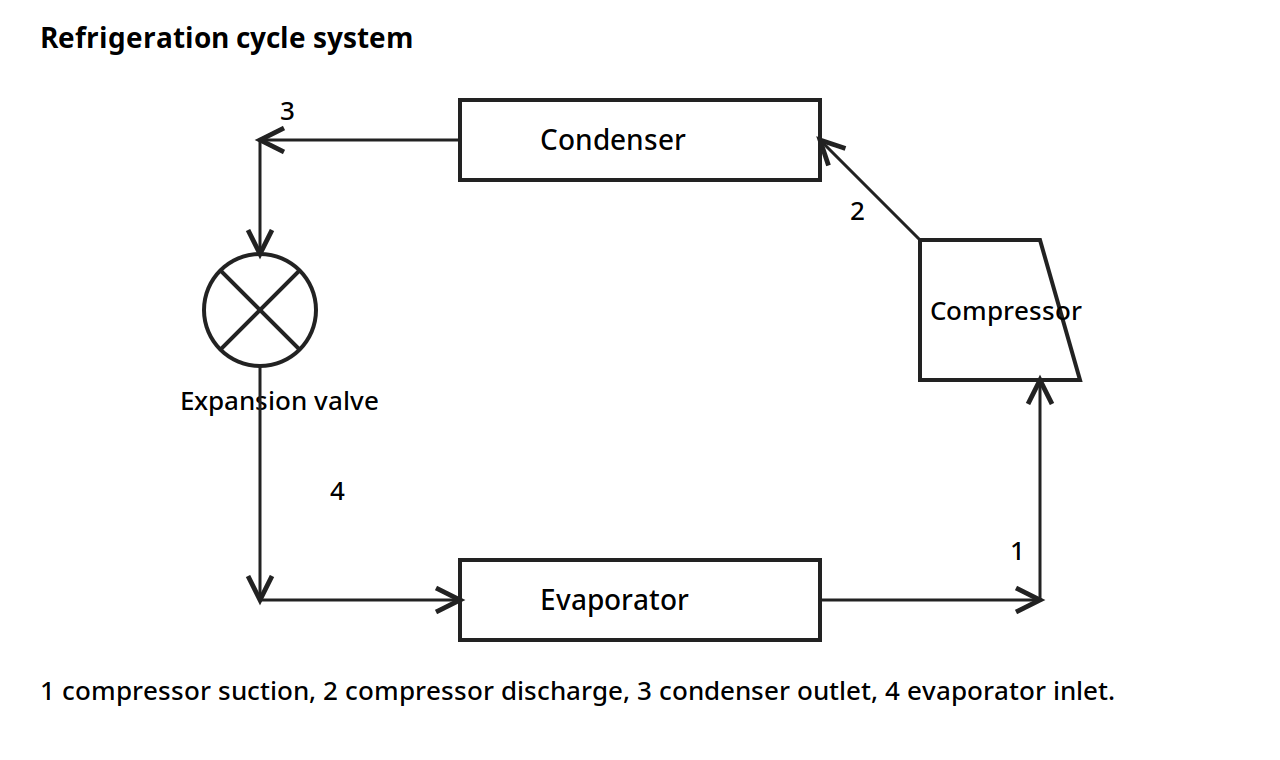
Figure 4.4: Refrigeration cycle system. The refrigerant evaporates in the evaporator, is compressed in the compressor, condenses in the condenser, and expands through the expansion valve. Reproduced from Ibarz, Fig. 16.4, p. 553, adapted from Stoecker and Jones, Refrigeration and Air Conditioning, McGraw-Hill, New York, 1982.
The compression work per unit mass of refrigerant is W_C = H₂ - H₁, where H₁ is the enthalpy at the compressor suction and H₂ is the enthalpy at the compressor discharge. The theoretical compressor power is Pow = w W_C = w(H₂ - H₁), where w is the mass flow rate of refrigerant. Those two equations, with the refrigerant tables, are the basis of refrigeration plant sizing.
Many plants need more than one temperature. A dairy, for example, may have one evaporator at -35 °C to harden ice cream and another at 2 °C to cool milk, both served by the same plant. That is a multipressure system: two evaporators at different pressures, with the vapour from the warmer evaporator compressed in stages or boosted to the level of the colder one.
The size of a refrigeration plant is often quoted in tons of refrigeration. One ton of refrigeration is the melting of one ton of ice in 24 hours, which is 288,000 BTU per 24-hour day, from 2000 lb of ice at 144 BTU per lb. It is an old unit, but it is still the unit the industry uses.
Table 4.4: Refrigerants (Ibarz Table 16.6, selected values)
| Refrigerant number | Chemical name | Formula |
|---|---|---|
| 11 | Trichlorofluoromethane | CCl₃F |
| 12 | Dichlorodifluoromethane | CCl₂F₂ |
| 13 | Chlorotrifluoromethane | CClF₃ |
| 22 | Chlorodifluoromethane | CHClF₂ |
| 40 | Chloromethyl | CH₃Cl |
| 113 | Trichlorotrifluoroethane | CCl₂FCClF₂ |
| 114 | Dichlorotetrafluoroethane | CClF₂CClF₂ |
| 50 | Methane | CH₄ |
| 170 | Ethane | C₂H₆ |
| 290 | Propane | C₃H₈ |
| 717 | Ammonia | NH₃ |
| 718 | Water | H₂O |
| 729 | Air | - |
| 744 | Carbon dioxide | CO₂ |
| 764 | Sulfur dioxide | SO₂ |
Table 4.4: Refrigerants, Ibarz Table 16.6, p. 572. Source: Stoecker and Jones, 1982. The book notes that halocarbons harm the ozone layer, that their use is limited, and that some are banned.
The book's table is given as the book gives it. Ammonia, number 717, remains the workhorse refrigerant of large food plants, because it is efficient and cheap, though it is toxic and needs careful handling. The halocarbons in the table were the common refrigerants when the book was written, and the book itself notes the ozone problem and the limits on their use.
4.8 Freezing equipment
Freezing equipment is built to remove heat fast, because fast freezing means small ice crystals and good quality. Gould classifies freezers into five types: still freezing in air; air blast or forced air freezers, generally in tunnels, but also in rooms with cold air circulating at more than 2,000 cubic feet per minute; single or double contact freezers, for packaged items; spray or fog freezers, with refrigerant sprayed over the packed or loose product; and direct or indirect immersion freezers, in which the product is immersed in the refrigerant, either packed or loose. Refrigerants vary from low pressure ammonia units to liquid nitrogen.
The plate freezer is the contact freezer: the food, usually packaged, is pressed between cold plates, and heat leaves by conduction through the plates. Horizontal plate freezers are the older form, and vertical plate freezers are a more recent development. The surface of the food and the cooling medium must be in good contact, because any air gap is an insulating layer, and the same lesson from Unit 3 applies: the largest resistance controls.
The air blast freezer is the workhorse for unpackaged foods. Cold air is blown at high speed over the product, in a tunnel or a room, and the high air velocity raises the surface coefficient. Continuous air blast freezers move the product through on a belt. The fluidized bed freezer is a form of air blast freezer for small loose pieces such as peas and berries: the air velocity is high enough to lift and suspend the pieces, so every surface is exposed to the cold air, and the pieces freeze separately instead of in a block. One of its major advantages is the ease with which the product can be handled afterwards, since the pieces stay free flowing.
Cryogenic freezing uses liquid nitrogen as the refrigerant. The product may be packaged and placed on trays, or individually quick frozen on belts and then packaged, or handled in bulk for secondary processing. The advantage of liquid nitrogen is a very rapid freezing rate and generally good preservation of quality in terms of texture, at least. The cost is high, so it is used where the quality justifies it. Frozen foods must always be kept frozen, in transport and storage below 0 °F, which is -17.8 °C, and the shelf life is restricted to time, usually not more than one year.
Quick check
You need to freeze loose peas so they stay separate and free flowing. Which freezer type do you pick, and why?
Check your answer
A fluidized bed freezer. The air lifts and suspends the peas, so every surface is exposed and the peas freeze separately instead of in a block.
Try it yourself
- Lethality addition. A can spends 5 minutes at 115 °C and 10 minutes at 110 °C, with z = 10 °C. What F value does it accumulate? How many more minutes at 110 °C would it need to reach F = 2.8?
- D value from a graph. Draw a TDT curve with D = 2 minutes. If the starting population is 10,000, how many survivors remain after 6 minutes? After 8 minutes?
- Plank in practice. A slab of food 4 cm thick is frozen in a blast freezer. If the thickness is doubled to 8 cm, what happens to the freezing time? Which term in Plank's equation grows, and by how much?
- Refrigeration load. A plant must remove 104 kW at peak, the bread freezing figure from Unit 1. Express that load in tons of refrigeration, using 1 ton = 3.517 kW. How many tons is the peak load?
- Crystal size. Freeze two identical samples of the same food, one in still air and one in liquid nitrogen. Predict which has smaller ice crystals, and say what happens to the texture of each on thawing.
Key ideas to carry forward
- Pasteurization destroys pathogens and some spoilage organisms; commercial sterilization destroys substantially all organisms and spores capable of growing under the storage conditions.
- Acidity decides the treatment: low-acid foods above about pH 4.5 need sterilization, acid foods can be pasteurized.
- Microbial death is first order: N = N₀ exp(-kt). The D value is the time for one log cycle of reduction, and the z value is the temperature rise that cuts D by ten.
- The F value adds up lethality across a changing temperature history, converted to equivalent minutes at 121 °C.
- The heat penetration curve, plotted on semilog paper, gives f_h and j_h, and the process time follows from B = f_h log(j_h I_h / g).
- Different z values for spores and for nutrients are the reason high temperature, short time processes protect quality.
- Fast freezing gives small ice crystals and good texture; slow freezing gives large crystals that damage tissue.
- Plank's equation gives the freezing time for a slab, cylinder or sphere, and it assumes the food starts at its freezing temperature.
- The vapour compression cycle moves heat from cold to hot using work: evaporation, compression, condensation and expansion.
- Freezing equipment is chosen for speed: plate, air blast, fluidized bed, immersion and cryogenic freezers each suit different products.
Glossary
Decimal reduction time (D value)
The time at a given temperature needed to reduce a microbial population by one log cycle, to one tenth of its starting number. Example: C. botulinum has a D value of 0.1 to 0.3 minutes at 121 °C.
z value
The temperature increase needed to reduce the D value by a factor of ten. Example: most bacterial spores have a z value of about 10 °C.
F value
The time at the reference temperature of 121.1 °C that gives the same lethality as the actual process. Example: a can process with F = 2.64 minutes is not quite enough when 2.8 minutes is required.
Commercial sterility
The destruction of substantially all microorganisms and spores capable of growing under the defined storage conditions, so the product is stable without refrigeration. Example: a canned bean is commercially sterile, while pasteurized milk is not.
Heat penetration curve
A plot of the difference between retort temperature and food temperature, on a logarithmic scale, against time, measured at the coldest point of the can. Example: the straight part of the curve gives f_h and j_h for the Ball formula method.
Heating rate index (f_h)
The time needed for the straight part of the heat penetration curve to pass through one log cycle. Example: a small f_h means the centre of the can heats fast.
Lag factor (j_h)
A number that measures how far the straight part of the heat penetration curve, extended back to zero time, falls below the starting temperature difference. Example: a large lag factor means the centre is slow to start warming.
Retort
A pressure vessel in which cans are sterilized with steam. Example: a batch retort holds a fixed number of cans and runs one process at a time.
Aseptic processing
Sterilizing the food first, in a continuous heat exchanger, and then packing it in a sterilized container under sterile conditions. Example: long-life milk in a carton is made by aseptic processing.
Initial freezing temperature
The temperature at which the first ice forms in a food, which falls as solutes concentrate during freezing. Example: milk starts to freeze at -0.5 °C, while apple concentrate starts at -11.33 °C.
Plank's equation
The equation that predicts the freezing time of a slab, cylinder or sphere from its size, density, latent heat, conductivity and surface coefficient. Example: doubling the thickness of a slab quadruples the conduction term in the freezing time.
Effective freezing time
The time for the geometric centre of the food to go from its initial temperature to a given final temperature below freezing. Example: a freezing time quoted without saying whether it is effective or nominal cannot be compared with another.
Refrigerant
The fluid that carries heat around a refrigeration cycle by evaporating and condensing. Example: ammonia, number 717, is the workhorse refrigerant of large food plants.
Ton of refrigeration
A unit of refrigeration capacity equal to melting one ton of ice in 24 hours, which is 288,000 BTU per 24-hour day. Example: a plant rated at 100 tons can remove about 352 kW of heat.
Fluidized bed freezer
A freezer in which cold air lifts and suspends small loose pieces, so every surface is exposed and the pieces freeze separately. Example: peas and berries are frozen in a fluidized bed so they stay free flowing.
References
- Earle, R. L. Unit Operations in Food Processing. 2nd edition. Pergamon Press. Chapter 6.
- Ibarz, Albert, and Barbosa-Cánovas, Gustavo V. Unit Operations in Food Engineering. CRC Press, 2003. Chapters 15 and 16.
- Brennan, J. G., Butters, J. R., Cowell, N. D., and Lilly, A. E. V. Food Engineering Operations. 3rd edition. Elsevier Applied Science. Chapters 10 and 13.
- Gould, Wilbur A. Unit Operations for the Food Industries. CTI Publications. Chapters 17 and 18.
- Heldman, D. R., and Singh, R. P. Food Process Engineering. 2nd edition. AVI Publishing. Chapters on thermal processing and freezing.
