Unit 3: Heat Transfer and Heat Exchangers
GIFSQ ID: FTN-0115
Unit 3 of 12 in Unit Operations. This page is one unit of the Unit Operations notes.
All units in Unit Operations:
- Unit 1: Introduction to Unit Operations, Units and Material and Energy Balances
- Unit 2: Fluid Flow, Pumps and Piping
- Unit 3: Heat Transfer and Heat Exchangers
- Unit 4: Thermal Processing, Refrigeration and Freezing
- Unit 5: Mass Transfer and Contact-Equilibrium Separations
- Unit 6: Drying and Dehydration
- Unit 7: Evaporation
- Unit 8: Distillation
- Unit 9: Extraction, Expression and Adsorption
- Unit 10: Membrane Separation
- Unit 11: Mechanical Separations: Filtration, Centrifugation, Sedimentation and Fluidization
- Unit 12: Size Reduction, Mixing and Emulsification
Previous unit: Unit 2: Fluid Flow, Pumps and Piping | Next unit: Unit 4: Thermal Processing, Refrigeration and Freezing
Unit 3: Heat Transfer and Heat Exchangers
Note
Heat a cold store wall from the outside and the cold leaks away, slowly, through brick, concrete and cork. Heat a pan of soup and the steam in the jacket gives up its heat through steel, into the soup, and the soup warms. Cool milk in a plate exchanger and the cold brine takes the heat away through thin steel plates, square metre after square metre. The same few rules govern all three, and this unit is about those rules, the numbers that go with them, and the machines built around them.
Questions to think about
- What drives heat to flow, and what holds it back?
- Why does a steel bolt through an insulated wall carry most of the heat?
- What is the difference between thermal conductivity and thermal conductance?
- Why is the coldest part of a can the hardest part to heat, and how do engineers allow for it?
- What is an overall heat transfer coefficient, and which resistance controls it?
- Why is countercurrent flow better than parallel flow in a heat exchanger?
- How do you size a heat exchanger from four temperatures and two flow rates?
3.1 Heat transfer is everywhere in food processing
Heat transfer is an operation that occurs repeatedly in the food industry. Whether it is called cooking, baking, drying, sterilizing or freezing, heat transfer is part of the processing of almost every food. An understanding of the principles which govern heat transfer is essential to an understanding of food processing.
Heat transfer is a dynamic process in which heat is transferred spontaneously from one body to another cooler body. The rate of heat transfer depends on the differences in temperature between the bodies: the greater the difference in temperature, the greater the rate of heat transfer. Temperature difference between the source of heat and the receiver of heat is therefore the driving force in heat transfer. The heat passing from one body to another travels through some medium which in general offers resistance to the heat flow. Both factors, the temperature difference and the resistance to heat flow, affect the rate of heat transfer, and they are connected by the general equation:
rate of transfer = driving force / resistance
For heat transfer, the rate of heat transfer equals the temperature difference divided by the heat flow resistance of the medium. During processing, temperatures may change and therefore the rate of heat transfer will change. That is called unsteady-state heat transfer, in contrast to steady-state heat transfer, when the temperatures do not change. An example of unsteady-state heat transfer is the heating and cooling of cans in a retort to sterilize the contents.
Heat can be transferred in three ways. In conduction, molecular energy is directly exchanged from the hotter to the cooler regions, the molecules with greater energy communicating some of their energy to neighbouring molecules with less energy. An example is the heat transfer through the solid walls of a refrigerated store. Radiation is the transfer of heat energy by electromagnetic waves, which transfer heat from one body to another in the same way as light waves transfer light energy. An example is a foodstuff passed below a bank of red hot electric resistance heaters. Convection is the transfer of heat by the movement of groups of molecules in a fluid, moved by density changes or by forced motion of the fluid. An example is cooking in a jacketed pan: without a stirrer, density changes cause heat transfer by natural convection, and with a stirrer the convection is forced. In general, heat is transferred in solids by conduction and in fluids by conduction and convection, while radiation occurs through open space. In practice the three types may occur together. For calculations it is often best to consider the mechanisms separately, and then to combine them where necessary.
Quick check
A loaf bakes in an oven with hot air blowing round it and red hot elements above it. Name the three mechanisms at work.
Check your answer
Conduction through the crust and crumb, convection from the moving hot air to the loaf surface, and radiation from the red hot elements to the loaf.
3.2 Conduction: Fourier's law and the slab
In heat conduction, the general rate equation can be applied directly. The driving force is the temperature difference per unit length of heat transfer path, also known as the temperature gradient. Instead of resistance to heat flow, its reciprocal, called the conductance, is used. The equation becomes:
rate of heat transfer = driving force x conductance
dQ/dθ = kA(dt/dx)
where dQ/dθ is the rate of heat transfer, the quantity of heat energy transferred per unit time, A is the area of cross section of the heat flow path, dt/dx is the temperature gradient, and k is the thermal conductivity of the medium. That equation is known as the Fourier equation for heat conduction. Heat flows from a hotter to a colder body, in the direction of the negative temperature gradient, so a minus sign should appear in the Fourier equation. In simple problems the direction of heat flow is obvious and the minus sign is considered confusing rather than helpful, so it has not been used.
Thermal conductivity is a property of the material. It does change slightly with temperature, but in many applications it can be regarded as a constant for a given material. In general, metals have a high conductivity, in the region of 50 to 400 J m⁻¹ s⁻¹ °C⁻¹. Most foodstuffs contain a high proportion of water, and as the thermal conductivity of water is about 0.7 J m⁻¹ s⁻¹ °C⁻¹ above 0 °C, thermal conductivities of foods are in this range. Ice has a substantially higher thermal conductivity than water, about 2.3 J m⁻¹ s⁻¹ °C⁻¹, so the thermal conductivity of frozen foods is higher than that of foods at normal temperatures. Most dense non-metallic materials have thermal conductivities of 0.5 to 2 J m⁻¹ s⁻¹ °C⁻¹. Insulating materials such as foamed plastics, cork and expanded rubber are in the range 0.038 to 0.052 J m⁻¹ s⁻¹ °C⁻¹, close to the conductivity of air, which is 0.024 J m⁻¹ s⁻¹ °C⁻¹ at 0 °C. Some newer insulating materials have thermal conductivities as low as 0.026 J m⁻¹ s⁻¹ °C⁻¹.
If a slab of material has two faces at different temperatures t₁ and t₂, heat flows from the face at the higher temperature to the other face. Under steady temperature conditions the rate of heat transfer is constant, and the Fourier equation becomes:
q = kA(t₁ - t₂)/x = kAΔt/x = (k/x)AΔt
where x is the thickness of the slab. That is the basic equation for simple heat conduction, and it can be used to calculate the rate of heat transfer through a uniform wall if the temperature difference across it and the thermal conductivity of the wall material are known.
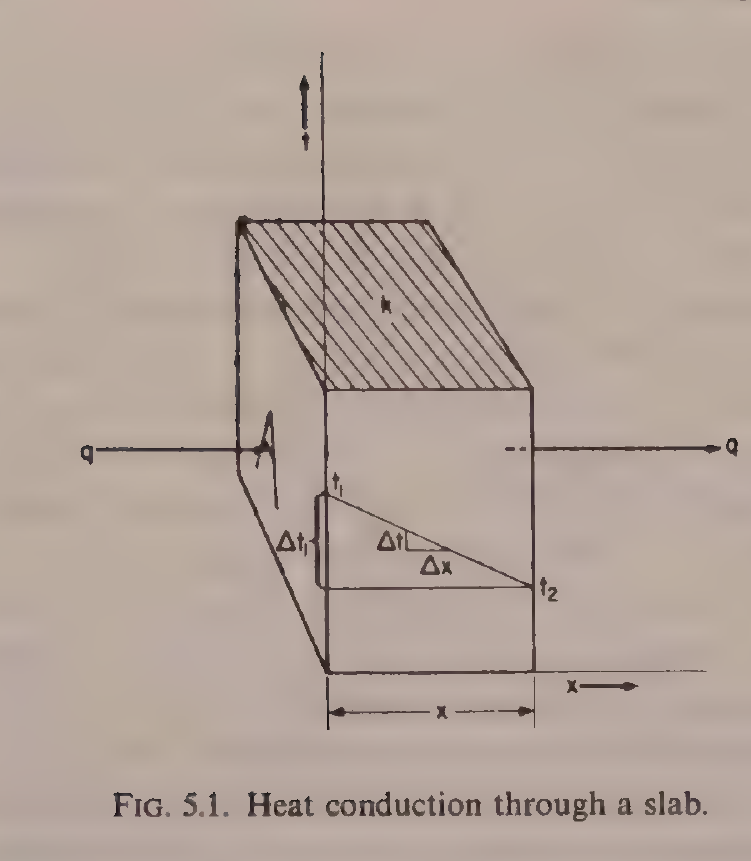
Figure 3.1: Heat conduction through a slab. Heat q flows from the face at temperature t₁ to the face at temperature t₂, across a thickness x, through a material of thermal conductivity k. Reproduced from Earle, Fig. 5.1, p. 48.
Worked example: heat through a cork slab (Earle Example 5.1)
A cork slab 10 cm thick has one face at -12 °C and the other face at 21 °C. If the mean thermal conductivity of cork in this temperature range is 0.042 J m⁻¹ s⁻¹ °C⁻¹, what is the rate of heat transfer through 1 m² of wall? The temperature difference is 21 - (-12) = 33 °C, the area is 1 m², k is 0.042 and x is 0.1 m. The rate is q = (0.042/0.1) x 1 x 33 = 13.9 J s⁻¹.
Quick check
Two walls have the same thickness and the same temperature difference. One is brick with k = 0.69, the other is cork with k = 0.043. Which passes more heat, and by what factor?
Check your answer
The brick wall, by a factor of 0.69/0.043, which is about 16 times as much heat.
3.3 Conductances in series and in parallel
The heat conductance is the quantity of heat that will pass in unit time, through unit area of a specified thickness of material, under unit temperature difference. It is C = k/x, with units J m⁻² s⁻¹ °C⁻¹. Conductance relates to the actual thickness of a given material, while conductivity relates only to unit thickness. That distinction matters whenever a wall is made of more than one layer.
Frequently, in heat conduction, heat passes through several consecutive layers of different materials. For example, in a cold store wall, heat might pass through brick, plaster, wood and cork. In the steady state, the same quantity of heat per unit time must pass through each layer. If the areas are the same, the temperature drops across the layers add, and the result is:
q = UAΔt, where 1/U = x₁/k₁ + x₂/k₂ + x₃/k₃ + ...
Here U is called the overall conductance for the combined layers. The same form as the single slab equation, extended to a composite slab.
Worked example: a cold store wall (Earle Example 5.2)
A cold store has a wall comprising 11 cm of brick on the outside, then 7.5 cm of concrete and then 10 cm of cork. The mean temperature within the store is maintained at -18 °C and the mean temperature of the outside surface of the wall is 18 °C. Calculate the rate of heat transfer through the wall and the temperature at the interface between cork and concrete. The thermal conductivities are for brick, concrete and cork, respectively, 0.69, 0.76 and 0.043 J m⁻¹ s⁻¹ °C⁻¹.
For brick, x₁/k₁ = 0.11/0.69 = 0.16. For concrete, x₂/k₂ = 0.075/0.76 = 0.10. For cork, x₃/k₃ = 0.10/0.043 = 2.33. The sum is 1/U = 0.16 + 0.10 + 2.33 = 2.6, so U = 0.38 J m⁻² s⁻¹ °C⁻¹. The temperature difference is 18 - (-18) = 36 °C, so the heat flow is q = UAΔt = 0.38 x 1 x 36 = 13.7 J s⁻¹ per m² of wall. For the cork layer, q = AΔt₃k₃/x₃, so 13.7 = 1 x Δt₃ x (1/2.33), giving Δt₃ = 32 °C. That is the difference between the cork and concrete interface and the inside surface of the cork, so the interface temperature is -18 + 32 = 14 °C.
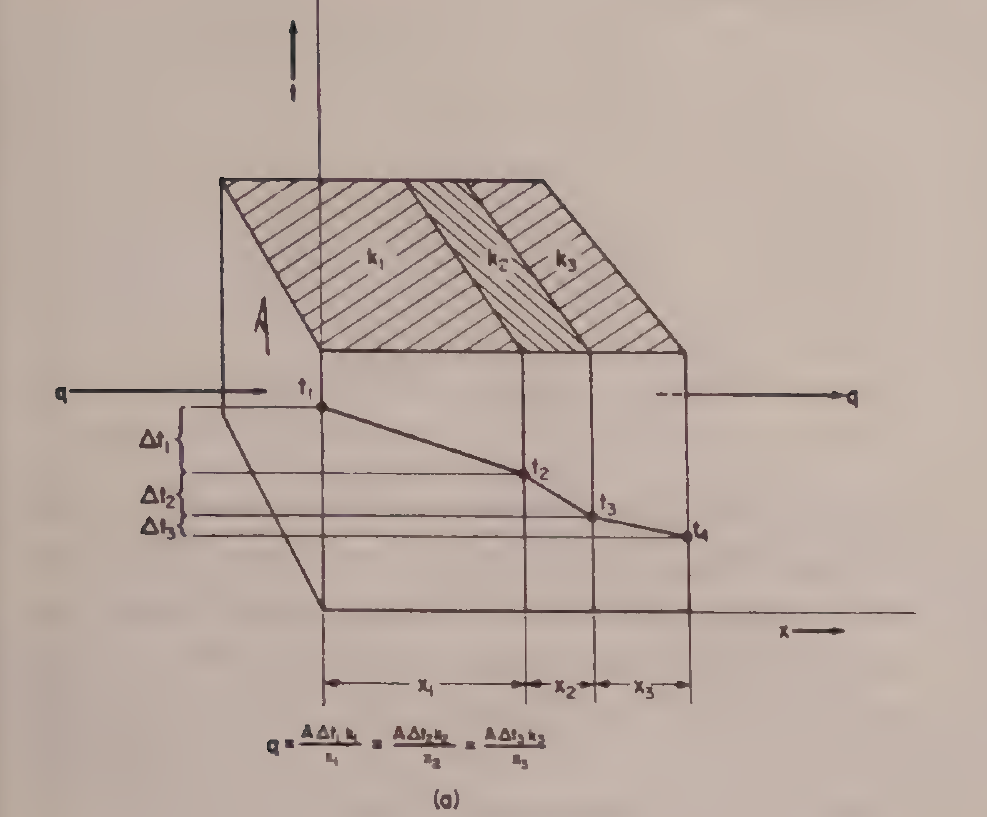
Earle Fig. 5.2(a): Heat conductances in series. Reproduced from Earle, Fig. 5.2(a), printed p. 49.
Notice where the resistance sits: the cork contributes 2.33 of the total 2.6, which is about 90% of the resistance. The brick and the concrete hardly matter. That is the point of the example, and it is a pattern that returns in every heat transfer calculation: find the largest resistance, because it controls the result.
Heat conductances in parallel are the opposite case. The material surfaces are parallel to the direction of heat transfer, so the heat passes through each material at the same time instead of through one and then the next. An example is the insulated wall of a refrigerator or an oven, in which the walls are held together by bolts. The bolts are in parallel with the direction of heat transfer through the wall: they carry most of the heat transferred and thus account for most of the losses.
Worked example: steel bolts in an oven wall (Earle Example 5.3)
The wall of a bakery oven is built of insulating brick 10 cm thick with a thermal conductivity of 0.22 J m⁻¹ s⁻¹ °C⁻¹. Steel reinforcing members penetrate the brick, and their total area of cross section represents 1% of the inside wall area. The thermal conductivity of the steel is 45 J m⁻¹ s⁻¹ °C⁻¹. Calculate the relative proportions of the total heat transferred through the wall by the brick and by the steel, and the heat loss for each m² of oven wall if the inner side is at 230 °C and the outer side is at 25 °C.
The temperature difference is the same for brick and steel, and the thickness is the same. For the brick, through 0.99 m²: q = 0.99 x (230 - 25) x 0.22 / 0.10 = 446 J s⁻¹. For the steel, through 0.01 m²: q = 0.01 x (230 - 25) x 45 / 0.10 = 923 J s⁻¹. The total is 446 + 923 = 1369 J s⁻¹ per m² of wall, and the steel, which is only 1% of the area, carries 923/1369, which is 67% of the heat. One percent of steel undoes almost all the insulation.
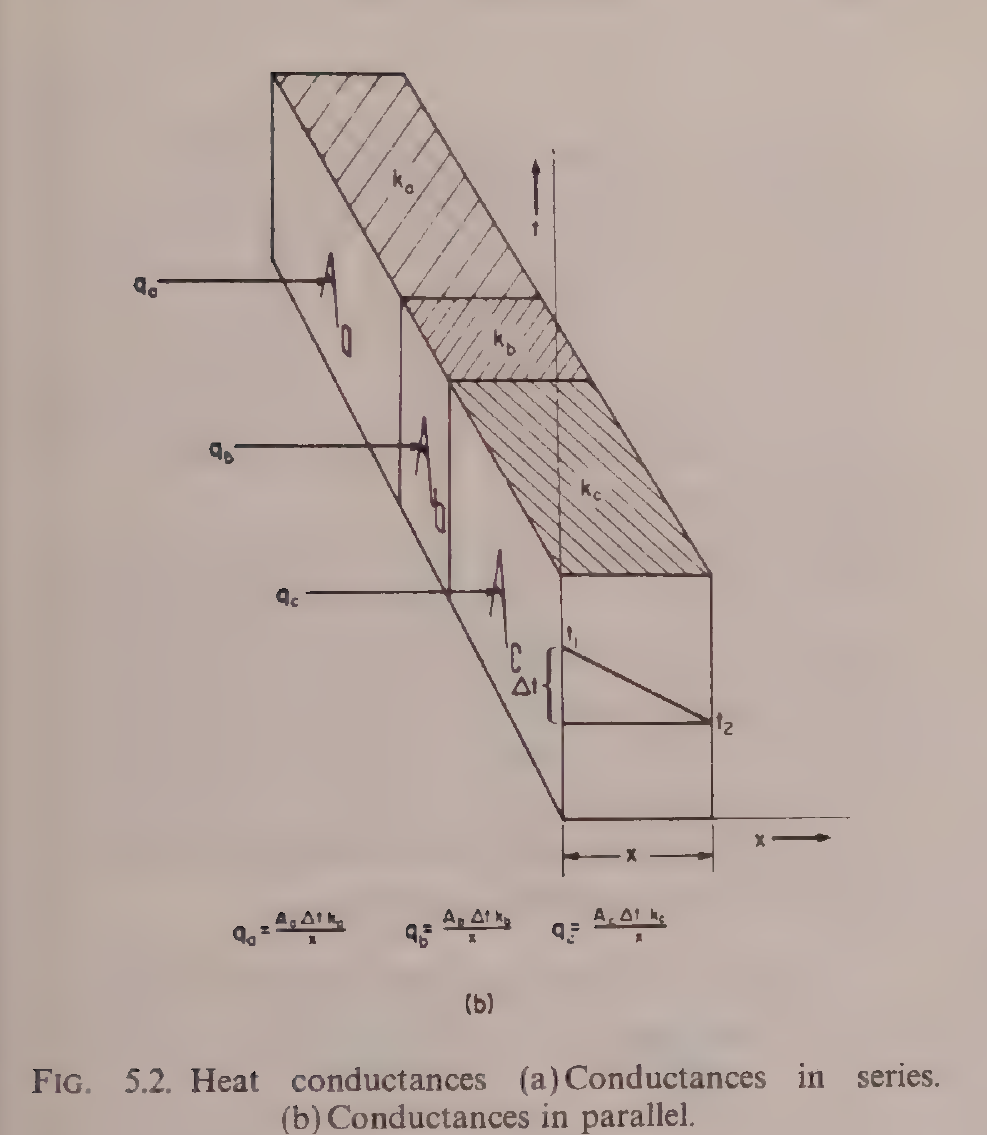
Earle Fig. 5.2(b): Heat conductances in parallel. Reproduced from Earle, Fig. 5.2(b), printed p. 49.
Practical note: when a cold room underperforms, look for the steel first: bolts, brackets, door frames and pipe supports are parallel paths that carry far more heat than their area suggests.
3.4 Thermal properties of foods: conductivity, specific heat and diffusivity
A heat transfer calculation is only as good as the properties fed into it, and foods need their own numbers. Ibarz Chapter 11 gathers them. Thermal conductivity, specific heat, density and thermal diffusivity are the four that matter, and each depends on composition and temperature.
Thermal conductivity of some foods is given in Ibarz Table 11.1. Selected values, with water content and temperature as given in the book, are:
Table 3.1: Thermal conductivity of some foods (Ibarz Table 11.1, selected values)
| Product | Water content (%) | Temperature (°C) | Thermal conductivity (J/s·m·°C) |
|---|---|---|---|
| Olive oil | - | 15 | 0.189 |
| Olive oil | - | 100 | 0.163 |
| Cod | 83 | 2.8 | 0.544 |
| Pork, perpendicular to the fibers | 75.1 | 6 | 0.488 |
| Pork, parallel to the fibers | 75.9 | 4 | 0.443 |
| Pork, fatty meat | - | 25 | 0.152 |
| Beef, lean, perpendicular to the fibers | 78.9 | 7 | 0.476 |
| Beef, lean, parallel to the fibers | 78.7 | 8 | 0.431 |
| Strawberries | - | -14 to 25 | 0.675 |
| Peas | - | 3-17 | 0.312 |
Table 3.1: Thermal conductivity of some foods, Ibarz Table 11.1, p. 329. Selected values; the full table in the book also lists soybean oil, vegetable and animal oils, sugars, lamb, veal and freeze-dried beef.
Two patterns stand out. Water content drives conductivity: lean meat at about 79% water conducts at about 0.48, while fatty meat conducts at 0.15. Direction matters too: meat conducts better across the fibers than along them, 0.488 against 0.443 for pork, because the fiber structure is not the same in both directions.
Specific heat is the energy needed to raise by 1 °C the temperature of one unit mass. For foods with a high water content above the freezing point, Siebel's equation is used:
Ĉp = 0.837 + 3.349 X_water
where Ĉp is in kJ/(kg·°C) and X_water is the mass fraction of water in the food. Charm's equation splits the food into fat, solids and water: Ĉp = 2.309 X_fat + 1.256 X_solids + 4.187 X_water. Choi and Okos give the general form as the sum over components of each component's specific heat times its mass fraction. Ibarz Table 11.4 lists measured values, including lean beef at 71.7% water with 3.433 kJ/kg·K, pasteurized whole milk at 87.0% water with 3.852 kJ/kg·K, skim milk at 90.5% water with 3.977 to 4.019 kJ/kg·K, apples raw at 84.4% water with 3.726 to 4.019 kJ/kg·K, potatoes at 79.8% water with 3.517 kJ/kg·K, and cucumbers at 96.1% water with 4.103 kJ/kg·K. The pattern is the same as for conductivity: more water means a higher specific heat, and the value for a watery food approaches that of water itself, 4.187 kJ/kg·K.
Thermal diffusivity, α, ties the three together: α = k/(ρĈp). It measures how fast a temperature change spreads through a material, rather than how much heat the material holds. Ibarz Table 11.5 gives values in units of 10⁻⁵ m²/s, including apples at 85% water and 0 to 30 °C with 1.37, strawberries pulp at 92% water and 5 °C with 1.27, avocado pulp at 24 °C with 1.24, sweet potato at 35 °C with 1.06, rising to 1.91 at 70 °C, and peas purée at 26 to 128 °C with 1.82. Diffusivity matters whenever a temperature change has to travel into the centre of a food, which is the subject of unsteady-state heat transfer and of Unit 4.
Quick check
Two foods have the same thermal conductivity, but one has twice the density and twice the specific heat of the other. Which one warms through faster, and why?
Check your answer
The lighter one, because thermal diffusivity is k divided by density times specific heat. With the same k and four times the denominator, the denser food has a quarter of the diffusivity, so a temperature change spreads four times more slowly.
3.5 Surface heat transfer: the film coefficient
So far the transfer has been through solids. In practice, heat must also pass from a fluid to a solid surface, or from a solid surface to a fluid. When heat is transferred from a fluid to a wall, some of the heat is transferred by conduction and some by convection, and the combined effect is expressed by Newton's law of cooling:
q = h_s A(t_f - t_s)
where q is the rate of heat transfer, A is the area of the surface, t_f is the temperature of the fluid, t_s is the temperature of the surface, and h_s is the surface heat transfer coefficient. The value of h_s depends on the properties of the fluid and on the nature of fluid flow near the surface. Typical values are listed in the table below.
Table 3.2: Approximate values of surface heat transfer coefficients (Earle Table 5.1)
| Fluid conditions | h_s (J m⁻² s⁻¹ °C⁻¹) |
|---|---|
| Boiling liquids | 2400-24,000 |
| Condensing liquids | 1800-18,000 |
| Still air | 6 |
| Moving air, 3 m/s | 30 |
| Liquids flowing through pipes | 1200-6000 |
Table 3.2: Approximate surface heat transfer coefficients, Earle Table 5.1, p. 62.
The range is enormous: still air transfers heat about a thousand times less well than a boiling liquid. That is why a steam jacket heats a pan far faster than a hot air oven at the same temperature, and why a still-air cold room cools food slowly.
Worked example: sugar solution in a jacketed pan (Earle Example 5.4)
Calculate the rate of heat transfer to a sugar solution in a jacketed pan from condensing steam, using the data given below. The pan contains a sugar solution of 1.4 m² area, which is maintained at 83 °C. Steam is condensing in the jacket at 200 kPa gauge, saturation temperature 134 °C, and the latent heat of the steam is 2164 kJ/kg. The heat transfer coefficient from condensing steam is 12,000 J m⁻² s⁻¹ °C⁻¹, from the sugar solution 3000 J m⁻² s⁻¹ °C⁻¹, and the wall is stainless steel 1.6 mm thick with a thermal conductivity of 21 J m⁻¹ s⁻¹ °C⁻¹.
The steam side resistance is 1/12,000, the solution side is 1/3000, and the wall resistance is 0.0016/21. Adding them: 1/U = 1/12,000 + 0.0016/21 + 1/3000, which is about 0.00049, so U is about 2030 J m⁻² s⁻¹ °C⁻¹. The temperature difference is 134 - 83 = 51 °C, so the rate of heat transfer is q = UAΔt = 2030 x 1.4 x 51 = 1.45 x 10⁵ J s⁻¹. The rate at which steam condenses is the heat rate divided by the latent heat: 1.45 x 10⁵ / 2.164 x 10⁶ = 0.067 kg s⁻¹, which is about 4 kg per minute. The solution side coefficient, 3000, is the controlling resistance: it is four times smaller than the steam side coefficient, so it dominates the sum.
Diagram: Sugar solution in a jacketed pan (Earle Example 5.4)
Steam condensing in the jacket at 134 °C
↓
Sugar solution 83 °C
Area 1.4 m²
↓
Heat rate q = 1.45 x 10⁵ J s⁻¹; steam condenses 0.067 kg s⁻¹
Diagram for Earle Example 5.4: condensing steam heats the sugar solution in the jacketed pan.
Practical note: if the soup in a jacketed pan is heating too slowly, stirring helps more than raising the steam pressure, because the liquid side film is usually the bottleneck.
3.6 The overall coefficient U and the controlling resistance
When heat passes from one fluid through a solid wall to another fluid, all the resistances are in series, and the general equation is:
1/U = 1/h₁ + x₁/k₁ + x₂/k₂ + ... + 1/h₂
where h₁ and h₂ are the surface coefficients on the two sides and the middle terms are the wall resistances. The value of U is the overall heat transfer coefficient. It depends on the nature of the fluid on both sides, on the wall material and thickness, and on the fluid velocities. When one of the surface coefficients is very large, as with condensing steam, its resistance is small and it does not control the overall coefficient. When one coefficient is much smaller than the others, it controls the overall coefficient, and improving the other resistances makes little difference. That is the single most useful insight in heat exchanger design: find the controlling resistance and attack it.
Worked example: a cold store wall with surface films (Earle Example 5.11)
The wall of a cold store is the same as in Example 5.2, brick 11 cm, concrete 7.5 cm, cork 10 cm, but now the surface coefficients are included. The outside air is moving at 6.7 m/s and the inside air at 0.61 m/s. Radiation coefficients are 6.25 J m⁻² s⁻¹ °C⁻¹ outside and 1.7 inside. The outside convection coefficient is 34, so the combined outside coefficient is 40 J m⁻² s⁻¹ °C⁻¹. The inside convection coefficient is 8.1, so the combined inside coefficient is 9.8 J m⁻² s⁻¹ °C⁻¹. The wall conductance is 0.38, as before, so 1/U = 1/40 + 1/0.38 + 1/9.8 = 2.76, which gives U = 0.36 J m⁻² s⁻¹ °C⁻¹. The heat flow is only slightly less than the 0.38 found without the films, because the cork resistance of 2.33 still dominates. The surface films matter most when the wall itself is a poor insulator, not when it is a good one.
Earle Fig. 5.2(a): Heat conductances in series, the same composite wall as in Example 5.2. Reproduced from Earle, Fig. 5.2(a), printed p. 49.
Worked example: brick against aluminium (Earle Example 5.12)
Compare the overall coefficients of two walls, one of 10 cm brick with a thermal conductivity of 0.7 J m⁻¹ s⁻¹ °C⁻¹ and one of 1.3 mm aluminium with a thermal conductivity of 208 J m⁻¹ s⁻¹ °C⁻¹. The surface coefficients are 9.9 and 40 J m⁻² s⁻¹ °C⁻¹. For the brick, 1/U = 1/9.9 + 0.10/0.7 + 1/40, which gives U = 3.7 J m⁻² s⁻¹ °C⁻¹. For the aluminium, 1/U = 1/9.9 + 0.0013/208 + 1/40, which gives U = 7.7 J m⁻² s⁻¹ °C⁻¹. The aluminium wall is only about twice as good as the brick wall, even though aluminium conducts heat about 300 times better than brick. The wall resistance is negligible in both cases, and the surface films control the result.
Diagram: Brick against aluminium (Earle Example 5.12)
k = 0.7 J m⁻¹ s⁻¹ °C⁻¹
U = 3.7 J m⁻² s⁻¹ °C⁻¹
Surface coefficients 9.9 and 40 J m⁻² s⁻¹ °C⁻¹ on the two sides
k = 208 J m⁻¹ s⁻¹ °C⁻¹
U = 7.7 J m⁻² s⁻¹ °C⁻¹
The surface films control the result in both cases
Diagram for Earle Example 5.12: a brick wall and an aluminium wall with the same surface films.
Quick check
A heat exchanger has a steam side coefficient of 12,000 and a liquid side coefficient of 300. You double the steam side coefficient to 24,000. Does the overall coefficient roughly double, or barely change?
Check your answer
Barely change. The liquid side resistance, 1/300, is forty times the steam side resistance, 1/12,000, so it controls the sum. Doubling the steam side changes the total resistance by a tiny amount.
3.7 Unsteady-state heat transfer: heating and cooling through
So far the temperatures have been steady. In food processing, temperatures change with time: a can heats up in a retort, a loaf cools on a rack, a sausage heats through in a smokehouse. That is unsteady-state heat transfer, and the temperature inside the food is not uniform. The outside heats first, and the heat then travels inward by conduction, at a rate set by the thermal diffusivity.
The method used in practice is the Gurney-Lurie charts, also called Heisler charts. For a slab, a cylinder and a sphere, the charts relate the temperature at a point inside the solid to two dimensionless groups: the Fourier number, Fo = kθ/(ρĈp r²), which is a dimensionless time, and the Biot number, Bi = h_s r/k, which compares the surface resistance with the internal resistance. When the Biot number is small, the surface resistance controls and the temperature inside the food is nearly uniform. When the Biot number is large, the internal conduction controls and a steep temperature gradient forms inside the food.
Earle works through the case of a sausage, a cylinder, heated in water, using the Gurney-Lurie charts with the food properties and the surface coefficient, to find how long it takes for the centre to reach a given temperature. The numbers in the printed scan of that example are too garbled to quote reliably, so the worked calculation is not reproduced here, and that limitation is recorded plainly: the method, the charts and the dimensionless groups are as the book gives them, but the worked numbers for Earle Example 5.5 could not be verified from the available scan.
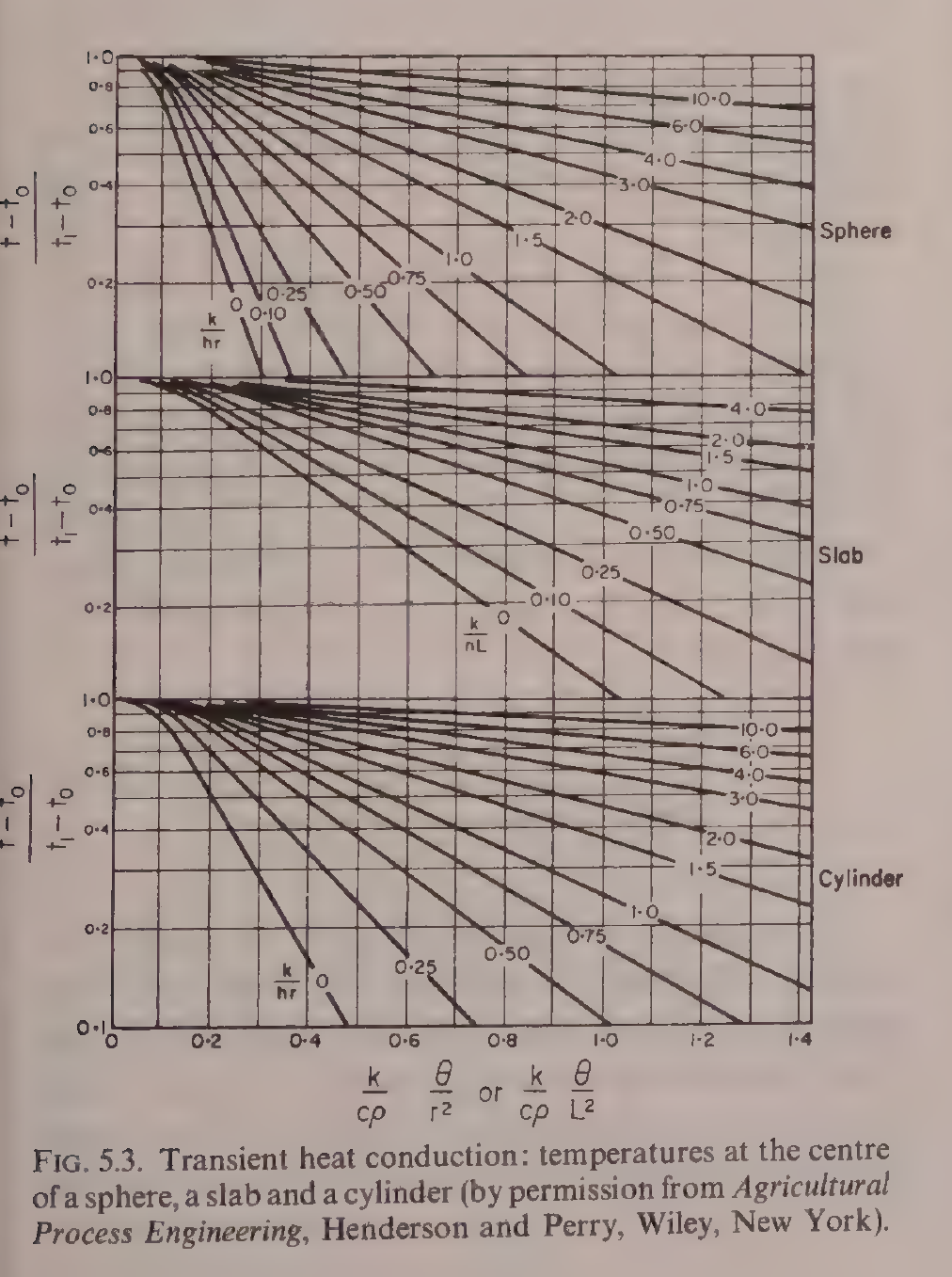
Earle Fig. 5.3: Transient heat conduction, temperatures at the centre of a sphere, a slab and a cylinder. The working charts for Earle Example 5.5. Reproduced from Earle, Fig. 5.3, printed p. 53.
The same unsteady-state idea returns in Unit 4, where the heat penetration curve of a can is the practical form of the same physics, with the centre temperature of the can tracked against time in the retort.
3.8 Radiation: heat that needs no medium
Radiation is the transfer of heat energy by electromagnetic waves. Unlike conduction and convection, it needs no medium: it crosses empty space, and it travels at the speed of light. The Stefan-Boltzmann law gives the rate at which a black body radiates heat:
q = σAT⁴
where q is the rate of heat transfer, σ is the Stefan-Boltzmann constant, A is the area of the radiating surface, and T is the absolute temperature in Kelvin. The value of σ in Earle is 5.73 x 10⁻⁸ J m⁻² s⁻¹ K⁻⁴. Real surfaces are not black bodies, and their radiation is reduced by the emissivity ε, a factor between 0 and 1, so q = εσAT⁴. Dull black surfaces have an emissivity of about 1, paper, painted metal, wood and most food surfaces about 0.9, rough unpolished metals 0.7 to 0.25, and polished metals about or below 0.05. That is why a polished steel surface stays cool in radiant heat while a blackened surface heats up.
In practice, radiation is rarely the only mechanism. A body in a room exchanges heat by radiation with the walls, and by convection with the air, at the same time. The two can be combined by defining a radiation coefficient, h_r, in the same form as a surface coefficient, so that the radiation rate is h_r A Δt, and the total coefficient is the sum of the convection and radiation coefficients. Earle uses that approach in the cold store example above, where the radiation coefficients of 6.25 outside and 1.7 inside were added to the convection coefficients.
Ibarz Chapter 14 covers the radiation laws in more depth: Planck's law for the spectrum of emitted radiation, Wien's displacement law for the wavelength of maximum emission, the Stefan-Boltzmann law for the total, and the view factor, which is the fraction of radiation leaving one surface that strikes another. The view factor matters whenever the geometry is not simple, for example a loaf on a conveyor under a bank of heaters.
Practical note: in a bakery oven, the elements glow at a high temperature and the fourth power in the Stefan-Boltzmann law makes radiation the dominant mechanism at the top of the loaf, which is why the crust browns and sets long before the crumb is done.
3.9 Convection: natural, forced, and the dimensionless groups
Convection is heat transfer by the movement of groups of molecules in a fluid. In natural convection the movement is caused by density changes: hot fluid rises, cold fluid sinks. In forced convection the fluid is moved by a pump, a fan or a stirrer. The surface coefficient h_s is the quantity that captures convection, and it is found from correlations built on dimensionless groups.
The Prandtl number, Pr = Ĉp μ/k, compares the momentum diffusivity of the fluid with its thermal diffusivity. It depends only on the fluid properties. The Nusselt number, Nu = h_s D/k, is the dimensionless form of the surface coefficient itself, for a characteristic length D. The Reynolds number, Re = Dvρ/μ, already met in Unit 2, describes the flow. A typical forced convection correlation has the form Nu = a Re^b Pr^c, with the constants depending on the geometry and the flow regime. For natural convection, the Grashof number, which contains the buoyancy force from density differences, takes the place of the Reynolds number.
Worked example: a sausage cooled in water (Earle Example 5.8)
A sausage 7.5 cm in diameter, at 74 °C, is cooled in water at 24 °C. The film temperature is (74 + 24)/2 = 49 °C, and at that temperature the water properties give a surface coefficient of 1904 J m⁻² s⁻¹ °C⁻¹, using the natural convection correlation for a horizontal cylinder. The heat transfer rate per unit area is then h_s Δt = 1904 x (74 - 24) = 95,200 J m⁻² s⁻¹. The high value, compared with still air at 6, shows what a liquid film can do.
Diagram: A sausage cooled in water (Earle Example 5.8)
Sausage 7.5 cm diameter at 74 °C
↓
Film temperature 49 °C
↓
Surface coefficient 1904 J m⁻² s⁻¹ °C⁻¹
Heat rate per unit area 95,200 J m⁻² s⁻¹
Diagram for Earle Example 5.8: a hot sausage is cooled in water at 24 °C.
Worked example: vegetable puree over a flat plate (Earle Example 5.9)
A vegetable puree flows at 3 m/min over a flat plate 0.9 m long and 0.6 m wide, held at 104 °C. The puree has a density of 1040 kg/m³, a specific heat of 3980 J kg⁻¹ °C⁻¹, a viscosity of 0.002 N s m⁻² and a thermal conductivity of 0.52 J m⁻¹ s⁻¹ °C⁻¹. The Reynolds number is 2.34 x 10⁴, so the flow is turbulent, and the Prandtl number is 15.3. The correlation then gives the Nusselt number and the surface coefficient. The final value of h_s in the printed scan is too garbled to quote reliably, so it is not reproduced here; the inputs and the two dimensionless numbers are as the book gives them.
Diagram: Vegetable puree over a flat plate (Earle Example 5.9)
Vegetable puree flows at 3 m per minute
↓
Held at 104 °C
↓
Reynolds number 2.34 x 10⁴, turbulent; Prandtl number 15.3
Diagram for Earle Example 5.9: puree flows over a flat plate held at 104 °C.
Worked example: heat loss from a cooking vessel by a draught (Earle Example 5.10)
A cooking vessel is exposed to a draught of air at 61 m/min. The surface coefficient from the book's correlation is about 9.7 J m⁻² s⁻¹ °C⁻¹. With an area of 3.4 m² and a temperature difference of 32 °C, the heat loss is about 9.7 x 3.4 x 32, which is about 1.1 x 10³ J s⁻¹. The draught matters: still air would give a coefficient of about 6, and a strong draught raises it well above that.
Diagram: Heat loss from a cooking vessel by a draught (Earle Example 5.10)
Draught of air at 61 m per minute
↓
Area 3.4 m²
Temperature difference 32 °C
↓
Surface coefficient about 9.7 J m⁻² s⁻¹ °C⁻¹
Heat loss about 1.1 x 10³ J s⁻¹
Diagram for Earle Example 5.10: a draught over the vessel raises the heat loss.
Quick check
You are cooling a hot liquid in a pipe. Would you rather increase the flow velocity or increase the pipe length to improve the heat transfer coefficient?
Check your answer
Increase the flow velocity. The surface coefficient rises with velocity through the Reynolds number, while length alone does not change the coefficient, only the area.
3.10 Heat exchangers: the machines that move heat
A heat exchanger is a device that transfers heat from one fluid to another without the two mixing, through a solid wall. The wall is usually thin metal, and the overall coefficient U is the key number. The heat transferred is:
q = UA Δt_m
where A is the heat transfer area and Δt_m is the mean temperature difference between the two fluids. The mean temperature difference is not the arithmetic mean, because the temperature difference changes along the exchanger. For two fluids exchanging heat, the logarithmic mean temperature difference is:
Δt_m = (Δt₁ - Δt₂)/ln(Δt₁/Δt₂)
where Δt₁ and Δt₂ are the temperature differences at the two ends of the exchanger.
3.10.1 Counterflow and parallel flow
The two fluids can flow in the same direction, parallel flow, or in opposite directions, counterflow. The figure below shows the temperature patterns for both. In counterflow, the temperature difference is more uniform along the exchanger, and the cold fluid can leave hotter than the hot fluid leaves. In parallel flow it cannot. For the same inlet and outlet temperatures, counterflow gives a larger logarithmic mean temperature difference, and therefore needs less area. That is why counterflow is the usual choice.
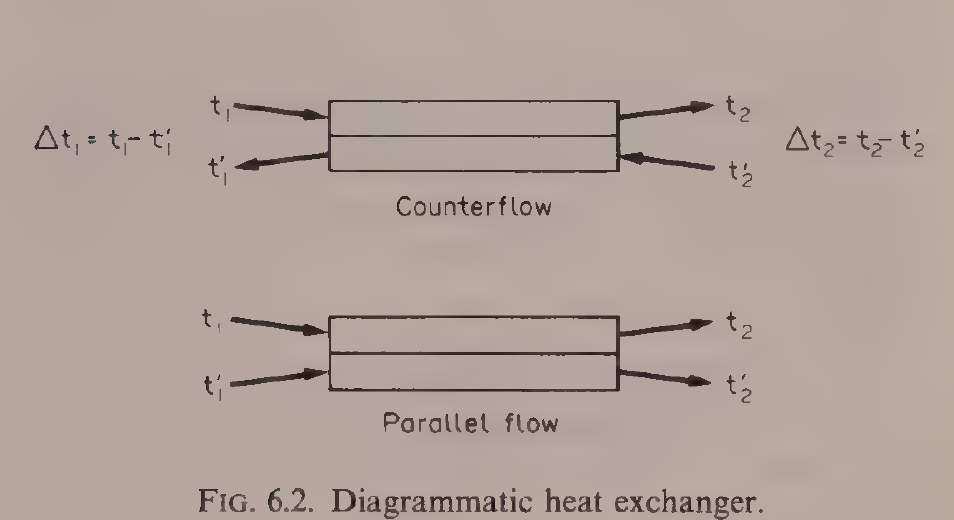
Figure 3.2: Counterflow and parallel flow in a heat exchanger. The temperature differences Δt₁ and Δt₂ are measured at the two ends, and the logarithmic mean temperature difference is (Δt₁ - Δt₂)/ln(Δt₁/Δt₂). Reproduced from Earle, Fig. 6.2, p. 66.
3.10.2 The concentric tube exchanger
The simplest heat exchanger is the concentric tube, or double pipe: one tube inside another, one fluid in the inner tube and the other in the annulus. Ibarz Figure 13.3 shows it in both arrangements.
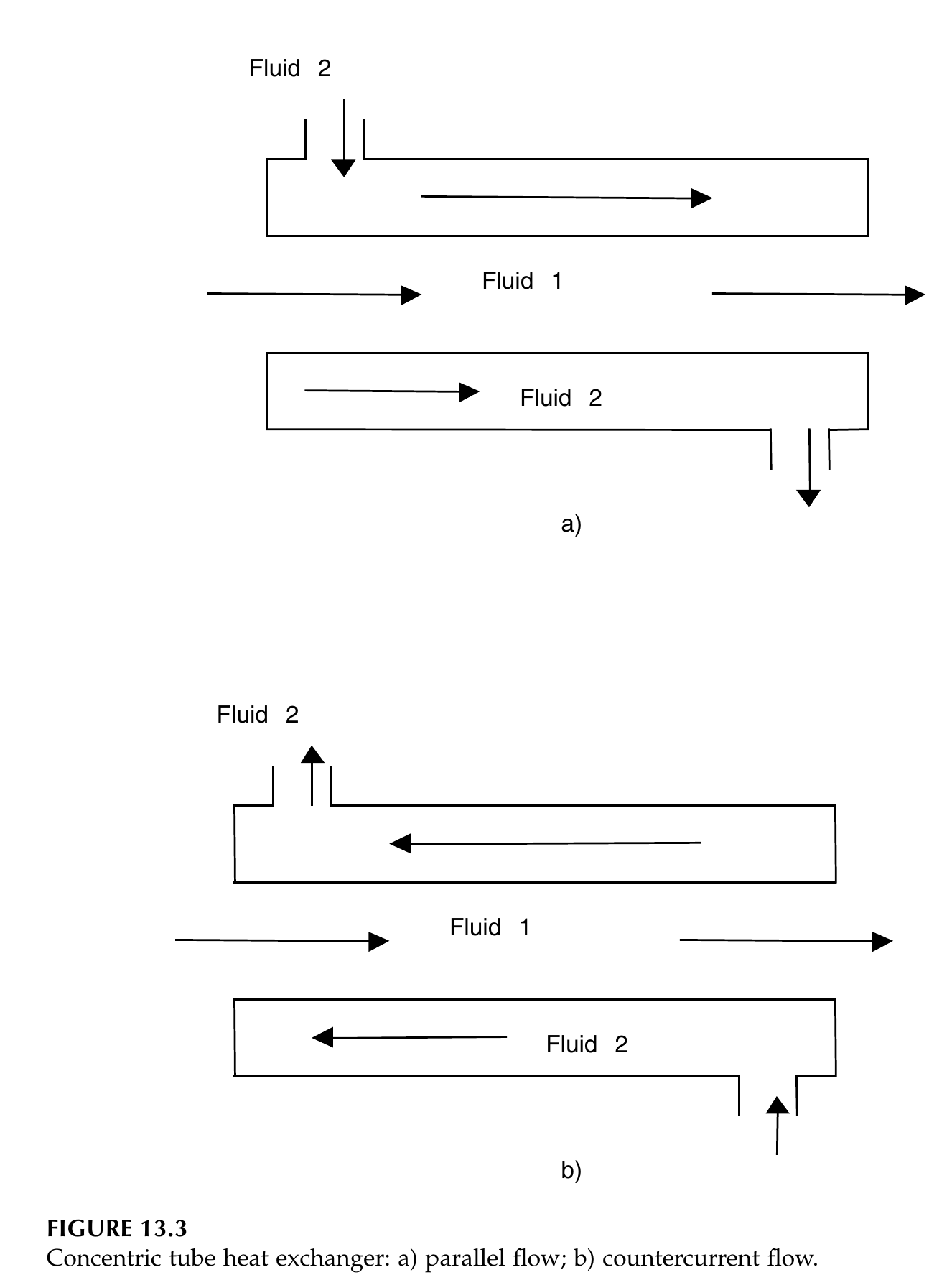
Figure 3.3: Concentric tube heat exchanger: (a) parallel flow; (b) countercurrent flow. Reproduced from Ibarz, Fig. 13.3, p. 379.
Worked example: a counterflow brine cooler (Earle Example 6.2)
In a counterflow heat exchanger, water is being chilled by a brine solution. The brine is flowing at the rate of 1.8 kg/s and its specific heat is 3.38 kJ kg⁻¹ °C⁻¹. The water is flowing at the rate of 1.05 kg/s and its specific heat is 4.18 kJ kg⁻¹ °C⁻¹. The brine enters at -8 °C and leaves at 10 °C, and the water enters at 32 °C. The exchanger has an area of 55 m². Calculate the water outlet temperature and the overall heat transfer coefficient.
The heat lost by the water equals the heat gained by the brine: 1.8 x 3.38 x (10 - (-8)) = 109.5 kJ/s. For the water, 109.5 = 1.05 x 4.18 x (32 - t_w1), so (32 - t_w1) = 109.5/(1.05 x 4.18) = 25, giving t_w1 = 7 °C. The temperature differences at the two ends are Δt₁ = 32 - 10 = 22 °C and Δt₂ = 7 - (-8) = 15 °C. The logarithmic mean temperature difference is Δt_m = (22 - 15)/ln(22/15) = 18.3 °C. The overall coefficient is U = q/(A Δt_m) = 109.5/(55 x 18.3) = 0.11 kJ m⁻² s⁻¹ °C⁻¹, which is 110 J m⁻² s⁻¹ °C⁻¹.
3.10.3 Shell and tube, plate, jacketed pan, scraped surface
The concentric tube exchanger is simple but its area per unit volume is small. For larger duties, the shell and tube exchanger is used: a bundle of tubes inside a shell, one fluid in the tubes and the other in the shell, with baffles to direct the shell side fluid across the tubes. The approach temperature, the difference between the outlet temperatures of the two fluids, can be as small as 1 °C in a shell and tube exchanger, against several degrees in simpler types, because the large area and the baffled flow make the heat transfer efficient.
The plate heat exchanger packs thin corrugated plates together, with hot and cold fluids flowing in alternate channels. The corrugations break up the flow and give high coefficients in a very small volume. Ibarz Figure 13.13 shows the construction.
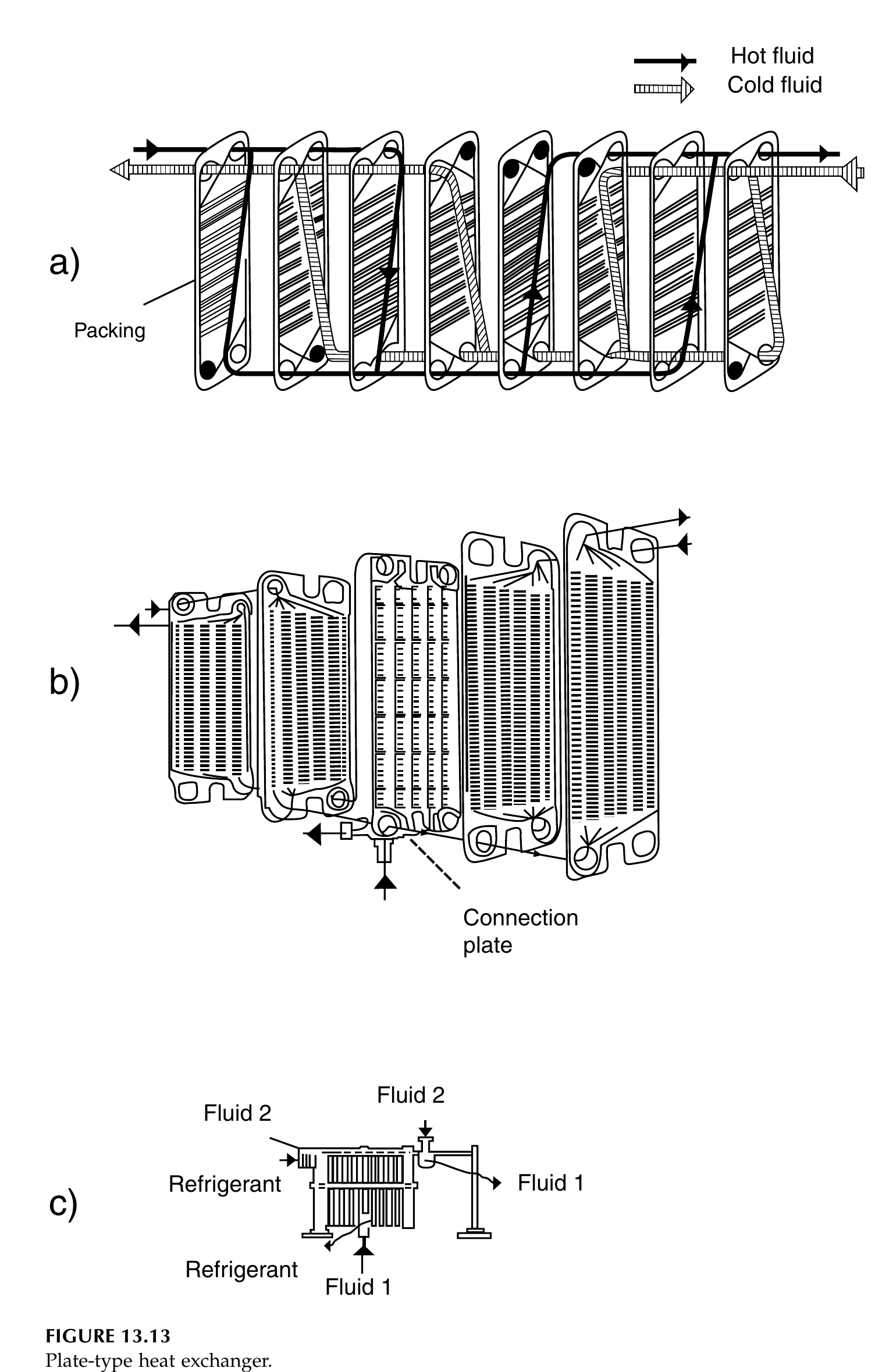
Figure 3.4: Plate-type heat exchanger: (a) plates with packing, (b) plates in exploded view, (c) plate pack with connection plate showing Fluid 1, Fluid 2 and Refrigerant connections. Reproduced from Ibarz, Fig. 13.13, p. 398.
The jacketed pan is the oldest heat exchanger in food processing: a vessel with a jacket around it, steam or hot water in the jacket, the food inside, and usually a stirrer. Earle Table 6.1 gives overall coefficients for jacketed pans, in J m⁻² s⁻¹ °C⁻¹: steam with a thin liquid in a cast iron pan, 1800; steam with a thick liquid, 900; steam with a paste in a stainless steel pan, 300; steam with boiling water in a copper pan, 1800. The coefficient falls as the food gets thicker, because the liquid side film controls, which is why a paste heats slowly even in a steam jacket.
Worked example: pea soup in a jacketed pan (Earle Examples 6.3 and 6.4)
50 kg of pea soup at 18 °C is heated in a jacketed pan by steam at 100 kPa gauge, saturation temperature 120 °C, latent heat 2202 kJ/kg. The overall coefficient is 300 J m⁻² s⁻¹ °C⁻¹ and the area is 1 m². The specific heat of the soup is 3.95 kJ kg⁻¹ °C⁻¹. Calculate the steam consumption at the start and the time needed to reach 90 °C.
At the start, the temperature difference is 120 - 18 = 102 °C, so q = UAΔt = 300 x 1 x 102 = 3.06 x 10⁴ J s⁻¹. The steam rate is q divided by the latent heat: 3.06 x 10⁴ / 2.202 x 10⁶ = 0.0139 kg s⁻¹, which is 50 kg per hour. As the soup warms, the temperature difference falls and the rate of heat transfer falls, so the time is found by integrating. The result is 803 s, which is 13.4 minutes to reach 90 °C.
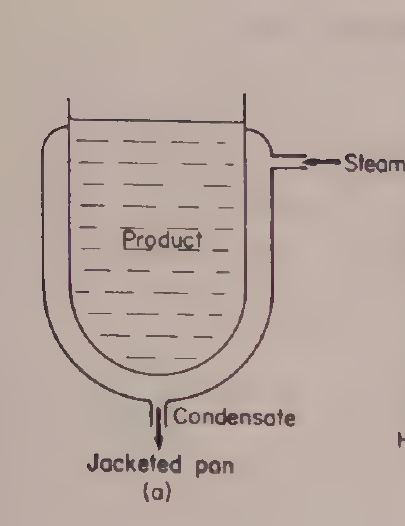
Earle Fig. 6.3(a): Jacketed pan. Reproduced from Earle, Fig. 6.3(a), printed p. 67.
The scraped surface heat exchanger is built for the foods that defeat the others: thick pastes, sticky products and foods that burn onto a hot wall. A rotor with scraper blades turns inside a cylinder, continuously scraping the product off the heated wall and mixing it. It is the exchanger of choice for products such as tomato paste, peanut butter and ice cream mix, where a plate exchanger would foul and a jacketed pan would scorch.
Quick check
You need to cool a thin juice quickly with a small temperature approach. Which exchanger type do you pick, and why?
Check your answer
A plate heat exchanger. The thin plates and corrugated channels give high coefficients and a large area in a small volume, and the approach temperature can be as small as about 1 °C.
3.11 Fouling: the dirt factor
In service, heat transfer surfaces foul. Milk stone, scale, burnt-on product and corrosion build up a layer on the wall, and that layer adds a resistance. The fouled overall coefficient U_F is related to the clean coefficient U by:
1/U_F = 1/U + R_h + R_c
where R_h and R_c are the dirt factors, or fouling resistances, on the hot and cold sides. Ibarz Table 13.1 gives dirt factors in m² °C/kW, including distilled water 0.09, sea water 0.09, river water 0.21, boiler water 0.26, very hard water 0.58, brine 0.264, organic liquids 0.176, fuel oil 1.056, tars 1.76, steam of good quality 0.052, steam of bad quality 0.09, air 0.26 to 0.53, and solvents vapour 0.14. A dirt factor of 1.056 for fuel oil means that a fuel oil film alone adds as much resistance as a clean coefficient of about 950 W/m²·°C, which is a large penalty.
The practical consequence is that heat exchangers are designed with a fouling allowance: the area is sized for the fouled condition, not the clean one. And the cleaning schedule is part of the design: a plate pasteurizer that is not cleaned on schedule will steadily lose capacity, and the outlet temperature will drift, which is a food safety matter as well as an energy matter.
Try it yourself
- Wall resistance hunt. Take the cold store wall of Example 5.2 and replace the cork with 10 cm of brick. Recompute U and the heat flow. Then replace the brick with 10 cm of cork instead. Which change matters, and why?
- Counterflow against parallel flow. For the brine cooler of Example 6.2, keep the same four temperatures but swap the flow arrangement to parallel. Work out the two end temperature differences and the logarithmic mean. How much more area would the parallel flow exchanger need for the same duty?
- Fouling check. A clean exchanger has U = 1000 J m⁻² s⁻¹ °C⁻¹. Add a dirt factor of 0.176 m² °C/kW on one side, the value for organic liquids. What is the fouled U, and by what percentage has the capacity fallen?
- Draw the temperature profile. Sketch the temperature of the hot and cold fluids along the length of a counterflow exchanger, and then along a parallel flow exchanger. Mark where the temperature difference is largest and smallest in each case.
Key ideas to carry forward
- Heat transfer rate equals driving force divided by resistance, and the driving force is the temperature difference.
- Conduction follows Fourier's law, q = kAΔt/x. Thermal conductivity is a property of the material; conductance is k/x for a real thickness.
- Resistances in series add. In a composite wall, the largest resistance controls the result.
- Resistances in parallel add as conductances. A small area of a good conductor, such as a steel bolt, can carry most of the heat.
- The overall coefficient U combines the two surface films and the wall. The smallest surface coefficient usually controls.
- Unsteady-state heat transfer is governed by thermal diffusivity, α = k/(ρĈp), and described by the Fourier and Biot numbers.
- Radiation follows the Stefan-Boltzmann law, q = εσAT⁴, and the emissivity of the surface decides how much it radiates.
- Convection correlations use the Reynolds, Prandtl and Nusselt numbers.
- In a heat exchanger, the logarithmic mean temperature difference is the correct mean, and counterflow gives a larger mean than parallel flow for the same end temperatures.
- Fouling adds a resistance. Design for the fouled condition and clean on schedule.
Glossary
Thermal conductivity (k)
A property of a material that says how well it conducts heat. High for metals, low for insulators. Example: copper conducts heat far better than cork, so a copper pan heats evenly and a cork slab insulates a cold store.
Thermal conductance (C)
The heat that passes in unit time through unit area of a specified thickness of material under unit temperature difference. C = k/x. Example: a 10 cm cork slab has a conductance of 0.43 J m⁻² s⁻¹ °C⁻¹, while a 20 cm slab has half that.
Overall heat transfer coefficient (U)
One number that combines the two surface films and the wall resistance into a single coefficient, so that q = UAΔt. Example: a jacketed pan with steam on one side and thick soup on the other has U of about 300 J m⁻² s⁻¹ °C⁻¹.
Surface heat transfer coefficient (h_s)
The coefficient that describes heat transfer between a fluid and a solid surface, combining conduction and convection in the fluid film. Example: condensing steam has h_s of about 12,000, still air about 6 J m⁻² s⁻¹ °C⁻¹.
Specific heat (Ĉp)
The energy needed to raise one kilogram of a material by 1 °C. Example: water needs 4.187 kJ/kg·°C, so a watery food such as cucumber needs more energy to heat than a fatty food.
Thermal diffusivity (α)
How fast a temperature change spreads through a material, equal to k divided by density times specific heat. Example: a food with high diffusivity warms through to the centre faster than one with low diffusivity.
Fourier number (Fo)
A dimensionless time used in unsteady-state heat transfer. Example: a large Fourier number means the heat has had time to travel deep into the food.
Biot number (Bi)
A dimensionless number comparing the surface resistance with the internal conduction resistance. Example: a small Biot number means the food temperature is nearly uniform inside, and the surface film controls.
Logarithmic mean temperature difference (LMTD)
The correct mean temperature difference to use in a heat exchanger, because the difference changes along the length. Example: for end differences of 22 °C and 15 °C, the logarithmic mean is 18.3 °C, not the arithmetic mean of 18.5 °C.
Counterflow
An arrangement in which the two fluids in a heat exchanger flow in opposite directions. Example: a counterflow brine cooler lets the water leave colder than the brine leaves, which parallel flow cannot do.
Dirt factor (fouling resistance)
An extra thermal resistance caused by deposits such as scale or burnt-on product on a heat transfer surface. Example: a fuel oil film has a dirt factor of 1.056 m² °C/kW, which cuts the capacity of an exchanger badly if it is not cleaned.
Emissivity (ε)
A number from 0 to 1 that says how well a surface radiates heat compared with a perfect black body. Example: a dull black surface radiates almost like a black body, while polished metal radiates very little.
Natural convection
Heat transfer by fluid movement caused by density changes, with hot fluid rising and cold fluid sinking. Example: a pan of soup heated from below circulates by natural convection without a stirrer.
Forced convection
Heat transfer by fluid movement caused by a pump, fan or stirrer. Example: a stirred jacketed pan heats faster than an unstirred one because the stirrer forces the soup past the wall.
References
- Earle, R. L. Unit Operations in Food Processing. 2nd edition. Pergamon Press. Chapters 5 and 6.
- Ibarz, Albert, and Barbosa-Cánovas, Gustavo V. Unit Operations in Food Engineering. CRC Press, 2003. Chapters 11, 12, 13 and 14.
- Brennan, J. G., Butters, J. R., Cowell, N. D., and Lilly, A. E. V. Food Engineering Operations. 3rd edition. Elsevier Applied Science. Chapters on heat transfer.
- Gould, Wilbur A. Unit Operations for the Food Industries. CTI Publications. Chapters on heating and heat exchangers.
- Heldman, D. R., and Singh, R. P. Food Process Engineering. 2nd edition. AVI Publishing. Chapters on heat transfer.
