GIFSQ ID: KBA-0408
Author: GIFSQ. Last updated: 2026-11-16.
Know which process makes milk safe and which one only stops the cream rising, in one paragraph.
Pasteurized and homogenized sound alike, yet they do different jobs.
Most milk gets both treatments, so the terms are easily confused.
Mix them up and you may trust the wrong process for safety.
The quick answer below separates them in one short paragraph.
Quick answer: Homogenization is a mechanical process. Milk is forced through a narrow valve at high pressure, and the fat globules are cut from about 3.5 micrometres to below 1 micrometre, so the cream no longer rises. Pasteurization is a heat treatment. Milk is held at a set temperature for a set time, for example 72 °C for 15 seconds, to kill the pathogens that cause disease. Homogenization does not kill microbes, and pasteurization does not stop cream from rising.
Contents
- 1. What is homogenization?
- 2. What is pasteurization?
- 3. How homogenization works
- 4. How pasteurization works
- 5. Homogenization vs pasteurization: the comparison
- 6. Worked examples
- 7. How they are used together in a milk plant
- 8. Advantages and limitations
- 9. Common mistakes
- 10. Frequently asked questions
- 11. Related articles
- 12. References
Key takeaways:
- Homogenization is pressure: it cuts fat globules small so cream stays mixed in the milk.
- Pasteurization is heat: it kills vegetative pathogens so milk is safe to drink.
- Homogenization does not kill microbes. Pasteurization does not stop cream from rising.
1. What is homogenization?
Homogenization is a mechanical process in which milk is forced through a narrow valve at high pressure. The pressure breaks the fat globules into much smaller ones, and the smaller globules stay spread through the milk instead of rising to form a cream layer.
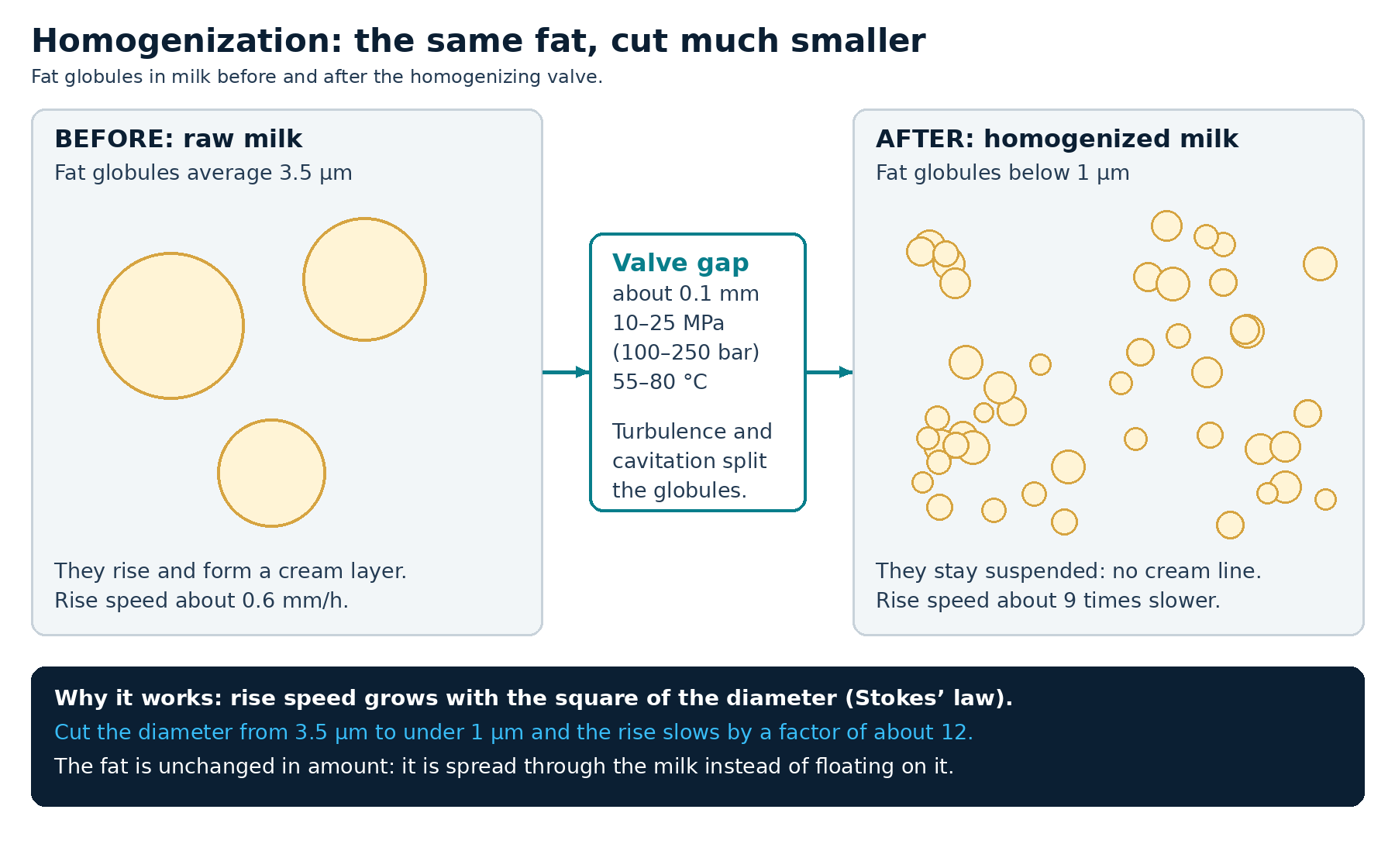
The process was invented by Auguste Gaulin in 1899. The milk is pumped at high pressure through a gap of about 0.1 mm between a valve and its seat. The fat globules are split by turbulence and by cavitation, the rapid forming and collapse of vapour bubbles in the fast-moving milk.
In raw milk, the fat globules average about 3.5 micrometres (µm) across. After homogenization they are below 1 µm. The total fat surface area grows 4 to 6 times, and the new globules are coated with casein adsorbed from the milk plasma, which keeps them stable.
Homogenization changes the appearance and the keeping quality of the milk, but it does not change the fat content. No fat is added and none is removed. It also does nothing for safety: homogenized milk still carries the same microbes as raw milk until it is pasteurized.
2. What is pasteurization?
Pasteurization is a heat treatment that destroys disease-causing microbes in milk without markedly changing the physical and chemical properties of the milk. It is named after Louis Pasteur, who first used heat treatment to prolong the storage time of wine in the 1860s.
The process is built around one index organism, the tubercle bacillus, the bacterium that causes tuberculosis. It is killed at 63 °C in 10 minutes, and complete safety is reached at 63 °C for 30 minutes. Every standard pasteurization time and temperature is set to destroy this organism, which also destroys the other common milk pathogens.
Pasteurization kills vegetative pathogens, but it does not kill spores. Pasteurized milk still needs refrigeration, and it still has a limited shelf life. The standard storage temperature is 7 °C (45 °F) or below.
The two methods used most in milk plants are LTLT and HTST. LTLT, low temperature long time, holds milk at 63 °C for 30 minutes in a batch vat. HTST, high temperature short time, holds it at 72 °C for 15 seconds in a continuous flow. The U.S. FDA Grade A Pasteurized Milk Ordinance sets the same minimums: 63 °C (145 °F) for 30 minutes, or 72 °C (161 °F) for 15 seconds.
3. How homogenization works
In raw milk, the fat globules float. Fat is lighter than the water phase of milk, so the globules rise and collect at the top as a cream layer. The speed at which a globule rises follows Stokes’ law:
v = d2(ρp − ρl)g / 18η
Here v is the rise speed, d is the globule diameter, ρp is the density of the fat, ρl is the density of the liquid, g is gravity, and η is the viscosity of the milk. The key point is the square: rise speed grows with the square of the diameter. Cut the diameter to one third and the rise slows to one ninth.
A worked value from the dairy handbook: a fat globule 3 µm across rises at about 0.6 mm per hour at 35 °C, and a 1 µm globule at about 0.067 mm per hour, roughly 9 times slower. Clusters in raw milk rise faster still, which is why the cream line appears quickly in unhomogenized milk.
Homogenization is normally done at 55–80 °C and 10–25 MPa (100–250 bar). The milk must be warm: cold milk homogenization is virtually ineffective, and below 40 °C the fat is not fully dispersed. Cream with more than 20% fat cannot be homogenized at high pressure, because the globules cluster and there is too little casein to coat the new surface.
Most plants use a two-stage homogenizer. The first stage does the main breaking, and the second stage breaks up the clusters that form after the first stage. The ratio of the second stage pressure to the first stage pressure is about 0.2, so a first stage at 20 MPa is followed by a second stage at about 4 MPa.
4. How pasteurization works
Heat kills microbes faster at higher temperatures. That is why pasteurization can be done in two ways that give the same safety: a low temperature for a long time, or a high temperature for a short time. The lethal effect is the same if the time-temperature pair is matched.
The FDA Grade A Pasteurized Milk Ordinance adds one rule for richer products: raise the temperature by 3 °C (5 °F) when fat is 10% or more, total solids are 18% or more, or sweeteners are added. Eggnog has its own minimums.
How the result is checked matters as much as the heat. The phosphatase test checks that the milk was heated enough: the enzyme alkaline phosphatase is destroyed by pasteurization, so a negative test means the milk was heated correctly. Kay and Graham developed the test in the mid-1930s. For cream heated above 80 °C the peroxidase test is used instead.
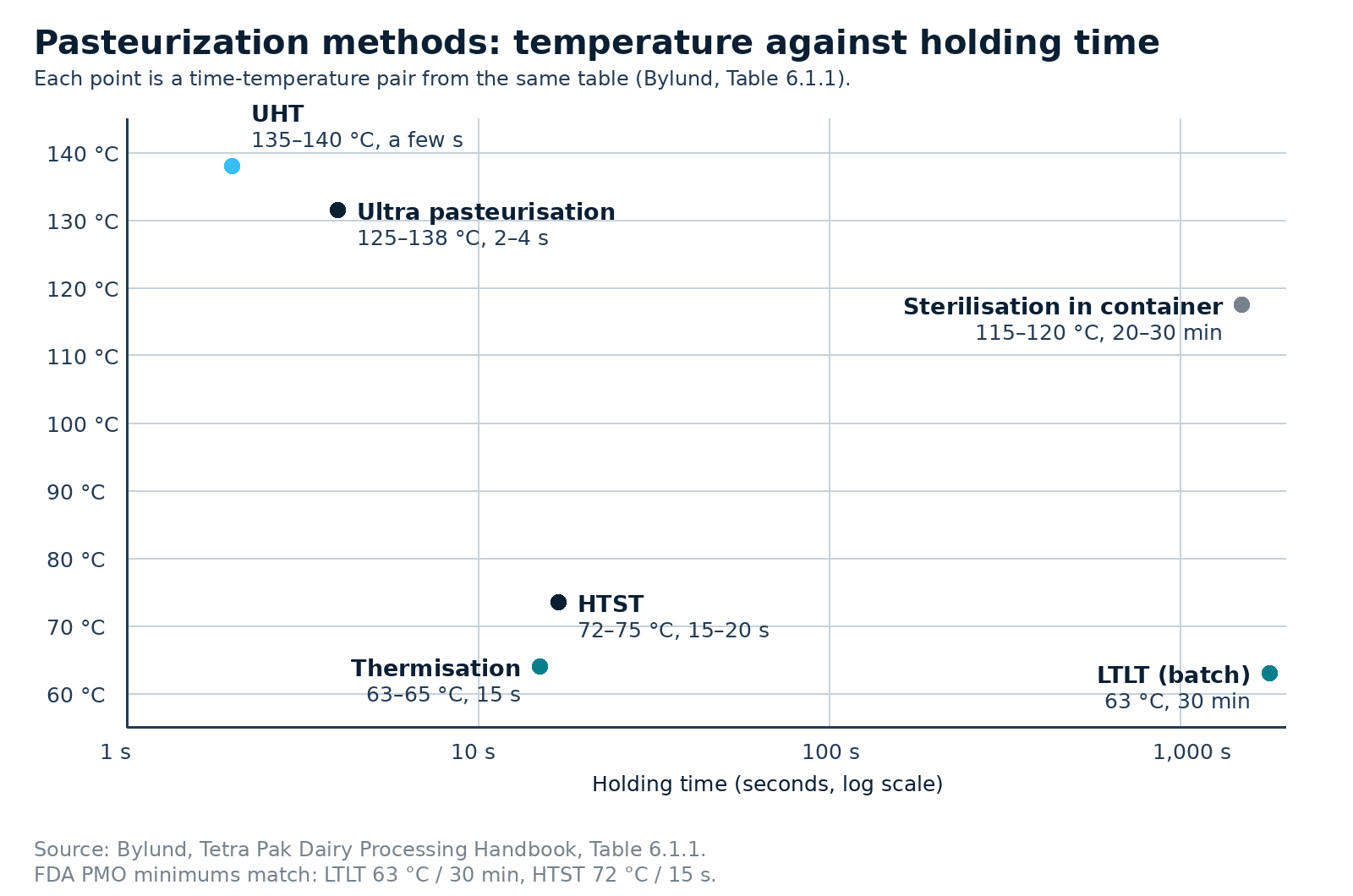
HTST, LTLT and UHT pasteurization methods compared
The standard pairs: thermisation 63–65 °C for 15 seconds, a mild treatment that extends raw milk life before processing, not pasteurization; LTLT 63 °C for 30 minutes; HTST milk 72–75 °C for 15–20 seconds and HTST cream above 80 °C for 1–5 seconds; ultra pasteurisation 125–138 °C for 2–4 seconds, giving extended shelf life; UHT 135–140 °C for a few seconds; sterilisation in the container 115–120 °C for 20–30 minutes.
5. Homogenization vs pasteurization: the comparison
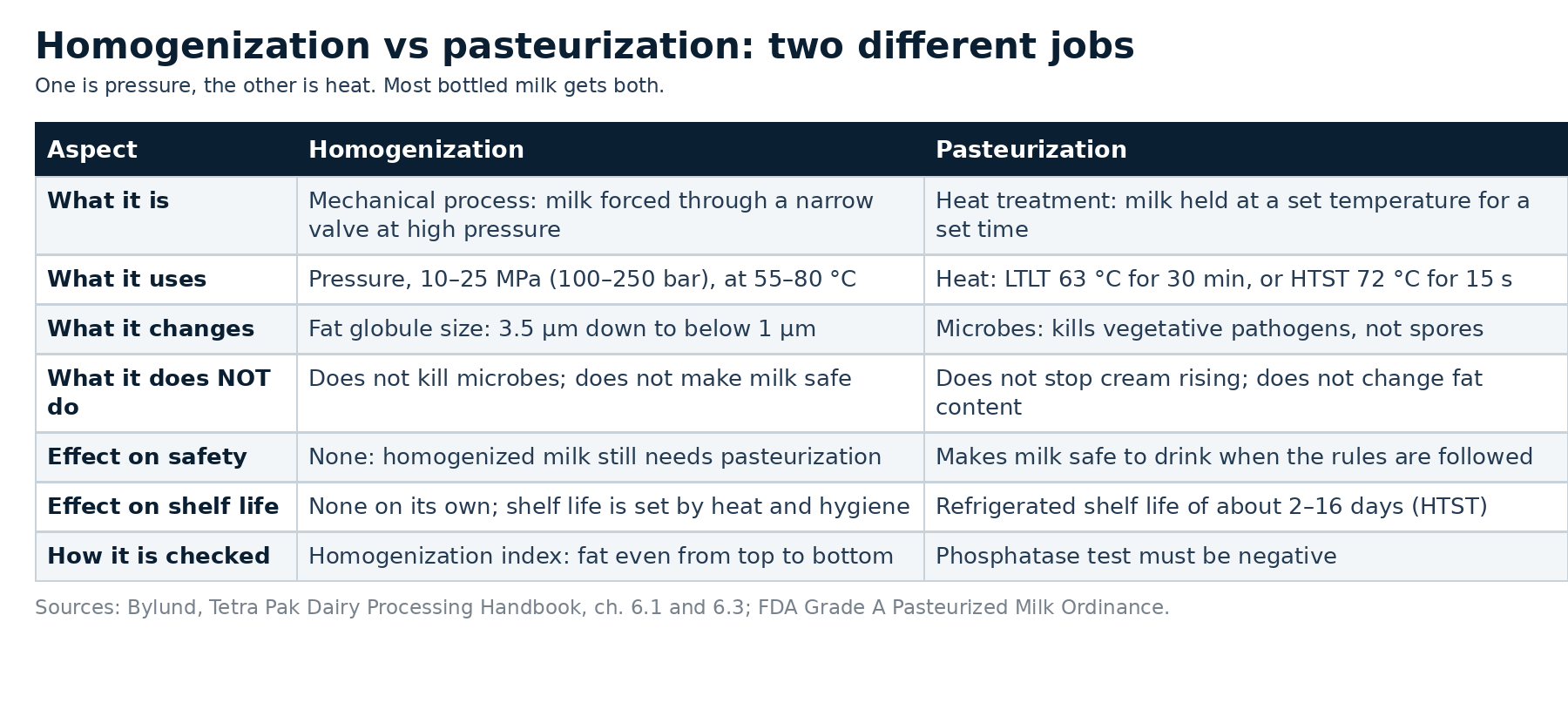
| Aspect | Homogenization | Pasteurization |
|---|---|---|
| What it is | Mechanical process: milk forced through a narrow valve at high pressure | Heat treatment: milk held at a set temperature for a set time |
| What it uses | Pressure, 10–25 MPa (100–250 bar), at 55–80 °C | Heat: LTLT 63 °C for 30 min, or HTST 72 °C for 15 s |
| What it changes | Fat globule size: 3.5 µm down to below 1 µm | Microbes: kills vegetative pathogens, not spores |
| What it does NOT do | Does not kill microbes; does not make milk safe | Does not stop cream rising; does not change fat content |
| Effect on safety | None: homogenized milk still needs pasteurization | Makes milk safe to drink when the rules are followed |
| Effect on shelf life | None on its own; shelf life is set by heat and hygiene | Refrigerated shelf life of about 2–16 days (HTST) |
| How it is checked | Homogenization index: fat even from top to bottom | Phosphatase test must be negative |
Homogenization index and phosphatase test: how each process is checked
The test that checks pasteurization is the phosphatase test. The test that checks homogenization is the homogenization index.
6. Worked examples
Example 1: how long before the cream line appears. A fat globule 3 µm across rises at 0.6 mm per hour. To rise 10 cm, the height of a small bottle, takes 100 ÷ 0.6 = 167 hours, about 7 days. A 1 µm globule in homogenized milk rises at 0.067 mm per hour, so the same 10 cm takes 100 ÷ 0.067 = 1,493 hours, about 62 days. That is why homogenized milk shows no cream line within its shelf life. (Illustrative calculation from Bylund’s worked value.)
Example 2: sizing an HTST holding tube. A plant runs milk at 10,000 litres per hour and needs a 15 second hold at 72 °C. The volume in the holding tube must be 10,000 × 15 ÷ 3,600 = 41.7 litres. A faster flow needs a longer tube for the same hold. (Illustrative calculation.)
Example 3: two-stage homogenization pressures. A plant runs the first stage at 20 MPa. The second stage is set at a ratio of 0.2, so its pressure is 20 × 0.2 = 4 MPa. It breaks up the clusters that form after the first stage. (Values from Bylund, ch. 6.3.)
7. How they are used together in a milk plant
In a normal market milk line, the milk is homogenized while it is hot, and then pasteurized, or the two steps sit in the same line. The order matters: the milk must be warm for homogenization to work, and pasteurization must follow so the milk is safe. Homogenizing cold milk and leaving it unpasteurized is a real hazard: the process breaks up the natural agglutinin aggregates that slow cream rising, while doing nothing to the microbes.
Ice cream mix shows the same order in a different product. The mix is pre-heated to 73–75 °C, homogenized at 14–20 MPa (140–200 bar), pasteurized at 83–85 °C for about 15 seconds, cooled to 5 °C, and aged for at least 4 hours at 2–5 °C. The homogenization gives the smooth texture, and the pasteurization gives the safety. The two steps are kept separate because they do separate jobs.
8. Advantages and limitations
Homogenization has clear advantages: no cream line, whiter milk because the smaller globules scatter light, less sensitivity to fat oxidation, fuller flavour and mouthfeel, and more stable cultured products. The limits are real too. Homogenized milk is more sensitive to light, which can give a sunlight flavour, and it is less suitable for semi-hard and hard cheese, because the curd is soft and hard to dewater.
Pasteurization has one large advantage: it makes milk safe to drink. Its limits are that it does not kill spores, it does not extend shelf life without refrigeration, and strong heating changes the milk. Intense heating denatures the proteins, gives a cooked flavour and then a burnt flavour, and impairs cheesemaking. That is why the standard methods use the lowest heat that gives safety, and ultra pasteurisation and UHT are used only where the longer shelf life is needed.
On nutrition, the U.S. Food and Drug Administration and the Centers for Disease Control and Prevention state that pasteurization does not significantly change the nutritional value of milk. Small losses of heat-sensitive vitamins occur, such as vitamin C and some B vitamins, but these are considered nutritionally insignificant because milk is not a primary source of them.
9. Common mistakes
- Thinking homogenized milk is pasteurized. The two words sound alike, but they describe different processes. Milk can be homogenized and still raw: check the label for pasteurized.
- Thinking pasteurization stops cream from rising. It does not. The cream line is a physics problem, and only homogenization fixes it.
- Homogenizing cold milk. Below 40 °C the fat is not fully dispersed, and cold milk homogenization is virtually ineffective.
- Heating too hard to be safe. Excess heat denatures protein, gives a cooked flavour, and damages cheesemaking. The standard time-temperature pairs are set for a reason.
- Storing pasteurized milk warm. Pasteurization does not kill spores, so pasteurized milk must be kept at 7 °C (45 °F) or below.
10. Frequently asked questions
Is homogenized milk the same as pasteurized milk?
No. Homogenization is a pressure process that cuts fat globules small so cream does not rise. Pasteurization is a heat process that kills pathogens so milk is safe to drink. Most bottled milk is both.
Does homogenization make milk safer to drink?
No. Homogenization does not kill microbes and does not change the fat content. Homogenized milk still needs pasteurization before it is safe to drink.
Does pasteurization stop the cream from rising?
No. Pasteurization is a heat treatment and does not change fat globule size. Only homogenization stops the cream line, by cutting the globules from about 3.5 µm to below 1 µm.
Which comes first, homogenization or pasteurization?
In a normal milk line the milk is homogenized while hot, and then pasteurized. In ice cream mix the order is the same: pre-heat, homogenize, then pasteurize at 83–85 °C for about 15 seconds.
Does UHT milk need refrigeration before opening?
No. UHT milk is heated to 135–140 °C for a few seconds and filled into sterile packs, so it keeps at room temperature until it is opened. After opening it must be refrigerated like pasteurized milk.
11. Related articles
- Difference Between Raw Milk and Pasteurized Milk
- Difference Between Pasteurized Milk and UHT Milk
- Difference Between Homogenized Milk and Non-Homogenized Milk
- Difference Between Pasteurization and Sterilization
- Difference Between TSS and TDS (Food and Water)
- Difference Between Moisture Content and Water Activity
- What Is HACCP? The 7 Principles Explained
- SOP: Determination of Phosphatase Activity in Dairy Products
- SOP: Alcohol Test for Heat Resistance of Milk
- Milk Fat Standardization Calculator
- Milk Homogenization Quiz
- Homogenization Quiz
- Food Safety Basics course
Conclusion: pressure does one job, heat does the other
Most bottled milk gets both, because the two processes do different jobs.
12. References
- Bylund, G. Tetra Pak Dairy Processing Handbook. Tetra Pak Processing Systems AB, Lund, Sweden. Chapter 6.1, Heat treatment of milk; Chapter 6.2, Sedimentation; Chapter 6.3, Homogenisation; Chapter 19, Ice cream. (Values used: fat globule size 3.5 µm to below 1 µm; pressure 10–25 MPa; temperature 55–80 °C; valve gap about 0.1 mm; surface area increase 4–6 times; two-stage ratio 0.2; Stokes’ law and the 0.6 mm per hour worked value; Table 6.1.1 time-temperature pairs; shelf life 2–16 days; ice cream mix sequence.)
- U.S. Food and Drug Administration. Grade A Pasteurized Milk Ordinance (PMO), 2019 Revision. Definition SS and the time-temperature table: batch 63 °C (145 °F) for 30 minutes; HTST 72 °C (161 °F) for 15 seconds; plus 3 °C (5 °F) for fat 10% or more, total solids 18% or more, or added sweeteners. (2023 Revision exists; the 2019 Revision table was the source used here.) Available from the FDA NCIMS model documents page: https://www.fda.gov/food/milk-guidance-documentsregulatory-information/national-conference-interstate-milk-shipments-ncims-model-documents
- U.S. Food and Drug Administration, 21 CFR 1240.61: mandatory pasteurization of milk and milk products in final package form shipped in interstate commerce, with the same time-temperature requirements as the PMO.
Codex Alimentarius. Code of Hygienic Practice for Milk and Milk Products, CXC 57-2004 (adopted 2004, amendment 2009). Pasteurization is defined there as a microbiocidal heat treatment designed to destroy Mycobacterium tuberculosis and Coxiella burnetii, which corroborates Bylund’s tubercle bacillus index organism. (Cited for the general hygiene framework; no specific value in this article comes from it.) https://codex.fao.org/restapi/searchstandard/CXC_057e.pdf?lang=en&id=415
U.S. Food and Drug Administration. The Dangers of Raw Milk: Unpasteurized Milk Can Pose a Serious Health Risk. “Pasteurization DOES NOT reduce milk’s nutritional value.” https://www.fda.gov/Food/ResourcesForYOu/consumers/ucm079516.htm
Centers for Disease Control and Prevention. Raw Milk Questions and Answers. “Many studies have shown that pasteurization does not significantly change the nutritional value of milk and dairy products.” https://stacks.cdc.gov/view/cdc/148135/cdc_148135_DS1.pdf
Test what you just learned with the milk homogenization quiz.
Then take the homogenization quiz to check the full topic.
Use the phosphatase test SOP to check pasteurization in your plant.
