Difference Between Moisture Content and Water Activity in Food
GIFSQ ID: ART-0471
Author: GIFSQ. Last updated: 2026-11-16.
Quick answer
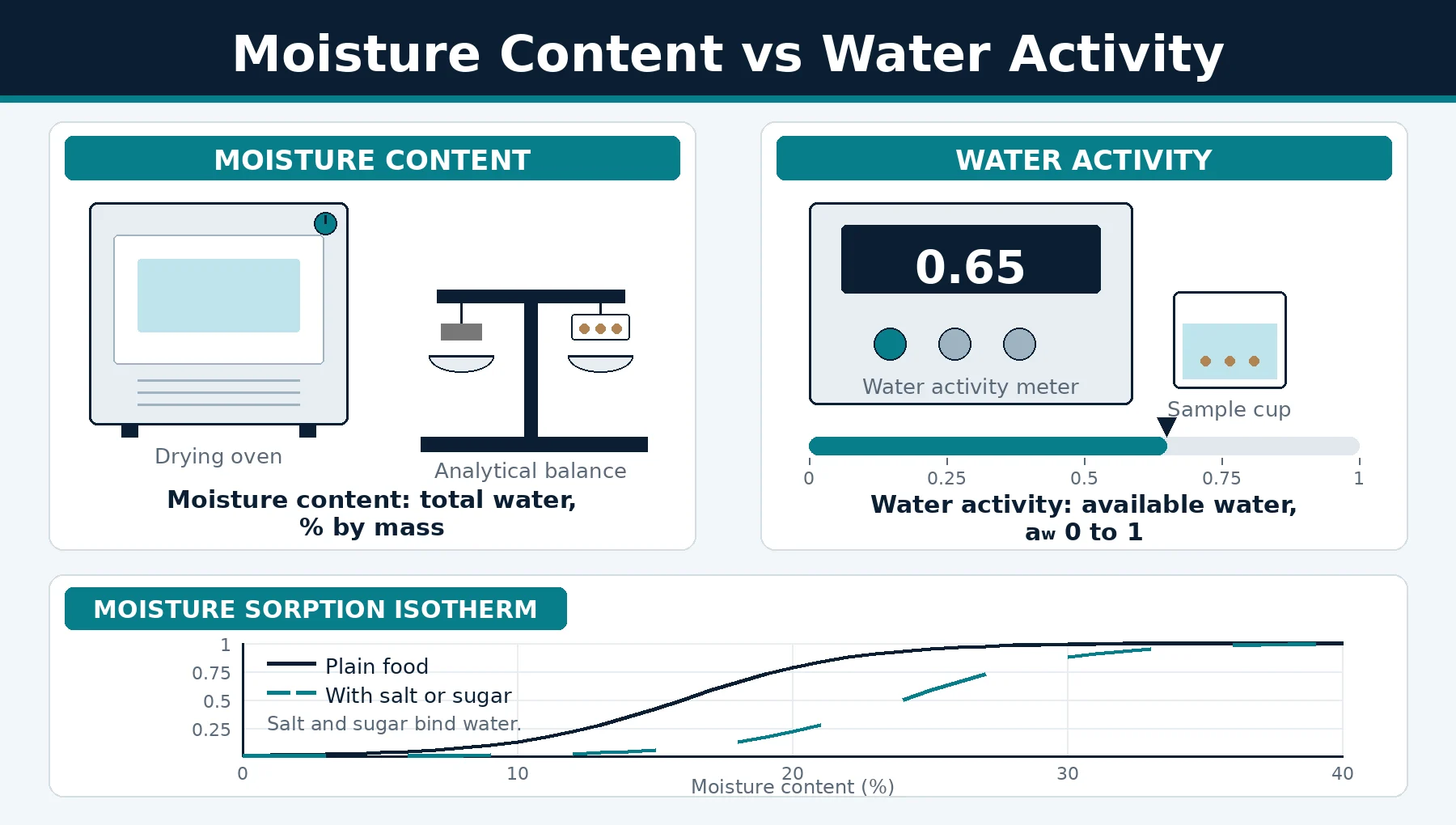
Moisture content is the total amount of water in a food, usually given as a percentage of mass. Water activity (aw) is the share of that water that is available for microbes and chemical reactions, given as a number from 0 to 1. Two foods can hold the same moisture content and still have different water activity, because salt, sugar and other food components bind water. Moisture content answers “how much water is there”. Water activity answers “can microbes use it”. For safety and shelf life, water activity is the number that matters.
Table of contents
- Quick answer
- 1. Introduction
- 2. What Is Moisture Content?
- 3. What Is Water Activity?
- 4. Difference Between Moisture Content and Water Activity
- 5. Why Are These Parameters Important in the Food Industry?
- 6. Relationship Between Moisture Content and Water Activity
- 7. Types and classification
- 8. Advantages and limitations
- 9. Frequently Asked Questions
- 10. Conclusion
- 11. References and Further Reading
- 12. Related GIFSQ Articles, SOPs and Tools
1. Introduction
Moisture content and water activity are two important parameters in food science and technology. Both are used to evaluate food quality, stability, processing characteristics and shelf life. Although these parameters are related, they measure different properties of water in food. Moisture content determines the total amount of water present in a food product, whereas water activity measures the availability of water for microbial growth and chemical reactions. Understanding the difference between these two parameters is essential for food manufacturers, quality assurance professionals, laboratory analysts and food scientists.
2. What Is Moisture Content?
Moisture content is the total quantity of water present in a food material, generally expressed as a percentage of the sample’s mass. It is an important parameter for determining food composition, processing requirements, storage stability and product quality.
2.1 Principle
The most common laboratory method for determining moisture content is the oven-drying method. The principle involves measuring the loss in mass of a food sample after heating under specified conditions. The mass loss is commonly considered moisture, although other volatile substances may also be lost.
2.2 Apparatus and Equipment
Analytical balance; Drying oven; Moisture dishes; Desiccator; Laboratory tongs; Sample grinder, where appropriate.
2.3 General Procedure
- Clean and dry the moisture dish. 2. Cool it in a desiccator and record its mass. 3. Weigh a representative food sample into the dish. 4. Dry the sample under the temperature and time specified by the applicable validated method. 5. Cool the dish in a desiccator. 6. Weigh the dried sample. 7. Calculate moisture content. The temperature and drying time depend on the food matrix and the selected analytical method. A validated standard method should be followed.
2.4 Calculation
Moisture content on a wet basis: Moisture (%) = [(Initial sample mass – Dry sample mass) / Initial sample mass] × 100. Example: Initial sample mass = 10 g; Dry sample mass = 8 g; Water loss = 2 g; Moisture content = (2 / 10) × 100. Result = 20% moisture.
3. What Is Water Activity?
Water activity (aw) is a measure of the availability of water in a food product for microbial growth and chemical or biochemical reactions. It is not the same as total moisture content. Water activity is expressed as a value between 0 and 1.
3.1 Scientific Principle
Water activity is defined as the ratio of the water vapour pressure above a food sample to the vapour pressure above pure water at the same temperature. Formula: aw = P / P0, where aw = Water activity, P = Water vapour pressure above the food, P0 = Vapour pressure of pure water at the same temperature. Water activity is also related to equilibrium relative humidity: aw = ERH / 100.
3.2 Apparatus and Equipment
Water activity meter; Sample cups; Temperature-controlled measurement chamber; Calibration standards; Representative food samples.
3.3 General Procedure
- Prepare a representative food sample. 2. Place the sample into a clean measurement cup. 3. Avoid overfilling the sample cup. 4. Insert the cup into the water activity meter. 5. Allow the sample and chamber to reach equilibrium. 6. Record the water activity reading. 7. Repeat measurements as required by the analytical method.
3.4 Example
Suppose a water activity meter gives a reading of 0.65. This means the water activity of the tested sample is 0.65 under the measurement conditions. It does not mean that the food contains 65% water.
4. Difference Between Moisture Content and Water Activity
| Parameter | Moisture Content | Water Activity |
|---|---|---|
| Definition | Total water in food | Availability of water |
| Measurement | Gravimetric or instrumental | Water activity meter |
| Unit | Percentage (%) | Dimensionless |
| Typical range | Depends on food | 0-1 |
| Main application | Composition and processing | Microbial and chemical stability |
| Equipment | Oven or moisture analyzer | Water activity meter |
| Result interpretation | Amount of water | Water availability |
5. Why Are These Parameters Important in the Food Industry?
5.1 Bakery Products: Moisture content influences texture, weight and product quality. Water activity helps assess microbial stability and packaging requirements. 5.2 Dried Fruits: Moisture content helps evaluate drying efficiency, while water activity helps assess storage stability. 5.3 Meat Products: Both parameters are useful in evaluating product characteristics, processing conditions and preservation effectiveness. 5.4 Powdered Foods: Moisture content and water activity help manufacturers assess caking, flowability and storage stability.
6. Relationship Between Moisture Content and Water Activity
Moisture content and water activity are related but not interchangeable. Two food products can have similar moisture contents but different water activities because water availability depends on the food’s composition and interactions between water and its constituents. For example, salt and sugar can reduce water activity by binding or influencing the availability of water. The relationship between moisture content and water activity can be represented by a moisture sorption isotherm.
7. Types and classification
Moisture content is reported in two ways. Wet basis expresses water as a percentage of the total sample mass, which is the form used in section 2.4. Dry basis expresses water as a percentage of the dry solids mass. The two bases give different numbers for the same sample, so the basis must always be stated with the result. A related live GIFSQ comparison covers this pair: Difference Between Wet Basis and Dry Basis.
Water activity is measured by two principles named in ISO 18787:2017. Dew-point measurement cools a mirror in a sealed chamber until condensation appears. The second principle measures the change in electrical conductivity of an electrolyte or the permittivity of a polymer. Both principles give the same quantity, aw, on the 0 to 1 scale. The standard states the measurement range 0 to 1 and lists products the method does not cover, including products stored below their freezing point and water-in-fat emulsions.
8. Advantages and limitations
Moisture content has clear strengths: the oven-drying method uses simple equipment, it is widely used across the food industry, and the result feeds directly into composition, yield and net weight control. Its limits are just as clear: it reports total water only, so it cannot predict whether microbes can grow, and any volatile substance lost on heating is counted as moisture, which can overstate the result for some foods.
Water activity has the opposite profile. Its strength is prediction: it tracks the water microbes can use, so it supports shelf-life and safety decisions, and regulators use it as a classification line (the FDA Inspection Technical Guide on water activity in foods states that a finished product controlled to aw 0.85 or less is not subject to 21 CFR Parts 108, 113 and 114). Its limits: it says nothing about total water, the sample must reach equilibrium before the reading is valid, and the measurement needs a dedicated meter and calibration standards.
Neither number replaces the other. A sound quality plan measures both where the product needs it.
9. Frequently Asked Questions
Q1. Is moisture content the same as water activity? No. Moisture content measures total water, whereas water activity measures the availability of water. Q2. Which is more important for microbial stability? Water activity is particularly important for assessing whether microorganisms can grow. Other factors, including pH, temperature and preservatives, also influence microbial growth. Q3. Can two foods have the same moisture content but different water activity? Yes. Their compositions and water-binding properties may differ. Q4. Which instrument measures water activity? A water activity meter. Q5. Why is water activity important in food preservation? It helps food manufacturers evaluate microbial growth potential and develop appropriate preservation and storage strategies.
10. Conclusion
Moisture content and water activity are essential analytical parameters in food science and technology. Moisture content provides information about the total quantity of water in a food product, while water activity provides information about water availability. Both measurements are important for food quality control, product development, preservation and shelf-life assessment. Food manufacturers should consider both parameters when developing safe, stable and high-quality food products.
11. References and Further Reading
- U.S. Food and Drug Administration. Inspection Technical Guide No. 39: Water Activity (aw) in Foods. 16 April 1984. https://www.fda.gov/inspections-compliance-enforcement-and-criminal-investigations/inspection-technical-guides/water-activity-aw-foods
- ISO 18787:2017. Foodstuffs: Determination of water activity. International Organization for Standardization, 2017.
- AOAC International. Official Methods of Analysis. 22nd edition, 2023. Oxford University Press.
- Fellows, P. J. Food Processing Technology: Principles and Practice. 5th edition, 2022. Elsevier/Woodhead Publishing.
Note: Always consult the applicable official method and its current edition before performing laboratory testing or reporting results.
12. Related GIFSQ Articles, SOPs and Tools
All links verified to return HTTP 200 on 2026-11-16.
Related articles on GIFSQ
- Difference Between Wet Basis and Dry Basis: https://gifsq.com/kb/difference-between-wet-basis-and-dry-basis/
- Difference Between Drying and Dehydration: https://gifsq.com/kb/difference-between-drying-and-dehydration/
- Difference Between Pasteurization and Sterilization: https://gifsq.com/kb/difference-between-pasteurization-and-sterilization/
- Difference Between TSS and TDS: https://gifsq.com/kb/difference-between-tss-and-tds/
- Water Activity (GIFSQ knowledge note): https://gifsq.com/kb/water-activity/
- Moisture Analysis (GIFSQ knowledge note): https://gifsq.com/kb/moisture-analysis/
- Food Science Comparisons hub: https://gifsq.com/food-science-comparisons/
Related laboratory SOPs (procedures stay in the Food Analysis section: this article links to them, it does not repeat them)
- SOP: Water Activity Measurement: https://gifsq.com/food-analysis/sop-water-activity-measurement/
- SOP: Determination of Water Activity Using the AquaLab Instrument: https://gifsq.com/food-analysis/sop-determination-of-water-activity-using-the-aqualab-instrument/
- SOP: Determining Water Activity in Foods, AquaLab Instrument (MFLP-66): https://gifsq.com/food-analysis/sop-determining-water-activity-foods-aqualab-instrument-mflp-66/
- SOP: Moisture Content by Karl Fischer Titration: https://gifsq.com/food-analysis/sop-moisture-content-by-karl-fischer-titration/
- SOP: Determination of Moisture in Dehydrated Fruits and Vegetables: https://gifsq.com/food-analysis/sop-determination-of-moisture-in-dehydrated-fruits-and-vegetables/
- SOP: Moisture in Spices and Condiments: https://gifsq.com/food-analysis/sop-moisture-in-spices-and-condiments/
Related tools
- Moisture Content Calculator (users enter sample weights and calculate moisture percentage): https://gifsq.com/tool/moisture-content-calculator/
- Grain Moisture Calculator: https://gifsq.com/tool/grain-moisture-calculator/
