GIFSQ ID: KBA-0406
Author: GIFSQ. Last updated: 2026-11-16.
Quick answer
The difference between TSS and TDS depends on the field you are in, because the letters TSS carry two meanings. In food technology, TSS means total soluble solids, read as degrees Brix with a refractometer: mostly sugars dissolved in juice, jam or syrup. In water work, TSS means total suspended solids, the particles a filter catches. TDS always means total dissolved solids: the salts and minerals that pass the filter, read in mg/L, or as a percentage in coffee.
Table of contents
- Key takeaways
- Which TSS?
- TSS in food technology
- TSS in water and wastewater
- TDS
- Comparison table
- How each is measured
- Worked examples
- Why it matters
- Common mistakes
- FAQ
- References
- Related GIFSQ articles
Key takeaways
- TSS has two meanings: total soluble solids in food (°Brix) and total suspended solids in water (mg/L). Check the field before you read the number.
- TDS always means total dissolved solids: what passes a filter of about 1.5 to 2 micron, read in mg/L, or as a percentage in coffee.
- In water testing, total solids split cleanly: TS = TSS + TDS. Measure any two and the third follows.
- A TDS meter reads electrical conductivity, not solids. It cannot see suspended particles or measure soluble solids in food.
- °Brix measures all soluble solids, not sugar alone. A refractometer reading guides sweetness, not nutrition.
Which TSS do you mean?
| If you are working with | TSS means | Unit | Read it with |
|---|---|---|---|
| Juice, jam, syrup, fruit | Total soluble solids | °Brix (% w/w as sucrose) | Refractometer at 20 °C |
| Water, wastewater, effluent | Total suspended solids | mg/L | Filter, dry at 103–105 °C, weigh |
| Drinking water, beverages, coffee | TDS means total dissolved solids | mg/L (ppm); coffee: % | Evaporate and weigh, or conductivity meter |
What is TSS in food technology?
In food technology, TSS means total soluble solids: the mass of solids dissolved in a food liquid, expressed as degrees Brix (°Brix). In fruit juice they are mostly sugars, with organic acids, soluble minerals and soluble pectin making up the rest.
ISO 2173:2003 defines soluble solids by the refractometric method as the concentration of sucrose in a water solution that has the same refractive index as the product tested. The result is a mass fraction in percent: a juice that reads 12 °Brix bends light the way a 12 percent sucrose solution does.
That reading tracks ripeness, sweetness and concentration in one quick test. Ranganna’s Handbook of Analysis and Quality Control for Fruit and Vegetable Products (2nd edition) records fresh fruit solids at about 8 to 18 percent, pineapple juice at 12 percent total soluble solids, and canning syrups graded at 10, 14, 18 and 22 °Brix from extra light to extra heavy.
Two limits matter. First, °Brix is a sucrose equivalent, not a sugar assay: other dissolved solids bend light too. A 2026 peer-reviewed study of 30 fruit beverages found °Brix ran above label sugar by 0.75 on average, and concluded that °Brix screens composition but cannot check label accuracy on its own. Second, Ohio State Extension states that °Brix values are at best an indication of soluble solids and potential sweetness, not proof of nutrition.
What is TSS in water and wastewater?
In water work, TSS means total suspended solids: the dry mass of particles a filter catches, reported in mg/L. The University of Georgia Extension defines the split by particle size: solids larger than the pore size of a glass-fiber filter, about 1.5 micron, stay on the filter and count as TSS. YSI uses a 2 micron filter for the same split, so say the cut-off is about 1.5 to 2 micron, depending on the method.
The filter catches everything larger than its pores: silt, sand, algae, bacteria, fibers and food-plant debris. The number says how much solid mass is there, not what it is made of.
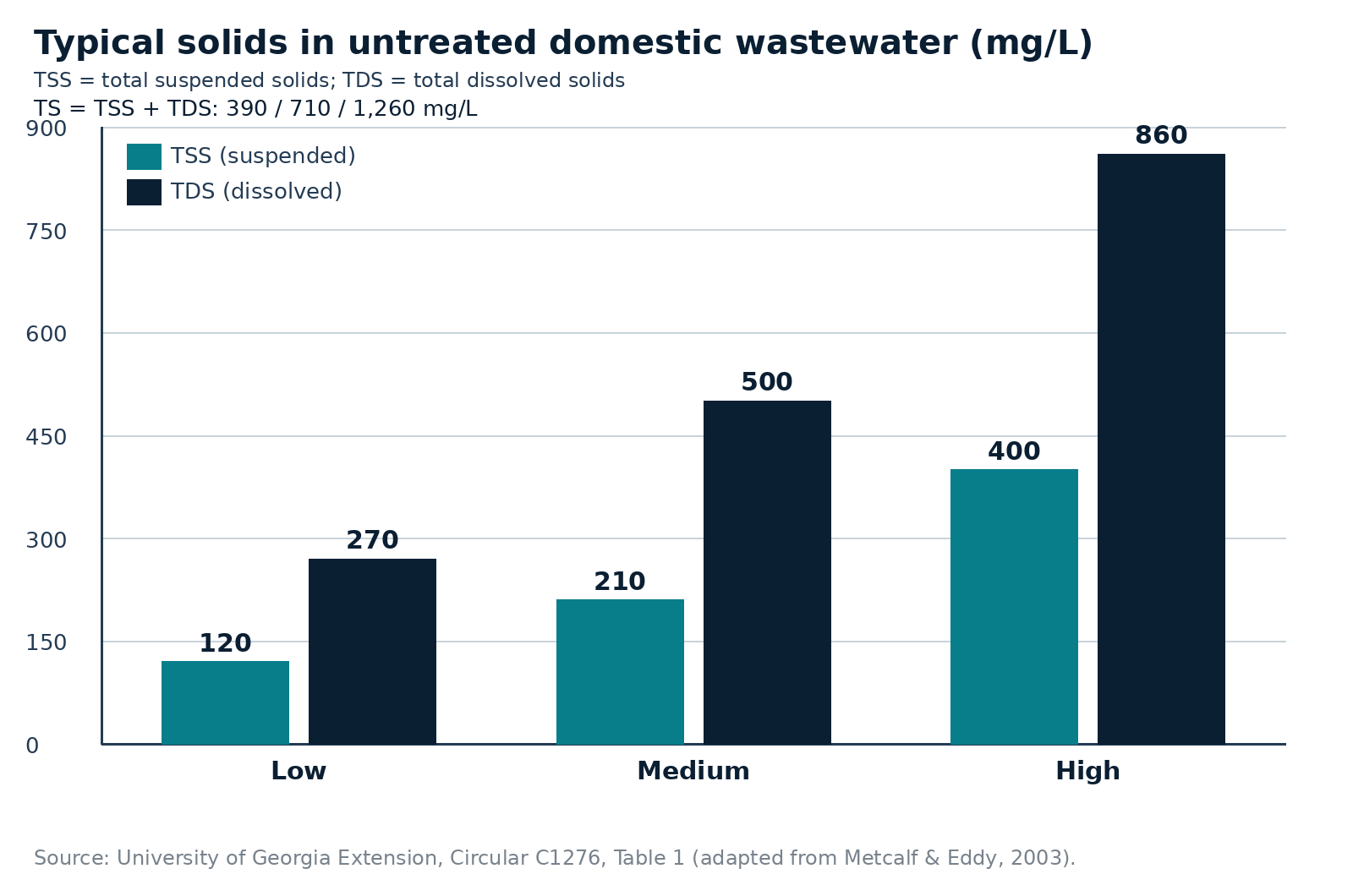
Untreated domestic wastewater carries, in mg/L, TSS of 120 (low), 210 (medium) and 400 (high), from the University of Georgia Extension, Circular C1276, Table 1, adapted from Metcalf and Eddy (2003). A food plant compares its effluent against those bands to judge how strong its wastewater is before treatment.
What is TDS?
TDS means total dissolved solids: the mass of everything dissolved in the water that passes the filter, salts, minerals and metal ions. It is reported in mg/L, which is numerically the same as parts per million (ppm), because 1 mg/L equals 1 ppm.
TDS is a bulk tally, not a chemical identity. Two waters can both read 500 mg/L while one holds harmless calcium bicarbonate and the other holds nitrate or sodium that matters. The number tells you how much is dissolved, never what it is.
Coffee uses the same term in a different unit: TDS is a percentage, how much of the drink is dissolved coffee. Filter coffee runs about 1.2 to 1.5 percent TDS, espresso about 8 to 12 percent. Strength (TDS) and extraction yield are separate numbers: a coffee can be strong and under-extracted, or weak and over-extracted, at the same time.
The only limit in this article comes from an official source that was opened and read: the US EPA sets a secondary maximum contaminant level (SMCL) for TDS of 500 mg/L, a non-enforceable guideline for taste, color and odor, not a health limit.
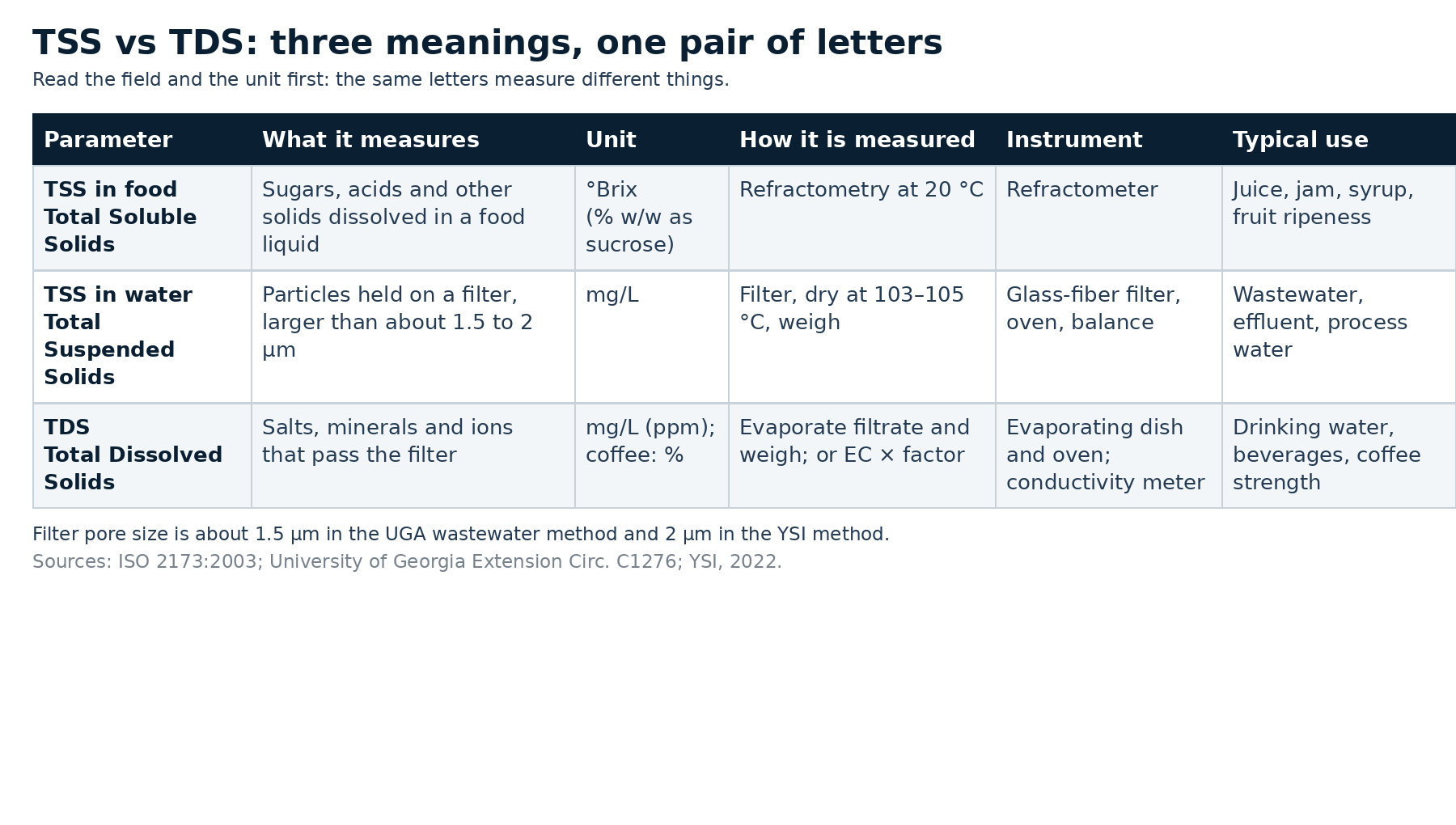
TSS vs TDS: comparison table
| Aspect | TSS in food: total soluble solids | TSS in water: total suspended solids | TDS: total dissolved solids |
|---|---|---|---|
| What it measures | Sugars, acids and other solids dissolved in a food liquid | Particles held on a filter, larger than about 1.5 to 2 µm | Salts, minerals and ions that pass the filter |
| Unit | °Brix (% w/w as sucrose) | mg/L | mg/L (ppm); coffee: % |
| How it is measured | Refractometry at 20 °C | Filter, dry at 103–105 °C, weigh | Evaporate filtrate and weigh; or EC × factor |
| Instrument | Refractometer | Glass-fiber filter, oven, balance | Evaporating dish and oven; conductivity meter |
| Typical use | Juice, jam, syrup, fruit ripeness | Wastewater, effluent, process water | Drinking water, beverages, coffee strength |
| Standard or method | ISO 2173:2003; AOAC 932.12 | Standard Methods 2540D; EPA Method 160.2 | Standard Methods 2540C; EPA Method 160.1 |
How each is measured
Filtration: water TSS and TDS by weighing
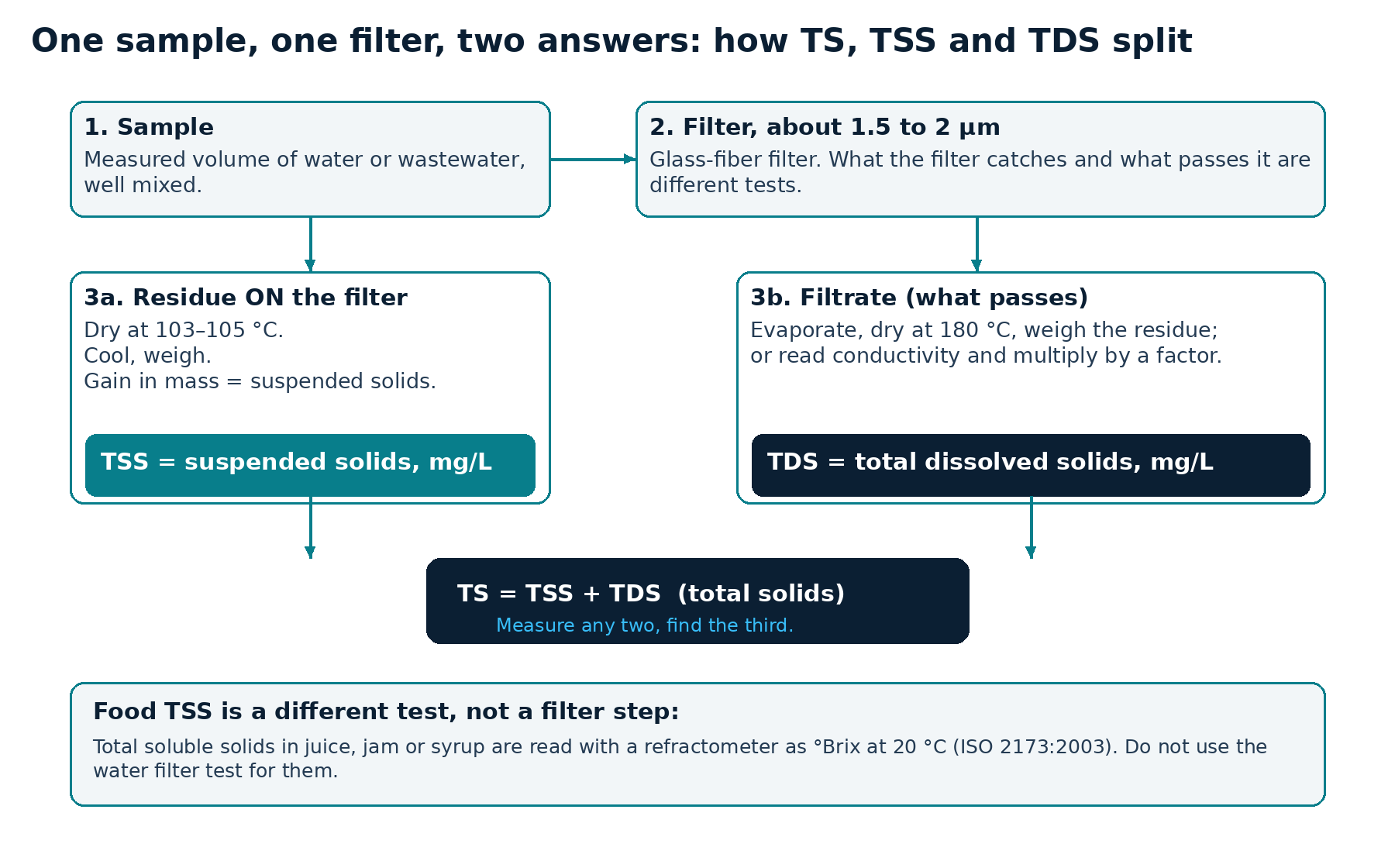
The laboratory method is filtration followed by weighing, and it is the reference against which every field estimate is judged. Dry a glass-fiber filter at 103–105 °C, cool it in a desiccator and weigh it; filter a measured volume of well-mixed sample, usually 25, 50 or 100 mL; dry the filter again at 103–105 °C, cool and weigh it. The gain in mass is the suspended solids.
TDS takes the other half of the same sample: the filtrate is evaporated and the residue dried at 180 °C to constant weight, then weighed (Standard Methods 2540C, EPA Method 160.1). Igniting the residue at 500 °C burns off the organic part and leaves the fixed solids.
The formulas are simple divisions:
- TSS (mg/L) = mass gain on the filter (mg) × 1000 / sample volume (mL)
- TDS (mg/L) = residue mass (mg) / sample volume (L)
- TS = TSS + TDS
TDS meter: conductivity times a factor
A handheld TDS meter does not measure solids at all. It measures electrical conductivity and multiplies it by a factor, because dissolved salts split into ions that carry current. Hanna Instruments states the relation as TDS = factor × EC at 25 °C, with the factor about 0.5 for strongly ionic solutions and up to 0.7 for weakly ionic ones such as fertilizers. Their example: 100 µS/cm at a factor of 0.5 reads 50 ppm.
The factor is the weak point: it is only sound when the solids are mostly ionic and their mix is known. YSI adds that TSS cannot be read directly in the field at all: turbidity sensors estimate it only through a correlation built for that one sampling site.
Refractometer: food TSS as °Brix
Food TSS is read with a refractometer, which measures how strongly a liquid bends light. ISO 2173:2003 sets the reference temperature at 20 °C ± 0.5 °C. Readings taken away from 20 °C are corrected back to it, salted products are corrected with S = (R − N) × 1.016, and highly acidic products such as citrus juices get an acidity correction.
Ohio State Extension gives the field routine: calibrate with distilled water, filter the sample so tissue does not reach the well, read at room temperature, and clean and dry the well between samples. Their warning: °Brix values say far more about how sweet a product may taste than about how nutritious it may be.
Worked examples
Illustrative example 1: TSS by filtration
A 100 mL sample is filtered through a pre-weighed glass-fiber filter. The filter weighs 1.1200 g before and 1.1331 g after drying at 103–105 °C.
- Gain in mass: 1.1331 − 1.1200 = 0.0131 g = 13.1 mg
- TSS = 13.1 mg × 1000 / 100 mL = 131 mg/L
Against the University of Georgia bands, 131 mg/L sits just above the low band of 120 mg/L.
Illustrative example 2: TDS from conductivity, and why the factor matters
The same sample reads 640 µS/cm at 25 °C. The estimate depends entirely on the factor:
- At a factor of 0.5: TDS = 640 × 0.5 = 320 ppm
- At a factor of 0.7: TDS = 640 × 0.7 = 448 ppm
Same water, same meter, two answers 128 ppm apart: a conductivity reading is an estimate, a gravimetric result is the reference. Always record the factor with the result.
Illustrative example 3: total solids from the two results
Using the 0.5 factor value from example 2:
- TS = TSS + TDS = 131 + 320 = 451 mg/L
That total sits between the low band (390 mg/L) and the medium band (710 mg/L).
Illustrative example 4: coffee extraction yield
A filter coffee reads 1.38 percent TDS. The brew weighs 300 g and the dose was 20 g of ground coffee.
- Extraction yield = TDS × brew weight / coffee dose = 1.38 × 300 / 20 = 20.7 percent
That sits inside the usual target of 18 to 22 percent. TDS alone says nothing about taste: two coffees can share 1.38 percent TDS and 20.7 percent extraction and still taste different.
Why it matters in food plants
Process water. Water that enters a food plant is a food safety control, not just a utility. Its dissolved load affects taste, scale in boilers and heat exchangers, and cleaning chemistry. A rising TDS trend in incoming water warns that the supply has changed.
Effluent. Discharge permits are written in mg/L of suspended solids, so a plant must know its TSS to stay inside them. The filter-and-weigh test is the number the permit recognises; turbidity alone is not a substitute without a site-specific correlation from paired lab results.
Juice and syrup quality. °Brix is the daily control number for juice, jam, jelly and syrup lines: ripeness at intake, sweetness in the blend, syrup grade in the can. A reading taken hot, uncorrected, or from an unfiltered sample is a wrong reading, and the batch pays for it.
Beverages and coffee. In brewing, TDS is the strength dial and extraction yield is the balance check. A cafe that reads 1.38 percent TDS and 20.7 percent extraction knows its recipe is in range; 1.0 percent TDS says the cup is thin, whatever the recipe card claims.
Common mistakes
- Using a TDS meter to measure suspended solids. A conductivity meter only sees ions. Suspended particles do not conduct, so they are invisible to it. A cloudy sample can read a low TDS while its TSS is high.
- Reading °Brix as TDS. °Brix is soluble solids in food; TDS in mg/L is dissolved solids in water. In coffee the two are linked only by an approximate factor: 10 °Bx is roughly 8.5 percent TDS, from a single source, flagged as approximate.
- Skipping temperature correction. The °Brix scale is set at 20 °C, so a hot sample read without correction gives a wrong number. Let the sample reach room temperature first.
- Using the wrong conductivity factor. Factors of 0.5 and 0.7 give answers 40 percent apart for the same water. Pick the factor for the water in front of you, record it, and confirm important results by the gravimetric method.
FAQ
Is TSS the same as TDS?
No. In water testing, TSS is what a filter catches (suspended solids) and TDS is what passes through it (dissolved solids). In food technology, TSS means something else again: total soluble solids, read as degrees Brix. Same letters, three meanings, so check the field and the unit before you use the number.
What does TSS mean in food technology?
In food technology, TSS means total soluble solids: sugars, acids and other solids dissolved in a food liquid, read as degrees Brix with a refractometer at 20 °C. It guides ripeness, sweetness and syrup strength in juice and jam, and it is measured by ISO 2173:2003.
How do you measure TSS in fruit juice?
Filter or press the juice to remove pulp, place a few drops on a refractometer, and read the degrees Brix at 20 °C, or with temperature correction. Calibrate with distilled water first, dry the well between samples, and record the reading with the sample details.
Can a TDS meter measure TSS?
No. A TDS meter reads electrical conductivity and converts it to an estimate of dissolved solids. It cannot see suspended particles at all, and it cannot measure soluble solids in food. Use filtration and weighing for water TSS, and a refractometer for food TSS.
How are total solids, TSS and TDS related?
In water testing, total solids equal suspended plus dissolved solids: TS = TSS + TDS. Measure any two and the third follows. In foods the same words split differently, so do not carry the water equation into a food laboratory.
References and further reading
- ISO 2173:2003, Fruit and vegetable products: Determination of soluble solids, Refractometric method. 2nd edition, 2003. Definition 2.1, principle at 20 °C ± 0.5 °C, salt correction S = (R − N) × 1.016. Text opened and read at standards.iteh.ai, 2026-11-16.
- Ranganna, S. Handbook of Analysis and Quality Control for Fruit and Vegetable Products. 2nd edition, 1986. Tata McGraw-Hill, New Delhi. Refractometer solids of fresh fruits about 8 to 18 percent; pineapple juice 12 percent TSS, 0.5 to 0.6 percent acidity; syrup grades extra light 10, light 14, heavy 18, extra heavy 22 °Brix; TSS of quick-frozen fruits by refractometer with correction to 20 °C.
- University of Georgia Extension. Understanding Laboratory Wastewater Tests II: Solids (TS, TSS, TDS, TVS, TFS). Circular C1276. Accessed 2026-11-16. https://fieldreport.caes.uga.edu/publications/C1276/understanding-laboratory-wastewater-tests-ii-solids-ts-tss-tds-tvs-tfs/ TS = TSS + TDS; glass-fiber filter about 1.5 micron; drying at 103–105 °C; ignition at 500 °C; 1 mg/L = 1 ppm; Table 1 typical domestic wastewater values, adapted from Metcalf and Eddy, 2003.
- YSI. Understanding Turbidity, TDS, and TSS. YSI blog, May 2022. Accessed 2026-11-16. https://ysi.com/ysi-blog/water-blogged-blog/2022/05/understanding-turbidity-tds-and-tss TDS passes a 2 micron filter; TSS does not pass; TSS estimated from turbidity with a site-specific correlation; TDS estimated from conductivity.
- Hanna Instruments. What is the relationship between TDS and EC? Accessed 2026-11-16. https://knowledge.hannainst.com/knowledge/ec-tds-what-is-the-relationship-between-tds-and-ec TDS = factor × EC at 25 °C; factor 0.5 for strongly ionic solutions, 0.7 for weakly ionic ones; 100 µS/cm at 0.5 = 50 ppm.
- Ohio State University Extension. Using °Brix as an Indicator of Vegetable Quality: A Summary of the Measurement Method. Fact sheet HYG-1652. Accessed 2026-11-16. https://ohioline.osu.edu/factsheet/HYG-1652 °Brix measures soluble solids, mainly sugars, as a guide to sweetness; refractometer measures light bending; reference temperature 20 °C; calibrate with distilled water; filter the juice; dry the well between samples; °Brix is only an indication of soluble solids and sweetness, not proof of nutrition.
- Kaffeemacher. Perfect coffee with the help of light: refractometers in coffee brewing. Accessed 2026-11-16. https://kaffeemacher.de/en/blogs/kaffeewissen/refractometer-and-tds TDS percent as coffee strength; extraction yield = TDS × brew weight / coffee dose; target 18 to 22 percent; filter coffee 1.2 to 1.5 percent TDS; 10 °Bx roughly 8.5 percent TDS (single source, approximate).
- US Environmental Protection Agency. Secondary Drinking Water Standards: Guidance for Nuisance Chemicals. Accessed and read 2026-11-16. https://www.epa.gov/sdwa/secondary-drinking-water-standards-guidance-nuisance-chemicals TDS secondary maximum contaminant level 500 mg/L; non-enforceable guideline for taste, color and odor; not considered a risk to human health at the SMCL.
- Standard Methods for the Examination of Water and Wastewater. Method 2540C (total dissolved solids, dried at 180 °C) and Method 2540D (total suspended solids, dried at 103–105 °C). American Public Health Association, American Water Works Association, Water Environment Federation.
- AOAC International. Official Method 932.12, Solids (Soluble) in Fruits and Fruit Products, Refractometer Method; Official Method 983.17, Solids (Soluble) in Citrus Fruit Juices, Refractometer Method.
- Refractometric °Brix against label-declared sugar in commercial fruit beverages. SciFood, 2026; received 3 March 2026, published 22 April 2026. 30 beverages; mean °Brix 9.47 ± 2.83 against label sugar 8.72 ± 2.09; mean bias +0.75; correlation r = 0.608. °Brix measures all soluble solids, not sugar alone.
Related GIFSQ articles, SOPs and tools
All links verified to return HTTP 200 on 2026-11-16.
Calculators:
- Brix Calculator: convert between °Brix, refractive index and sugar content for juice and syrup work.
- Dry Matter Calculator: dry matter and moisture arithmetic for food samples.
- Moisture Content Calculator: moisture percentage from wet and dry weights.
Related posts:
- Water Quality in Food Production: Why Potable Water Is a Food Safety Control: why incoming water quality is a control point, not just a utility.
- Water Activity vs Moisture Content: Why the Difference Matters: the other pair of look-alike terms every food student mixes up.
- Brix Measurement: Refractometry in Food QC: the refractometer method behind food TSS.
- Difference Between Total Solids and Total Dissolved Solids: the neighbouring comparison, TS against TDS.
- Difference Between Refractometry and Polarimetry: the two optical methods behind sugar and solids testing.
Quizzes and courses:
- Test yourself with the GIFSQ quizzes: 1,709 free food science and food safety quizzes, including the TSS Quiz.
- Food Safety Basics course: the starting course for food safety staff.
Laboratory procedures (Food Analysis SOPs; the article links to them, it does not repeat them):
- SOP: Determination of Total Soluble Solids by Refractometer
- SOP: Determination of Total Soluble Solids by Brix Hydrometer
- SOP: Determination of Total Soluble Solids in Frozen Fruits
- SOP: Determination of Total Solids in Water
Suggested external authority links (for the published page):
- YSI, Understanding Turbidity, TDS, and TSS (field methods): https://ysi.com/ysi-blog/water-blogged-blog/2022/05/understanding-turbidity-tds-and-tss
- US EPA, Secondary Drinking Water Standards: https://www.epa.gov/sdwa/secondary-drinking-water-standards-guidance-nuisance-chemicals
Call to action: Check your own numbers with the Brix Calculator, then take the TSS Quiz to see whether you can tell the three meanings apart.
