What Is Food Quality Control?
GIFSQ ID: ART-2238
Food quality control (QC) is the set of checks a food business runs on its materials, its process and its finished products to prove that every batch meets its specification. It is the inspection, testing and measurement work: taking samples, running tests, checking weights, reading thermometers, looking at labels, and deciding whether a lot is accepted, held or rejected. Quality control asks one question about a product that already exists: does this batch meet the specification?
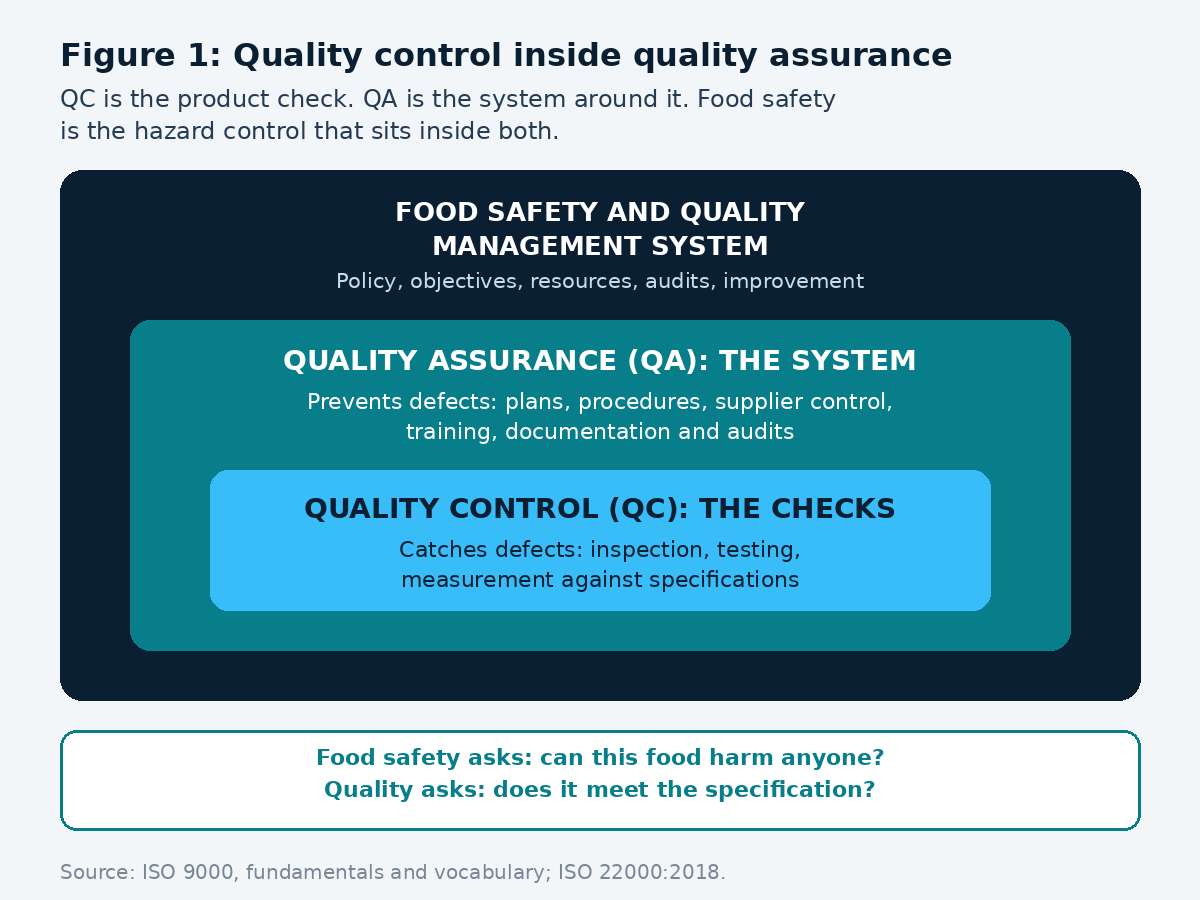
QC is one part of quality: quality assurance (QA) is the system that prevents defects, and food safety is the hazard control that keeps food from harming anyone. This article explains what QC is, how it differs from QA and food safety, the methods it uses, and how to build a QC program.
Key takeaways
- Quality control is the product check: inspection, testing and measurement against a specification, batch by batch.
- Quality assurance is the system that prevents defects; quality control is the check that catches them. Neither replaces the other.
- Food safety and food quality are different questions: safety asks whether food can harm anyone, quality asks whether it meets the specification.
- The main QC methods are specifications, sampling, testing, inspection, statistical process control and records.
- A lot is accepted or rejected by a sampling plan, not by a guess: the plan says how many to test and how many defects are allowed.
Contents
- What Is Food Quality Control?
- Why Food Quality Control Matters
- QC vs QA vs Food Safety
- The Core Elements and Methods of Food Quality Control
- Sampling and Acceptance: A Worked Example
- Statistical Process Control and Control Charts
- The Seven Quality Management Principles
- How to Build a QC Program Step by Step
- What Is Law, What Is a Standard, and What Is Guidance?
- Illustrative scenario: A Small Bakery Builds Its QC Program
- Common QC Mistakes to Avoid
- Free QC Resources from GIFSQ
- Frequently Asked Questions
- Conclusion
- References
What Is Food Quality Control?
ISO 9000, the fundamentals and vocabulary standard for quality management, defines quality control as the part of quality management focused on fulfilling quality requirements. In plain language: QC is the operational work that checks whether a product, a batch or a process actually meets the requirements written down for it. A requirement here is a specification: a target value with a limit, such as a pack weight of 500 g, a moisture content below 12 percent, or a pH between 4.0 and 4.6.
Quality in food has two sides. The first is safety: the food must not harm the consumer. The second is everything else the customer expects: taste, appearance, texture, weight, shelf life and honest labelling. QC covers both, because both are written into specifications. A batch can be safe and still fail QC, for example when the packs are underweight, and a batch can meet every quality specification and still be unsafe. That is why QC and food safety work together but are not the same thing.
Quality thinking moved through four eras, described by David Garvin in 1988: inspection, statistical quality control, quality assurance, and strategic quality management. Modern food QC uses all four: it inspects, it uses statistics, it works inside a system, and it is managed.
Figure 1 shows where QC sits: the product checks inside the QA system, inside the food safety and quality management system.
Why Food Quality Control Matters
A food business that does not check its product finds out about problems from its customers, and by then the cost is at its highest. QC finds problems while they are still cheap to fix.
- Safer food: testing and inspection catch hazards and defects before the product leaves the plant.
- Consistent product: customers get the same taste, weight and appearance every time they buy, which is what keeps them buying.
- Regulatory compliance: regulators require evidence that specifications and safety controls are met, and QC records are that evidence.
- Lower cost of failure: a rejected batch costs far less than a recall, a complaint or a lost customer.
QC vs QA vs Food Safety
These three terms are used as if they meant the same thing. They do not. QC checks the product. QA builds the system that prevents defects. Food safety controls the hazards. Table 1 sets out the difference.
| Quality control (QC) | Quality assurance (QA) | Food safety | |
|---|---|---|---|
| What it is | The checks that prove a product meets its specification | The system that prevents defects | The hazard control that keeps food from harming anyone |
| Question it answers | Does this batch meet the specification? | Will our way of working reliably produce quality? | Can this food harm anyone? |
| Focus | The product, batch by batch | The process and the system | The hazard at each step |
| When it acts | During and after production | Before and during production | Before and during production |
| Main tools | Inspection, testing, measurement, sampling plans, control charts | Procedures, training, supplier control, audits, corrective action | Hazard analysis, CCPs, PRPs, monitoring |
| Who does it | QC technicians, lab staff, line inspectors | Quality manager, auditors, management | Food safety team, production staff |
| What it produces | An accept, hold or reject decision | Confidence that requirements will be met | A controlled hazard and a safe product |
ISO 9000 defines quality assurance as the part of quality management focused on providing confidence that quality requirements will be fulfilled. Notice the word confidence: QA does not test the product, it builds the conditions under which a good product is the normal result, and QC is the check that proves it. A plant with QA and no QC has confidence with no evidence. A plant with QC and no QA finds the same problems again and again.
Our comparison article The Critical Difference between Quality Assurance (QA) and Quality Control (QC) goes deeper into the QA and QC pair. Our FSMS explainer explains the management system that holds QA, QC and food safety together.
The Core Elements and Methods of Food Quality Control
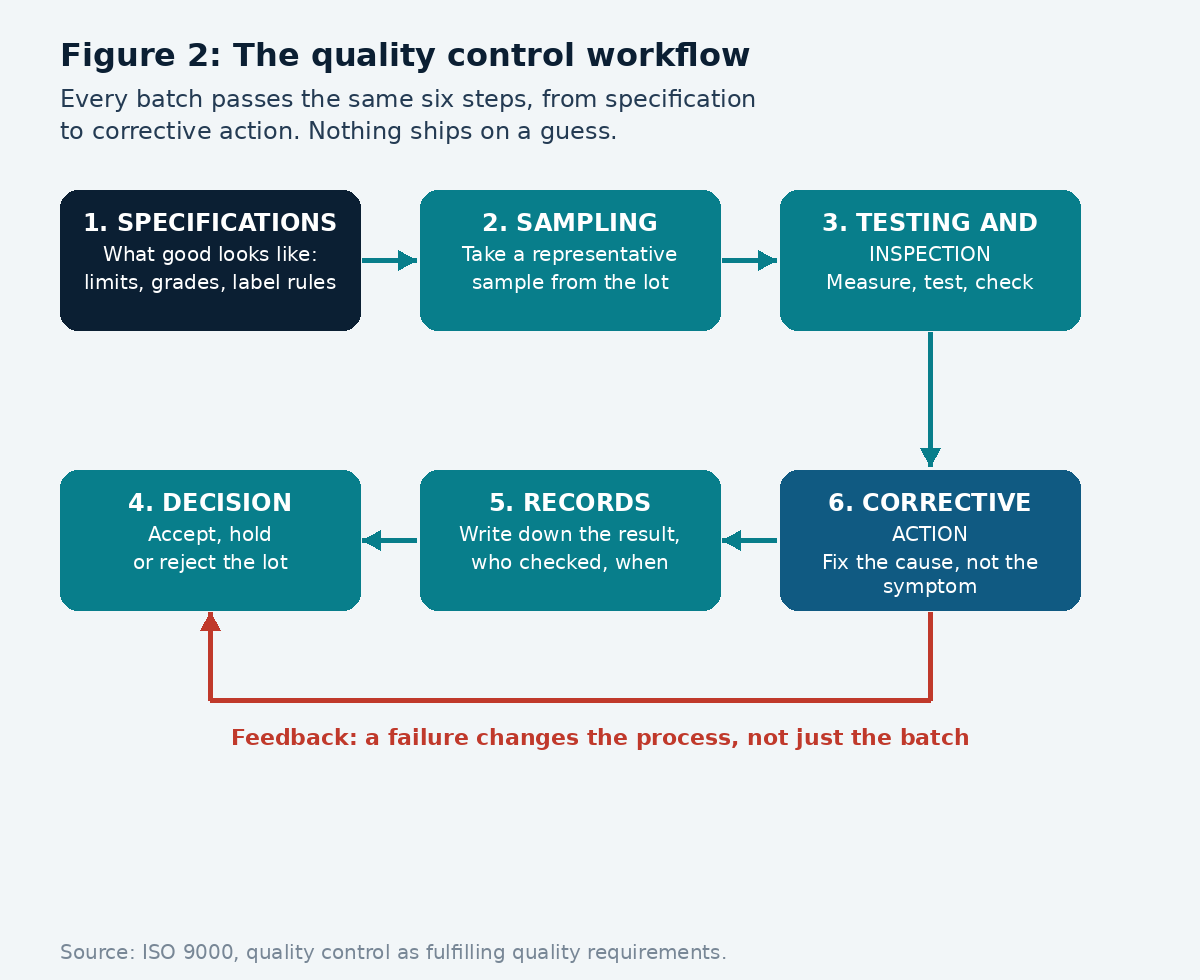
QC is not one test. It is a set of methods that run together through production, shown in Figure 2: every batch passes the same six steps.
Specifications
Everything starts with a written specification: what good looks like, in numbers. It names the product, the limits and the method of checking: raw milk with a maximum bacterial count, flour with a protein range, a finished pack weighing 500 g with a tolerance, a label that names every allergen. A specification without a number cannot be checked, and a check without a specification is a guess.
Sampling
Testing every unit is usually impossible or wasteful, and for destructive tests it is impossible by definition. QC tests a sample and uses it to judge the lot. The sample must represent the lot: taken at random, from different parts of it, and large enough for the decision.
Testing and inspection
Testing measures a property in the laboratory or at the line: moisture, pH, water activity, fat content, salt, microbial counts, foreign material. Inspection looks, weighs, reads and compares: pack weight, seal integrity, label accuracy, colour, damage. Sensory testing checks taste, smell, texture and appearance. The method must suit the property and the instrument must be calibrated, or the result means nothing. Our comparison article Accuracy vs Precision explains why a measurement can be consistent and still wrong.
Calibration
Every measuring instrument drifts, so thermometers, balances, pH meters and moisture analysers are checked against a known standard on a schedule, and the check is recorded. An uncalibrated thermometer can pass a batch that should have failed. Our article on calibration programs explains why the check matters.
Documentation and records
The check is written down as it happens: what was tested, the result, who checked it, when, and the decision. Records prove the work was done and give the evidence an auditor or a regulator asks for. If it is not recorded, you cannot prove it happened.
Sampling and Acceptance: A Worked Example
Acceptance sampling answers a practical question: how many units do we test, and how many defects are allowed, before we accept or reject the whole lot? The answer comes from a sampling plan, and the most used system is ISO 2859, sampling by attributes, indexed by the acceptable quality limit (AQL): the worst average quality level that is still tolerable when lots keep coming.
Here is a worked example from a published source, Ranganna, Analysis and Quality Control for Fruit and Vegetable Products, Chapter 34, Statistical Quality Control, Tables 34-1 to 34-4. A lot of 18,000 mangoes arrives for processing. The business uses general inspection level II and an AQL of 1 percent. The tables give sample size code letter M for this lot size and level.
- Single sampling: test 315 mangoes. Accept the lot if 7 or fewer are defective (Ac = 7). Reject it if 8 or more are defective (Re = 8).
The plan does not promise a perfect lot. It balances two risks: rejecting a good lot and accepting a bad one. The operating characteristic curve shows the balance: for the code letter N plan at AQL 1.0 percent in the same chapter, a lot that is actually 3 percent defective is accepted only about 13 percent of the time, while a lot that is actually 1 percent defective is accepted about 98 percent of the time.
Do not invent a sampling plan. Use a published table such as ISO 2859 or a recognised equivalent, and write down which table, code letter and AQL you used. Our free Sampling Plan Calculator: AQL and Acceptance Decision applies the acceptance decision once you have the plan.
Statistical Process Control and Control Charts
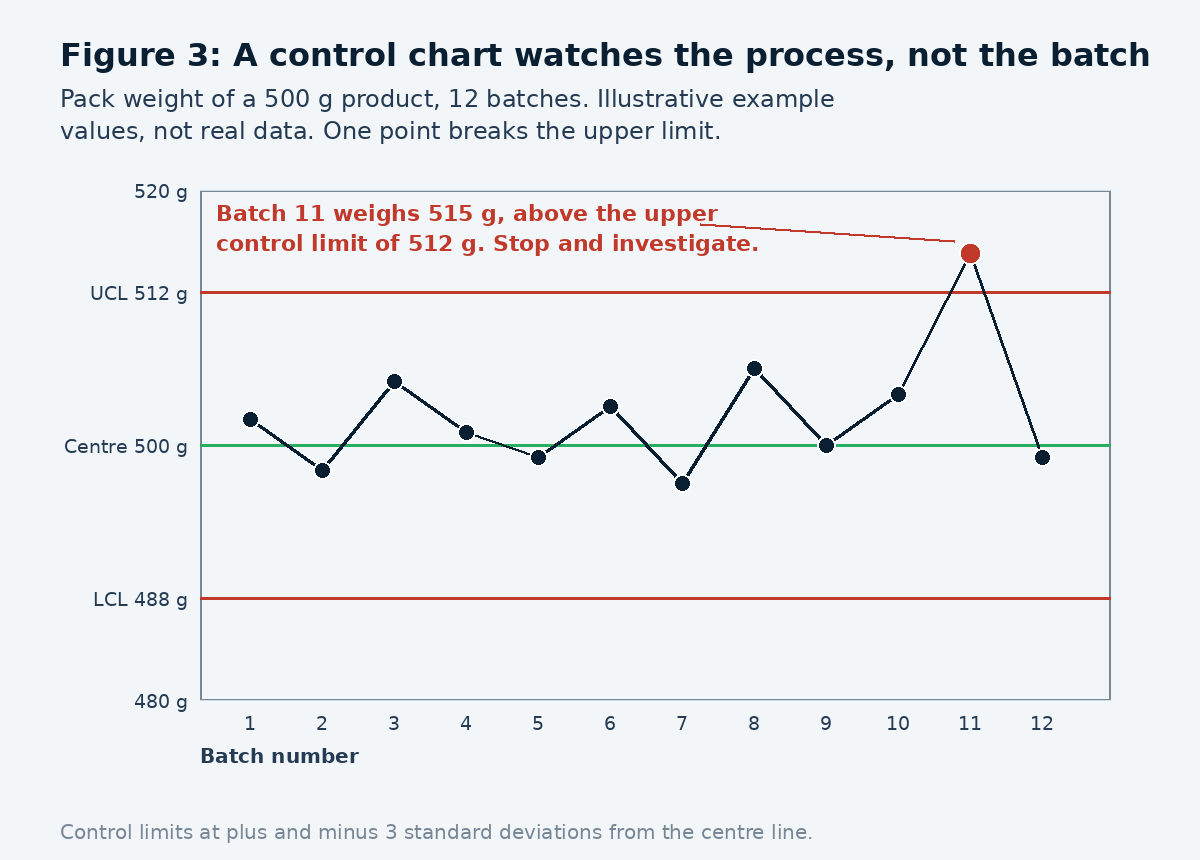
A control chart is the simplest SPC tool and the most useful. It plots a measurement over time, usually one point per batch, against three lines: the centre line, which is the process average, and the upper and lower control limits, usually set at plus and minus 3 standard deviations from the centre line. The limits describe what the process normally does, not what the specification allows. A process can be in control and still make out-of-specification product: that means the process itself needs fixing, not just the batch.
Variation comes in two kinds. Common cause variation is the normal wobble of a stable process: small differences in raw material, temperature and handling. Special cause variation is a change: a new supplier, a worn part, a wrong setting, an untrained operator. Points inside the limits with no pattern mean common cause variation: leave the process alone. A point outside a limit, or a run of points on one side of the centre line, means special cause variation: stop and find the cause.
Figure 3 shows a control chart for the pack weight of a 500 g product over 12 batches, with illustrative values, not real data. Eleven batches sit inside the limits. Batch 11 weighs 515 g, above the upper control limit of 512 g: that batch is held, the cause is investigated, and the chart goes back to watching the process.
The Seven Quality Management Principles
QC sits inside a quality management system, and that system rests on seven quality management principles defined in ISO 9000. They are beliefs about what makes a system work, not requirements you are audited against: the requirements are in ISO 9001.
| Principle | In one line |
|---|---|
| Customer focus | Meet customer requirements and try to exceed customer expectations |
| Leadership | Leaders set direction and create the conditions for quality |
| Engagement of people | Competent, empowered people at every level make the system work |
| Process approach | Manage activities and resources as connected processes, so results are consistent |
| Improvement | Getting better is a permanent aim, not a project with an end date |
| Evidence-based decision making | Decisions rest on the analysis of data, not on opinion or habit |
| Relationship management | Manage relationships with suppliers, customers and others, because quality depends on them |
The current quality management system standard is ISO 9001:2026, published on 16 September 2026, replacing ISO 9001:2015, and the seven principles are unchanged in the 2026 edition. ISO 9001 is voluntary: a business chooses it, or a customer asks for it. What makes quality control mandatory is the law in your country, not ISO 9001.
How to Build a QC Program Step by Step
A QC program is built in order. Each step depends on the one before it.
- Write the specifications: for each raw material, in-process check and finished product, the property, the limit and the method of checking. Take the limits from regulation, customer requirements or validated science, never from a guess.
- Choose the sampling plans: the sample size and acceptance number for each check, from a published table such as ISO 2859, and write down which table, code letter and AQL apply.
- Set up the testing and inspection: which tests run in the laboratory and which at the line, who does them, and how often. Make sure the instruments are calibrated and the methods are written down.
- Train the people who check: a checker who does not know the specification, the method and the decision rule cannot make a sound decision. Record the training.
- Run the checks and record the results. Test, inspect, decide, record: accept, hold or reject, with the result, the checker and the date written down as it happens.
- Watch the process with control charts. Plot the key measurements over time, act on signals of special cause variation, and leave a stable process alone.
- Handle nonconformities: write down what happens to a failed lot (hold, rework, downgrade or discard it), find the cause, and record the action. A failed lot must never quietly re-enter production.
- Review and improve. Audit the program, review the results with management, fix the causes of repeated failures, and update the specifications and plans when a product, process, ingredient or piece of equipment changes.
What Is Law, What Is a Standard, and What Is Guidance?
One of the most common mistakes is treating a voluntary standard as if it were the law. The five kinds of requirement below are different, and they carry different weight.
| Kind | Set by | Must you follow it? | Example |
|---|---|---|---|
| Legal requirement | A government, in law | Yes, where it applies to you | A written food safety plan under the US FSMA rule (21 CFR 117); a preventive control plan under Canada’s SFCR; HACCP procedures under EU Regulation 852/2004, Article 5 |
| International standard | ISO, by consensus | Only if you choose it, or a customer or regulator asks for it | ISO 9001:2026 (quality management); ISO 22000:2018 (FSMS); certification is voluntary |
| Industry guidance | Codex, sector bodies, scheme owners | Recommended practice, not law | Codex CXC 1-1969 Rev. 2020; ISO/TS 22002 PRP guidance; ISO 2859 sampling guidance; GFSI-benchmarked schemes (FSSC 22000, BRCGS, SQF) |
| Scientific recommendation | Validation studies and published science | The evidence behind your limits | A pasteurisation time and temperature proven to control the hazard; a control chart limit set from process data |
| GIFSQ educational interpretation | GIFSQ, in this article | No: this article explains the subject; it is not legal advice | The plain-language explanations and the illustrative scenario below |
The law differs by country and sector. In the United States, the FSMA preventive controls rule requires most registered food facilities to hold a written food safety plan, prepared or overseen by a Preventive Controls Qualified Individual and reanalysed at least every three years. In Canada, the Safe Food for Canadians Regulations require a preventive control plan for most licence holders. In the European Union, Regulation 852/2004 requires food business operators, except primary producers, to put permanent procedures based on HACCP principles in place.
Illustrative scenario: A Small Bakery Builds Its QC Program
A small bakery makes 2,000 packs of crackers a day for local shops, with six staff and one part-time quality lead. Its QC program is built the way this article describes, and the numbers below are illustrative, not a real plant.
The bakery starts with specifications: flour protein 10 to 12 percent, dough moisture 28 to 32 percent, finished cracker moisture below 4 percent, pack weight 200 g, and labels naming wheat and milk. Incoming flour is sampled from every delivery and tested for moisture and protein, dough moisture is checked on every batch, and finished crackers are sampled each hour for moisture and pack weight, plotted on a control chart centred on 200 g.
One morning the chart shows three packs in a row above the upper control limit. The quality lead stops the line, finds a worn filler nozzle, replaces it, and the weights come back inside the limits. The affected batches are checked pack by pack, the good packs are released, and the incident, the cause and the fix are written in the QC record. The program did not prevent the fault. It caught it before the packs left the building, and it changed the process so it does not happen again.
Common QC Mistakes to Avoid
- Testing without a specification. A result means nothing if no limit says whether it passes or fails.
- Uncalibrated instruments. A measurement from an uncalibrated thermometer or balance is a guess with a number attached.
- Treating QC as the whole of quality. Inspection alone cannot fix a bad process. QC must sit inside QA, and QA inside the management system.
- Confusing a control limit with a specification limit. A control limit describes what the process normally does; a specification limit describes what the customer accepts. A process can be in control and still fail the specification.
Free QC Resources from GIFSQ
- Go deeper with the Strategic Quality Management for Food Industry Excellence course.
- Start from the basics with the Food Safety Basics course.
- Learn the hazard control method in the HACCP Principles and Implementation course, a free intermediate program.
- Learn corrective action in the Mastering CAPA course.
- Learn to audit your own system with the Internal Auditing Best Practices course.
- Read the management system in What Is a Food Safety Management System (FSMS)? and the standard in brief on the ISO 22000 page.
- Study the subject in the FTN units Food Quality Control and Standards and Quality Control and Assurance.
- Use the Sampling Plan Calculator: AQL and Acceptance Decision and the Pathogen Sampling Plan Builder.
- Check your understanding with the Food Quality Control Part 1 Quiz, the Quality Control Quiz hub and the free food safety quizzes.
- Use the Internal Food Safety Audit guide (40-point checklist) and ready-to-use SOPs and templates.
- Need expert support with your QC program or audit? Book a consultation.
Frequently Asked Questions
What is food quality control?
Food quality control is the set of checks a food business runs on its materials, process and finished products to prove that every batch meets its specification, using inspection, testing and measurement. It ends in a decision: accept, hold or reject the lot.
What is the difference between QC and QA?
QC checks the product that already exists, using inspection and testing, to see whether it meets the specification. QA is the system that prevents defects: procedures, training, supplier control and audits. QC catches defects; QA stops them happening. Both are needed.
What are the 7 QC tools?
The seven basic quality tools are the cause-and-effect diagram, the check sheet, the control chart, the histogram, the Pareto chart, the scatter diagram and the flow chart: simple graphical tools for finding causes and watching variation, used inside a QC program. Some lists use stratification as the seventh tool instead of the flow chart.
What is the role of a quality control inspector?
A QC inspector checks materials, in-process output and finished products against specifications, records the results, and decides whether a lot is accepted, held or rejected. The inspector also reports failures so the cause can be fixed.
How is quality control done in the food industry?
It follows the same six steps for every batch: write the specification, take a representative sample, test and inspect it, decide accept, hold or reject, record the result, and fix the cause of any failure. Sampling plans such as ISO 2859 and control charts turn those steps into numbers.
Conclusion
Food quality control is the check that proves a batch meets its specification. It sits inside quality assurance, which prevents defects, and inside the food safety and quality management system, which sets the direction. Write the specification, sample properly, test with calibrated instruments, decide by the plan, record the result, and fix the cause when something fails. A program that does those six things catches problems while they are still cheap to fix.
Ready to put it into practice? Explore our courses, try the free sampling plan calculator, test yourself with the food quality control quiz, or book a consultation with a GIFSQ expert.
References
- ISO 9000, Quality management systems: Fundamentals and vocabulary (quality control and quality assurance definitions, seven quality management principles). International Organization for Standardization.
- ISO 9001:2026, Quality management systems: Requirements. International Organization for Standardization, published 16 September 2026, replacing ISO 9001:2015.
- ISO 22000:2018, Food safety management systems: Requirements for any organization in the food chain. International Organization for Standardization, published June 2018.
- ISO 2859-1, Sampling procedures for inspection by attributes: Sampling schemes indexed by acceptance quality limit (AQL) for lot-by-lot inspection.
- Codex Alimentarius Commission, General Principles of Food Hygiene, CXC 1-1969, Rev. 2020. FAO/WHO.
- Ranganna, S., Handbook of Analysis and Quality Control for Fruit and Vegetable Products, 2nd edition, Chapter 34, Statistical Quality Control, Tables 34-1 to 34-4 and Figure 34.1 (worked AQL 1 percent plans, code letter M; operating characteristic readings for code letter N).
- Shewhart, W. A., Economic Control of Quality of Manufactured Product, 1931 (control charts; common cause and special cause variation).
- Garvin, D. A., Managing Quality: The Strategic and Competitive Edge, 1988 (four eras: inspection, statistical quality control, quality assurance, strategic quality management).
- US Food and Drug Administration, Current Good Manufacturing Practice, Hazard Analysis, and Risk-Based Preventive Controls for Human Food, 21 CFR Part 117.
- US Department of Agriculture, Food Safety and Inspection Service, 9 CFR Part 417 (HACCP systems for meat and poultry).
- Government of Canada, Safe Food for Canadians Regulations (preventive control plan for licence holders).
- European Union, Regulation (EC) No 852/2004 on the hygiene of foodstuffs, Article 5.
- FDA, Food Code (model code adopted by US states).
- Global Food Safety Initiative, benchmarking requirements (GFSI-benchmarked schemes: FSSC 22000, BRCGS, SQF).
Author: GIFSQ. Last reviewed: November 17, 2026.
