What Is a Food Safety Management System (FSMS)?
GIFSQ ID: ART-2237
A food safety management system (FSMS) is the organised set of policies, procedures, people and records a food business uses to make sure its food is safe every day. It joins three things into one working system: good hygiene practices that keep the plant clean, a HACCP-based plan that controls the significant hazards, and management routines that set objectives, train staff, check results and improve the system. ISO 22000:2018 is the international standard that describes the requirements for an FSMS, and a business can have its system certified against it.
Key takeaways
- An FSMS is a management system, not a single document: policy, people, procedures and records working together.
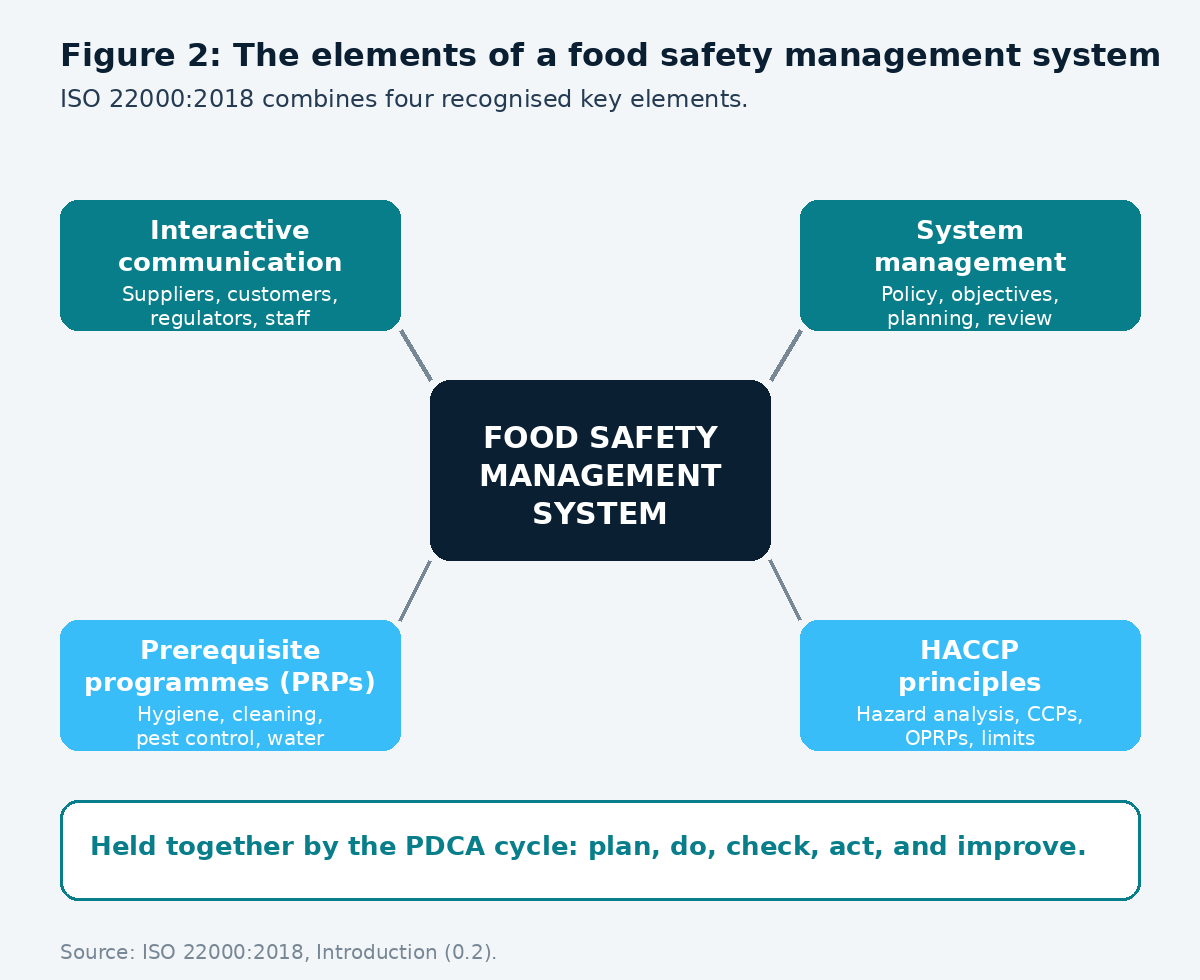
- It rests on four elements: interactive communication, system management, prerequisite programmes and HACCP principles.
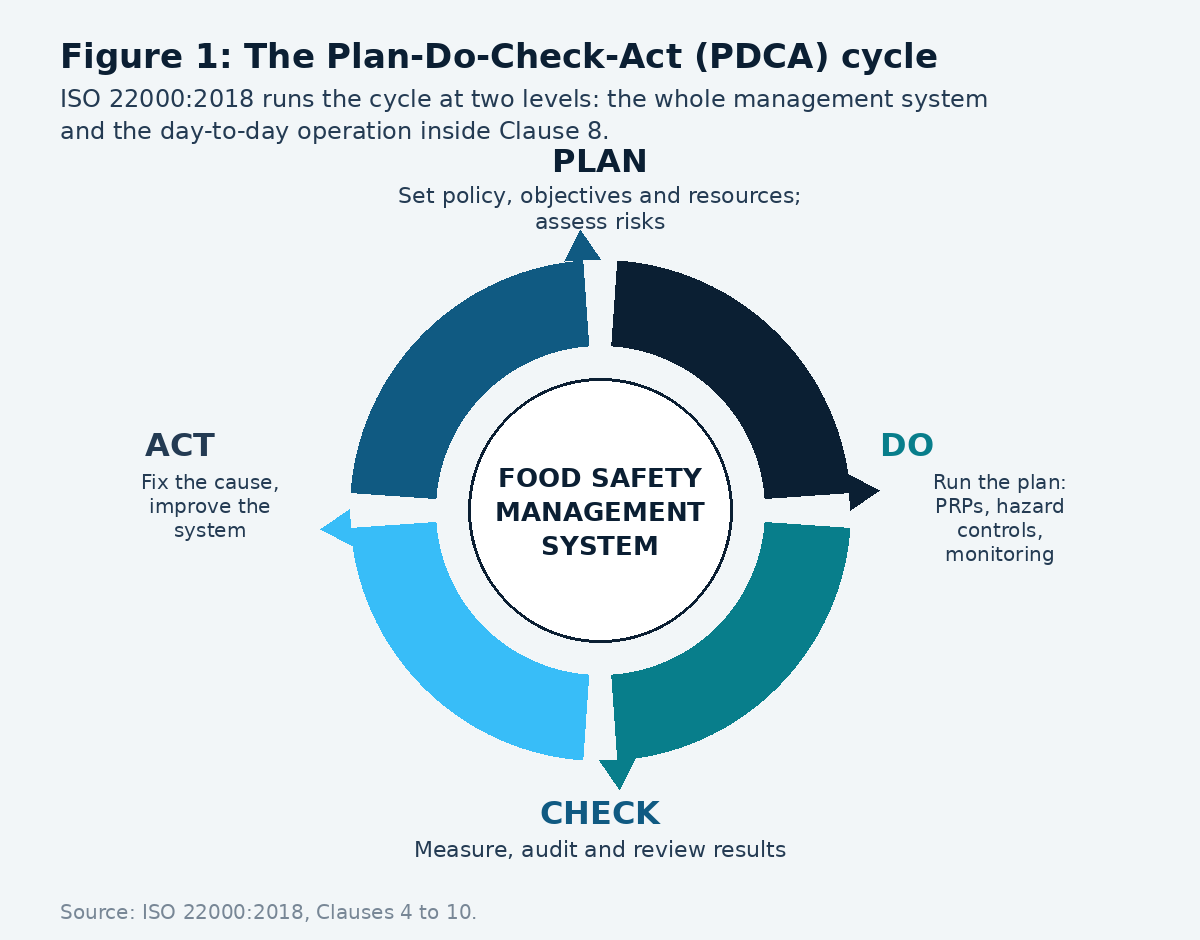
- The PDCA cycle (plan, do, check, act) runs at two levels: the whole system and daily operation.
- ISO 22000 is a voluntary standard. The law in your country is what makes a food safety plan mandatory.
Contents
- What Is a Food Safety Management System?
- Why an FSMS Matters
- The Core Elements of an FSMS
- How to Build an FSMS Step by Step
- FSMS vs HACCP vs ISO 22000 vs GMP
- What Is Law, What Is a Standard, and What Is Guidance?
- Illustrative scenario: A Small Dairy Builds Its FSMS
- Common FSMS Mistakes to Avoid
- Free FSMS Resources from GIFSQ
- Frequently Asked Questions
- Conclusion
- References
What Is a Food Safety Management System?
An FSMS is the management system an organisation uses to direct and control its food safety work. That is the plain-language meaning of the term in ISO 22000:2018, the international standard titled “Food safety management systems: Requirements for any organization in the food chain”. The standard applies to any organisation in the food chain, from a farm supplier to a retailer, and it was published in June 2018, replacing the 2005 edition.
Food safety itself means the assurance that food will not cause harm to the consumer when it is prepared and eaten as intended. A food safety hazard is a biological, chemical or physical agent in food that has the potential to cause harm. The FSMS keeps those hazards under control every batch, every day, not only on audit day.
Why an FSMS Matters
A food business that runs on memory and habit has no way to prove its food is safe, and no way to find the cause when something goes wrong. An FSMS gives it both.
- Safer food: hazards are controlled at the steps where they can actually be controlled, and the controls are checked.
- Faster answers when things go wrong: records show what happened, when, and who checked it, so a problem can be traced and fixed.
- Regulatory compliance: many regulators require a documented food safety plan, and an FSMS is the structure that holds that plan.
- Customer and market access: retailers and export buyers often ask for a certified FSMS before they buy.
- Clear accountability: every control has an owner, a limit and a record.
The Core Elements of an FSMS
ISO 22000:2018 combines four recognised key elements: interactive communication, system management, prerequisite programmes and HACCP principles. Figure 2 shows how they fit together.
Prerequisite programmes (PRPs)
PRPs are the basic conditions and activities that keep the environment fit for producing safe food: premises, water quality, cleaning, pest control, personal hygiene, maintenance and waste handling. They are not chosen to control one specific hazard; they keep the whole plant hygienic so the hazard controls can do their job.
HACCP principles
The HACCP principles are the hazard control engine of the system. The business lists the hazards at each step, picks the significant ones, and controls them through the hazard control plan. ISO 22000:2018 sorts the controls into three tiers. A critical control point (CCP) is a step where a control is applied to a significant hazard with a measurable critical limit, such as a cooking temperature. An operational prerequisite programme (OPRP) is a control for a significant hazard managed against an action criterion, a measurable or observable specification, instead of a critical limit, such as allergen segregation between runs. PRPs form the third tier. Together, CCPs and OPRPs form the hazard control plan.
Management commitment and leadership
Top management owns the system. In ISO 22000:2018 this is Clause 5: leadership sets the food safety policy, assigns roles, names a food safety team leader, provides the resources, and reviews the system. A system only the quality manager cares about fails at the first busy week.
Communication
Interactive communication runs in two directions. Inside the business, staff must know the hazards, the limits and what to do when a limit is missed. Outside it, the system must exchange information with suppliers, customers and regulators: what is in the product, how it must be stored, and what to do if a problem is found.
PDCA continual improvement
ISO 22000:2018 runs the Plan-Do-Check-Act cycle at two levels. The first covers the whole management system: context, leadership, planning, support, performance evaluation and improvement (Clauses 4 to 7 and 9 to 10). The second covers the operational work inside Clause 8: hazard analysis, control measures and verification. Figure 1 shows the cycle. The system never stands still: plan the work, do it, check the results, act on what you find, and plan again a little better.
Documentation and records
The system is written down, and the work is recorded as it happens. Documents describe what must be done: the policy, the procedures, the hazard control plan. Records prove what was done: monitoring results, corrective actions, verification results, management review minutes. If it is not recorded, you cannot prove it happened. Document control keeps the current version in use and the old version out of reach.
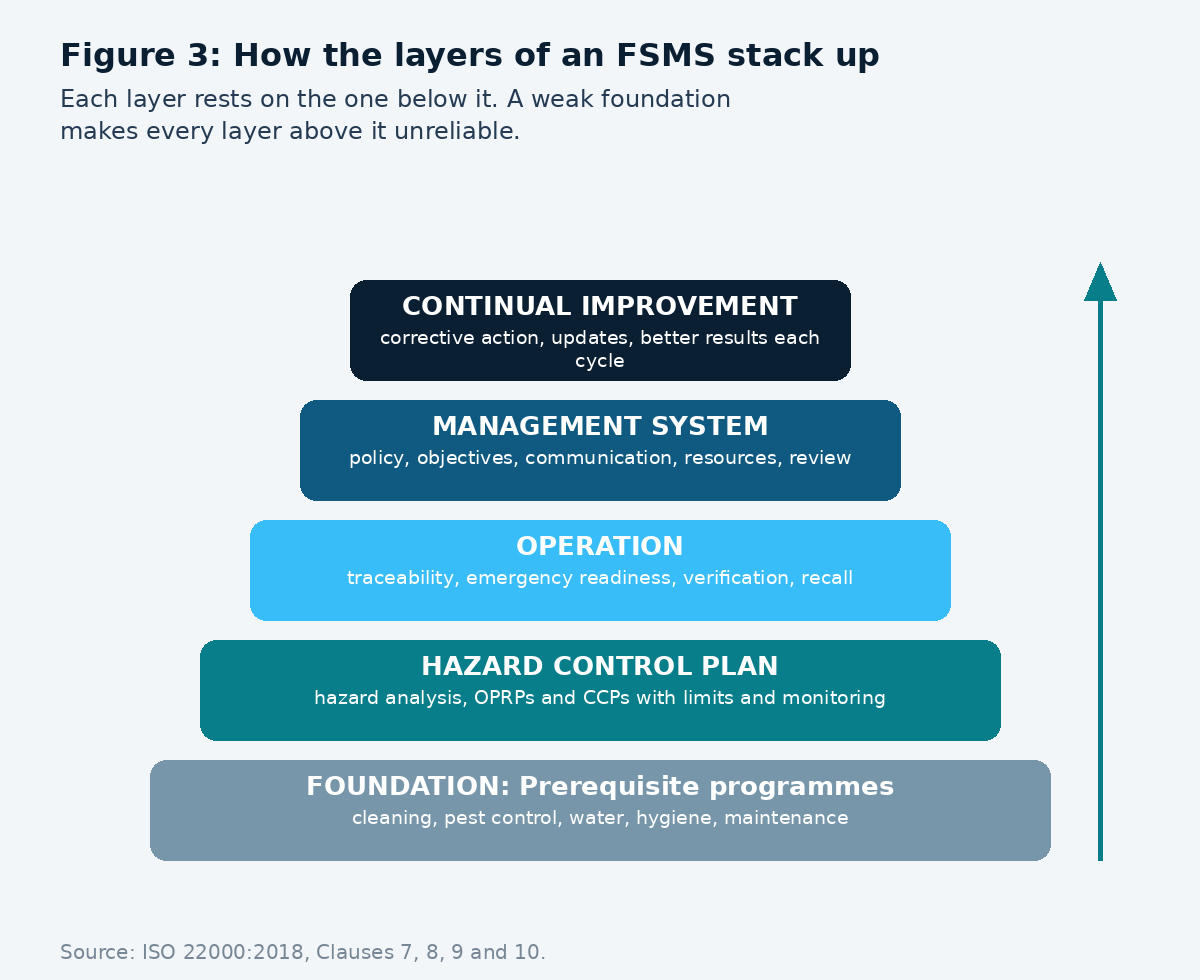
Figure 3 shows how the layers stack: PRPs at the foundation, the hazard control plan above them, then operation, then the management system, with continual improvement on top. A weak foundation makes every layer above it unreliable.
How to Build an FSMS Step by Step
Building an FSMS is a project with a clear order. The steps below follow the structure of ISO 22000:2018, Clauses 4 to 10.
- Set the scope and get management behind it. Decide which products, processes and sites the system covers, get top management to approve the policy and the resources, and name the food safety team and its leader.
- Describe the context. List the internal and external issues that affect food safety, and the needs of customers, suppliers and regulators.
- Put the prerequisite programmes in place. Cleaning, pest control, water, hygiene, maintenance and supplier approval come before hazard analysis, because the analysis assumes they work.
- Describe the products and draw the flow diagram. Record ingredients, packaging, shelf life, storage and intended use, including vulnerable consumers. Draw every step from receiving to dispatch, then confirm it on the production floor.
- Run the hazard analysis. List the hazards at each step, judge which are significant, and choose the control measures. Sort them into PRPs, OPRPs and CCPs, and write the hazard control plan.
- Set the limits and the monitoring. Give each CCP a measurable critical limit and each OPRP an action criterion. Decide who checks, what they check, how and how often, and the corrective action for a missed limit.
- Train, run and record. Train the people who carry out each control, run the system, and record the monitoring, corrective actions and verification results as they happen.
- Check, review and improve. Run internal audits, review the results with management, fix the causes of problems, and update the system when a product, process, ingredient or piece of equipment changes.
FSMS vs HACCP vs ISO 22000 vs GMP
These terms are often confused. An FSMS is the whole management system. HACCP is the hazard control method inside it. ISO 22000 is the standard that describes the requirements for an FSMS. GMP is the set of general hygiene and operating practices that forms the foundation.
| FSMS | HACCP | ISO 22000 | GMP | |
|---|---|---|---|---|
| What it is | The whole management system for food safety | A hazard control method | The international standard for an FSMS | General hygiene and operating practices |
| Focus | Policy, people, procedures, records and improvement | Specific hazards at specific steps | Management, planning, HACCP and PRPs | The whole facility and its conditions |
| Scope | The entire business and its food chain | One product or process | Any organisation in the food chain | One facility and its operations |
| Certifiable? | Yes, against ISO 22000 or a GFSI-benchmarked scheme | Usually audited inside another scheme | Yes | Audited inside other schemes |
| Who sets the rules | ISO 22000, or a scheme such as FSSC 22000 | Codex CXC 1-1969 Rev. 2020 | ISO Technical Committee 34 | Regulators, industry codes, customers |
| Best for | Running food safety as a managed system | Building your hazard control plan | A company-wide certifiable system | Your baseline hygiene programme |
What Is Law, What Is a Standard, and What Is Guidance?
One of the most common mistakes is treating a voluntary standard as if it were the law. The five kinds of requirement below are different, and they carry different weight.
| Kind | Set by | Must you follow it? | Example |
|---|---|---|---|
| Legal requirement | A government, in law | Yes, where it applies to you | A written food safety plan under the US FSMA rule (21 CFR 117); a preventive control plan under Canada’s Safe Food for Canadians Regulations; HACCP-based procedures under EU Regulation 852/2004, Article 5 |
| International standard | ISO, by consensus | Only if you choose it, or a customer or regulator asks for it | ISO 22000:2018, the FSMS standard; certification is voluntary |
| Industry guidance | Codex, sector bodies, scheme owners | Recommended practice, not law | Codex CXC 1-1969 Rev. 2020; ISO/TS 22002 PRP guidance; GFSI-benchmarked scheme requirements (FSSC 22000, BRCGS, SQF) |
| Scientific recommendation | Validation studies and published science | The evidence behind your limits | A pasteurisation time and temperature proven to control the hazard |
| GIFSQ educational interpretation | GIFSQ, in this article | No: this article explains the subject; it is not legal advice | The plain-language explanations and the illustrative scenario below |
The law is what makes a food safety plan mandatory, and it differs by country and sector. In the United States, the FSMA preventive controls rule requires most registered food facilities to hold a written food safety plan, prepared or overseen by a Preventive Controls Qualified Individual and reanalysed at least every three years; the USDA requires HACCP plans for meat and poultry. In Canada, the Safe Food for Canadians Regulations require a preventive control plan for most licence holders. In the European Union, Regulation 852/2004 requires food business operators, except primary producers, to put permanent procedures based on HACCP principles in place. Check which rules apply to your product and country.
Illustrative scenario: A Small Dairy Builds Its FSMS
A small dairy makes pasteurised milk and yoghurt from milk collected from 40 farms. It sells 5,000 litres a day to local shops. Its FSMS is built the way this article describes, and the numbers below are illustrative, not a real plant.
The dairy starts with PRPs: a cleaning schedule for the tanks and lines, pest control, water testing, and a supplier approval file for each farm. Then it runs the hazard analysis. The significant hazard in raw milk is pathogenic bacteria, and the control is pasteurisation. The pasteuriser is a CCP with a critical limit of 72 °C for 15 seconds. An operator checks the temperature of every batch with a calibrated probe and records the result. If a batch falls below 72 °C, the corrective action is written down in advance: hold the batch, re-pasteurise it or discard it, find the cause, and record the action. Allergen segregation between the plain and flavoured yoghurt runs is an OPRP, managed against an action criterion of a completed changeover cleaning check. The owner reviews the records each month.
Common FSMS Mistakes to Avoid
- A system that only exists on paper. Documents without trained people, monitoring and records are not a system.
- Weak PRPs. If hygiene is poor, the hazard control plan ends up with too many CCPs and is hard to run.
- Copying a generic system. An FSMS has to match your products, processes and equipment.
- Confusing OPRPs and CCPs. A CCP has a measurable critical limit and the product is held when it is missed. An OPRP has an action criterion, and the team judges whether the product can be released.
- No management review. A system nobody reviews slowly drifts away from what the plant actually does.
- Never updating the system. New ingredients, suppliers and equipment all change the hazards.
Free FSMS Resources from GIFSQ
- Learn the hazard control method in the HACCP Principles and Implementation course, a free intermediate program.
- Go deeper with the ISO 22000 Lead Auditor course.
- Learn corrective action in the Mastering CAPA course.
- Learn to audit your own system with the Internal Auditing Best Practices course.
- Start from the basics with the Food Safety Basics course.
- Read the ISO 22000 page for the standard in brief.
- Compare the systems in HACCP vs ISO 22000, ISO 22000 vs FSSC 22000 and CCP vs OPRP.
- Build your plan with the HACCP and Food Safety Plan Helpers.
- Use the Internal Food Safety Audit guide (40-point checklist).
- Download ready-to-use SOPs and templates.
- Check your understanding with the free food safety quizzes.
- Need expert support with your system or audit? Book a consultation.
Frequently Asked Questions
What is a food safety management system?
An FSMS is the organised set of policies, procedures, people and records a food business uses to keep its food safe every day. It combines good hygiene practices, a HACCP-based hazard control plan and management routines such as training and checking results.
What are the elements of an FSMS?
ISO 22000:2018 names four key elements: interactive communication, system management, prerequisite programmes and HACCP principles. Around them sit policy, objectives, resources, documentation, verification and continual improvement through the PDCA cycle.
What is the difference between HACCP and an FSMS?
HACCP is a method for controlling hazards at specific process steps. An FSMS is the whole management system around it: policy, hygiene programmes, communication, records and the improvement cycle. HACCP is one part of an FSMS, not the whole of it.
Is ISO 22000 the same as an FSMS?
No. ISO 22000:2018 is the international standard that describes the requirements for an FSMS. An FSMS is the system a business actually runs. A business can build an FSMS without ISO 22000, and it can have its FSMS certified against ISO 22000.
Is a food safety management system mandatory?
It depends on your country and sector. Many regulators require a documented food safety plan, such as the FSMA food safety plan in the United States or the preventive control plan under Canada’s Safe Food for Canadians Regulations. ISO 22000 certification is voluntary.
How long does it take to build an FSMS?
There is no fixed time. A small business with strong hygiene practices and one product line can build a working system in weeks; a large plant with many products takes months. The time depends on how much of the foundation already exists and how many people must be trained.
Conclusion
An FSMS turns food safety from a set of documents into a managed routine: hygiene programmes keep the plant fit, the hazard control plan controls the significant hazards, management sets the direction and checks the results, and the PDCA cycle improves the system a little at a time. Start with strong prerequisite programmes, build the hazard control plan with a team, and review the system whenever something changes.
Ready to put it into practice? Explore our courses, try the free HACCP tools, or book a consultation with a GIFSQ expert.
References
- ISO 22000:2018, Food safety management systems: Requirements for any organization in the food chain. International Organization for Standardization, published June 2018.
- Codex Alimentarius Commission, General Principles of Food Hygiene, CXC 1-1969, Rev. 2020. FAO/WHO.
- ISO/TS 22002-1, Prerequisite programmes on food safety: Food manufacturing; ISO/TS 22002-2, Catering; ISO/TS 22002-3, Farming.
- US Food and Drug Administration, Current Good Manufacturing Practice, Hazard Analysis, and Risk-Based Preventive Controls for Human Food, 21 CFR Part 117.
- US Department of Agriculture, Food Safety and Inspection Service, 9 CFR Part 417 (HACCP systems for meat and poultry).
- Government of Canada, Safe Food for Canadians Regulations (preventive control plan for licence holders).
- European Union, Regulation (EC) No 852/2004 on the hygiene of foodstuffs, Article 5.
- FDA, Food Code (model code adopted by US states).
- Global Food Safety Initiative, benchmarking requirements (GFSI-benchmarked schemes: FSSC 22000, BRCGS, SQF).
- US Food and Drug Administration, Grade A Pasteurized Milk Ordinance (high-temperature short-time pasteurisation: 72 °C for 15 seconds).
Author: GIFSQ. Last reviewed: November 17, 2026.
