GIFSQ ID: KBA-0407
Author: GIFSQ. Last updated: 2026-11-16.
Quick answer
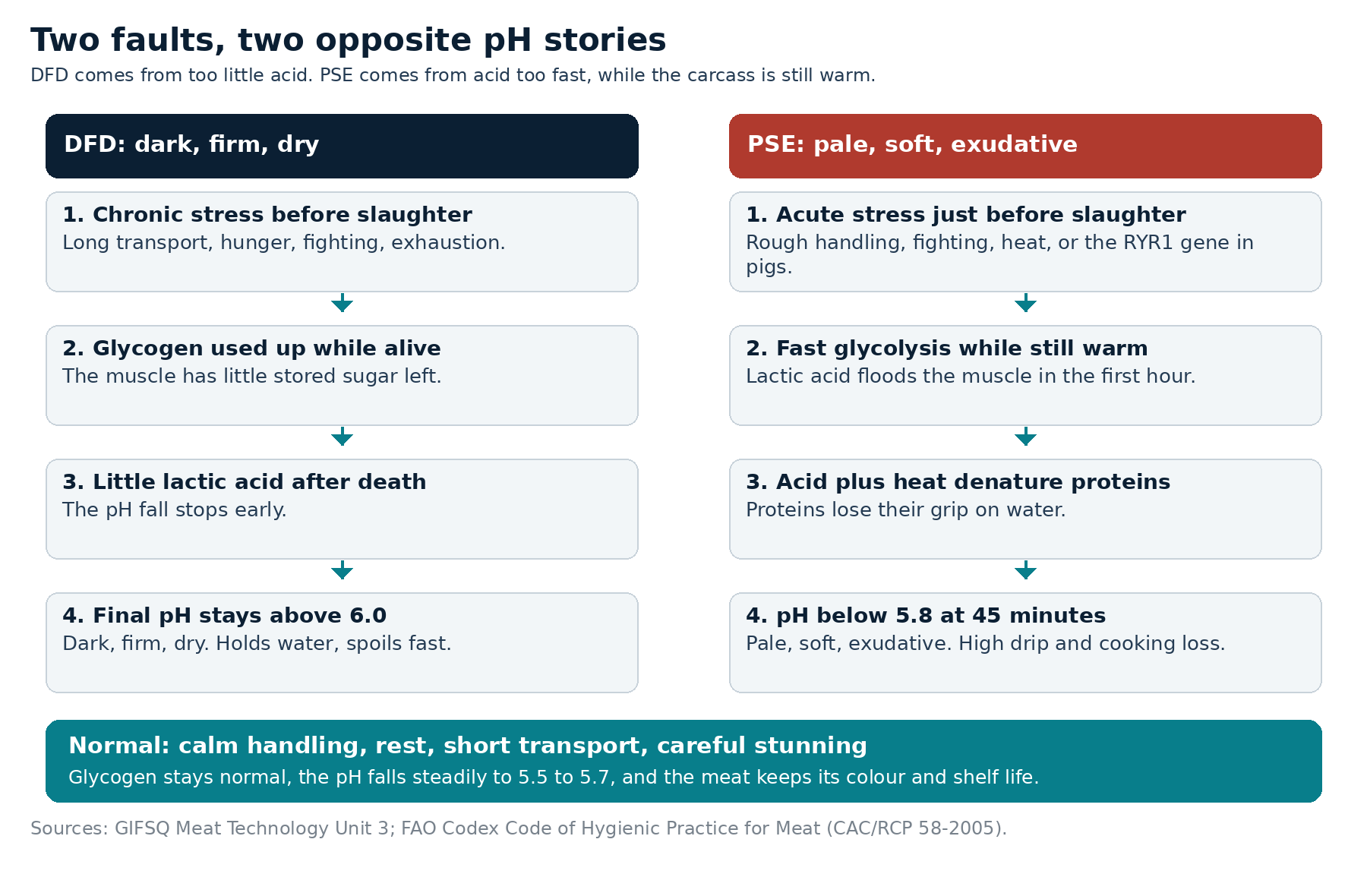
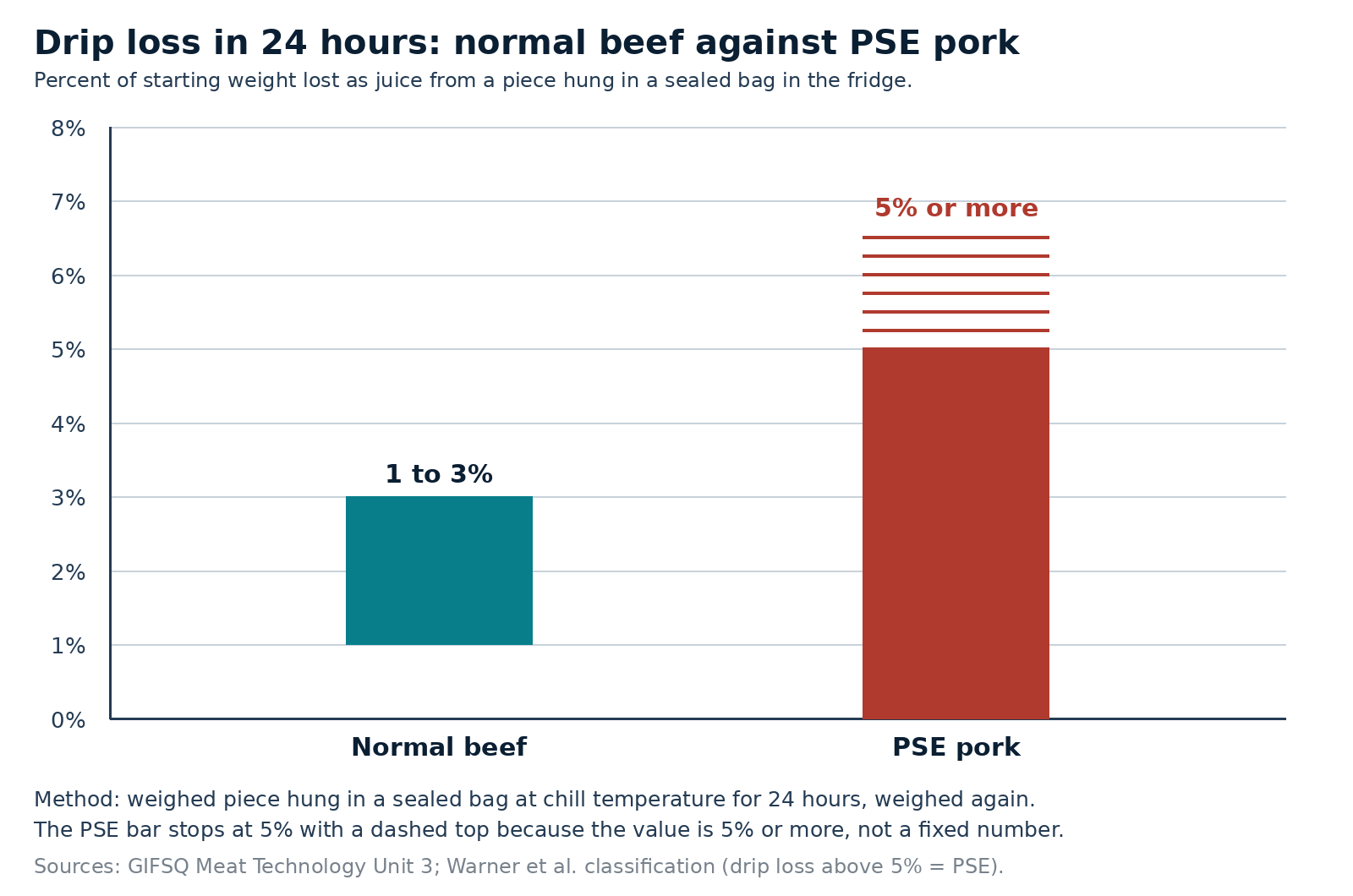
DFD and PSE are opposite quality faults of fresh meat. DFD (dark, firm, dry) meat comes from an animal stressed for a long time before slaughter: its muscle glycogen ran out, so little lactic acid formed after death, and the final pH stayed above 6.0. It looks dark and firm, with a dry surface, but spoils fast. PSE (pale, soft, exudative) meat comes from an animal stressed sharply just before slaughter, or from a pig carrying the halothane (RYR1) gene: lactic acid flooded the muscle while the carcass was still warm, the pH fell below 5.8 within 45 minutes, and acid plus heat denatured the proteins. It looks pale, feels soft, and weeps juice: PSE pork can lose 5% or more of its weight as drip in 24 hours. Neither fault makes meat unfit to eat, and both are judged by pH at 45 minutes and 24 hours, colour lightness (L*), and drip loss.
Table of contents
- Quick answer
- Key takeaways
- What is DFD meat?
- What is PSE meat?
- The principle behind both: post-mortem pH
- Types and classification
- DFD and PSE in detail
- DFD vs PSE: comparison table
- Figures
- Worked examples
- Applications
- Advantages and limitations
- Detection and prevention
- FAQs
- References
- Related GIFSQ articles
Key takeaways
- DFD and PSE are opposites: DFD is a pH fall that stops too early, PSE is one that happens too fast.
- DFD: final pH above 6.0, from long stress and glycogen loss before slaughter.
- PSE: pH below 5.8 at 45 minutes, from sharp stress just before slaughter or the RYR1 gene in pigs.
- Normal meat: final pH 5.5 to 5.7, bright cherry red, drip loss 1 to 3% per day in beef.
- DFD holds water but spoils fast; PSE loses water and cooks down badly.
- Sort them by pH at 45 minutes and 24 hours, colour lightness L*, and drip loss.
What is DFD meat?
DFD stands for dark, firm, dry. It is meat whose ultimate pH stays above 6.0 instead of falling to the normal 5.5 to 5.7. The cause sits before slaughter: an animal exposed to long, drawn-out stress, such as a long journey, hunger, fighting, or exhaustion, uses up the glycogen stored in its muscles while still alive. After death there is too little glycogen left to turn into lactic acid, so the pH fall stops early.
The high pH changes the look and feel. Swollen, tightly packed fibres absorb light instead of scattering it, so the cut surface looks dark, almost black-red, and feels firm. The proteins hold water tightly inside the fibres, so almost no free water reaches the surface and it looks dry, even though DFD meat has a high water-holding capacity: the water is there, it is just locked inside.
What is PSE meat?
PSE stands for pale, soft, exudative. It is meat whose pH falls below 5.8 within 45 minutes of slaughter, while the carcass is still warm, around 35 °C. The cause is the opposite of DFD: sharp stress in the minutes just before slaughter, or a genetic fault in pigs. The gene is the halothane gene, a mutation in the RYR1 gene that controls calcium release in muscle. In stress-susceptible pigs it triggers a fast, uncontrolled glycolysis after death. Breeding programmes that removed the halothane gene from pig lines cut PSE sharply.
The fast acid fall plus the heat of the warm carcass denatures the muscle proteins. Denatured proteins lose their grip on water, so juice leaks out of the cut surface: that is the “exudative” part, and it is why PSE pork can lose 5% or more of its weight as drip in 24 hours. The same denaturation scatters light at the surface instead of letting it pass in, so the meat looks pale and washed out, and feels soft and flabby.
PSE is mainly a pork problem, because the RYR1 gene is a pig problem. DFD is seen most often in beef, where long transport drains glycogen, and also occurs in pork and lamb.
The principle behind both: post-mortem pH
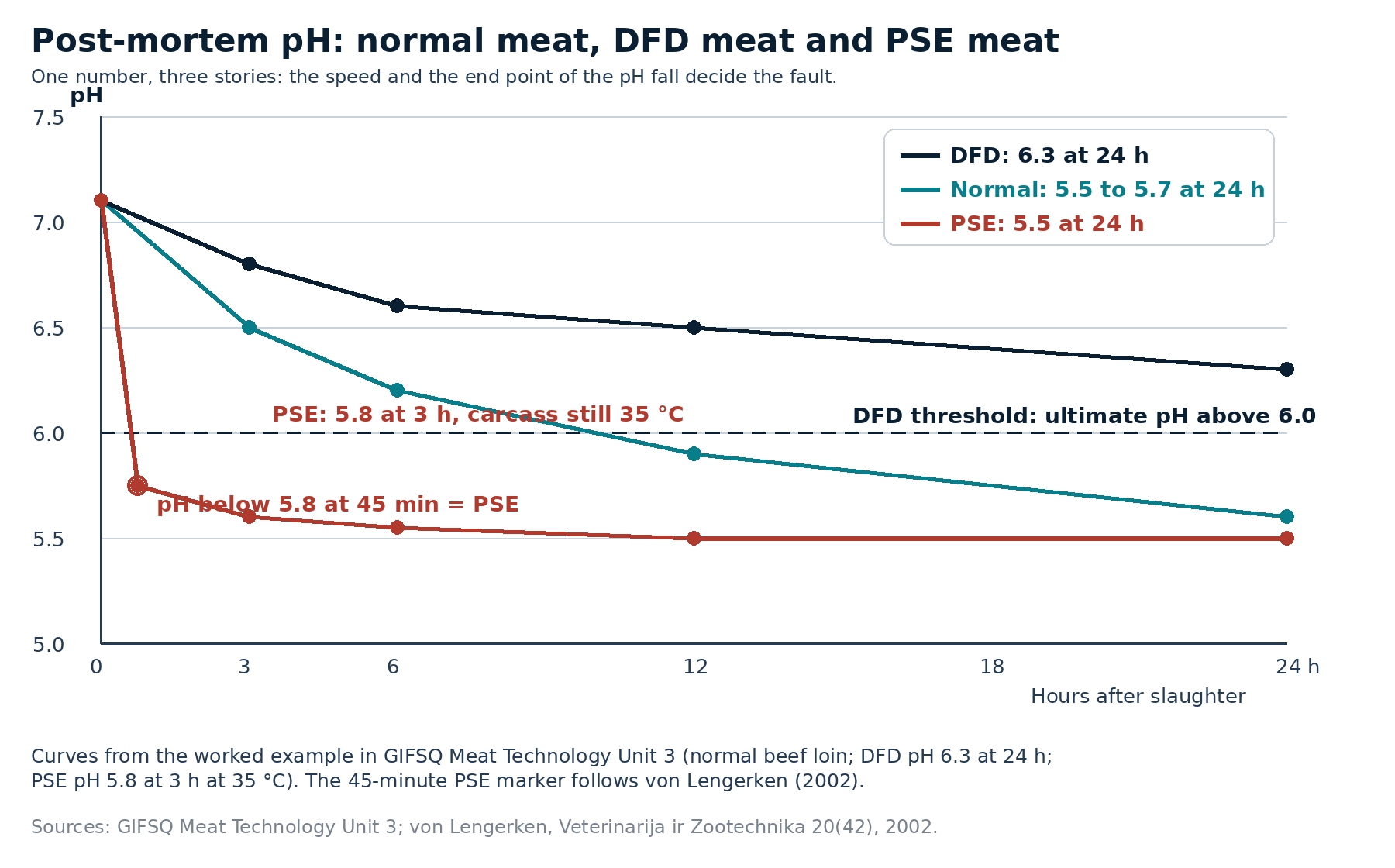
Everything in this article follows from one chain of events. In a living animal, muscle pH is about 7.0 to 7.2. At slaughter, blood flow stops, oxygen runs out, and the muscle keeps making energy without oxygen: it breaks down glycogen into lactic acid, and the acid lowers the pH. In normal beef the pH falls from 7.0 to 7.2 at slaughter to about 6.5 at 3 hours, 6.2 at 6 hours, 5.9 at 12 hours, and 5.5 to 5.7 at 24 hours. That final value is the ultimate pH.
As the pH falls, rigor mortis sets in as the muscle’s energy runs out: in beef it starts at about 10 to 12 hours and is complete at about 24 hours. The pH also passes the isoelectric point of the muscle proteins, about pH 5.0 to 5.5, where they hold the least water. Normal meat ends just above that point, so it holds a useful amount of water and keeps a bright cherry-red colour from oxymyoglobin.
DFD stops the chain early: no glycogen, little acid, pH stuck above 6.0, so the fibres stay swollen and water stays locked in. PSE runs it too fast: acid arrives while the carcass is still warm, and acid plus heat denature the proteins before the chill can protect them. Once denatured, chilling cannot undo a protein, so PSE must be prevented before slaughter, not fixed after.
Types and classification
Plants sort meat by three measurements: pH at 45 minutes (pH₄₅), pH at 24 hours (pH₂₄), and drip loss, with colour lightness (L*) as a fast extra check. One widely used pork classification, the Warner et al. criteria as used by Torres Filho et al. (2017), gives four classes:
| Class | Colour (L*) | Drip loss | pH at 24 hours |
|---|---|---|---|
| PSE (pale, soft, exudative) | above 50 | above 5% | below 6.0 |
| RSE (reddish-pink, soft, exudative) | 42 to 50 | above 5% | below 6.0 |
| RFN (reddish-pink, firm, non-exudative) | 42 to 50 | below 5% | below 6.0 |
| DFD (dark, firm, dry) | below 42 | below 5% | about 6.0 |
No single number decides the class: the bands overlap, so all three measures are read together. Other schemes use different L* cut-offs (Warriss and Brown: normal 49 to 60, DFD 42 to 48, PSE 60 to 66), and some add a fifth class, PFN (pale, firm, non-exudative), for pale meat that does not weep. A plant should use the cut-offs validated for its own instrument and muscle.
DFD and PSE in detail
Look, feel and water. DFD is dark because swollen fibres absorb light; PSE is pale because denatured proteins scatter light at the surface. DFD feels firm because its fibres are swollen and tightly packed; PSE feels soft because denaturation has loosened the protein structure. DFD holds water well: the pH is far from the isoelectric point, so proteins hold water tightly and the surface looks dry because the water stays inside the fibres. PSE holds water badly: denatured proteins cannot hold it, so juice leaves as drip and cooking loss. Normal beef loses 1 to 3% of its weight as drip per day; PSE pork loses 5% or more in 24 hours.
Shelf life and processing. DFD meat spoils fast: with no glucose left and a pH above 6.0, bacteria attack amino acids and make stale odours at low counts. PSE meat keeps a more normal shelf life, but its pale colour and wet surface make it look stale even when fresh. Neither fault makes meat unfit for human consumption, but both make it hard to process. PSE meat binds poorly, loses weight rapidly in cooking, and gives lower yields; cured products from it come out drier, paler, and two-toned. DFD meat loses less moisture in curing and cooking, but salt penetrates it slowly, so curing takes longer and can be uneven.
DFD vs PSE: comparison table
| Feature | DFD meat | PSE meat | Normal meat |
|---|---|---|---|
| Full name | Dark, firm, dry | Pale, soft, exudative | No fault |
| Cause | Chronic stress, glycogen used up | Acute stress, or RYR1 gene in pigs | Calm handling, rest, short transport |
| pH in the first hours | Above 6.0, falling slowly | Below 5.8 at 45 minutes | About 6.5 at 3 hours |
| Ultimate pH at 24 hours | Above 6.0 | 5.5 to 5.8 | 5.5 to 5.7 |
| Speed of pH fall | Too slow | Too fast, while carcass still warm | Steady over 24 hours |
| Colour | Dark, almost black-red | Pale, washed out | Bright cherry red |
| Colour lightness (L*) | Below 42 | Above 50 | 42 to 50 |
| Light scattering | Scatters less light | Scatters more light | – |
| Texture | Firm, dry surface | Soft, flabby, wet surface | Firm, moist surface |
| Water-holding capacity | High, water locked inside fibres | Low, proteins denatured | Normal |
| Protein denaturation | No denaturation of muscle protein | Denaturation of muscle protein | – |
| Drip loss in 24 hours | Low, below 5% | High, 5% or more | 1 to 3% per day (beef) |
| Shelf life | Short, spoils fast | Normal length, looks stale | Normal |
| Microbial contamination | Prone to microbial contamination | Less prone than DFD meat | – |
| Processing use | Curing is slow, salt penetration restricted | Poor binding, low yields, pale cured products | All products |
| Cooking yield | Higher than PSE | Lower | – |
| Myosin filament length | – | Reduced by around 8–10% (Kim et al., 2014) | – |
| Mostly seen in | Mostly cattle | Mostly pork, also poultry | – |
Figures
Worked examples
Illustrative scenario 1: reading a pH curve. A beef loin reads pH 6.8 at 3 hours and pH 6.3 at 24 hours. The normal curve expects about 6.5 at 3 hours and 5.5 to 5.7 at 24 hours, so this carcass is falling slowly and stops above 6.0: it is DFD. The plant should not send it for long ageing or retail display as fresh steak; it will spoil fast and look dark on the shelf.
Illustrative scenario 2: drip loss arithmetic. A 500 g piece of PSE pork loses 6% of its weight as drip in 24 hours: 500 × 0.06 = 30 g of juice in the bag. A 500 g piece of normal beef losing 2% loses 10 g. The 20 g gap is water the PSE piece will never give back, and it is lost again, faster, in cooking.
Applications
Sorting at the plant. Carcasses are probed for pH₄₅ on the line and pH₂₄ the next day, then routed: normal meat to fresh retail and ageing, PSE meat to products where binding can be helped and pale colour matters less, DFD meat to fast-turnover cooked products, never to long ageing.
Retail display. Colour decides what a shopper picks up. PSE pork looks pale and wet in the tray, so it sells slowly even when fresh; DFD beef looks dark, so shoppers read it as old.
Processing and food service. A sausage or ham maker checks the pH of incoming meat before formulating: PSE meat needs a recipe that copes with poor binding and high cooking loss; DFD meat needs a longer cure because salt moves into it slowly. A kitchen that buys PSE pork will see steaks shrink and come out dry; the fix is buying meat with a normal pH fall, or a slow, moist cook.
Advantages and limitations
DFD meat has one real strength: it holds water well, so it loses little weight in cooking and curing. Its limits are heavier: it looks dark, it spoils fast, and salt penetrates it slowly, so it is a poor choice for fresh retail, long ageing, and fast curing.
PSE meat has one narrow strength: its low pH and pale colour make it easy to spot and sort on the line, and it can still be used in formed and comminuted products where binding is helped by the recipe. Its limits are heavier: high drip loss, high cooking loss, poor binding, low yields, and pale, two-toned cured products.
Neither fault has an advantage that outweighs its cost, which is why both are prevented rather than managed. Normal meat, with a steady pH fall to 5.5 to 5.7, serves fresh retail, ageing, curing, and cooking without a compromise.
Detection and prevention
Detection. Measure pH with a probe in the muscle: pH₄₅ below 5.8 points to PSE, and pH₂₄ above 6.0 points to DFD. Measure colour with a colorimeter and read L*: high values point to PSE, low values to DFD, but only against cut-offs validated for the same instrument and muscle. Measure drip loss by the bag method: a weighed piece hung in a sealed bag at chill temperature for 24 hours, then weighed again; a loss above 5% points to PSE. Read all three together, never one alone.
Prevention. DFD is prevented before slaughter: calm handling, rest in lairage, short transport, feed and water, and no mixing of unfamiliar animals. The Codex Code of Hygienic Practice for Meat asks that lairages be built and run so animals are not exposed to undue stress, and that only animals judged sufficiently rested go to slaughter. PSE is prevented the same way, plus genetics: breeding programmes that removed the halothane gene from pig lines cut PSE sharply. Fast chilling after slaughter also helps, because it cools the muscle before the acid can do its damage, but it cannot undo proteins that are already denatured.
FAQs
Is DFD meat safe to eat? Yes. DFD is a quality fault, not a safety fault. The meat is fit for human consumption, but it spoils faster than normal meat, so cook and eat it quickly and never hold it for long ageing.
Is PSE meat safe to eat? Yes. PSE is also a quality fault, not a safety fault. The meat is fit to eat, but it loses juice, shrinks in cooking, and binds poorly, so it suits formed and comminuted products better than fresh steaks.
What pH means DFD meat? An ultimate pH above 6.0 at 24 hours. Normal meat reaches 5.5 to 5.7. The pH at 45 minutes is also high in DFD meat, because the fall is slow from the start.
What pH means PSE meat? A pH below 5.8 at 45 minutes after slaughter, while the carcass is still warm. The final pH at 24 hours is usually normal, 5.5 to 5.8, which is why the early reading matters: by the next day, the pH alone no longer shows the fault.
Can DFD or PSE meat be fixed after slaughter? No. Once the pH fall has gone wrong, no chill, cure, or cook puts it right. The meat can be sorted and used well, but the fault is set in the hours before and after slaughter, so prevention is the only real fix.
References
- GIFSQ Food Technology Notes, Meat Technology, Unit 3: Post-mortem biochemical changes in meat. The unit gives the normal pH curve (7.0 to 7.2 at slaughter, 6.5 at 3 hours, 6.2 at 6 hours, 5.9 at 12 hours, 5.5 to 5.7 at 24 hours), the DFD description (ultimate pH above 6.0, chronic stress, glycogen depletion, dark colour from light absorption, firm texture, high water-holding capacity, fast spoilage), the PSE description (rapid pH fall while the carcass is warm at 35 °C, pale colour, soft texture, exudative, drip loss 5% or more in pork, normal beef drip loss 1 to 3% per day), rigor timing in beef (starts 10 to 12 hours, complete at 24 hours), the isoelectric point (pH 5.0 to 5.5), and beef ageing (7 to 21 days at 0 to 4 °C). Built from Lawrie’s Meat Science, 7th ed., Warriss, Meat Science, 2nd ed., and Forrest et al., Principles of Meat Science, 5th ed.
- von Lengerken, G. (2002). PSE and DFD: two opposing meat defects. Veterinarija ir Zootechnika, 20(42), 49-54. The paper gives the PSE marker (pH below 5.8 at 45 minutes), the RYR1 (halothane) gene as the causal mutation for porcine stress syndrome, and the finding that removing the halothane gene from pig lines reduced PSE.
- Torres Filho, R. de A., Cazedey, H. P., Fontes, P. R., Ramos, A. de L. S., and Ramos, E. M. (2017). Drip loss assessment by different analytical methods and their relationships with pork quality classification. Journal of Food Quality, 2017, article 9170768. doi: 10.1155/2017/9170768. The paper uses the Warner et al. pork classification (PSE: L* above 50, drip loss above 5%, pH₂₄ below 6.0; RSE: L* 42 to 50, drip loss above 5%, pH₂₄ below 6.0; RFN: L* 42 to 50, drip loss below 5%, pH₂₄ below 6.0; DFD: L* below 42, drip loss below 5%, pH₂₄ about 6.0) and confirms the bag method of Honikel as the standard drip loss method.
- Warriss, P. D., and Brown, S. N. Colour lightness bands for pork (normal L* 49 to 60, DFD 42 to 48, PSE 60 to 66), as reported in the pork quality classification literature.
- Newton, K. G., and Gill, C. O. (1978). The development of the anaerobic spoilage flora of meat stored at chill temperatures. Journal of Applied Bacteriology, 44, 197-205. DFD meat spoils fast because, with glucose absent, bacteria attack amino acids and make stale odours at low cell counts.
- Fujii, J., et al. (1991). Identification of a mutation in porcine ryanodine receptor associated with malignant hyperthermia. Science, 253(5018), 448-451. The RYR1 gene mutation behind stress susceptibility in pigs.
- FAO. Meat processing technology for small- to medium-scale producers (FAO Agricultural Services Bulletin). PSE meat has poor binding properties, loses weight rapidly during cooking, and gives lower processing yields; DFD meat shows less moisture loss in curing and cooking but restricted salt penetration; neither is unfit for human consumption.
- Jacobs, J. (1978). Pale, Soft and Exudative (PSE) Pork. University of Idaho Cooperative Extension Service, Current Information Series No. 454. PSE pork makes cured products drier, paler, and two-toned; PSE is linked to stress before slaughter and to genetics.
- FAO/WHO Codex Alimentarius. Code of Hygienic Practice for Meat, CAC/RCP 58-2005, 2nd edition (2009). Lairages should be designed and run so animals are not exposed to undue stress, and only animals judged sufficiently rested should go to slaughter.
- Monroy, M., Prasher, S., Ngadi, M. O., Wang, N., and Karimi, Y. (2010). Pork meat quality classification using Visible/Near-Infrared spectroscopic data. Biosystems Engineering, 107, 271-276. The paper lists five pork quality classes: RFN, PSE, DFD, RSE and PFN (pale, firm, non-exudative).
- Simoes, J., editor-in-chief (2026). Encyclopedia of Livestock Medicine for Large Animal and Poultry Production. Springer Nature, 1,645 pages. Entry: Pale, Soft, Exudative Meat, Table 1, p. 955: Difference between pale, soft, exudative and dark-firm dry meat. ISBN 978-3-031-61548-1.
- Kim, Y. H. B., Warner, R. D., and Rosenvold, K. (2014). Influence of high pre-rigor temperature and fast pH fall on muscle proteins and meat quality: A review. Animal Production Science, 54(4), 375-395. The review on high pre-rigor temperature and fast pH fall cited under the encyclopedia table above; the source for the myosin filament shortening in PSE meat.
Related GIFSQ articles
- Difference Between TSS and TDS (Food & Water): the previous comparison in this series, on total suspended and dissolved solids.
- Water Activity vs Moisture Content: water activity and moisture, the two numbers that decide how fast food spoils, and why DFD meat spoils fast at a high pH.
- What Is HACCP? The 7 Principles Explained: the food safety system that covers pre-slaughter handling, chilling, and processing control.
- Difference Between Cured and Uncured Meat: curing, and why salt penetration matters in DFD meat.
- Difference Between Red Meat and White Meat: colour and composition across meat types.
- Difference Between Fresh Meat and Processed Meat: what processing does to fresh meat.
- Difference Between Fermented Meat and Salt-Cured Meat: two preservation routes that depend on pH and salt.
- Difference Between Pathogenic and Spoilage Microorganisms: the spoilage bacteria that end DFD shelf life early.
- Meat Technology (Food Technology Notes): the full FTN subject, including Unit 3 on post-mortem biochemical changes.
- Drip Loss Calculator: work out drip loss from before and after weights.
- Water-Holding Capacity Calculator: work out water-holding capacity from a press or drip test.
- Water-Holding Capacity Worksheet: record and compare water-holding results.
- Meat Quality Quiz: test what you know about meat quality.
- Rigor Mortis Quiz: rigor mortis and post-mortem change.
- Postmortem Biochemistry Quiz: glycolysis, pH fall, and rigor.
- HACCP Principles and Implementation (course): the course that covers hazard control from slaughter to shelf.
