Food Processing Quiz: Thermal, Freezing & Drying Quizzes
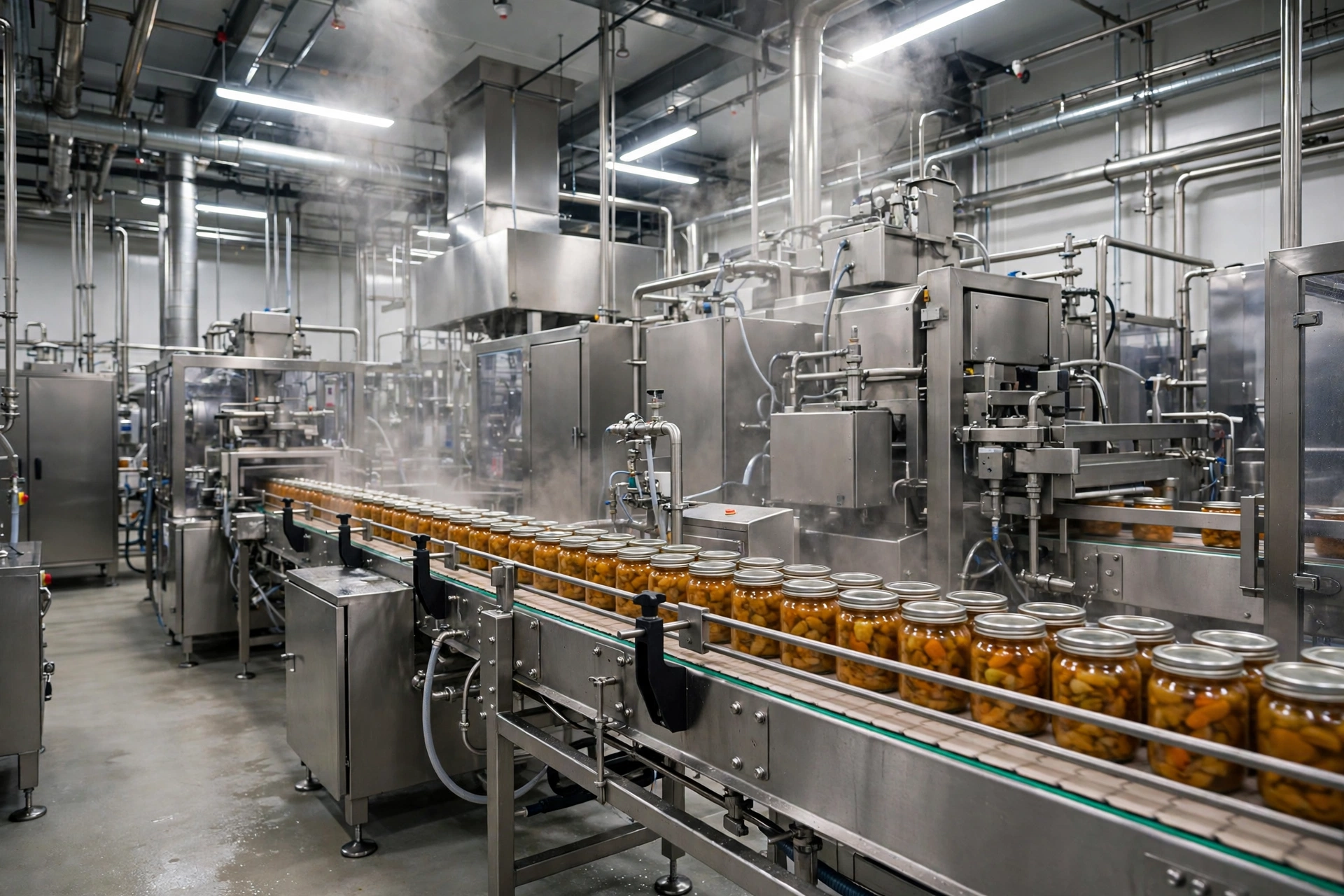
A sealed can of tuna stays safe on a shelf for years without refrigeration. Behind that ordinary fact sits a validated retort schedule designed to destroy Clostridium botulinum spores, the reference hazard for low-acid canned foods. Every preservation method works the same way: identify what makes the food spoil or become unsafe, then apply a controlled process that stops it. This food processing quiz hub covers the full toolkit, from canning lines that are a century old to cold plasma units still entering plants today.
Each set holds 20 multiple-choice questions on one preservation method or technology. Read the process description first, attempt the set closed-book, then study the explanations for every miss before re-taking. Pair this hub with the food engineering quizzes when you want the calculation side of the same operations. For hazards, critical limits, and management systems, see the food safety and HACCP quizzes; for finished-product development, the food product technology quizzes continue the story.
Difficulty runs from Beginner (definitions and recognition, such as naming the target organism in milk pasteurization) through Intermediate (comparing methods and predicting outcomes) to Advanced (process calculations, parameter selection, and validation concepts) and Expert (troubleshooting scenarios and multi-step process design). Operators often start at Intermediate; students should begin with the fundamentals group.
Processing Fundamentals and Shelf Life
Processing Fundamentals: Why foods are processed at all: the goals of safety, shelf life, and quality, plus the vocabulary of unit operations and process flow diagrams.
Shelf-Life Preservation: What limits shelf life: microbial, chemical, and physical deterioration, and how hurdle concepts combine mild treatments for stability.
Heat-Based Processing
Thermal Processing: Time-temperature relationships, D- and z-values, and how lethality calculations prove a heat process is safe.
Pasteurization: Mild heat treatments for milk, juice, and beer: HTST and UHT principles, target organisms, and quality trade-offs.
Sterilization: Full destruction of microorganisms and spores for shelf-stable products, including in-container and aseptic approaches.
Canning: The classic shelf-stable package: can seaming, exhausting, and the process steps that keep low-acid foods safe.
Retort Processing: Steam and water-immersion retorts, come-up time, and scheduled processes validated for commercial sterility.
Microwave Processing: Dielectric heating for tempering, drying assist, and pasteurization; penetration depth and uniformity challenges.
Ohmic Heating: Passing electric current directly through food for rapid, uniform heating of pumpable products with particulates.
Cold and Moisture Control
Drying & Dehydration: Removing water to halt microbes: tray, spray, and freeze drying, plus drying curves and rehydration quality.
Freezing: Ice crystallization, freezing rates, and cold-chain practice; why fast freezing protects texture.
Refrigeration: Chilled storage principles: temperature control, humidity management, and the refrigeration cycle in food plants.
Chilling: Rapid cooling after cooking or slaughter: cook-chill systems and the race past the temperature danger zone.
Fermentation, Chemical, and Atmosphere Methods
Fermentation: Controlled microbial transformation: yogurt, cheese, sauerkraut, and soy sauce, with starter cultures and acid development.
Chemical Preservation: Organic acids, sulfites, and nitrites: mechanisms of action, usage levels in general terms, and label implications.
Modified Atmosphere: Changing the gas mix inside a package to slow spoilage: MAP gases, film permeability, and produce respiration.
Controlled Atmosphere: Precision gas storage for fruits and bulk commodities: oxygen, carbon dioxide, and ethylene management over months.
Novel and Emerging Technologies
High Pressure Processing: HPP inactivates pathogens with pressure instead of heat, keeping fresh flavor in juices and ready meals.
Pulsed Electric Field: PEF uses short electric pulses that perforate microbial membranes, applied in juice preservation and extraction.
Cold Plasma: Ionized gas treatments for surface decontamination of produce, grains, and packaging materials.
Irradiation: Ionizing radiation doses for sprout inhibition, insect control, and pathogen reduction; labeling rules in broad terms.
Ultrasound: Power ultrasound for cleaning, emulsification, extraction, and assisting microbial inactivation.
Emerging Technologies: The horizon: UV-LED, pulsed light, and other methods moving from laboratory trials to production lines.
Suggested learning path
- Processing Fundamentals and Shelf-Life Preservation, to frame every method that follows.
- Pasteurization and Thermal Processing, the heat-preservation core with its lethality math.
- Canning, Retort Processing, and Sterilization, where thermal processing meets packaging.
- Drying & Dehydration, Freezing, Refrigeration, and Chilling, the temperature and moisture track.
- Fermentation and Chemical Preservation, the biological and chemical track.
- Modified Atmosphere and Controlled Atmosphere, the gas-phase track.
- Microwave Processing and Ohmic Heating, alternative heating methods.
- High Pressure Processing, Pulsed Electric Field, Irradiation, Ultrasound, Cold Plasma, and Emerging Technologies, the non-thermal frontier.
Who should take these quizzes
Plant operators and production supervisors validate what they run every shift. QA staff connect process parameters to the critical limits they monitor. Food science students meet the methods behind their textbooks. Auditors test process-validation knowledge against schemes built on Codex and GFSI-recognized standards. R&D teams scouting novel technologies get a fast orientation before pilot trials.
When you finish a set here, browse all quizzes in the GIFSQ Quiz Center for related topics across the full library.
GIFSQ Food Safety Desk · Published: October 1, 2026
Quizzes in this category
Every quiz in this category, with answers. Pick one to start.
Fermentation & Traditional Foods
- Acetic Fermentation Quiz (20 questions)
- Alcoholic Fermentation Quiz (20 questions)
- Contamination Control in Fermentation Quiz (20 questions)
- Fed-Batch Quiz (20 questions)
- Fermentation , Part 2 (20 questions)
- Fermentation , Part 3 (20 questions)
- Fermentation Quiz (20 questions)
- Fermentation and Pickling Quiz (20 questions)
- Fermentation and Probiotics Quiz (20 questions)
- Fermentation Fundamentals Quiz (20 questions)
- Fermentation Kinetics Quiz (20 questions)
- Fermentation Media Quiz (20 questions)
- Fermentation Process Control Quiz (20 questions)
- Fermentation Quiz (Set 2) (20 questions)
- Fermentation Scale-Up Quiz (20 questions)
- Fermentation Technology Quiz (20 questions)
- Fermented Foods , Part 2 (20 questions)
- Fermented Foods , Part 3 (20 questions)
- Fermented Foods Quiz (20 questions)
- Fermented Foods Quiz (Set 2) (20 questions)
- Food Fermentation and Industrial Microbiology , Part 1 Quiz (20 questions)
- Food Fermentation and Industrial Microbiology , Part 2 Quiz (20 questions)
- Food Fermentation and Industrial Microbiology , Part 3 Quiz (20 questions)
- Food Fermentation and Industrial Microbiology , Part 4 Quiz (20 questions)
- Food Fermentation and Industrial Microbiology , Part 5 Quiz (20 questions)
- Food Fermentation and Industrial Microbiology , Part 6 Quiz (20 questions)
- Industrial Fermentation Products Quiz (20 questions)
- Lactic Fermentation Quiz (20 questions)
- Other Fermentation Products Topics Quiz (20 questions)
- Probiotics & Prebiotics Quiz (20 questions)
- Probiotics and Prebiotics Quiz (20 questions)
- Solid-State Fermentation Quiz (20 questions)
- Soybean and Fermented Foods Quiz (20 questions)
- Submerged Fermentation Quiz (20 questions)
Food Processing & Preservation
- Advanced Preservation Quiz (20 questions)
- Aging Quiz (20 questions)
- Biological Preservation Quiz (20 questions)
- Blanching Quiz (20 questions)
- Canning , Part 2 (20 questions)
- Canning , Part 3 (20 questions)
- Canning Quiz (20 questions)
- Cold Plasma Quiz (20 questions)
- Curing Quiz (20 questions)
- Downstream Processing Quiz (20 questions)
- Emerging Preservation Technologies Quiz (20 questions)
- Food Irradiation Quiz (20 questions)
- Food Irradiation Technology Quiz (20 questions)
- Food Preservation Quiz (20 questions)
- Food Preservation and Thermal Processing Quiz (20 questions)
- Food Preservation Methods Quiz (20 questions)
- Food Preservation Principles Quiz (20 questions)
- Food Processing Quiz (20 questions)
- Food Processing Fundamentals Quiz (20 questions)
- Food Processing Technology Quiz (20 questions)
- Food Product Development Shelf-Life Quiz (20 questions)
- Food Product Preservation Quiz (20 questions)
- HPP Quiz (20 questions)
- Irradiation , Part 2 (20 questions)
- Irradiation Quiz (20 questions)
- Irradiation Quiz (Set 2) (20 questions)
- Microwave and Dielectric Heating , Part 2 (20 questions)
- Microwave and Dielectric Heating Quiz (20 questions)
- Minimal Processing , Part 2 (20 questions)
- Minimal Processing Quiz (20 questions)
- Ohmic Heating Quiz (20 questions)
- Ohmic Heating Technology Quiz (20 questions)
- Other Emerging Food Processing Topics Quiz (20 questions)
- Ozone Quiz (20 questions)
- PEF Quiz (20 questions)
- Pasteurization Quiz (20 questions)
- Post-pasteurization Contamination Quiz (20 questions)
- Preservation Quiz (20 questions)
- Preservation Principles Quiz (20 questions)
- Processing & Preservation , Part 1 Quiz (20 questions)
- Processing & Preservation , Part 2 Quiz (20 questions)
- Processing Aids Quiz (20 questions)
- Shelf-Life Studies Quiz (20 questions)
- Thermal Preservation Quiz (20 questions)
- Thermal Processing , Part 2 (20 questions)
- Thermal Processing Quiz (20 questions)
- Thermal Processing and Canning Quiz (20 questions)
- UHT Quiz (20 questions)
- UV Processing Quiz (20 questions)
