Food Engineering Quiz: Heat Transfer & Unit Operations
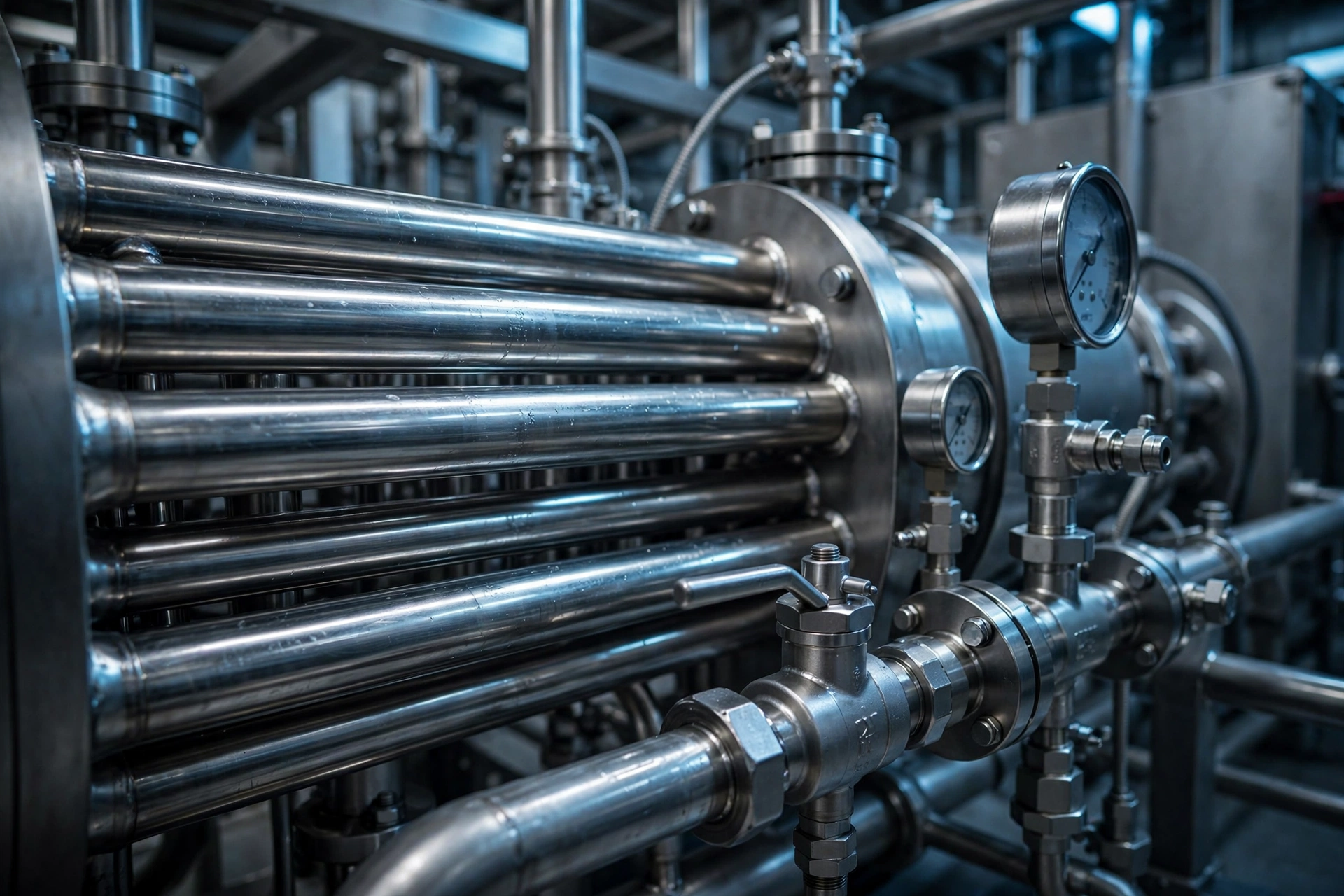
Scaling a sauce from a 50-liter pilot kettle to a 5,000-liter production vessel is not a matter of multiplying the recipe. Heat transfer rates change, mixing times stretch, and pump curves decide whether the line still reaches its pasteurization target. Food engineering supplies the calculations that keep scale-up safe and consistent. This food engineering quiz hub trains those calculations alongside the unit operations and control systems that run a modern food plant.
Each set holds 20 multiple-choice questions on one engineering topic. Work calculation questions with pen and paper before looking at the options; guessing from the answer list teaches nothing. Read every explanation, especially for unit operations you have never seen in person. For the preservation science behind these operations, pair this hub with the food processing and preservation quizzes. The chemistry underneath sits in the food science and technology quizzes, and plant-management topics continue in the food industry operations quizzes.
Beginner questions test definitions and recognition, such as naming the parts of a psychrometric chart. Intermediate questions ask you to apply a formula or select equipment for a duty. Advanced questions demand full worked calculations: balances, heat transfer rates, and pressure drops. Expert sets present troubleshooting cases where several concepts interact. Most learners should follow the suggested path below in order.
One habit pays off across every topic here: after each set, write down the three formulas you used most and the one you reached for incorrectly. Engineering exams reward fluent recall of the right equation more than clever derivation on the spot. The quizzes in this hub repeat core formulas across topics on purpose, so the balances and transfer equations become reflex rather than a lookup exercise.
Engineering Fundamentals
Material Balance: Tracking every kilogram in and out: steady-state balances on mixers, dryers, and separators.
Energy Balance: Heat in, heat out: accounting for sensible and latent heat across a process line.
Thermodynamics: First and second law applications: refrigeration cycles, steam tables, and energy-efficiency thinking.
Psychrometry: Moist-air properties on the psychrometric chart: the backbone of drying and air-conditioning calculations.
Process Calculations: Unit conversions, concentration expressions, and the problem-solving routines every calculation set builds on.
Transport Phenomena
Heat Transfer: Conduction, convection, and radiation in foods: fouling, heat exchangers, and transient heating of solids.
Mass Transfer: Diffusion and convection of moisture, solutes, and gases: drying theory and packaging permeation.
Fluid Mechanics: Pumps, pipes, and pressure drop: Newtonian and non-Newtonian flow in real food lines.
Rheology: Engineering-side flow behavior: viscosity models such as power-law fluids and their effect on pumping and mixing.
Mechanical Unit Operations
Unit Operations: The organizing idea of process engineering: how common operations repeat across very different food lines.
Size Reduction: Crushing, grinding, and cutting: energy laws, particle size distributions, and effects on extraction and drying.
Mixing: Blending liquids, powders, and doughs: impeller types, mixing time, and scale-up rules.
Separation: Splitting streams by density, size, or solubility: the principles behind the equipment in this group.
Filtration: Cake filtration and clarification: filter media, pressure drop, and juice and oil clarification practice.
Centrifugation: Sedimentation at high g-force: cream separation, clarification, and decanter operation.
Evaporation: Concentrating liquids under vacuum: multiple-effect evaporators, boiling-point elevation, and energy economy.
Drying: Equipment-side drying: spray dryers, tray dryers, and fluidized beds, with heat and mass balances on each.
Membrane Technology: Reverse osmosis, ultrafiltration, and microfiltration: concentration and fractionation without heat.
Process Control and Equipment
Process Control: Feedback loops, PID tuning basics, and how controllers hold temperature and flow on target.
Automation: PLCs, SCADA, and recipe management: how modern food plants run with fewer manual interventions.
Process Instrumentation: Sensors and transmitters for temperature, pressure, flow, and level, with calibration thinking throughout.
Food Processing Equipment: The hardware itself: materials of construction, hygienic design principles, and equipment selection logic.
Suggested learning path
- Process Calculations, then Material Balance and Energy Balance, the accounting every engineer does daily.
- Thermodynamics and Psychrometry, for energy systems and air-water behavior.
- Fluid Mechanics, then Heat Transfer and Mass Transfer, the transport core.
- Rheology, since food flow behavior shapes equipment choice.
- Unit Operations as an overview, then Size Reduction, Mixing, Separation, Filtration, Centrifugation, and Membrane Technology.
- Evaporation and Drying, the concentration and dehydration operations.
- Process Instrumentation, Process Control, and Automation, the measurement-to-control chain.
- Food Processing Equipment, where theory meets hygienic hardware selection.
Who should take these quizzes
Food engineering and food technology students preparing for exams and placement tests. Plant and process engineers who validate lines and troubleshoot throughput problems. QA staff who review process validations and critical limits. Auditors assessing whether a facility’s processes match its documented controls. Career switchers from mechanical or chemical engineering entering the food industry get a structured bridge into food-specific practice.
Ready for more? Browse all quizzes in the GIFSQ Quiz Center and keep working through the library.
GIFSQ Food Safety Desk · Published: October 1, 2026