Gut Microbiome & Cardiovascular Defense: Fiber and Prebiotics
1. Executive Summary & Biological Hazard/Benefit Profile

The gut microbiome is increasingly recognized as a metabolic interface between dietary substrates and host cardiovascular physiology. The relevant question is not whether a specific bacterial species is universally “good” or “bad.” The more defensible engineering model is functional: what substrates reach the colon, which organisms can utilize them, which metabolites are produced, and how those metabolites interact with intestinal, hepatic, vascular, renal and immune systems.
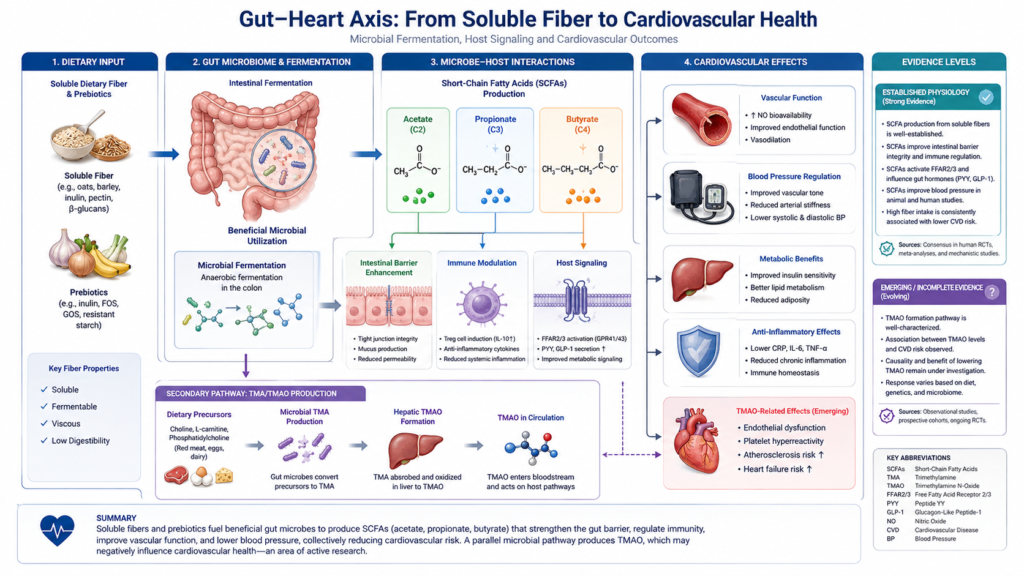
Dietary fiber is particularly important because humans lack the enzymes required to digest many fiber structures in the small intestine. Fermentable fractions can therefore reach the colon, where microbial metabolism generates short-chain fatty acids (SCFAs), principally acetate, propionate and butyrate. These metabolites can influence epithelial integrity, immune signaling, vascular physiology, appetite and metabolic regulation.
Recent reviews identify several microbiome-linked pathways relevant to cardiovascular disease, including SCFAs, trimethylamine-N-oxide (TMAO), bile-acid signaling, intestinal permeability and inflammatory pathways. However, the causal chain remains incomplete. Associations between dysbiosis and cardiovascular disease do not establish that correcting a particular microbiome signature will prevent cardiovascular events.
A 2025 systematic review and meta-analysis of prebiotic interventions found a significant reduction in systolic and diastolic blood pressure among hypertensive participants in the human studies analyzed: approximately −8.5 mmHg systolic and −5.2 mmHg diastolic. The pooled result across hypertensive and non-hypertensive participants was not statistically significant. This distinction is important: promising intervention-specific findings should not be converted into a universal claim that prebiotics prevent cardiovascular disease.
The evidence therefore supports fiber-rich dietary patterns as a cardiovascular nutrition strategy while treating isolated prebiotic supplements as an emerging intervention requiring dose-specific and product-specific validation.
2. Industrial and Physiological Mechanisms
2.1 Soluble fiber as a fermentation substrate
Soluble fiber is a broad functional category rather than a single chemical entity. Pectin, beta-glucans, gums and some resistant or fermentable carbohydrate fractions can alter viscosity, nutrient diffusion and microbial substrate availability.
From a food-processing perspective, molecular structure matters. Degree of polymerization, branching, linkage chemistry, molecular weight, hydration characteristics and processing history can change both physicochemical behavior and microbial fermentability.
Oats and barley provide beta-glucans. Fruits and vegetables contribute pectins. Legumes provide multiple fermentable carbohydrate fractions. Psyllium is a viscous soluble fiber with different physicochemical behavior from rapidly fermented fructans such as inulin.
Consequently, “fiber” should not be treated as a single microbiological input.
2.2 Microbial fermentation and SCFA generation
Once fermentable carbohydrates reach the colon, microbial metabolic networks convert them into organic acids and gases. Acetate, propionate and butyrate are the principal SCFAs.
Butyrate is particularly important for colonic epithelial metabolism. Acetate and propionate can enter systemic circulation and participate in host metabolic signaling. SCFAs also interact with G-protein-coupled receptors and other signaling pathways involved in immune and vascular regulation.
The response is substrate-dependent and person-dependent. Two individuals consuming the same fiber may generate different microbial metabolites because baseline microbiome composition, transit time, medication exposure, habitual diet and host physiology differ.
This explains why microbiome interventions should not be evaluated solely by measuring whether one genus increased.
2.3 Intestinal barrier and inflammatory signaling
The intestinal barrier separates luminal microbial products from systemic circulation. Disruption of barrier function can increase exposure to microbial components such as lipopolysaccharide, potentially contributing to inflammatory signaling.
Prebiotic fibers may support barrier function indirectly through microbial metabolism and epithelial effects. However, biomarkers such as zonulin, circulating inflammatory proteins or fecal metabolites should not automatically be interpreted as validated surrogate endpoints for cardiovascular events.
2.4 TMAO and dietary substrate competition
Another gut-heart pathway involves microbial metabolism of dietary precursors such as choline and carnitine to trimethylamine, followed by hepatic conversion to TMAO.
Higher TMAO concentrations have been associated with cardiovascular disease in observational research. The mechanism is more complicated than simply labeling TMAO as a “toxin.” Production depends on substrate exposure, microbial metabolic capacity and host hepatic metabolism.
This is one reason a cardiovascular microbiome strategy cannot be reduced to “increase probiotics.” The objective should be improved overall dietary substrate quality and metabolic function rather than manipulation of one microbial measurement.
2.5 Bile-acid signaling
Gut microorganisms transform primary bile acids into secondary bile acids. These molecules participate in signaling through pathways involving receptors such as FXR and TGR5 and therefore connect intestinal microbial metabolism with lipid handling, glucose metabolism and energy regulation.
The direction and clinical importance of these effects depend on the specific bile-acid pool and host context. More microbial transformation is not inherently better; the physiological outcome depends on which metabolites are produced and at what concentrations.
3. Empirical Critical Limits & Verification Matrix
There is no validated universal “cardiovascular prebiotic dose” or microbiome critical limit equivalent to a food-safety CCP. The appropriate approach is to distinguish established dietary reference values from product-specific clinical endpoints.
| Control Parameter | Validated Operational Limit / Reference Value | Monitoring Tool & Frequency | Standard Reference |
|---|---|---|---|
| Total fiber intake | Canada AI is based on 14 g/1,000 kcal/day; adult values vary by age/sex | Dietary assessment; periodic review | Health Canada Dietary Reference Intakes |
| Adult Canadian fiber target | Common reference: 25 g/day women; 38 g/day men | Food record / dietary assessment | Health Canada |
| Prebiotic dose | No universal cardiovascular dose; establish from product-specific human trials | Controlled intervention protocol | ISAPP consensus principles |
| SCFA concentration | No universal clinical cardiovascular critical limit | Validated targeted metabolomics | Study-specific analytical SOP |
| Blood pressure | Clinical treatment target is patient-specific; not a microbiome CCP | Validated automated BP measurement | Clinical guideline / trial protocol |
Health Canada’s current consumer guidance identifies fiber as a nutrient to increase and lists 25 g/day for Canadian women and 38 g/day for Canadian men as general needs. Its Dietary Reference Intakes framework uses 14 g/1,000 kcal/day as the underlying Adequate Intake basis for total fiber.
The key QA distinction is that these are nutrition reference values, not proof that exceeding them produces additional cardiovascular protection.
4. Multi-Jurisdictional Regulatory Alignment
Canada
Health Canada regulates nutrition information and health claims on foods. Fiber quantity and labeling must be supported by applicable Canadian requirements. A general statement that fiber is associated with health should not be converted into an unauthorized disease-treatment claim.
For product development, manufacturers should distinguish:
- Total dietary fiber.
- Naturally occurring dietary fiber.
- Functional fiber.
- Isolated prebiotic ingredients.
- Probiotic microorganisms.
- Synbiotic combinations.
These categories are scientifically related but are not interchangeable.
United States
U.S. food labeling and health claims are subject to FDA requirements. A prebiotic ingredient should not be marketed as preventing, treating or curing cardiovascular disease without the regulatory basis required for such a claim.
The FDA’s treatment of dietary fiber also illustrates why ingredient classification requires evidence of physiological benefit rather than simply chemical non-digestibility.
European Union and Global Standards
EU nutrition and health claims operate under a defined authorization framework. Codex Alimentarius provides internationally relevant principles for nutrition labeling and health claims, but a scientific association does not itself establish authorization for a commercial cardiovascular claim.
For multinational product development, the evidence package should therefore separate scientific efficacy from jurisdiction-specific claim authorization.
5. Facility/Product Development Remediation Plan & QA Checklist
For a manufacturer developing a fiber-enriched or prebiotic food, the primary control problem is reproducibility.
- Raw-material qualification
- Confirm identity, purity, moisture and relevant compositional specifications.
- Establish supplier controls for botanical or carbohydrate sources.
- Define acceptance criteria for lot-to-lot variation.
- Process validation
- Assess whether extrusion, baking, milling, enzymatic treatment or thermal processing changes molecular structure.
- Measure relevant physicochemical properties after processing.
- Confirm that the finished product delivers the declared fiber quantity.
- Formulation verification
- Confirm analytical fiber content using the method appropriate to the jurisdiction and ingredient matrix.
- Avoid assuming that total fiber equals prebiotic activity.
- If a prebiotic claim is made, establish evidence that the specific substrate produces the claimed microbiological and health effect.
- Stability testing
- Evaluate fiber functionality through shelf life.
- Monitor moisture migration, oxidation where relevant, texture and ingredient interactions.
- Verify that the active substrate remains within specification.
- Human-evidence alignment
- Use the same ingredient identity, formulation and meaningful dose in efficacy trials as in the commercial product.
- Define cardiovascular endpoints before the study begins.
- Include appropriate dietary and medication controls.
6. Analytical Testing Protocols & Laboratory Diagnostics
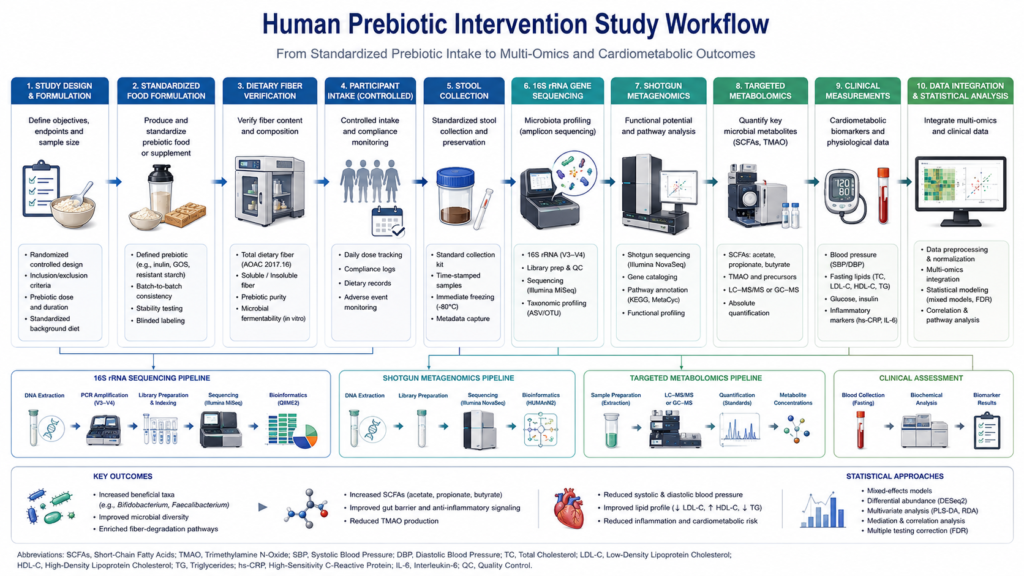
Microbiome research requires a layered analytical strategy.
16S rRNA sequencing can characterize bacterial community structure but generally does not provide complete functional resolution.
Shotgun metagenomic sequencing provides greater information on microbial genes and metabolic potential.
Targeted metabolomics can quantify SCFAs, bile acids, TMAO and related metabolites. These measurements are often more mechanistically informative than taxonomy alone.
Quantitative PCR can be useful for targeted microbial groups where validated assays are available.
Blood-pressure measurement, lipid panels and inflammatory biomarkers provide host-level outcomes that can be linked with microbiome measurements.
For high-quality intervention studies, sample collection timing, storage temperature, extraction procedures, sequencing batch, bioinformatic pipeline and metabolomic calibration must be standardized. Stool samples are particularly sensitive to collection and storage conditions, so deviations can introduce analytical variation that may be incorrectly attributed to dietary treatment.
7. Technical FAQs
Q1: Is soluble fiber automatically a prebiotic?
No. A prebiotic is defined by selective utilization by host microorganisms that confers a health benefit. Many fibers influence the microbiome, but not every fiber meets the stricter scientific definition of a prebiotic.
Q2: Does increasing beneficial bacteria prove cardiovascular benefit?
No. A taxonomic change is a mechanistic observation, not a cardiovascular endpoint. Strong evidence should connect the intervention to microbial function, relevant metabolites and clinically meaningful host outcomes.
Q3: Can prebiotics replace cardiovascular medication?
No. Current evidence does not support replacing antihypertensive, lipid-lowering or other prescribed cardiovascular therapy with prebiotic supplementation.
Q4: Is a higher SCFA concentration always better?
Not necessarily. SCFA biology is concentration-, tissue- and pathway-dependent. The objective is an appropriate metabolic profile rather than maximizing one metabolite.
Q5: What is the most defensible dietary strategy?
For the general population, increasing total fiber through vegetables, fruits, legumes, nuts, seeds and whole grains is consistent with Health Canada’s dietary guidance. Product-specific prebiotic supplementation should be evaluated separately because dose, substrate chemistry and individual tolerance vary.
8. Verified External Standards & Direct References
- Health Canada. “Fibre.” Canadian nutrition guidance and fiber intake information.
- Health Canada. “Dietary Reference Intakes Tables: Reference Values for Macronutrients.”
- Msdi AS, Wang EM, Garey KW. Nutrients. 2025;17(15):2502. PMID 40806090.
- Makkieh Y, et al. American Heart Journal Plus. 2025;61:100687. PMID 41732311.
- Edpuganti S, et al. Gut Microbiome and Cardiovascular Health: Mechanisms, Therapeutic Potential and Future Directions. 2025. PMID 41377642.
- Gibson GR, et al. ISAPP consensus statement on the definition and scope of prebiotics. Nature Reviews Gastroenterology & Hepatology. 2017;14:491–502. DOI 10.1038/nrgastro.2017.75.
- ISAPP. 2026 consensus statement on the definition and scope of gut health.
Evidence position: The strongest current case is for fiber-rich dietary patterns and selected prebiotic interventions as potential modifiers of cardiometabolic risk factors. The evidence does not yet justify claiming that a particular prebiotic product prevents cardiovascular events.
