SOP: Enumeration of Enterococci in Foods by the Pour Plate Method
GIFSQ — Global Institute for Food Safety & Quality
1. Principle
This SOP enumerates enterococci in foods following the APHA Compendium of Methods for the Microbiological Examination of Foods (CMMEF), Chapter 9, 4th Edition. Measured volumes of the sample dilution are pour-plated in KF agar containing 1% TTC solution. After incubation at 35 °C ± 1 °C for 46–50 hours, the colonies are counted and the count is calculated as colony-forming units per gram or millilitre of the food.
2. Apparatus required
- Sterile Petri dishes
- Sterile pipettes
- Water bath, for tempering the agar
- Incubator capable of maintaining 35 °C ± 1 °C
3. Reagents
- A. KF streptococcal agar (commercially available), with 2 mL of filter-sterilized 1% TTC solution added aseptically per 200 mL of medium
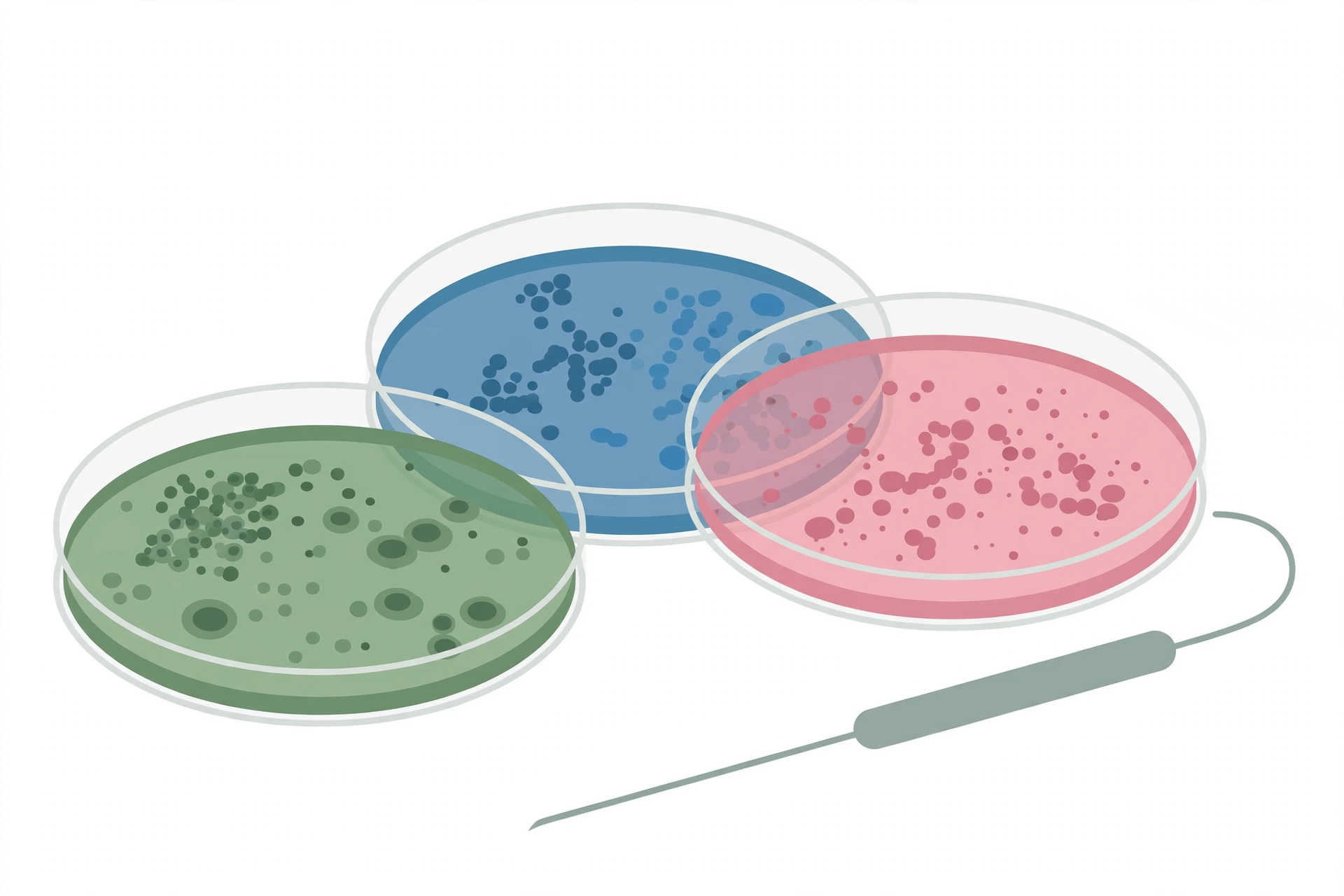
- KF agar uses sodium azide as the selective agent and TTC as the differential indicator; the medium contains 2.0% maltose and 0.1% lactose. E. faecalis reduces TTC to its red formazan derivative, giving deep red colonies; other group D enterococci and streptococci reduce it only weakly and form light pink colonies
- B. 1% TTC solution (2,3,5-triphenyltetrazolium chloride): TTC — 1.0 g; distilled water — 100.0 mL
- To prepare: suspend the TTC in 100 mL of distilled water; sterilize by filtration; aseptically dispense into containers; store refrigerated
- C. Brain heart infusion (BHI) broth, for confirmation
- D. Bile-esculin agar, for confirmation
- E. BHI broth containing 6.5% NaCl, for confirmation
- F. 3% hydrogen peroxide solution, for the catalase test
4. Sample preparation
- Prepare a 1 in 10 dilution of the sample and further decimal dilutions.
5. Procedure
Label the plates with the sample and the dilution
↓
Pipette 1 mL of the dilution into each of two sterile Petri dishes
↓
Add 2 mL of the 1% TTC solution to each 200 mL of tempered KF agar, mix, and pour 12 to 15 mL into each dish
↓
Mix gently and allow the agar to solidify
↓
Invert the plates
↓
Incubate at 35 °C ± 1 °C for 46–50 hours (48 ± 2 hours)
↓
Count all red and pink colonies with a dissecting microscope (15 diameters) or a colony counter; report the number as the KF enterococcal count
5a. Low-count variant
If a low count is expected
↓
Plate 1 mL of the 1:10 dilution into each of 10 Petri dishes
↓
Proceed as above
↓
The total number of colonies on the 10 plates is the count per g of food
5b. Confirmation of enterococci
If confirmation is desired
↓
Pick 5 to 10 typical colonies and transfer each into a separate tube of BHI broth
↓
Incubate at 35 °C for 18 to 24 hours
↓
Prepare gram-stained smears and check for typical enterococcal morphology (gram-positive cocci, elongated, in pairs and occasionally short chains)
↓
Test for catalase activity by adding 1 mL of 3% hydrogen peroxide to a culture and checking for oxygen bubbles (enterococci are catalase-negative; do not test for catalase directly on the azide-containing KF agar)
↓
Check growth with blackening on bile-esculin agar after 24 hours at 35 °C
↓
Check growth in BHI broth containing 6.5% NaCl after 72 hours at 35 °C
↓
Check growth at 45 °C in BHI broth tempered to 45 °C before incubation
6. Calculation
CFU per g or mL = N / (V × D)
Where,
- N = total number of colonies counted on all plates of the dilution
- V = total volume of diluted sample plated, in mL (2 mL for the 1 mL in duplicate scheme)
- D = dilution of the plated dilution (for example, 10^−1)
Report the count as colony-forming units per gram or millilitre of the food.
7. Precautions
- Use sterile technique throughout.
- Mix the sample gently with the agar and allow it to solidify before inverting the plates.
- Incubate at the stated temperature for the full stated time before counting.
- For dairy products, a more selective medium or a higher incubation temperature (45 °C) may be needed to reduce background growth of lactobacilli and lactic streptococci.
8. References
- APHA, Compendium of Methods for the Microbiological Examination of Foods (CMMEF), Chapter 9, 4th Edition.