Phosphatase Test in Milk Pasteurization: How It Works
GIFSQ ID: ART-2256
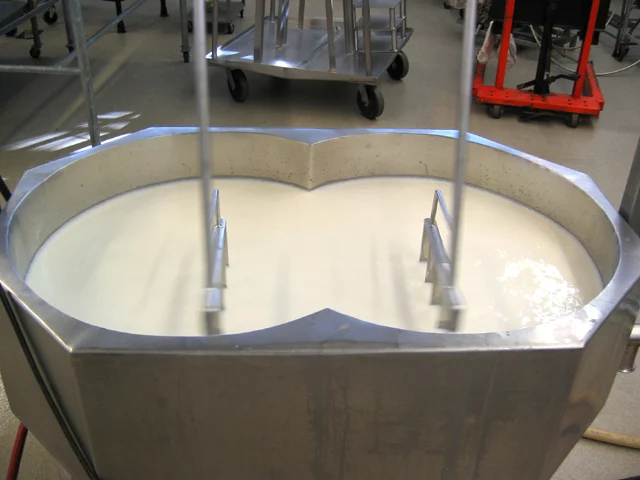
What is the phosphatase test?
Alkaline phosphatase (ALP) is an enzyme naturally present in raw milk. It is destroyed by the heat treatment needed for proper pasteurization, and it is destroyed at a slightly higher time-temperature combination than the one needed to kill the most heat-resistant milk pathogens, Mycobacterium tuberculosis and Coxiella burnetii. That margin is why the enzyme is the standard marker for pasteurization: if the heat destroyed the enzyme, it destroyed those pathogens too.
The International Dairy Federation defines pasteurization as a heat treatment that minimizes the health hazards from pathogenic micro-organisms in milk while causing minimal chemical, physical and flavour change. A pasteurized product must be cooled without delay, packaged with minimum delay under conditions that minimize contamination, and show a negative phosphatase test immediately after heat treatment.
How the test works
The test mixes a milk sample with a substrate that changes colour when active alkaline phosphatase is present. If the enzyme is still active, the sample turns yellow. If the heat treatment destroyed the enzyme, there is no colour change and the result is negative. A negative result means the milk was heated enough. A positive result means active enzyme remains, so either the heat treatment was too weak or raw milk was mixed into the pasteurized milk after heating.
In the European Union, a negative result for cows’ milk means an activity of 350 milliunits per litre or less, measured by the ISO 11816-1 standard method. In Canada, the Scharer method is the official method. In a well-run dairy, pasteurized milk typically shows activity far below the legal limit, often under 20 milliunits per litre.
The FSSAI method
The Food Safety and Standards Authority of India (FSSAI) publishes the standard method in its Manual of Methods of Analysis of Foods: Milk and Milk Products (2015), section 1.3.1, based on IS 1479 (Part II) 1961 and IS 8479 (Part II) 1977. Dairy laboratories use it to check that the heat treatment was thorough and that no raw milk was added after heating.
The substrate is disodium p-nitrophenyl phosphate in a buffer of pH 10.2. The compound is colourless in solution. Alkaline phosphatase in the milk splits it and frees p-nitrophenol, which turns an intense yellow in alkaline conditions. The yellow colour is matched against standard colour discs in a Lovibond comparator, which reads directly in micrograms of p-nitrophenol per ml of milk.
Reagents and apparatus
All reagents must be of analytical grade.
- Buffer solution: 1.5 g of sodium bicarbonate and 3.5 g of anhydrous sodium carbonate dissolved in water and made up to one litre. Store in a refrigerator and discard after one month.
- Substrate: disodium p-nitrophenyl phosphate, solid, kept in a refrigerator.
- Buffer-substrate solution: 0.15 g of substrate in a 100 ml measuring cylinder, made up to 100 ml with buffer solution. Store in a refrigerator and protect from light. It must read less than the standard marked 10 on comparator disc APTW or APTW 7 when viewed through a 25 mm cell, with distilled water as the blank. Discard after one week.
- Apparatus: a Lovibond comparator with stand for reflected light, comparator disc APTW or APTW 7, two fused glass cells of 25 mm depth, a water bath or incubator held at 37.5 ± 0.5°C, 1 ml and 5 ml pipettes, a 1 litre graduated flask, a 100 ml measuring cylinder, and test tubes of 150/16 mm with rubber stoppers.
Procedure
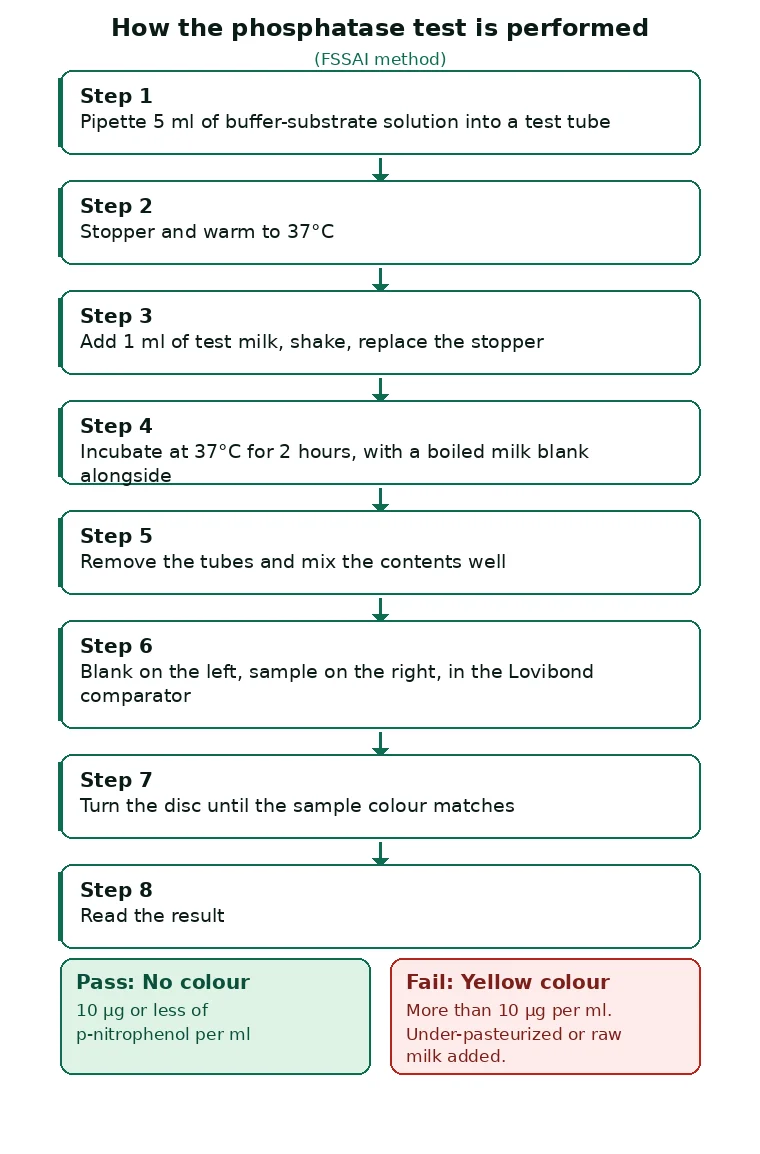
- Pipette 5 ml of buffer-substrate solution into a test tube, stopper it, and bring the temperature to 37°C.
- Add 1 ml of the test milk, shake, replace the stopper, and incubate at 37°C for 2 hours.
- Incubate one blank with each series of samples, prepared from boiled milk of the same type as the sample under test.
- After 2 hours, remove the tubes and mix the contents well.
- Place the boiled milk blank on the left of the comparator stand and the test sample on the right.
- Read in reflected light by revolving the disc until the test sample is matched. If the reading falls between two standards, mark it with a plus or minus sign against the figure for the nearest standard.
Interpretation
The test is satisfactory if it gives a reading of 10 µg or less of p-nitrophenol per ml of milk. Properly pasteurized milk gives no discernible colour. The test does not apply to sour milk or to milk preserved with chemical preservatives.
Precautions
- Clean all glassware before use by soaking in chromic acid, prepared by slowly adding 4 volumes of concentrated sulphuric acid (H2SO4) to 5 volumes of 8% potassium dichromate. Rinse in warm water and distilled water and dry. Glassware used for this test must be used for no other purpose and kept apart from other apparatus.
- Use a fresh pipette for each sample of milk. Pipettes must not be contaminated with saliva.
- Examine the sample as soon as possible after it arrives at the laboratory. If it cannot be tested at once, keep it at 3°C to 5°C, and bring it to room temperature immediately before testing.
Modern instrumental methods
The colour-comparison methods above are still the reference bench methods, but most high-throughput dairy laboratories now measure alkaline phosphatase with fluorometric instruments. Systems such as Fluorophos and Charm detect the fluorescent product formed when the enzyme acts on its substrate, and they report a numeric activity in milliunits per litre within minutes instead of after a two-hour incubation. The reference fluorometric method is ISO 11816-1, which is the method behind the European Union limit of 350 milliunits per litre for cows’ milk.
Fluorometric testing does not change what the result means: it only measures the same enzyme faster and with a number instead of a colour match. A result at or below the legal limit is a pass, and a high reading is investigated the same way as a yellow tube in the FSSAI or Scharer method: check the heat treatment, check for raw milk added after heating, and consider reactivation or microbial phosphatase before condemning the milk.
| Method | Principle | Readout | Limit or fail point |
|---|---|---|---|
| FSSAI method (IS 1479, IS 8479) | Colorimetric: p-nitrophenol released, matched in a Lovibond comparator | Micrograms of p-nitrophenol per ml | Pass at 10 µg per ml or less; above that is a fail |
| Scharer method (Canada) | Colorimetric: phenol released, compared against standards | Colour comparison | Official method in Canada; a positive result means active enzyme remains |
| Fluorometric, ISO 11816-1 (Fluorophos, Charm) | Fluorescence from the enzyme reaction, read by instrument | Milliunits per litre (mU/L) | European Union pass at 350 mU/L or less for cows’ milk |
| Failure level | Any method, high activity | mU/L | Above 500 mU/L is treated as failed pasteurization |
| Typical well-run dairy | Any method | mU/L | Often under 20 mU/L, far below the legal limit |
Pasteurization conditions the test verifies
Temperature: 63°C | Time: 30 minutes
Batch process in vats. The 1923 UK regulations set 62.8 to 65.6°C for 30 minutes.
Temperature: 72 to 75°C | Time: 15 to 20 seconds
Continuous flow, the modern norm. The UK minimum is 71.1°C for 15 seconds. In the USA, nearly 77°C for up to 40 seconds is practised.
Temperature: 63 to 65°C | Time: 15 seconds
A mild pre-treatment only. It does not destroy phosphatase, so the test stays positive.
Temperature: 63°C | Time: 30 minutes
UK Dairy Products (Hygiene) Regulations 1995. Cream must show a negative alkaline phosphatase test.
Temperature: 72°C | Time: 15 seconds
UK minimum. IDF and Bøgh-Sørensen (1992): 75°C for 15 seconds at 10 to 20 percent fat, 80°C for 15 seconds above 20 percent fat.
Cream needs slightly stronger treatment than milk because its fat protects microbes from heat.
The peroxidase test
The phosphatase test proves the milk was heated enough. The peroxidase test proves it was not heated too much. Peroxidase is a second milk enzyme and needs 80°C to be inactivated, so properly pasteurized milk must show a negative phosphatase test and a positive peroxidase test. If peroxidase is absent, the milk was overheated. The need to preserve peroxidase is what limits how hot the treatment can go.
When the test can mislead
Alkaline phosphatase can reactivate when milk is stored at higher temperatures for extended times (Fram, 1957; Eddleman and Babel, 1958), so a sample tested late after warm storage can read positive even though the milk was pasteurized correctly. Spores that survive pasteurization can germinate and produce heat-resistant microbial phosphatase, which also gives a positive result unrelated to the heat treatment. The International Dairy Federation recognised these difficulties in 1995 and recommends caution. The limits set for cows’ milk also do not transfer to sheep or goat milk: activity in raw sheep milk is about three times higher than in cows’ milk, and in goat milk about five times lower, and it varies between breeds. The European Food Safety Authority proposed provisional limits of 500 milliunits per litre for sheep milk and 300 for goat milk.
The test also does not detect the bacteria that survive pasteurization. Thermoduric bacteria such as Streptococcus thermophilus, Lactobacillus bulgaricus and Lactococcus lactis, and spore-formers such as Bacillus cereus and Clostridium species, survive the heat and set the shelf life. Microbial quality is checked separately, by plate counts and coliform testing.
Frequently Asked Questions
What does a negative phosphatase result mean?
A negative result means the milk was heated enough: the heat destroyed the alkaline phosphatase enzyme, so no colour develops. In the European Union a negative result for cows’ milk means an activity of 350 milliunits per litre or less, measured by the ISO 11816-1 method.
What causes a false positive phosphatase result?
Three things can give a positive result in properly pasteurized milk: the enzyme reactivating when milk is stored warm for a long time, heat-resistant microbial phosphatase from spores that survived pasteurization, and raw milk mixed into pasteurized milk after heating. A positive result should be investigated before the milk is condemned.
What is the EU limit for alkaline phosphatase in pasteurized milk?
For cows’ milk the European Union limit is 350 milliunits per litre or less, measured by ISO 11816-1. The European Food Safety Authority proposed provisional limits of 500 milliunits per litre for sheep milk and 300 for goat milk, because the natural activity differs by species.
