SOP: Determination of Total Ash
GIFSQ — Global Institute for Food Safety & Quality
Principle
Ash is the inorganic residue remaining after the destruction of organic matter by ignition. It may not be exactly equivalent to the mineral matter of the food, because some constituents may be lost by volatilization or may interact during ignition. A high ash content, or a low alkalinity of the ash, may in some cases suggest the presence of adulterants, and the acid-insoluble ash is a measure of sand and other siliceous matter present.
Apparatus required
- Three silica dishes (7–8 cm diameter)
- Water bath
- Bunsen burner
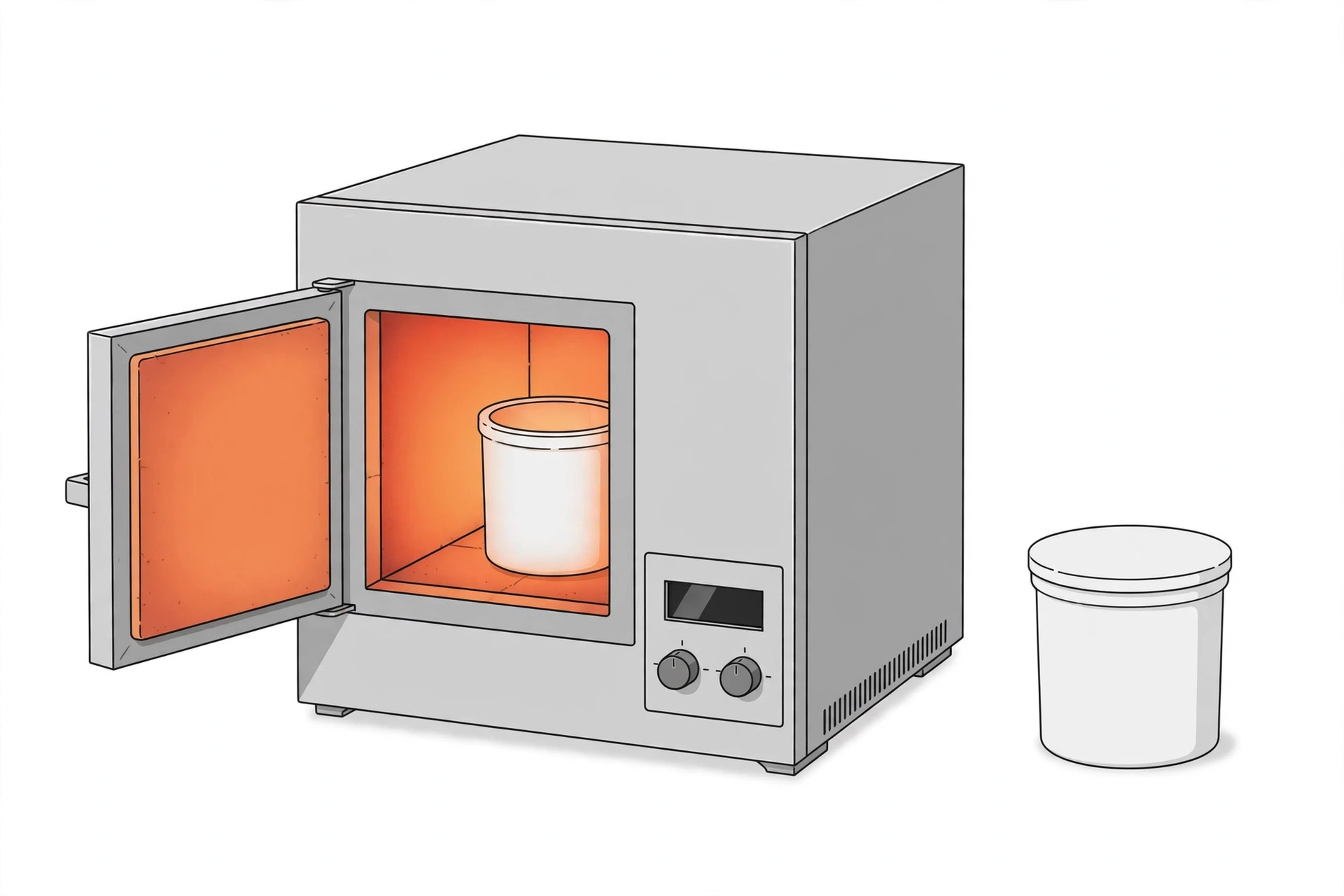
- Muffle furnace
- Desiccator
- Platinum wire (for breaking up incompletely ashed material)
- Petri dish (for covering fluffy ash before weighing)
Procedure
Note the tare weight of three silica dishes (7–8 cm diameter)
↓
Weigh 5–10 g of the sample (or more, if minerals are to be estimated) into each dish
↓
If the sample is moist, dry it on a water bath (the dishes used for the oven-drying moisture determination may be used for ashing)
↓
Ignite the dish and its contents on a Bunsen burner
↓
Ash the material in a muffle furnace at not more than 525°C for 4–6 hr; ash overnight if need be
↓
Cool the dishes and weigh
↓
The difference in weights gives the total ash content, expressed as percentage
Calculation
Total ash % = [(Weight of dish with ash − Tare weight of dish) × 100] ÷ Weight of sample taken
Where,
- Weight of dish with ash = weight of the cooled silica dish with the ash (g)
- Tare weight of dish = weight of the empty silica dish noted before weighing the sample (g)
- Weight of sample taken = weight of the sample weighed into the dish (g)
Precautions
- Do not exceed 525°C during ashing.
- If ashing is not complete, break up the ash with a platinum wire and reignite.
- If the ash is fluffy, spattering of ash occurs — cover it with a petri dish after placing the silica dishes in the desiccator, prior to weighing.
- Difficulty in achieving complete combustion, or possible loss by volatilization on ignition, may be overcome by moistening the substance to be ignited (or the carbonaceous residue from it) with concentrated sulphuric acid.
References
Ranganna, S., Handbook of Analysis and Quality Control for Fruit and Vegetable Products, 2nd edition.