SOP: Determination of Total Reducing Sugars and Fructose by the Rapid Colorimetric Method
GIFSQ — Global Institute for Food Safety & Quality
Principle
Ferricyanide is used in a carbonate-phosphate buffer as the oxidizing agent for sugars. The ferrocyanide produced is measured colorimetrically using the blue solution formed after the addition of Nelson’s arsenomolybdate reagent. When heated at 100°C for 10 min, glucose and fructose are oxidized in equal amounts. When heated at 55°C for 30 min, all the fructose, but only one-eighth to one-ninth of the glucose, is oxidized. The amounts of the two sugars in a mixture are then determined by calculation. Clarification of the juice samples with neutral lead acetate has no effect on the colorimetric determination of sugars. The method, originally developed for the estimation of sugars in citrus juices, can also be used for other fruits and vegetables and their products.
Apparatus required
- 100-ml volumetric flasks
- 250-ml volumetric flask
- 150-ml beaker
- Boiling water bath
- Water bath at 55°C
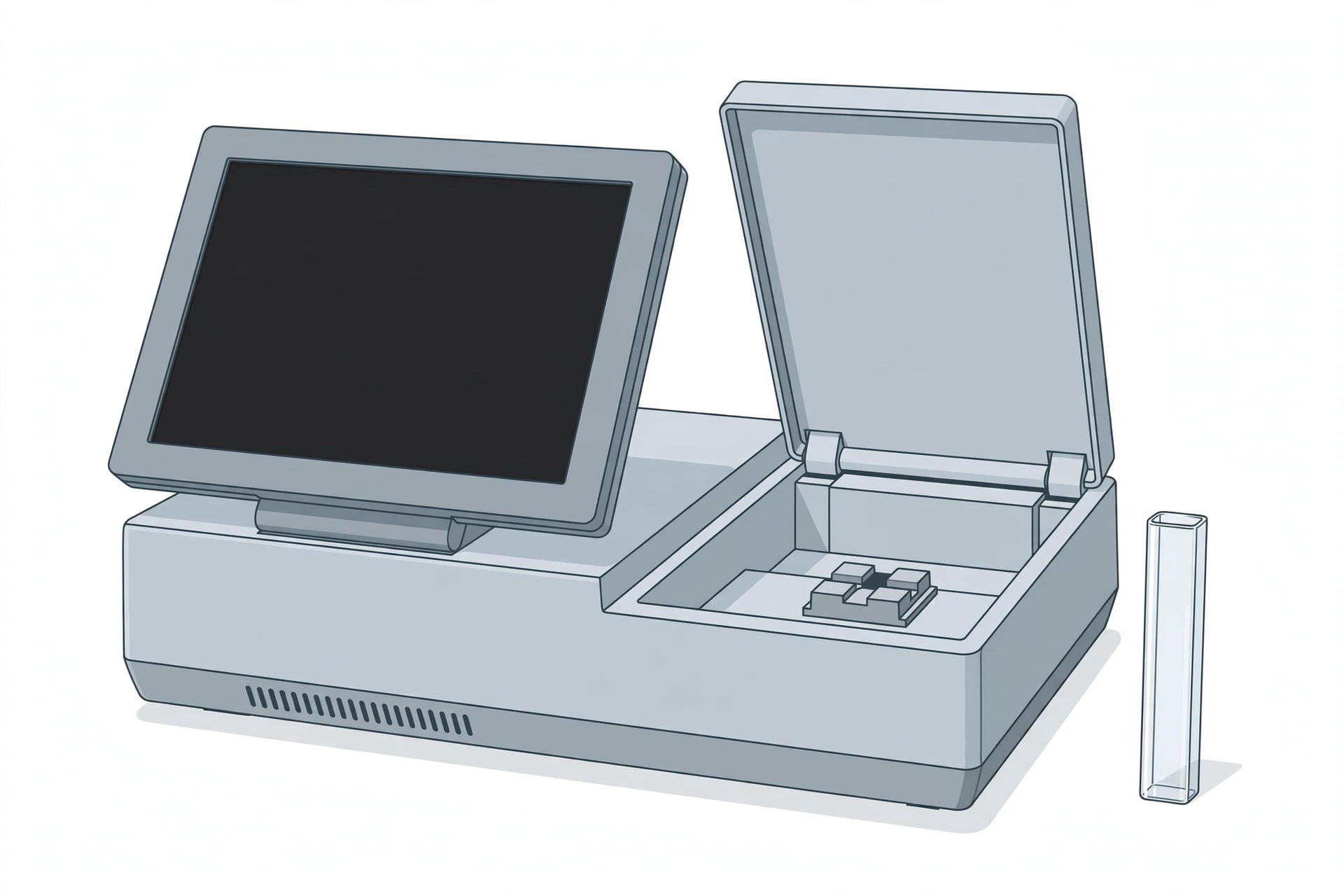
- Spectrophotometer (absorbance at 515 nm)
- pH meter
Reagents
a. Alkaline ferricyanide solution: dissolve 160 g of anhydrous sodium carbonate (Na₂CO₃) and 150 g of disodium phosphate heptahydrate in 850 ml of distilled water; add 4 g of potassium ferricyanide; dilute to 1 litre.
b. Arsenomolybdate solution: dissolve 25 g of ammonium molybdate tetrahydrate in 450 ml of distilled water; add 21 ml of conc. H₂SO₄, followed by 3 g of sodium arsenate in 25 ml of distilled water; heat at 55°C for 30 min in a water bath with constant stirring, or in an incubator maintained at 37°C for 24–48 hr.
c. 2 N H₂SO₄: dilute 56 ml of conc. H₂SO₄ (sp. gr. 1.84) to 1 litre.
d. 10 N and 1 N NaOH.
e. Dilute HCl, 1+1 by volume.
Sample preparation
The solution for the determination should contain not more than 150 mg of reducing sugars per 100 ml. For all citrus juices, a 1 to 50 dilution is usually sufficient: place 5 ml of the juice in a 250-ml volumetric flask and dilute to volume with distilled water.
Procedure — Total reducing sugars
Pipette 1 ml of the dilute juice into a 100-ml volumetric flask and add 5 ml of the ferricyanide solution
↓
Immerse in a boiling water bath for 10 min
↓
After heating, cool the flask quickly in running water, and partially neutralize the contents with 10 ml of 2 N H₂SO₄
↓
Mix the contents of the flask thoroughly until no more gas evolves; add 4 ml of the arsenomolybdate solution, mix, and dilute to volume
↓
Measure the absorbance of the solution at 515 nm, using a reagent blank run like the sample to set the instrument
Procedure — Fructose
Follow the procedure for total reducing sugars, except that the temperature and duration of heating are changed to 55°C for 30 min. The result obtained is termed apparent fructose — it is slightly higher than the true fructose content in the sample, which is calculated by the formula given below.
Procedure — Total sugars and sucrose
Take 50 ml of the diluted juice in a 150-ml beaker and add 10 ml of dilute HCl (1+1)
↓
Allow to stand at room temperature for 18 hr to invert the sucrose
↓
Add 5 ml of 10 N NaOH and adjust the contents to a pH between 5 and 7 with 1 N NaOH, using a pH meter
↓
Transfer the contents to a 100-ml volumetric flask and dilute to volume
↓
Pipette a 1-ml aliquot of this solution into a 100-ml volumetric flask, and follow the procedure described for the determination of reducing sugars
↓
Calculate the amount of sucrose from the difference between the reducing sugars content before and after inversion, and multiply by the factor 0.95
Calibration
To construct the standard curves, take known glucose solutions containing 0.02, 0.04, 0.06, 0.08, 0.10, 0.12 and 0.14 g of sugar per 100 ml, and fructose solutions similarly. Draw standard curves for glucose and fructose at both 100°C and 55°C. At 100°C glucose and fructose have similar rates of oxidation, and the curves are identical. At 55°C, the values for fructose are about eight times higher than those for glucose at the same concentrations. All curves obey Beer’s law and pass through the origin.
Calculation
k = c ÷ a … (1)
S = K × A × D … (2)
G + F = S … (3)
G ÷ Q + F = L … (4)
G = (S − L) × [Q ÷ (Q − 1)] … (5)
Where,
- k = factor for unit absorbance, or slope of the curve
- c = concentration in g of reducing sugars per 100 ml
- a = absorbance of the solution at that concentration
- K = average of the k values at the different sugar concentrations (average slope of the curve)
- S = total reducing sugar concentration of the sample (mg/100 ml); also = % total reducing sugars, the sum of G and F, in equations (3) to (5)
- A = absorbance of the sample
- D = dilution factor
- Kf = K value for fructose at 55°C, obtained from the fructose standard curve in the manner described for K
- Kg = K value for glucose at 55°C, obtained from the glucose standard curve
- Q = ratio of Kg to Kf (the ratio between the glucose slope and the fructose slope at 55°C)
- G = % glucose in the sample
- F = % fructose in the sample
- L = % apparent fructose (calculated from equation 2, substituting L for S and Kf for K)
The quotient Q ÷ (Q − 1) is used as a constant in the calculation of the true glucose value; the true fructose value is obtained by difference.
Precautions
- The solution for the determination must not contain more than 150 mg of reducing sugars per 100 ml.
- Cool the flask quickly in running water after the heating step.
- Run a reagent blank exactly like the sample and use it to set the instrument.
References
Ranganna, S., Handbook of Analysis and Quality Control for Fruit and Vegetable Products, 2nd edition.
Ting, S.V., J. Agr. Food Chem., 4, 263 (1956) — cited in the book.