SOP: Determination of Sugars by the Lane and Eynon Method
GIFSQ — Global Institute for Food Safety & Quality
Principle
Invert sugar reduces the copper in Fehling’s solution to red, insoluble cuprous oxide. The sugar content of a food sample is estimated by determining the volume of the unknown sugar solution required to completely reduce a measured volume of Fehling’s solution.
Apparatus required
- 250-ml conical flasks
- 50-ml burette
- Volumetric flasks (1-litre, 500-ml, 250-ml, 100-ml)
- 50-ml beakers
- Hot plate or burner covered with asbestos-filled wire gauze
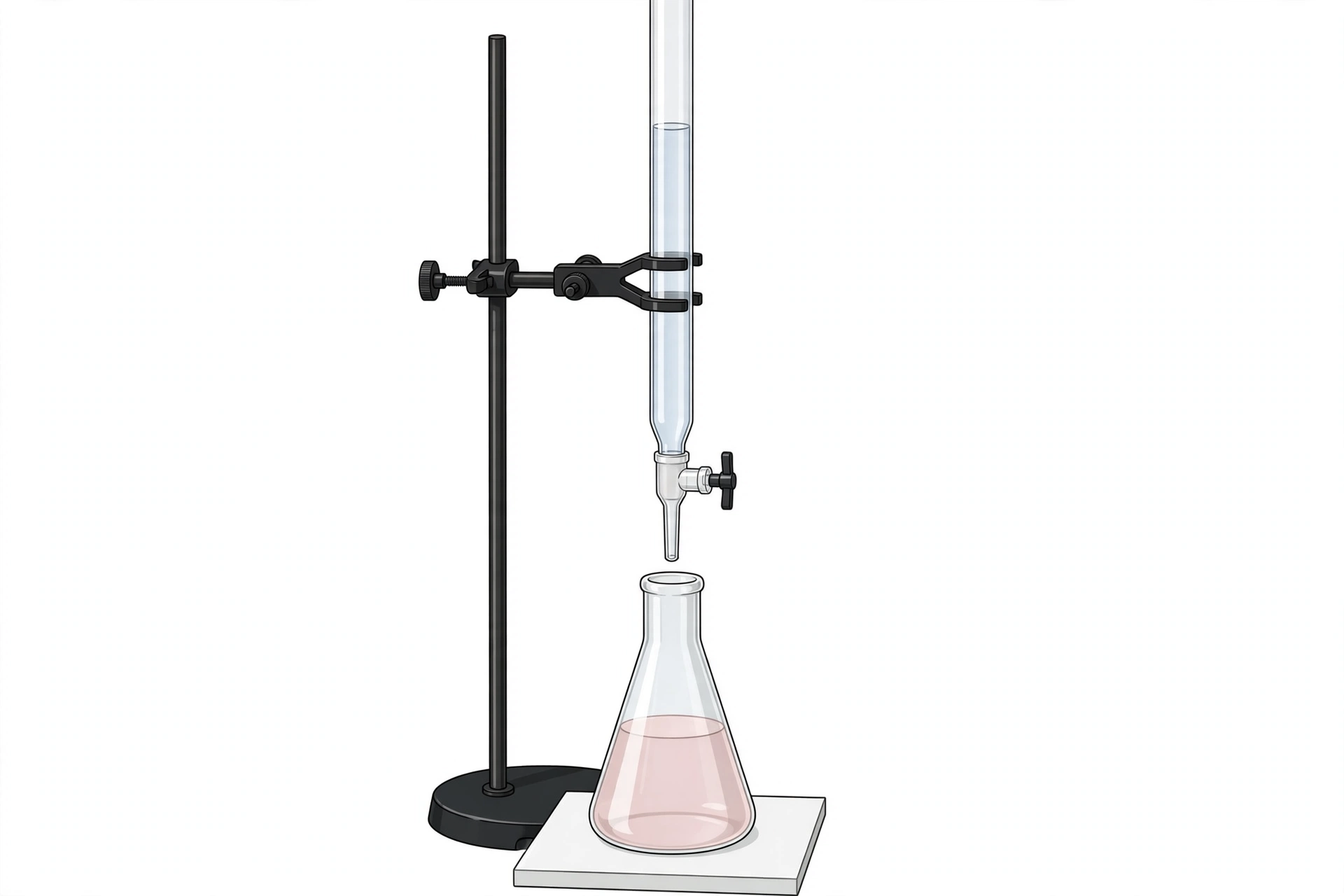
Reagents
a. Fehling’s solution (A): dissolve 69.28 g of copper sulphate (CuSO₄·5H₂O) in water and dilute to 1,000 ml; filter through No. 4 Whatman paper if necessary.
b. Fehling’s solution (B): dissolve 346 g of Rochelle salt (potassium sodium tartrate, KNaC₄H₄O₆·4H₂O) and 100 g of NaOH in water and make up to 1,000 ml.
c. Methylene blue indicator: dissolve 1 g of methylene blue in 100 ml of water.
d. 45% neutral lead acetate solution: dissolve 225 g of neutral lead acetate in water and dilute to 500 ml.
e. 22% potassium oxalate solution: dissolve 110 g of potassium oxalate (K₂C₂O₄·H₂O) in water and dilute to 500 ml. An excess of lead acetate in the sugar solution causes an error in the titration, so determine the exact amount of potassium oxalate solution necessary to precipitate the lead from the lead acetate solution: pipette 2-ml aliquots of the lead acetate solution into each of six 50-ml beakers containing 25 ml of water; add 1.6, 1.7, 1.8, 1.9, 2.0 and 2.1 ml of potassium oxalate solution respectively; filter each through a 41H Whatman paper and collect the filtrate in a 50-ml conical flask; to each of the filtrates add a few drops of potassium oxalate solution — the correct amount of potassium oxalate required is the smallest amount which, when added to 2 ml of lead acetate solution, gives a negative test for lead in the filtrate (lead gives a white precipitate with HCl or a yellow precipitate with potassium chromate solution); mark the equivalent volume on the bottle and use it in the sugar determinations.
f. Standard invert sugar solution: weigh accurately 9.5 g of AR sucrose into a 1-litre volumetric flask; add 100 ml of water and 5 ml of conc. HCl; allow to stand for 3 days at 20–25°C (or 7 days at 15°C) for inversion to take place, then make up to the mark with water — this solution is stable for several months. Working standard: pipette 25 ml of the standard invert solution into a 100-ml volumetric flask and add about 50 ml of water; add a few drops of phenolphthalein indicator and neutralize with 20% NaOH until the solution turns pink; acidify with 1 N HCl, adding it dropwise until one drop causes the pink colour to disappear; make up to the mark with water (1 ml = 2.5 mg of invert sugar).
Standardization of Fehling’s solution
Mix equal quantities of Fehling’s solutions A and B (50 ml of each)
↓
Pipette 10 ml of the mixed solution into a 250-ml conical flask and add 25–50 ml of water
↓
From a 50-ml burette add 18–19 ml of the standard invert sugar solution (almost the whole of the amount required to reduce all the copper, so that not more than 1 ml is needed later to complete the titration)
↓
Heat the flask containing the cold mixture over a hot plate or burner covered with asbestos-filled wire gauze
↓
When the liquid begins to boil, keep it in moderate ebullition for 2 min
↓
Without removing the flask from the flame, add 3 drops of methylene blue indicator solution
↓
Complete the titration in a further 1 min, so that the reaction mixture boils altogether for 3 min without interruption — the end point is the decolourization of the indicator
↓
Note the volume of sugar solution required for completely reducing 10 ml of Fehling’s solution — the equivalent volume should be 20.37 + 0.05 ml (as printed in the book); if the variation from this is too wide, adjust the concentration of the Fehling’s solution so that the equivalent volume of neutralized sugar solution for 10 ml of Fehling’s solution is 20.37 + 0.05 ml
Factor for Fehling’s solution (g of invert sugar per 10 ml of Fehling’s solution) = (Titre × 2.5) ÷ 1000
Sample preparation
- Fruit juices: weigh 25 g of filtered (Whatman No. 4) juice into a 250-ml volumetric flask; add about 100 ml of water and neutralize with 1 N NaOH; add 2 ml of lead acetate solution; shake and let stand for 10 min; add the necessary amount of potassium oxalate solution to remove the excess lead; make up to volume with water and filter.
- Jams, jellies and marmalades: place 50 g of the blended jam in a 500-ml beaker and add 400 ml of water; neutralize the solution with 1 N NaOH using phenolphthalein indicator; boil gently for 1 hr with occasional stirring, adding boiling water to maintain the original level; cool and transfer to a 500-ml volumetric flask; make up to volume and filter through No. 4 Whatman paper; pipette a 100-ml aliquot into a 500-ml volumetric flask; add 2 ml of neutral lead acetate solution and about 200 ml of water; let stand for 10 min; precipitate the excess lead with potassium oxalate solution; make up to the mark and filter.
- Preserves and candied peel: grind the sample in a blender or using a pestle and mortar; proceed as described for jams, jellies and marmalades above.
Procedure — Reducing sugars
Make the sugar solution neutral and adjust its concentration so that the titre value falls between 15 and 50 ml (0.1–0.3 g of sugar per 100 ml, when 10 ml of mixed Fehling’s solution is used)
↓
Titrate first by the incremental method; when the correct dilutions are established, perform subsequent titrations by the standard method
Incremental method of titration
Pipette 10 ml of the mixed Fehling’s solution into a 250-ml flask and add 50 ml of water
↓
Fill the burette with the clarified sugar solution; add from the burette enough sugar solution to reduce almost completely the Fehling’s solution used
↓
Mix and heat to boiling on a hot plate or burner covered with a clean asbestos-filled wire gauze; boil for 15 sec
↓
If the blue colour remains, add a further 2–3 ml of the sugar solution, boiling for a few seconds after each addition, until only the faintest perceptible blue colour remains
↓
Add 3 drops of methylene blue solution and complete the titration by adding the sugar solution dropwise until the indicator is completely decolourized
↓
Record the volume of solution required, attaining the end point as rapidly as possible and keeping a total boiling period of 3 min
Standard method of titration
Pipette 10 ml of mixed Fehling’s solution into each of two 250-ml conical flasks
↓
Fill the 50-ml burette with the solution to be titrated and run into the flask almost the whole volume of sugar solution required to reduce the Fehling’s solution, so that 0.5–1.0 ml is required later to complete the titration
↓
Mix the contents of the flask, heat to boiling and boil moderately for 2 min
↓
Add 3 drops of the methylene blue solution, taking care not to let it touch the side of the flask
↓
Complete the titration within 1 min by adding 2–3 drops of sugar solution at 5–10 sec intervals, until the indicator is completely decolourized
↓
Note the volume of solution required — at the end point the boiling liquid assumes the brick-red colour of precipitated cuprous oxide
Procedure — Total sugars
Pipette 50 ml of the clarified solution into a 250-ml conical flask; add 5 g of citric acid and 50 ml of water
↓
Boil gently for 10 min to complete the inversion of sucrose, then cool
↓
Transfer to a 250-ml volumetric flask and neutralize with 1 N NaOH using phenolphthalein as indicator; make up to volume
↓
Take an aliquot and determine the total sugars as invert sugars by the titration described above
Alternative inversion at room temperature: transfer a 50-ml aliquot of the clarified and deleaded solution to a 250-ml flask; add 10 ml of HCl (1+1) and allow to stand at room temperature (20°C or above) for 24 hr; neutralize with conc. NaOH solution and make up to volume.
Calculation
a. % Reducing sugars = (mg of invert sugar × Dilution × 100) ÷ (Titre × Wt. or volume of sample × 1000)
b. % Total sugars as invert sugars = calculated as in (a), using the titre value obtained in the determination of total sugars after inversion
c. % Sucrose = (% Total invert sugars − % Reducing sugars originally present) × 0.95
d. % Total sugars = % Reducing sugars + % Sucrose
For an approximate value only: % = (Factor × Dilution × 100) ÷ (Titre × Wt. or volume of sample)
Where,
- mg of invert sugar = mg of invert sugar equivalent to 10 ml of Fehling’s solution at the observed titre, read from the tabulated Lane-Eynon factors (adapted from the AOAC Official Methods of Analysis, 11th edition, p. 936, as cited in the book)
- Dilution = total dilution of the sample solution
- Titre = volume of the sugar solution required to reduce 10 ml of Fehling’s solution (ml)
- Wt. or volume of sample = weight or volume of the original sample (g or ml)
- Factor = g of invert sugar per 10 ml of Fehling’s solution = (Titre × 2.5) ÷ 1000
Precautions
- Do not interrupt the boiling for more than a few seconds during the titration — the indicator undergoes back-oxidation rapidly when air has free access into the flask.
- The indicator is so sensitive that the end point can be determined within one drop of the sugar solution.
- In case of doubt at the end point, remove the flask from the flame and hold it against a sheet of white paper — the liquid appears bluish if the indicator is not completely decolourized.
- Excess lead acetate in the sugar solution causes an error in the titration — delead with the determined equivalent amount of potassium oxalate solution.
References
Ranganna, S., Handbook of Analysis and Quality Control for Fruit and Vegetable Products, 2nd edition.
Lane, J.H. & Eynon, L., J. Soc. Chem. Ind., 42, 32T (1923) — cited in the book.
Ruck, J.A., Chemical Methods for Analysis of Fruit and Vegetable Products, Canada Dept. of Agriculture, Publication No. 1154, p. 9 (1963) — cited in the book.