SOP: Determination of Sodium Chloride Content in Salt
GIFSQ — Global Institute for Food Safety & Quality
1. Principle
Chloride is estimated in a sample solution by titrating with standard silver nitrate solution, using potassium chromate as indicator, and is expressed as sodium chloride.
2. Application
This method is applicable to estimate the sodium chloride percentage where chloride is present as sodium chloride.
3. Apparatus
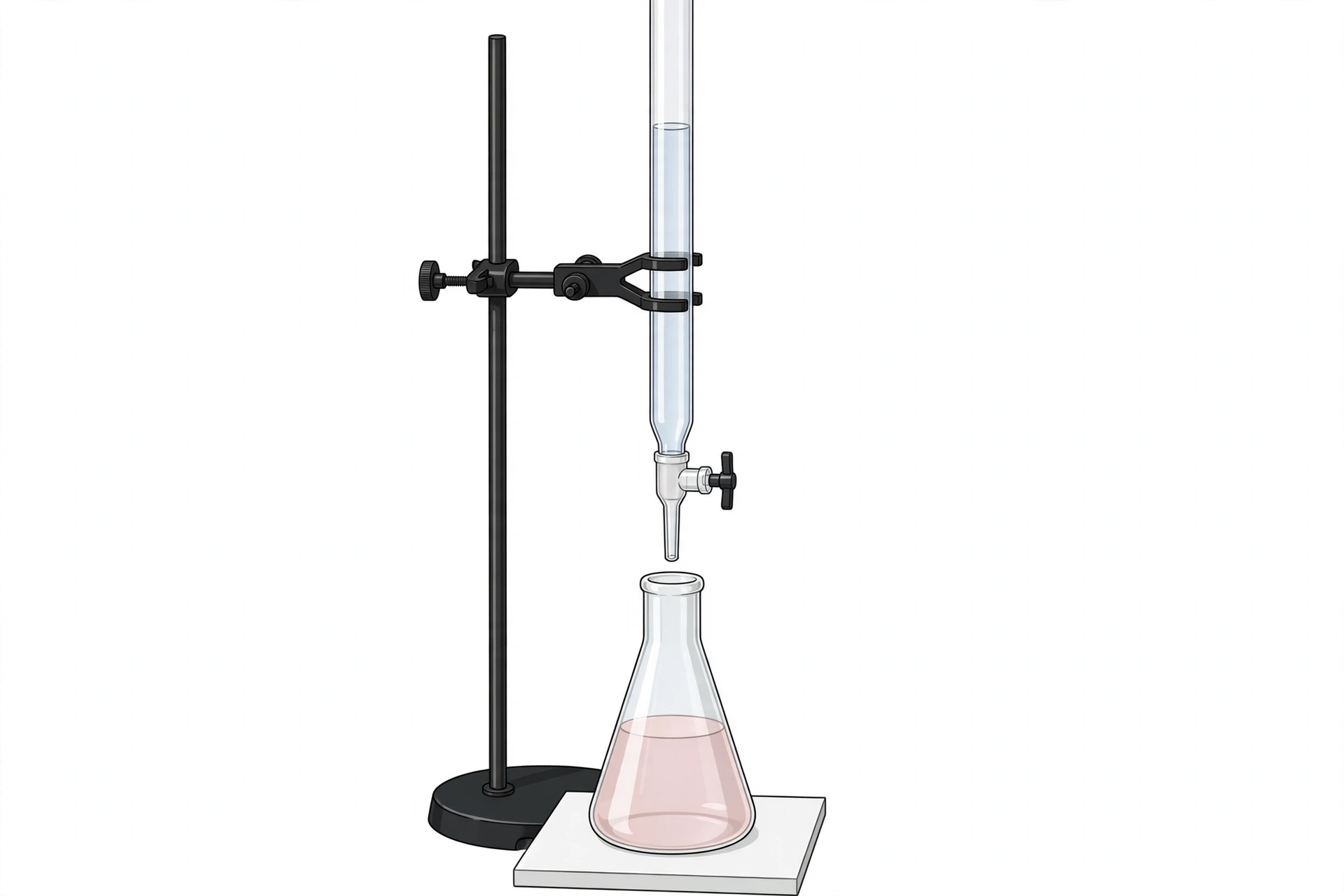
Burette, pipette, conical flask, volumetric flask, beaker.
4. Reagent
0.1 N AgNO₃; potassium chromate solution.
5. Procedure
Weigh 0.5 g of salt sample, removing moisture
↓
Dissolve it in 100 mL volumetric flask and make volume up to mark
↓
Pipette out 10 mL sample solution and dilute to about 50 mL in 250 mL conical flask
↓
Add 1 mL potassium chromate indicator and titrate it with 0.1 N AgNO₃ solution
↓
Note the end point with the appearance of faint reddish brown color
6. Calculation
% NaCl = [S(AgNO₃) × 58.44 × V(AgNO₃)] ÷ Wt. of Sample
Where,
– V(AgNO₃) = Volume of AgNO₃ used
– S(AgNO₃) = Strength of AgNO₃
7. Precaution
- Titration should be carried out in neutral solution or very faintly alkaline solution, i.e. pH range 6.5 to 9.
References
Rangana S. (1986), Handbook of analysis and quality control for fruit and vegetable products, 2nd edn, Page 204.