SOP: Determination of Solids-Not-Fat (SNF) Percentage in Milk by the Use of Lactometer
GIFSQ — Global Institute for Food Safety & Quality
A. Determination of SNF in milk at 20°C
Scope
This method is applicable to raw milk, fluid milk and pasteurized milk.
Principle
The main constituents of milk are water, fat, proteins, lactose and ash or minerals. The “total solid” of milk is the constituent other than water, and the total solid minus fat is called “solid not fat” (SNF). The SNF is calculated using a formula that contains fat percentage and corrected lactometer reading.
Apparatus
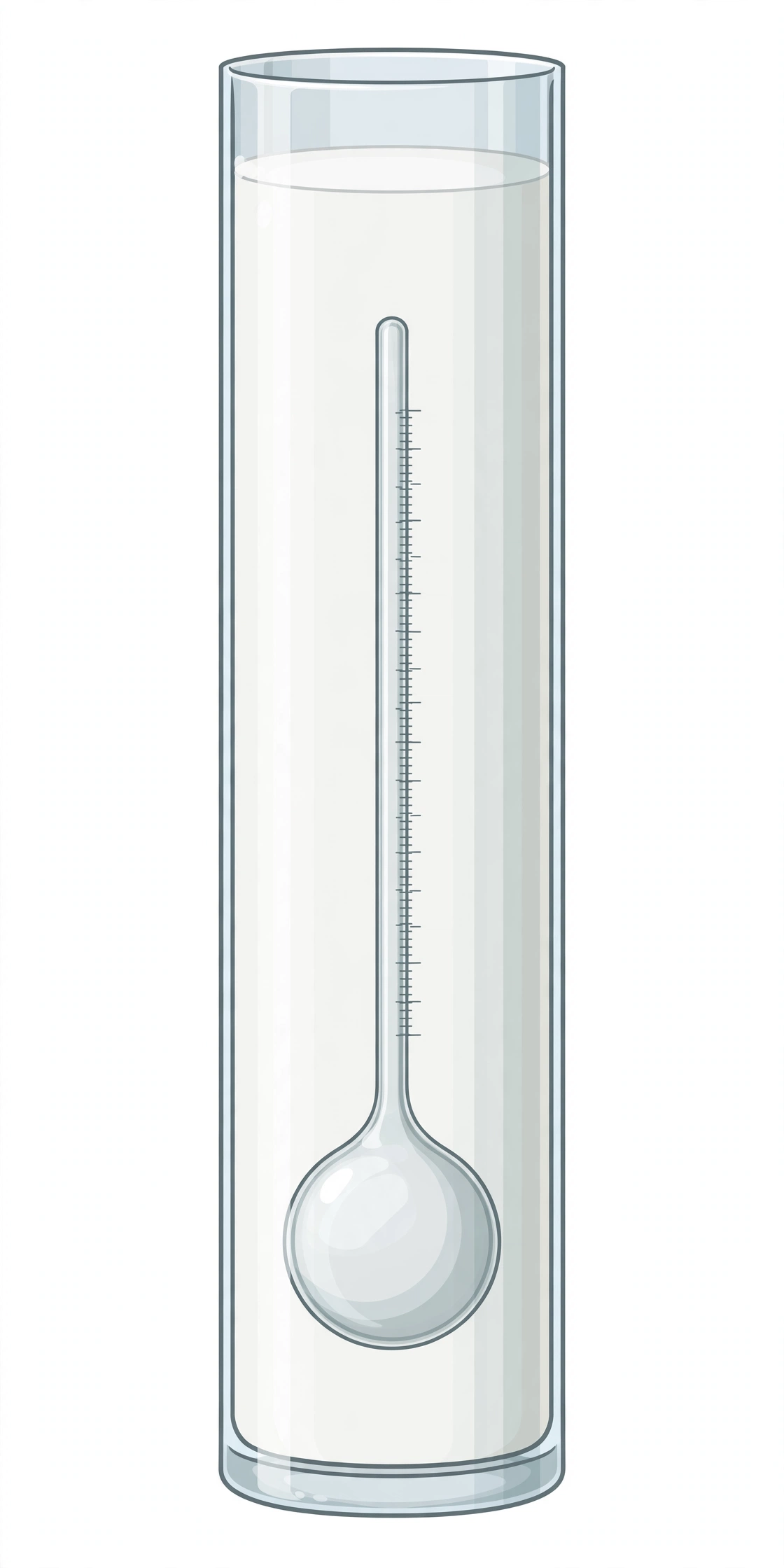
a. Gerber lactometer (thermolactodensimeter, graduated at 20°C, scale 20 to 40 with 0.5 division on graduation)
b. Lactometer jar (must be large enough to float the lactometer freely)
Procedure
Warm the milk to and keep at 40–45°C for five minutes
↓
Mix carefully but thoroughly, avoiding inclusion of bubbles
↓
Cool to 20 ± 2°C and determine the density as soon as possible
↓
Fill the cylinder to overflowing by pouring the sample over the lactometer bulb, avoiding bubble formation
↓
Allow the lactometer to float in the milk without permitting more than a few mm of the stem above the milk surface to become wetted
↓
Read the scale at the top of the meniscus, the eye being horizontal to it; move the hydrometer a few mm vertically and check the reading
↓
Remove the lactometer; record the reading, and determine and record the temperature of the milk
Notes: Warming the sample to 40–45°C is to ensure the fat is in a liquid condition. This can therefore be omitted if the sample has been warm for some time previously. Lactometer slide rules allow for density determinations between about 15°C and 25°C.
Calculation
SNF = 0.25 D + 1.22 F + 0.72
The formula applies if the temperature of the sample is 20°C and if the fat of the milk is in the liquid state.
Where,
– F = % m/m fat
– D = (1000 × density − 1000)
– SNF = solids-not-fat
If the milk was not at 20°C, the density must be corrected before application of the formula, adding to “D” 0.2 for each degree above 20 and subtracting for each degree below.
Reference: FAO 1986, Manual of Food Quality Control; 8. Food Analysis: Quality, Adulteration and Test of Identity. Reprinted 1997, Method 2.1, page 12, 13.
B. Determination of SNF in milk at 27°C
Procedure
Adjust the temperature of the milk sample to 27°C
↓
Mix the contents of the sample bottle by inverting the bottle gently 5 times, being careful to avoid the formation of air bubbles and foam
↓
Invert the sample bottle gently two to three times
↓
Pour enough milk into the lactometer jar, avoiding the formation of air bubbles, and ensure that some milk overflows when the lactometer is inserted
↓
Insert the lactometer gently, to wet the stem not more than a short length, about 3 mm beyond the position of equilibrium; the lactometer should float freely and shall not touch the sides of the jar
↓
Allow the lactometer to remain steady in the milk, and take the reading within 30 seconds, at level, at the point of the lactometer where the surface of the milk cuts across the stem
↓
Note the temperature of the milk, and obtain the corrected lactometer reading (CLR) by applying the correction factor shown in the temperature correction chart below
Calculation
SNF % = (CLR ÷ 4) + 0.25 × F + 0.5
Where,
– F = milk fat percentage
Correction to lactometer readings taken at temperatures other than 27°C
| Temperature of observation, °C | Correction |
|---|---|
| 25.0 | −0.7 |
| 25.5 | −0.5 |
| 26.0 | −0.3 |
| 26.5 | −0.2 |
| 27.0 | 0 |
| 27.5 | +0.2 |
| 28.0 | +0.3 |
| 28.5 | +0.5 |
| 29.0 | +0.7 |
Reference: NDDB (2001), Laboratory Handbook for Dairy Industry, Method 5.9, page 56, 57.