SOP: Procedure for the Isolation of Salmonella species by the Modified Semi-Solid Rappaport Vassiliadis (MSRV) Method
GIFSQ — Global Institute for Food Safety & Quality
(Health Canada, Compendium of Analytical Methods, Volume 3 — Laboratory Procedure MFLP-75, March 2016)
Principle
This procedure detects motile Salmonella spp. to determine compliance with Sections 4 and 7 of the Food and Drugs Act and/or other relevant federal regulations. It is validated for raw unprocessed poultry products, dry dairy products, low-moisture chocolate/bakery products, animal feeds, and environmental surface samples. It should not be used to culture samples when Pullorum Disease or Fowl Typhoid, caused by S. Pullorum or S. Gallinarum respectively, is suspected. Positive results must be confirmed with a cultural method. This edition replaces MFLP-75, dated June 2004, and the supplement, dated February 2006.
The method was developed by Chau and Huang, and by De Smedt and colleagues, and compared against the HPB Salmonella method (MFHPB-20) by Poppe and colleagues and by Oggel and colleagues. It rests on the ability of Salmonella spp. to grow and move through Modified Semi-Solid Rappaport Vassiliadis (MSRV) medium after incubation at 42°C under adequate moisture conditions. Most Salmonella strains migrate more than 20 mm from the inoculation site within 24 – 48 h; a minimum of 48 h is recommended for processed foods and other stressed samples. Using this medium can shorten the identification time of a positive sample by 24 h compared with the conventional culture method.
MSRV medium is a very soft semi-solid agar medium, and the plates are fragile and must be handled with care. Beyond that limitation, the method is very simple to use and gives presumptive evidence of the presence of Salmonella: motile Salmonella appear as opaque halos of growth on the semi-solid agar. This method does not detect non-motile salmonellae.
Apparatus
- Modified Semi-Solid Rappaport Vassiliadis (MSRV) plates
- Buffered Peptone Water (BPW), Nutrient Broth (NB), or other pre-enrichment media as specified for specific commodities (see MFHPB-20)
- MacConkey agar plates
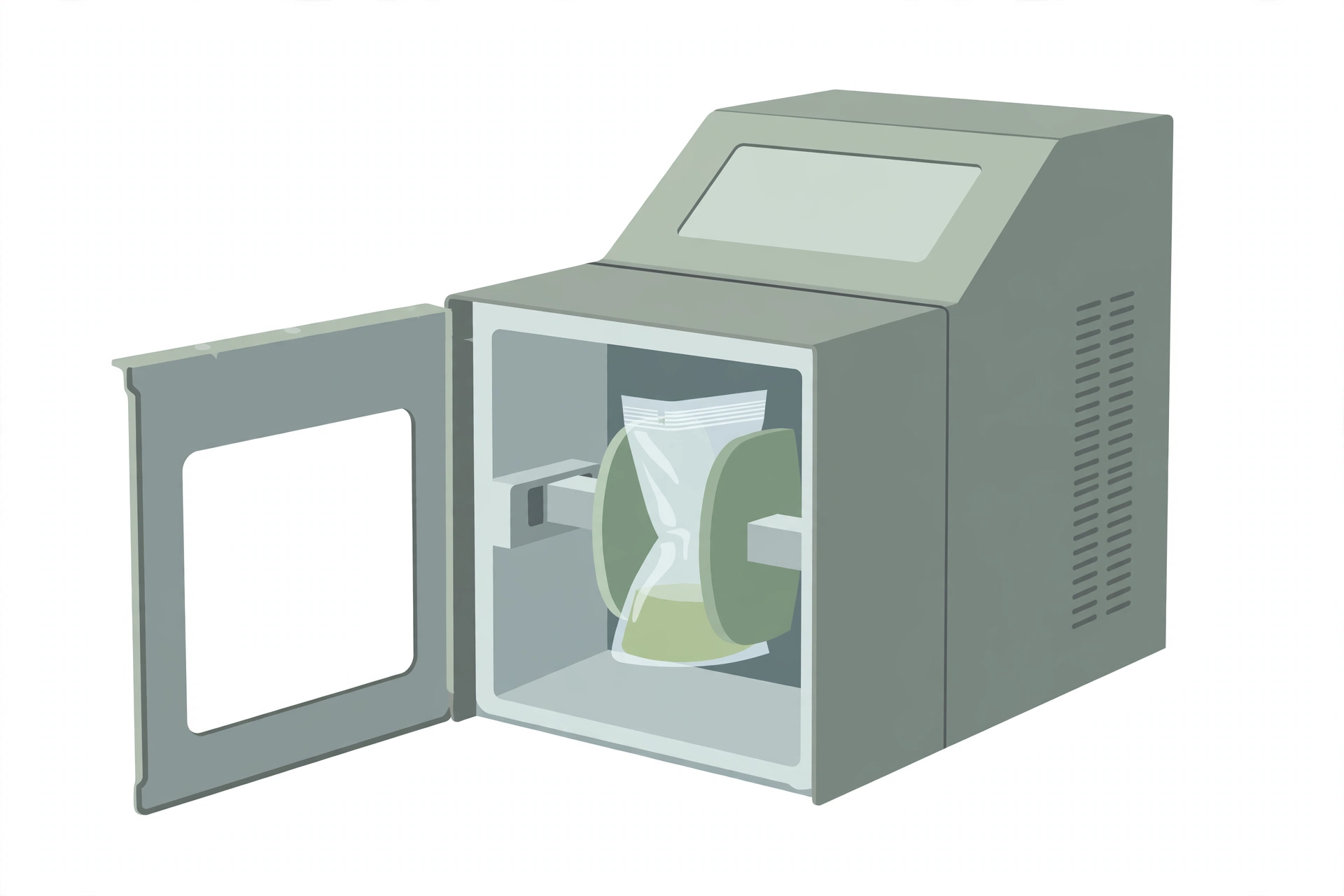
- Stomacher bags for homogenate
- Incubators capable of maintaining 35 and 42°C
- Control cultures — Positive: Salmonella Typhimurium (e.g. ATCC #14028) or S. Berta (e.g. ATCC #8392) or other motile Salmonella spp.; Negative: E. coli or other non-salmonellae
Note: The media listed above are commercially available and are to be prepared and sterilized according to the manufacturer’s instructions.
Sample preparation
Each sample unit may be analyzed individually or the analytical units may be combined where the requirements of the applicable sampling plan can be met.
- In the laboratory before analysis, keep sample units refrigerated or frozen depending on the nature of the product (except for shelf-stable foods). Thaw frozen samples in a refrigerator or under time and temperature conditions that prevent microbial growth or death.
- Analyze sample units as soon as possible after their receipt in the laboratory.
- To ensure a truly representative analytical unit, agitate liquids or free-flowing materials until the contents are homogeneous. If the sample unit is a solid, obtain the analytical unit by taking a portion from several locations within the sample unit. To reduce the workload, the analytical units may be combined for analysis; it is recommended that a composite contains no more than five analytical units.
- Follow MFLP-41 for collection of environmental surface samples.
Procedure
Preparation for analysis
- Have sterile pre-enrichment media ready
↓ - Clean the surface of the working area with a suitable disinfectant
Primary enrichment
Choose the branch for the commodity:
- Raw poultry products, dry dairy products, and low-moisture chocolate/bakery products: follow the pre-enrichment steps of MFHPB-20
- Animal feeds or feed ingredients: equilibrate the 25 g or 100 g (or sample weight) in 2 volumes of NB or BPW for 1 h at 35°C
↓ - Add another 7 volumes of pre-enrichment broth to keep a 1 in 10 final dilution, and stomach
- Environmental samples: follow MFLP-41 — add NB or BPW at 100 mL/unit (sponge) or 10 mL/unit (swabs), then incubate at 35°C for 18 – 24 h
↓ - Incubate the inoculated pre-enrichment broth for 18 – 24 h at 35°C
↓ - Inoculate the control cultures into the same pre-enrichment medium being used for the analysis; use these control cultures to inoculate all subsequent media
Secondary enrichment in MSRV
- Inoculate 0.1 mL of the pre-enrichment broth on one side of an MSRV plate, a few millimetres from the edge; similarly inoculate the positive and negative control broths onto additional plates
↓ - Stack the MSRV plates on trays to a maximum of 3 in height and incubate upright in a high-moisture incubator at 42°C for 24 – 72 h
↓ - Examine the plates at 24 h ± 2 h (with the aid of a viewing lamp, if required); measure the distance from the edge of the inoculation point to the farthest boundary of migration
↓ - If migration is not evident or is less than 20 mm, re-incubate and re-examine the plates one or more times as appropriate, from 48 h ± 4 h up to a maximum of 72 h ± 6 h (this allows further resuscitation of injured Salmonella in processed foods and stressed samples)
↓ - At 72 h ± 6 h incubation, the MSRV is considered negative for Salmonella if migration is still less than 20 mm
↓ - From the outermost edge of the migration area (the point farthest away from the inoculation point), pick a portion of the growth and inoculate a plate of MacConkey agar for isolated colonies; incubate at 35°C for 18 – 24 h, then select isolated colonies from the MacConkey plate for confirmatory testing
Confirmation
- Presumptive positive results must be confirmed culturally using the biochemical screening and serological confirmation steps described in method MFHPB-20
Precautions
- The laboratory supervisor must ensure that completion of the analysis described in this method is done in accordance with the International Standards reference “ISO/IEC 17025:2005 (or latest version): General Requirements for the Competence of Testing and Calibration Laboratories”.
- It is the responsibility of the laboratory to ensure equivalency if any variations of the media formulations listed here are used (either product that is commercially available or made from scratch).
- It is the responsibility of each laboratory to ensure that the temperatures of the incubators or water baths are maintained at the recommended temperatures. Where 35°C is recommended in text of the method, the incubator may be at 35 ± 1.0°C. Similarly, lower temperatures of 30 or 25 may be ± 1.0°C. However, where higher temperatures are recommended, such as 43 or 45.5°C, it is imperative that the incubators or water baths be maintained within 0.5°C due to potential lethality of the higher temperatures on the microorganism(s) being isolated, unless otherwise specified in the method.
References
- Health Products and Food Branch (as the title page prints the branch name). MFLP-75, “Procedure for the Isolation of Salmonella species by the Modified Semi-Solid Rappaport Vassiliadis (MSRV) Method.” Compendium of Analytical Methods, Volume 3, Health Canada, March 2016.
- Chau, P.Y and C.T. Huang.1976. A simple procedure for screening Salmonellae using a semi-solid enrichment and semi-solid indicator medium. J. Appl. bacteriol. 41:283-294.
- DeSmedt, J.M., R.F. Bolderdijk, H.F. Rappold and D. Lautenschlaeger. 1986. Rapid Salmonella detection in foods by motility enrichment on a Modified Semi-solid Rappaport-Vassiliadis medium. J. Food Prot. 49:510-514.
- DeSmedt, J.M. and R.F. Bolderdijk. 1987. Dynamics of Salmonella isolation with Modified Semi-solid Rappaport-Vassiliadis medium. J. Food Prot. 50:658-661.
- Microbiological Methods Committee. 2009. MFHPB-20: Isolation and identification of Salmonella from food and environmental samples. In: Volume 2. Compendium of Analytical Methods.
- Oggel, J., D.C. Nundy, P.A. Zebchuk and S.J. Shaw. 1995. Reliability of the Modified Semi-solid Rappaport-Vassiliadis agar and the modified 1-2 Test system for detection of Salmonella in poultry feeds. J. Food Prot. 58:98-101.
- Poppe, C., R.J. Irwin, C.M. Forsberg, R.C. Clarke and J.J. Oggel. 1991. The prevalence of Salmonella Enteritidis and other Salmonella spp. among Canadian registered commercial layer flocks. Epidemiol. Infect. 106:259-270.
- Poppe, C., C.L. Duncan and A. Mazzocco. 1998. Salmonella contamination of hatching and table eggs: a comparison. Can. J. Vet. Res. 62:191-198.