SOP: Determination of Nitrogen by the Micro-Kjeldahl Method
GIFSQ — Global Institute for Food Safety & Quality
Principle
The nitrogen content is estimated by the Kjeldahl method, which is based on the determination of the amount of reduced nitrogen (NH₃ and NH₄) present in the sample. The various nitrogenous compounds are converted into ammonium sulphate by boiling with conc. H₂SO₄. The ammonium sulphate formed is decomposed with an alkali (NaOH), and the ammonia liberated is absorbed in excess of neutral boric acid solution and then titrated with standard acid.
Apparatus required
- Kjeldahl digestion flasks (250-ml capacity)
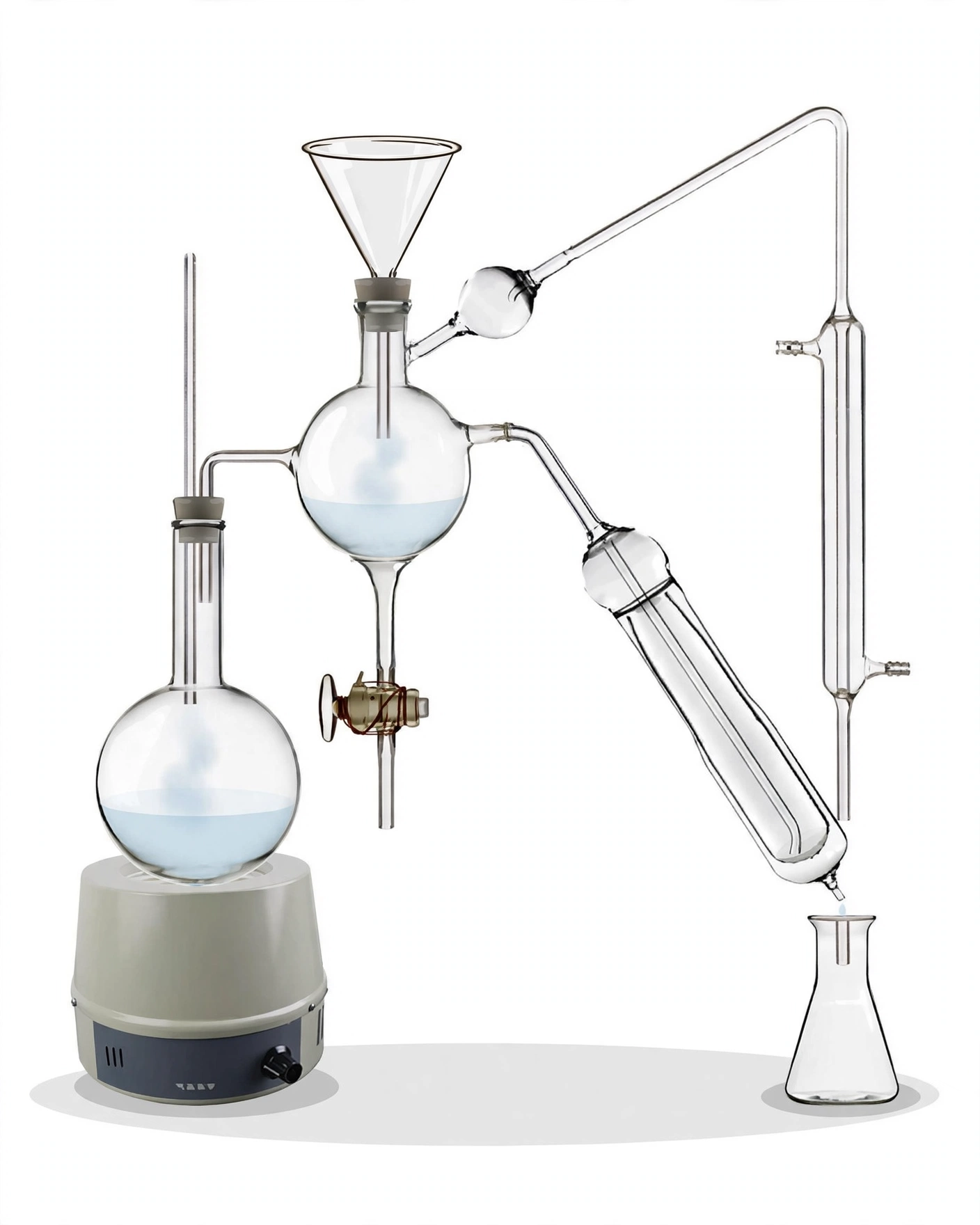
- Modified Parnas-Wagner distillation apparatus (Pyrex glass; two compact units joined glass-to-glass with a short rubber tubing; steam generator: a 1-litre round-bottom flask with a side arm for refilling, filled two-thirds with distilled water — when heated it gives enough steam for 8 to 12 determinations)
- 100-ml volumetric flask
- Microburette
- Bunsen burner
Reagents
a. Mixed indicator: prepare 0.1% bromocresol green and 0.1% methyl red indicators in 95% alcohol separately; mix 10 ml of the bromocresol green with 2 ml of the methyl red solution in a bottle provided with a dropper which delivers about 0.05 ml per 4 drops.
b. 2% boric acid: dissolve 10 g of boric acid crystals in 500 ml of boiling distilled water; after cooling, transfer the solution into a glass-stoppered bottle — it keeps indefinitely.
c. 0.01 N hydrochloric acid: check the concentration of the final solution against pure sodium carbonate.
d. 30% sodium hydroxide: dissolve 150 g of sodium hydroxide pellets in 350 ml of distilled water; store the solution in a bottle closed with a rubber stopper.
e. Catalyst for digestion: mix 2.5 g of powdered selenium dioxide (SeO₂), 100 g of potassium sulphate (K₂SO₄) and 20 g of copper sulphate (CuSO₄·5H₂O).
Procedure — Digestion
Weigh 4–6 g of fruit or 2–4 g of vegetable and transfer to a 250-ml Kjeldahl flask, taking care to see that no portion of the sample clings to the neck of the flask
↓
Add 1–2 g of the catalyst mixture and 25 ml of conc. H₂SO₄
↓
Place the flask in an inclined position in the digestion chamber and heat gently over a low flame until the initial frothing ceases, then let the mixture boil briskly at a moderate rate, rotating the flask several times during heating
↓
Continue heating for about an hour or more until the colour of the digest is pale blue
↓
Cool the digest and add slowly 30–40 ml of water in 5-ml portions with mixing
↓
Cool and transfer the digest to a 100-ml volumetric flask; rinse the digestion flask 2 or 3 times, transfer to the volumetric flask, cool and make to volume with water
↓
Carry out a blank digestion without the sample and make the digest to 100 ml
Procedure — Distillation and titration
Set up the distillation apparatus; place a flask under the condenser and boil the distilled water in the steam generator with a Bunsen burner — about 5 ml of distillate should collect per minute; fill the funnel with distilled water and open the stopcock momentarily to drain the water in
↓
Pipette 5 ml of 2% boric acid and add 4 drops of the mixed indicator into a clean conical flask; fill the microburette with 0.01 N HCl to the zero mark
↓
Open the stopcock with one hand and with the other hand pipette 5.0 ml of the digest into the distilling flask; rinse the funnel twice with 2–3 ml portions of distilled water; then introduce 10 ml of 30% NaOH and close the stopcock
↓
Steam-distil — the boric acid changes from bluish purple to bluish green as soon as it comes in contact with ammonia; the change, which is very sharp, takes place 20–30 sec after the pinch clamp is closed
↓
Three to five minutes after the boric acid has changed colour, lower the conical flask so that the condenser tip is 1 cm above the liquid; wash the end of the condenser with a little distilled water; continue distillation for another minute and then remove the burner
↓
Titrate with standard hydrochloric acid until the blue colour disappears (if preferred, continue the titration until a faint pink tinge appears and subtract 0.02 ml from the burette reading)
↓
Carry out the blank distillation and titration as in the case of the sample — distillation and titration require 5–8 min
Calculation
Nitrogen % = [(Sample titre − Blank titre) × Normality of HCl × 14 × Volume made up of digest] ÷ [Aliquot of digest taken × Weight of sample taken × 1000]
Protein % = Nitrogen % × 6.25
Where,
- Sample titre = ml of 0.01 N HCl used for the sample distillate
- Blank titre = ml of 0.01 N HCl used for the blank
- Normality of HCl = normality of the standard hydrochloric acid
- 14 = atomic weight of nitrogen
- Volume made up of digest = 100 ml
- Aliquot of digest taken = 5.0 ml
- Weight of sample taken = weight of the sample (g)
- Protein is calculated from nitrogen on the assumption that plant proteins contain 16% nitrogen
Precautions
- See that no portion of the sample clings to the neck of the digestion flask.
- Add the water to the cooled digest slowly, in 5-ml portions, with mixing.
- Support the receiving flask in an oblique position so that the condenser tip is completely immersed in the boric acid liquid during distillation.
- The titration may be done in daylight or artificial light; there is no danger of missing the end point, because after the appearance of the pink tinge the intensity of the pink colour increases considerably with a trace more of 0.01 N HCl.
References
Ranganna, S., Handbook of Analysis and Quality Control for Fruit and Vegetable Products, 2nd edition.
Ma, T.S. & Zuazaga, G., Ind. Eng. Chem., Anal. Edn., 14, 280 (1942) — cited in the book.