SOP: Determination of Iodine Content in Iodized Salt
GIFSQ — Global Institute for Food Safety & Quality
Salt is iodized by using compound potassium iodate (KIO₃), so that iodine in a salt corresponds to the iodine in a potassium iodate.
1. Application
This method is applicable for determination of iodine content in powdered salt as well as Dhikke (large crystallized) salt.
2. Apparatus
Erlenmeyer flask, pipette, burette.
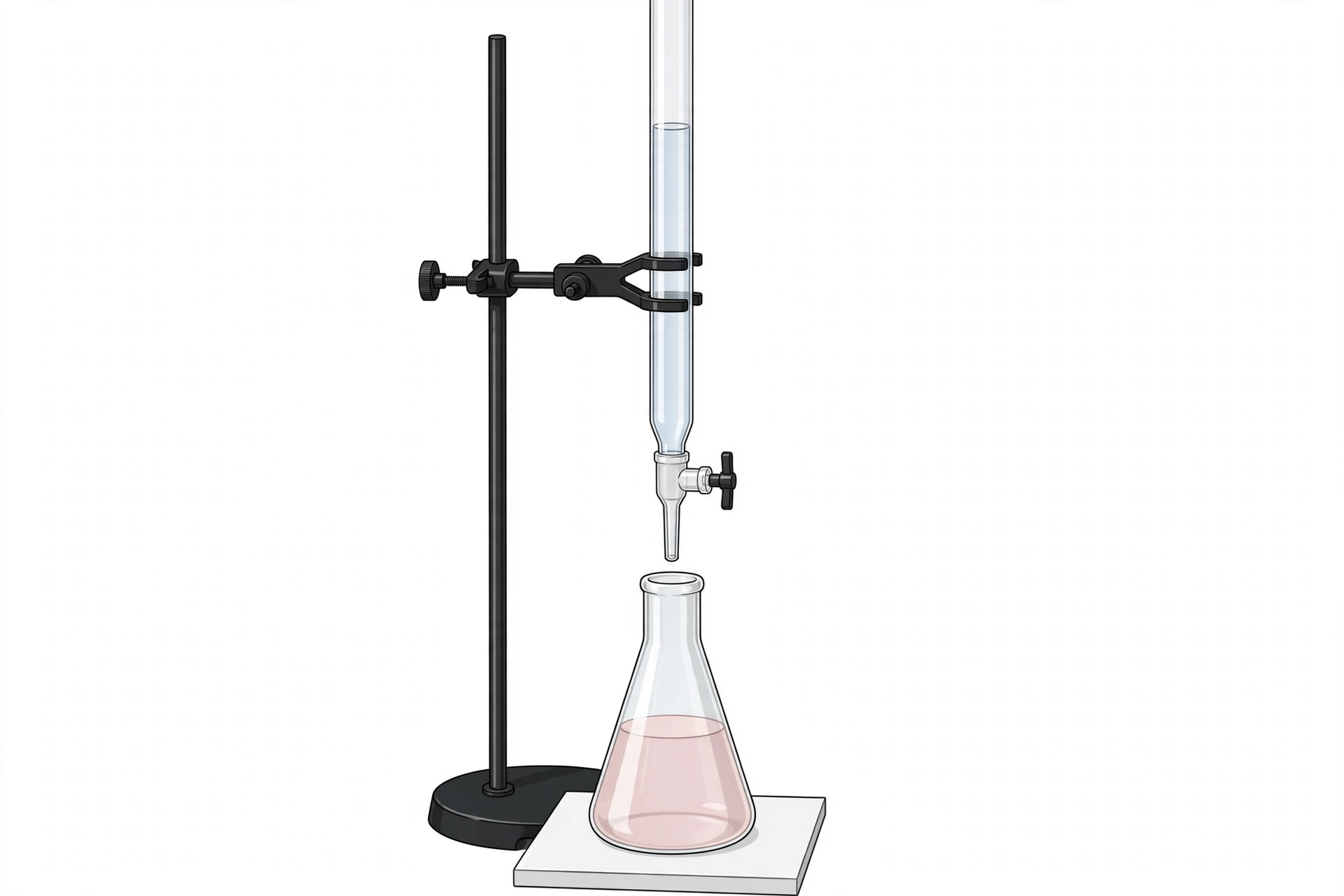
3. Reagents
- 0.005 N sodium thiosulfate solution
- 10% potassium iodide solution
- 2 N H₂SO₄ solution
- 1% starch solution (freshly prepared)
4. Procedure
Take 20 g of sample in Erlenmeyer flask
↓
Add 100 mL of boiled distilled water and shake to dissolve the salt
↓
Add 2 mL 2 N H₂SO₄ solution followed by addition of 10 mL of 10% KI solution. Close the flask stopper and keep it in dark about 10 minutes
↓
Titrate the content with standard 0.005 N Na₂S₂O₃ solution
↓
Stop titration as soon as solution turns to pale yellow
↓
Add 2 mL of 1% starch solution. Solution turns deep purple
↓
Continue titration until the purple coloration disappears
↓
Note the burette reading
5. Calculation
Iodine content in ppm (on dry basis) = [105.7 × V₁ × F × 100] ÷ [M × (100 − m)]
Where,
– V₁ = volume in mL of 0.005 N sodium thiosulphate solution required for titration
– F = Actual normality of sodium thiosulphate ÷ Nominal normality of sodium thiosulphate
– M = mass, in g, of the salt sample taken for analysis
– m = percentage moisture content
6. Limit of Detection
This method is applicable to estimate iodine content in iodized salt in µg/g of sample.
7. Precautions
- Reagent mixture should be kept in dark.
- Thiosulfate is standardized daily.
- Starch should be added near endpoint.
References
IS 7224-2006 H-3.2, Method B (Alternate Method when Iodate is used for Iodizing the Salt).