SOP: Enumeration of Escherichia coli Using Compact Dry EC Medium Count Plates
GIFSQ — Global Institute for Food Safety & Quality
Principle
The method is applicable to the enumeration of viable Escherichia coli to determine compliance with the requirements of Sections 4 and 7 of the Food and Drugs Act and/or other relevant federal regulations. It has been validated for use with raw milk cheeses, raw meat, and fresh fruit and vegetables. It is not applicable for the detection of E. coli O157.
Compact Dry EC is a ready-to-use chromogenic medium for performing E. coli counts. It contains dehydrated culture media and a cold water-soluble gelling agent in a non-woven cloth matrix. One milliliter (mL) of the diluted sample is added directly to the film in the middle of the plate, diffusing automatically and evenly into the film, which transforms the dried media into a gel within seconds. The plate is then incubated, examined for typical colonies, and counted. Compact Dry has a long shelf life, can be stored at room temperature, and does not require manual sample spreading.
The Compact Dry EC System contains the substrates 5-bromo-6-chloro-3-indolyl-β-D-galactopyranoside (Magenta-Gal) for coliforms, and 5-bromo-4-chloro-3-indolyl-β-D-glucuronic acid, cyclohexylammonium salt (X-Gluc) for E. coli. E. coli forms blue colonies on the plate by cleaving the chromogenic substrates, whereas other coliforms form red colonies on the plate.
Apparatus
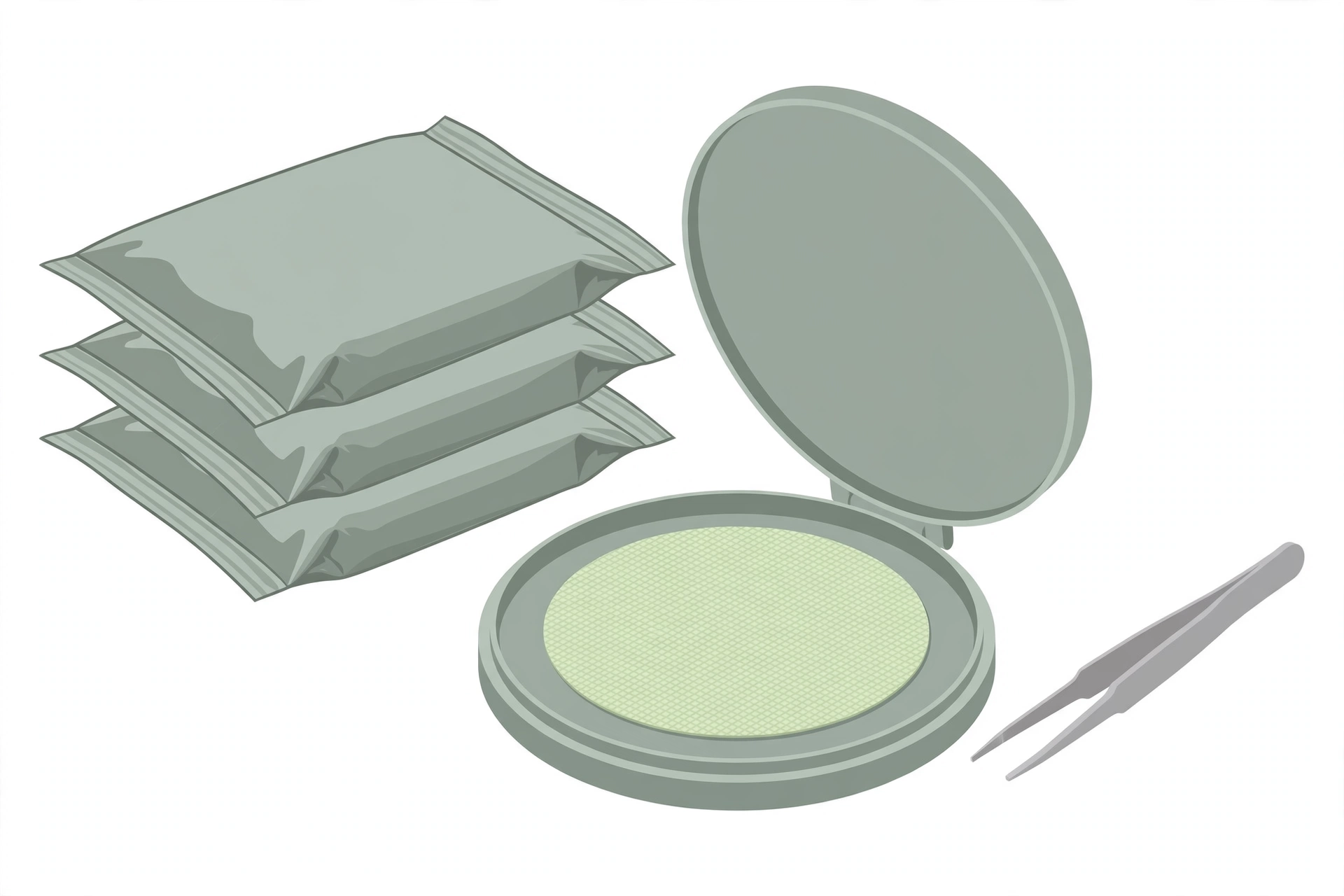
- Compact Dry EC plates (NISSUI Pharmaceutical Co.; commercially available, e.g. Hardy Diagnostics, catalogue # 54082) — store at 1 to 30°C
- Package insert, including instructions for use
- Stomacher, blender or equivalent
- Incubator capable of maintaining 42°C ± 0.5°C
- Colony counter and/or magnified illuminator
- Positive and negative control cultures, ATCC or equivalent
It is the responsibility of each laboratory to ensure that the temperatures of the incubators or water baths are maintained at the recommended temperatures. The following applies to steps of the method which apply to growth only. Where a temperature of ≤ 37°C is recommended in the text of the method, the temperature may be ± 1.0°C, e.g. 35 ± 1.0°C. However, where higher temperatures are recommended, it is imperative that the incubators or water baths be maintained within 0.5°C due to potential lethality of the higher temperatures on the microorganism(s) being isolated.
Reagents
The method formulates the following media itself; everything else is used as named:
- Initial diluent: Buffered Peptone Water. When testing raw milk cheese, use Buffered Peptone Water preheated to 35°C.
- Peptone Water 0.1% (the method’s media-formula section titles it “Peptone (0.1%) Water”).
Buffered Peptone Water
- Peptone: 10.0 g
- Sodium Chloride (NaCl): 5.0 g
- Disodium phosphate: 3.5 g
- Potassium dihydrogen phosphate: 1.5 g
- Distilled water: 1.0 L
Dissolve the ingredients in 1.0 L of distilled water and adjust the pH to 7.2 ± 0.2. Dispense and autoclave for 15 min at 121°C.
Peptone (0.1%) Water
- Peptone: 1.0 g
- Distilled water: 1.0 L
Dissolve the ingredients in 1.0 L of distilled water and adjust the pH to 7.0 ± 0.2. Dispense and autoclave for 15 min at 121°C.
Sample preparation
- In the laboratory prior to analysis, except for shelf-stable foods, keep sample units refrigerated or frozen, depending on the nature of the product.
- Thaw frozen samples in a refrigerator, or under time and temperature conditions which prevent microbial growth or death.
- Analyze sample units as soon as possible after their receipt in the laboratory.
- Have sterile diluent prepared, pre-warmed to room temperature or 35°C before use. When testing raw milk cheese, use Buffered Peptone Water preheated to 35°C.
- Clean the surface of the working area with a suitable disinfectant.
- Place the Compact Dry EC plate on a flat surface. Mark identifying sample information on memorandum section.
- To ensure a representative analytical unit for solid samples, obtain the analytical unit by taking a portion from several locations within the sample.
- Prepare dilutions:
- Raw milk cheese and raw meat samples: prepare a 1 in 10 (1:9) dilution in Buffered Peptone Water. Stomach or blend as required for thorough mixing. If required, prepare additional dilutions in Peptone Water. (The source prints “Stomach” as the verb here.)
- Fresh fruit and vegetables: prepare dilutions as described above. Only plate the 1 in 100 (1:99) dilution or other higher serial dilutions.
- An inhibitory effect has been observed when analysing fresh fruit and vegetable samples at the 1 in 10 (1:9) dilution. To obtain reliable results for fruit and vegetable samples, it is necessary to use a secondary dilution [i.e., 1 in 100 (1:99)] for the E. coli count.
Procedure
Inoculation and incubation
- Open the lid and inoculate by pipetting 1 mL of the diluted sample directly to the centre of a plate.
↓ - Allow the inoculum to spread evenly across the plate, being careful not to touch the surface of the matrix with the pipet tip.
↓ - Replace the lid and leave the plate undisturbed to allow the inoculum to diffuse and the gel to form.
↓ - Return unused plates to the foil pouch and store at room temperature.
↓ - Invert the plates and incubate in a horizontal position at 42°C for 24 ± 2 h.
Reading results
- Count plates promptly after the incubation period. Count all blue colonies.
↓ - Use a standard colony counter and/or magnified-illuminator to facilitate counting if needed. (The source prints “magnified-illuminator” here and “magnified illuminator” in the materials list; each is carried as printed in its own place.)
↓ - The growth area is 20 cm². The back of the plate has a grid of 1 cm x 1 cm markings to make the colony counting easier. (The source prints the grid as “1 cm x 1 cm”, with the letter x.)
↓ - For estimates on plates containing more than 150 colonies: count the average number of colonies in one or more representative grids, determine their average number, and multiply this average by 20 to determine the estimated total count per plate.
↓ - Calculate the number of colonies per g of sample from plates at dilution levels with statistically significant numbers of colonies (i.e., 15 to 150). If there are no plates within that range, plates containing between 1 and 14 colonies can be used.
↓ - When counting colonies on duplicate plates of consecutive dilutions, only plates with counts in the statistically significant range should be used to determine the average.
↓ - Plates with high concentrations of bacteria will cause the entire growth area to become white/pink. In this case, repeat the sample using higher dilutions.
Interpretation of results
- Blue colonies are confirmed E. coli.
↓ - Report the final result as the number of colony forming units (CFU) of E. coli per g of product.
↓ - If there are no typical E. coli colonies, report as E. coli less than the dilution factor per g of product.
Precautions
- The laboratory supervisor must ensure that completion of the analysis described in this method is done in accordance with the International Standards reference “ISO/IEC 17025 (latest version): General Requirements for the Competence of Testing and Calibration Laboratories”.
- It is the responsibility of the laboratory to ensure equivalency if any variations of the media formulations listed here are used (either product that is commercially available or made from scratch).
References
- Health Canada. 2023. MFLP-113: Enumeration of Escherichia coli Using Compact Dry EC Medium Count Plates. Compendium of Analytical Methods, Volume 3. Health Products and Food Branch. No “replaces” line exists in this method.
- Compact Dry EC Instructions for use, current version.