SOP: Detection of Thermophilic Flat Sour Sporeformers in Low-Acid Canned Foods
GIFSQ — Global Institute for Food Safety & Quality
1. Principle
This SOP detects thermophilic flat sour sporeformers in low-acid canned foods and their ingredients following the APHA Compendium of Methods for the Microbiological Examination of Foods (CMMEF), Chapter 25, 4th Edition. The typical organisms are Bacillus stearothermophilus and Bacillus coagulans, sporeforming thermophilic facultative aerobes that ferment carbohydrates to short-chain fatty acids, souring the product without producing enough gas to change the flat appearance of the container ends. Spoilage seldom occurs if holding temperatures are kept below about 43 °C; above about 43 °C, viable spores germinate and grow out. Spores of B. stearothermophilus have exceptionally high heat resistance: the D-value at 121.1 °C ranges from 4.0 to 5.0 minutes with a z-value of 7.8 to 12.2 °C. The upper growth temperature limit is 65 to 75 °C. These bacteria have no public health significance.
2. Apparatus required
- Autoclave (also for heat shocking food samples)
- Sanitary can opener (for opening canned food samples aseptically)
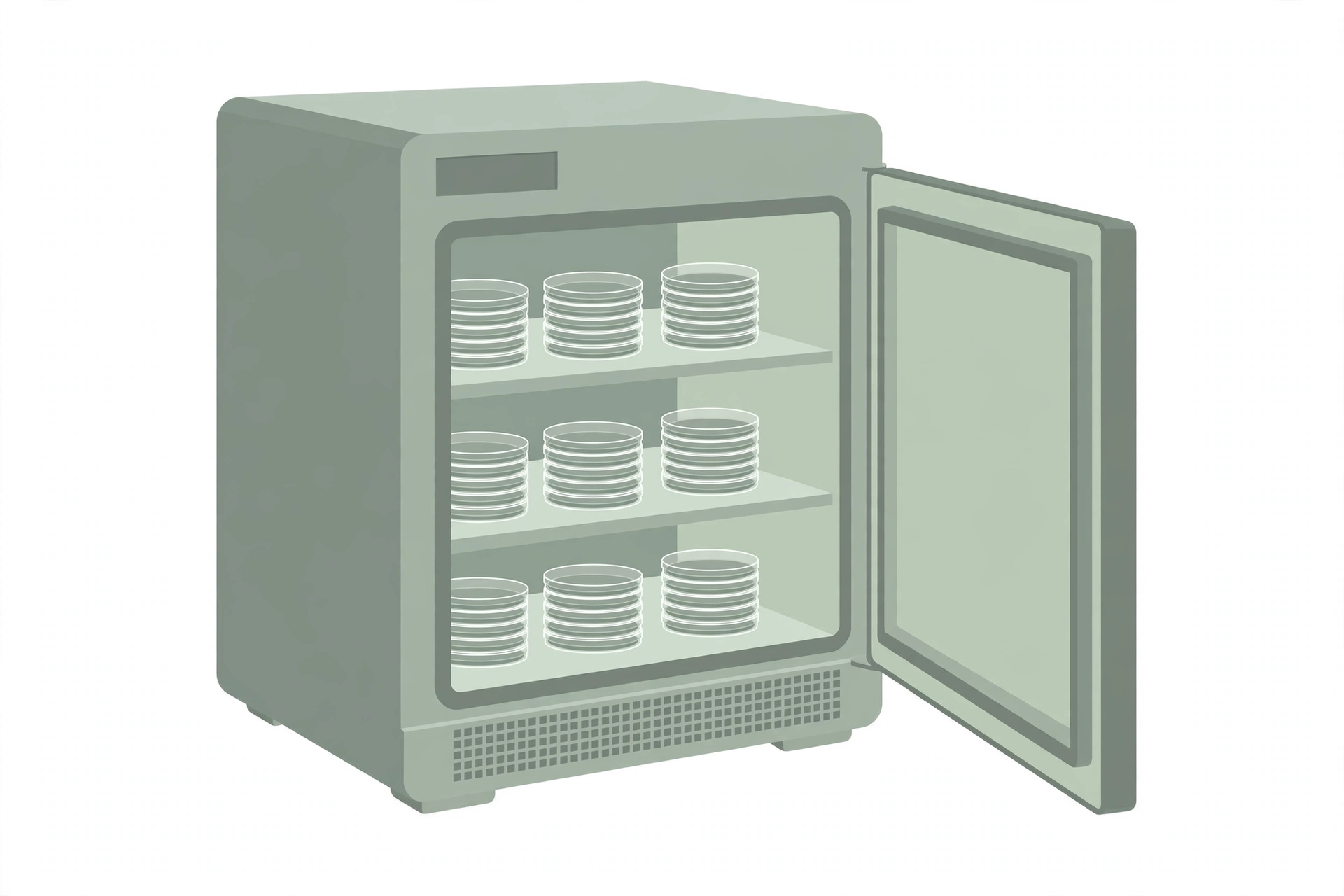
- Incubator controlled to about 55 °C
- Microscope
- pH meter (electrometric); a pH color comparator with bromcresol purple and methyl red reagents and standards may be substituted
- Sterile Petri dishes, glass or plastic
- Sterile 1 mL and 10 mL Mohr pipettes (sample pipettes from straight-wall borosilicate tubing, 7–8 mm × 35–40 cm; disposable pipettes may be used)
- 250 mL and 300 mL Erlenmeyer flasks (for ingredient analysis)
- Dilution bottles (6 to 8 oz) with distilled water for dilution blanks
- Special water bath for starch work
- Sterile 6-inch cotton or alginate swabs
3. Reagents
- A. Dextrose tryptone agar (commercially available)
- Flat sour colonies are round, 2 to 5 mm in diameter, with a dark opaque center, usually surrounded by a yellow halo in a field of purple. The yellow color may be missing with low-acid-producing strains or where alkaline reversion has occurred. Subsurface colonies are compact and biconvex to pinpoint. B. stearothermophilus gives pinhead-size brown colonies
- B. Dextrose tryptone broth (commercially available)
- C. Dextrose broth (commercially available)
- D. Nutrient broth (commercially available; for nutrient supplementation of line samples)
- E. Sterile plain 2% agar in water (20.0 g of agar per litre of distilled water), for stratifying starch plates
- F. Crystal violet solution (for direct smears)
4. Sample preparation
- Ingredients (sugar): collect half-pound samples from each of five bags, drums or boxes of a shipment or lot of dry sugar, starch, flour or similar ingredients; seal and transport to the laboratory. Sample spices in appropriately smaller volumes. For liquid sugar, collect five separate 6 to 8 oz (200–250 mL) samples from a tank or truck while it is being filled or emptied.
- Ingredients (equipment and product in process): collect scrapings or swab samples of food-contact surfaces, or wet surfaces positioned over food, in sterile tubes or sampling bags. Chill samples thoroughly without delay to prevent growth of thermophilic bacteria before examination; immersion of the sample container in cold tap water is usually adequate. Do not use glass containers for collecting equipment samples.
- Finished product: when spore contamination during production is the concern, obtain processed containers representing (a) start of operations, (b) before midshift shutdown, (c) startup after midshift shutdown and (d) end of shift — at least 10 containers for each period. When insufficient cooling or storage above 43 °C is suspected, obtain containers at random from the lot and record the location of each (position on pallet, pallet location).
- Heat shock (general): unless otherwise specified, heat shock at 100 °C for 30 minutes or 110 °C for 10 minutes, followed by rapid cooling. Heat shock eliminates all organisms except the spores of concern and activates maximum spore germination.
- Sugar for analysis: place 20 g of dry sugar in a sterile 250 mL Erlenmeyer flask marked at 100 mL. Add sterile water to the 100 mL mark and agitate to dissolve. For liquid sugar, add the volume equivalent by degrees Brix to 20 g of dry sugar and dilute with water to 100 mL.
- Starch for analysis: place 20 g of starch in a dry sterile 250 mL Erlenmeyer flask and add sterile cold water to the 100 mL mark with intermittent shaking. Shake well for a uniform suspension.
5. Procedure
5a. Sugar
Bring the prepared sugar solution rapidly to a boil and continue boiling for 5 minutes, then cool immediately in water
↓
Pipette 2 mL of the heated sugar solution into each of 5 Petri plates
↓
Add dextrose tryptone agar, swirl gently to distribute the inoculum, and allow to solidify
↓
Incubate the inverted plates at 50 to 55 °C for 48 to 72 hours
↓
Count the typical flat sour colonies and the total thermophilic spore count (every colony on each of the 5 plates)
5b. Starch
Pipette 10 mL of the starch suspension into a 300 mL flask containing 100 mL of sterile dextrose tryptone agar at 55 to 60 °C. Use large-bore pipettes and keep the starch suspension under constant agitation while pipetting
↓
Shake the flask in boiling water for 3 minutes to thicken the starch
↓
Place the flask in the autoclave and heat at 5 lb pressure (108.4 °C) for 10 min
↓
After autoclaving, agitate gently while cooling as rapidly as possible. Do not agitate violently, which incorporates air bubbles that interfere with reading the plates
↓
When the mixture cools to about 45 °C, distribute it about equally into 5 plates and allow to solidify
↓
Stratify with a thin layer of sterile plain 2% agar in water and allow to solidify, to prevent spreader interference
↓
Incubate the inverted plates at 50 to 55 °C; count colonies at 48 hours and at 72 hours
5c. Other ingredients
Apply the sugar and starch procedures to other ingredients used in low-acid canned foods, with modifications for the physical or chemical characteristics of the ingredient, such as smaller sample sizes or plating smaller volumes of suspension in more than 5 plates because of colony particle size interference during counting
5d. Equipment and product in process (line samples)
Use quantities of sample equivalent to the amount of material in a container of finished product; prepare 5 to 20 replicates
↓
After closing, warm the containers to the initial temperature of the commercial process and subject them to the normal commercial thermal process
↓
Incubate at 55 °C for 5 to 7 days
↓
Open and determine growth of flat sour bacteria by pH measurement, supplemented by microscopic examination of a direct smear if necessary
↓
If the sample material may lack essential nutrients, add nutrient broth or dextrose broth instead of water. If in doubt whether the material supports germination and outgrowth, inoculate a control sample with B. stearothermophilus spores, heat shock, and incubate at 55 °C for 48 to 72 hours
↓
Alternate route: make agar plate counts on serial dilutions of each heat-shocked line sample on dextrose tryptone agar, incubated at 55 °C for 48 to 72 hours
↓
Swabs or scrapings: shake in a known volume of diluent, heat shock the suspension, plate on dextrose tryptone agar, incubate at 55 °C for 48 to 72 hours, and calculate the numbers of microorganisms per unit area sampled
5e. Finished product
Incubate containers of processed product at 55 °C for 5 to 7 days, then open and examine for flat sour spoilage
↓
Compare the pH of the incubated samples with normal unincubated controls; this is usually sufficient to show flat sour spoilage
↓
If the results are not clear, confirm by direct microscopic examination of smears from both incubated and unincubated control containers. Examine products with confusing physical characteristics in a wet mount using phase optics
↓
Samples from a warehouse where insufficient cooling or storage above 43 °C is known or suspected are examined the same way but without the preliminary 55 °C incubation
6. Calculation
- The combined count of typical flat sour colonies from the 5 plates represents the number of flat sour spores in 2 g of the original sample (20 g sample diluted to 100 mL; 10 mL of this dilution plated). Multiply this count by 5 to express the result as the number of spores per 10 g of sample.
- The total thermophilic spore count is made by counting every colony on each of the 5 plates, then calculating in terms of number of spores per 10 g of sample.
- NFPA standards for thermophilic flat sour spores in sugar or starch for canners’ use: for the five samples examined, a maximum of not more than 75 spores and an average of not more than 50 spores per 10 g of sugar (or starch).
- NFPA standard for the total thermophilic spore count: for the five samples examined, a maximum of not more than 150 spores and an average of not more than 125 spores per 10 g of sugar (or starch).
- The sugar and starch standards may be used as a guide for evaluating other ingredients, keeping in mind the proportion of the other ingredients in the finished product relative to the quantity of sugar or starch used.
7. Precautions
- Handle samples other than finished products so that there is no opportunity for spore germination or spore production between collection and examination.
- Before making a positive judgment on a sample based on pH or microscopic examination of direct smears, be sure these characteristics are known for normal control products obtained from the same production code as the suspect samples; if unavailable, use a product from the same manufacturer bearing the next closest production code.
- Do not allow incubated agar plates to dehydrate during incubation; placement in oxygen-permeable bags minimizes dehydration.
- Recovery of heated spores is best at 45 to 50 °C and in neutral media; after spore heating, water is the best diluent. No growth of B. stearothermophilus occurs at pH 5.
- Flat sour spores show exceptional resistance to heat and chemicals and are difficult to destroy; control spore populations in ingredients and products entering the plant and use sound plant sanitation.
8. References
- APHA, Compendium of Methods for the Microbiological Examination of Foods (CMMEF), Chapter 25, 4th Edition.