SOP: Determination of Crude Fiber
GIFSQ — Global Institute for Food Safety & Quality
1. Principle
Crude fiber is the loss on ignition of the dried residue remaining after digestion of the sample with 1.25% (w/v) H₂SO₄ and 1.25% (w/v) NaOH solutions under specified conditions. The method is applicable to materials from which the fat can be and is extracted to obtain a workable residue, including grains, meals, flours, feeds, fibrous materials and pet foods.
2. Apparatus
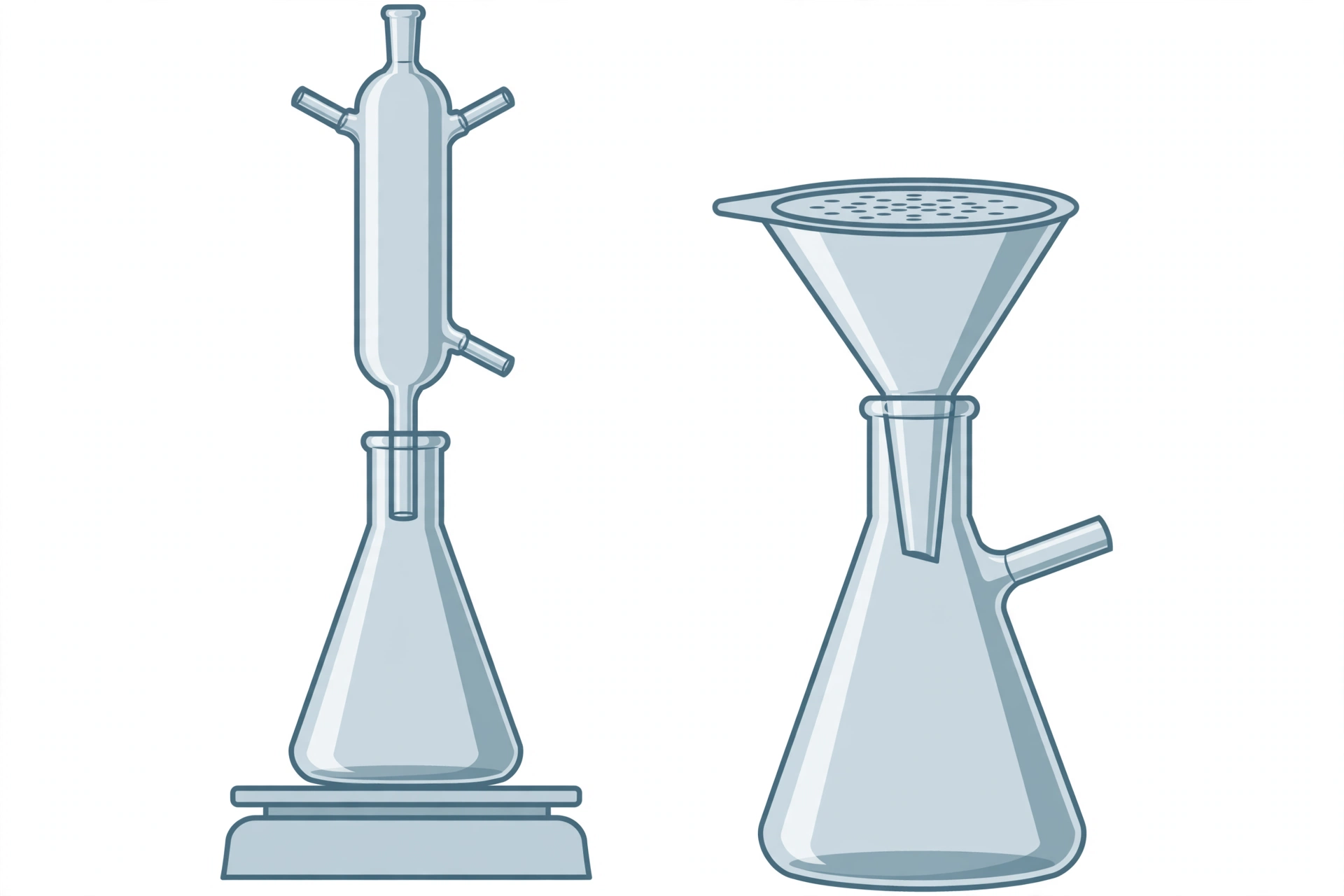
a. Digestion apparatus — with condenser to fit a 600 mL beaker, and hot plate
b. Desiccator
c. Suction filtering device with Buchner funnel
d. Gooch crucible — clean a new crucible as follows: brush and flow hot tap water into the crucible to remove as much ash as possible. Submerge the crucible in base solution (dissolve 5 g Na₂H₂EDTA, 50 g Na₂HPO₄ and 200 g KOH in water and dilute to 1 L) for ≥ 5 minutes; remove and rinse with hot tap water. Submerge in HCl (1+1) for ≥ 5 minutes; remove and rinse thoroughly with hot tap water followed by distilled water. After 3–4 uses, backwash by inverting the crucible in the filtration apparatus and flowing near-boiling water through it under partial vacuum.
3. Reagents
a. Sulfuric acid solution — 1.25% (w/v) or 0.128 M, accurately prepared and confirmed by titration
b. Sodium hydroxide solution — 1.25 g NaOH/100 mL or 0.313 M, accurately prepared
c. Bumping chips or granules
d. Petroleum ether
4. Procedure
Take 2.5–3 g of defatted sample into a 1 L reflux flask, avoiding fiber contamination from paper
↓
Add 0.25–0.5 g bumping granules to the flask, followed by 200 mL of near-boiling 1.25% H₂SO₄
↓
Place the flask on the digestion apparatus and boil for 30 minutes, rotating the flask periodically
↓
Remove the flask and filter through fine linen held in a funnel
↓
Wash with boiling water until the washings are no longer acid to litmus
↓
Transfer the acid-free residue from the funnel into the reflux flask with 200 mL of near-boiling 1.25% NaOH solution
↓
Place the flask on the digestion apparatus and boil for 30 minutes
↓
Remove the flask and filter through the filtering cloth
↓
Wash thoroughly with near-boiling water until alkali free
↓
Transfer to a Gooch crucible prepared with a thin compact layer of ignited asbestos
↓
Dry the Gooch crucibles and contents at 130 ± 2°C in an air oven for 2 hours
↓
Cool in a desiccator to room temperature and weigh (W₁)
↓
Incinerate the contents of the Gooch crucible in a muffle furnace until all carbonaceous matter is burnt
↓
Cool to room temperature in a desiccator and weigh (W₂)
5. Calculation
Crude fiber (%) = (Loss in weight on ignition ÷ Weight of test portion) × 100
= [(W₁ − W₂) ÷ W] × 100
Where,
– W₁ = weight in grams of Gooch crucible and dried residue before ashing
– W₂ = weight in grams of Gooch crucible containing ash
– W = weight in grams of defatted dried sample taken for the test
References
FSSAI Manual of Methods of Analysis of Foods, Cereal and Cereal Products (2016), part 8.8.