Food Product Development Quiz: NPD & Packaging Practice
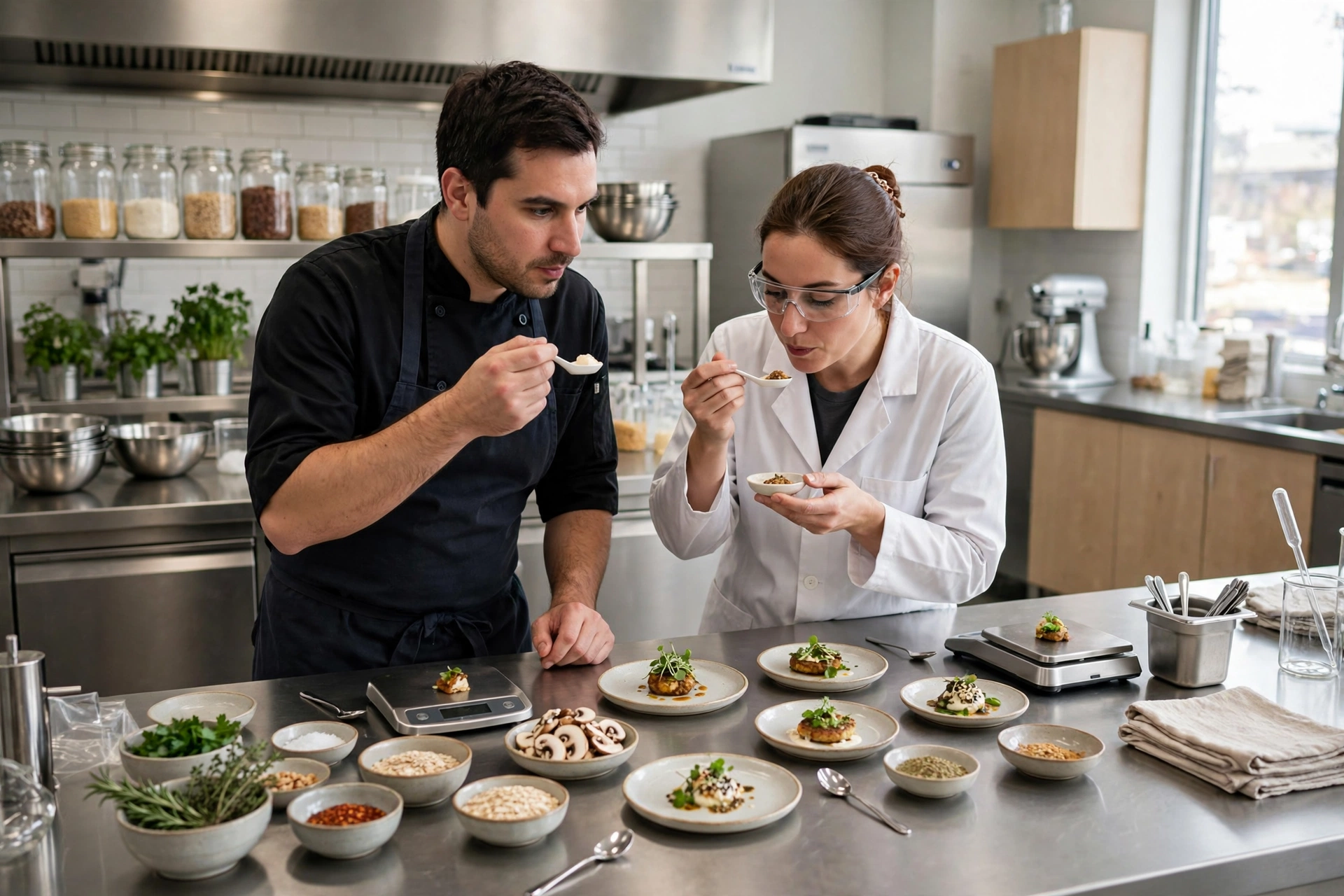
Every product on a supermarket shelf survived the same gauntlet: a brief, a bench formula, a pilot trial, shelf-life studies, packaging decisions, and a truthful label. Somewhere in that chain, a developer made a judgment call with incomplete data. This food product development quiz hub exists to make those judgment calls easier, with questions that rehearse the science behind each stage of development.
These quizzes cover GIFSQ category 10, Product Development & Innovation, the full arc of bringing a product to life: new product development and formulation, ingredient selection and optimization, sensory evaluation and consumer testing, shelf-life and stability work, packaging choices, additives and fortification, reformulation and clean label demands, and the innovation methods behind the process. If you arrived here searching for a food product development quiz, this hub is that collection in one place.
One warning before you begin: development knowledge decays fast when it lives only in your head. A rule about water activity learned three years ago will blur exactly when a pilot batch of bars starts weeping syrup. Treat these quizzes as dry runs for the bench, not exams to pass once and forget.
From idea to formula
New Product Development. Covers the stage-gate process: ideation, concept screening, feasibility, bench work, pilot scale-up, and launch. Questions test how teams move a product through gates without losing the original brief.
Formulation. Gets into the mathematics of recipes: balancing ingredients to hit targets for nutrition, cost, and functionality, plus the role of water, fat, and hydrocolloids in structure.
Ingredient Selection. Examines how developers choose suppliers and ingredients: functionality, cost-in-use, availability, allergen status, and compatibility with the process and the label.
Product Optimization. Reviews experimental design for tweaking formulas: factorial experiments, response surface methods, and how to read results when several variables move at once.
Innovation. Looks at the methods behind new ideas: trend analysis, technology scouting, open innovation, and how development teams respond to changing consumer expectations.
Testing and shelf life
Sensory Evaluation. Covers discrimination tests, descriptive analysis, and trained panel management, including how to set up tests that give answers you can act on.
Consumer Testing. Focuses on hedonic testing, preference mapping, and central location versus home-use tests, plus the basics of interpreting liking scores without overreading small differences.
Shelf-Life. Examines the determinants of how long a product stays acceptable: microbial, chemical, and physical modes of failure, and how packaging, formulation, and storage conditions interact.
Stability. Goes deeper into chemical stability: oxidation, moisture migration, texture loss, and color change, with questions on the analytical methods that track them.
Accelerated Shelf-Life. Reviews the principles and limits of accelerated testing: elevated temperature studies, Q10 concepts, and why accelerated results need real-time confirmation before a date goes on pack.
Packaging and label
Food Packaging. Covers the functions of packaging: protection, preservation, communication, and convenience, and how developers match pack format to product needs and distribution chains.
Packaging Materials. Details the common materials: glass, metal, plastics, paperboard, and flexible films, including barrier properties, seal integrity, and migration basics.
Food Additives. Tests knowledge of additive functions: preservatives, antioxidants, emulsifiers, stabilizers, and colors, plus the regulatory logic behind permitted levels and labeling.
Fortification. Examines adding micronutrients to foods: nutrient selection, stability through processing and storage, bioavailability, and the difference between mandatory and voluntary fortification programs.
Reformulation. Covers redesigning existing products: reducing sugar, salt, or fat while holding texture and flavor, and the technical traps that make reformulation harder than it looks.
Clean Label. Addresses pressure for simple ingredient lists: replacing synthetic additives with natural alternatives, the functional trade-offs involved, and what clean label means on pack.
Suggested learning path
- Start with New Product Development. The stage-gate framework gives every later topic a home in the timeline of a real project.
- Learn Formulation and Ingredient Selection together. Recipes and sourcing decisions feed each other, and the quizzes reinforce the connection.
- Add Product Optimization. Once you can build a formula, learn to improve one systematically with experimental design rather than trial and error.
- Take Food Additives and Fortification. Functional ingredients slot into the formulation knowledge you have, and the questions demand precision about levels and purposes.
- Study Sensory Evaluation, then Consumer Testing. Trained-panel science first, then consumer liking: the contrast teaches which questions each method can answer.
- Work through Shelf-Life, Stability, and Accelerated Shelf-Life. The longest technical block: failure modes, the chemistry behind them, and the testing methods that predict them.
- Cover Food Packaging and Packaging Materials. With shelf-life thinking fresh, packaging decisions read as solutions to the failure modes just studied.
- Finish with Reformulation, Clean Label, and Innovation. These apply everything above to the briefs developers receive today: make it healthier, make it simpler, make it new.
Who should take these quizzes
Product developers and R&D staff are the core audience: these quizzes mirror the decisions they make between brief and launch. QA and QC professionals benefit because development choices become their specifications, and understanding the intent behind a spec makes deviations easier to judge. Food science students get interview-grade preparation across the topics employers probe, and marketing staff who sit in development meetings will find the sensory, consumer testing, and clean label sets useful for holding their own in cross-functional discussions.
Difficulty runs from beginner through expert. Beginner questions cover definitions and recognition, intermediate questions require application, advanced questions involve calculations and data interpretation, and expert questions present case studies with multi-step reasoning: a failed shelf-life study, a reformulation that lost its texture. Begin below your comfort level and climb once scores are consistent.
Adjacent hubs extend the picture: the food product technology hub continues into manufacturing science, the food science and technology hub deepens the fundamentals behind your formulas, and the food sustainability hub covers the environmental side of packaging and sourcing. For everything in one place, browse all quizzes on the Quiz Center.
GIFSQ Food Safety Desk · Published: October 1, 2026