SOP: Determination of Water Soluble Ash — Tea and Coffee
GIFSQ — Global Institute for Food Safety & Quality
1. Principle
The total ash obtained is boiled with distilled water and filtered hot through an ashless filter paper (No. 42 or equivalent). The residue is washed with hot water until it is free from alkali. The filter paper along with residue is ignited in the same crucible for ashing, and the difference in weight is determined as water soluble ash.
2. Application
The method is applicable to all types of tea and coffee products.
3. Apparatus
- Funnel
- Ashless filter paper (No. 42 or equivalent)
- Red litmus paper
4. Procedure
Add 10–20 mL of distilled water in the crucible containing total ash
↓
Heat nearly to boiling for 5 minutes
↓
Filter through ashless filter paper (No. 42 or equivalent)
↓
Wash residue with hot water for 4–5 times till alkali free
(Collect the filtrate in a conical flask for determination of alkalinity of ash)
↓
Dry the ashless paper with residue in an oven
↓
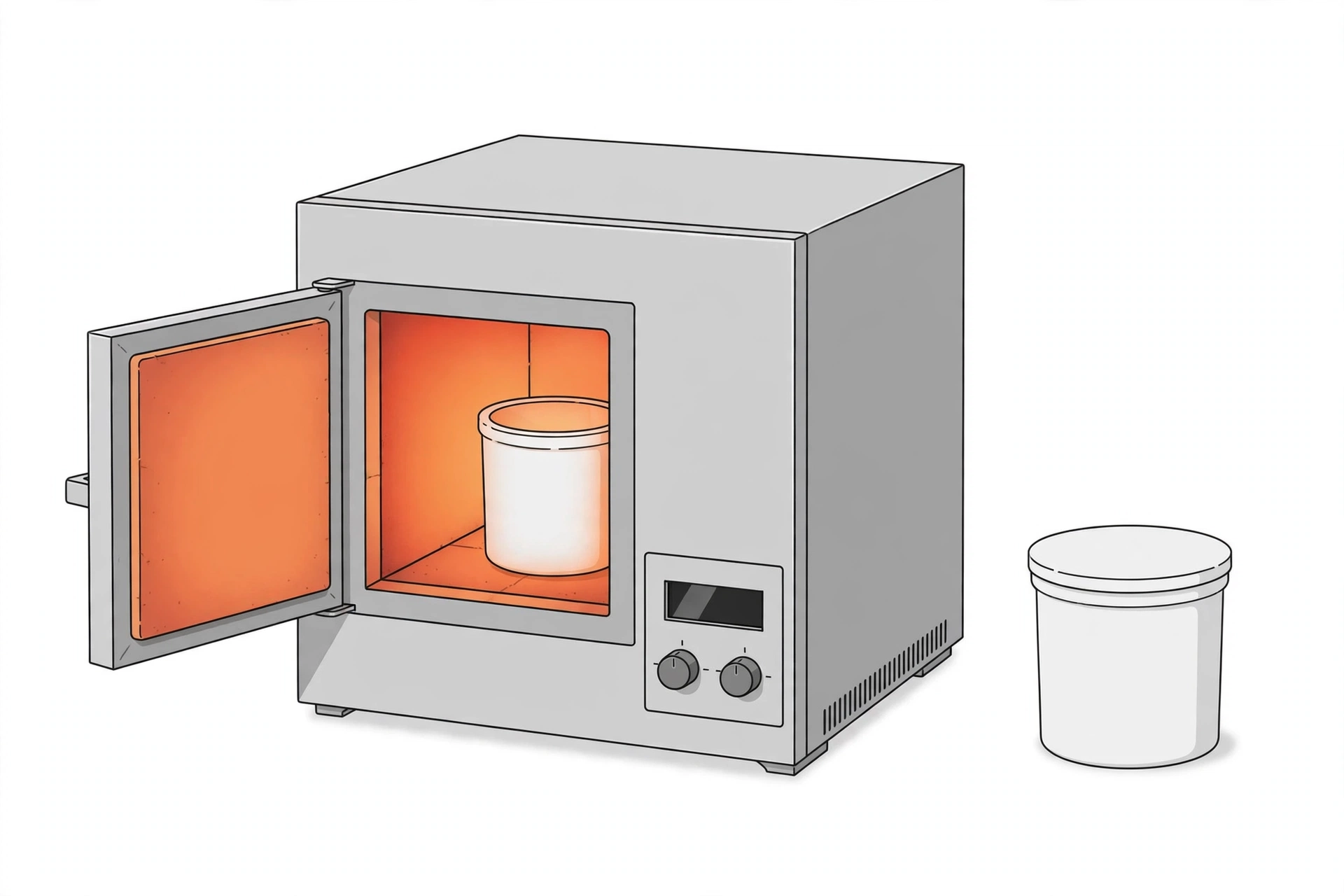
Transfer to muffle furnace and ignite at 550°C for 2 hours
↓
Cool in a desiccator and weigh
↓
Repeat the process till the difference in two consecutive weighings is less than 1 mg
↓
Record the lowest weight (D)
5. Calculation
Water Soluble Ash (% DWB) = [(B − D) ÷ (B − W)] × 100 × [100 ÷ (100 − M)]
Where,
– W = Weight of empty crucible
– B = Weight of crucible with Total Ash
– D = Weight of crucible and Water insoluble Ash
– M = % moisture
– 100/(100 − M) = Factor for dry basis
6. Precaution
Boiling of ash should be taken carefully, i.e. no content losses on boiling. It certainly affects the water-soluble ash and alkalinity of ash.
7. Limit of detection
The level of limit of detection of this method depends upon the weighing system, quality of filter paper and temperature of water.
References
FSSAI 2015, 1.4; Determination of Water Soluble Ash.