SOP: Determination of Total Foreign Matter in Food Grains
GIFSQ — Global Institute for Food Safety & Quality
1. Principle
The test sample is examined for its general condition, then separated over a set of sieves arranged in descending order of aperture, with a solid pan at the bottom. Foreign matter retained on the sieves and collected in the bottom pan — together with material of similar size picked out by hand — is weighed, and the total foreign matter is expressed as a percentage of the sample taken. Terms used here follow the grain grading definitions (extraneous material/refraction, organic matter, inorganic matter).
2. Equipment
a. Balance — sensitivity 1 mg
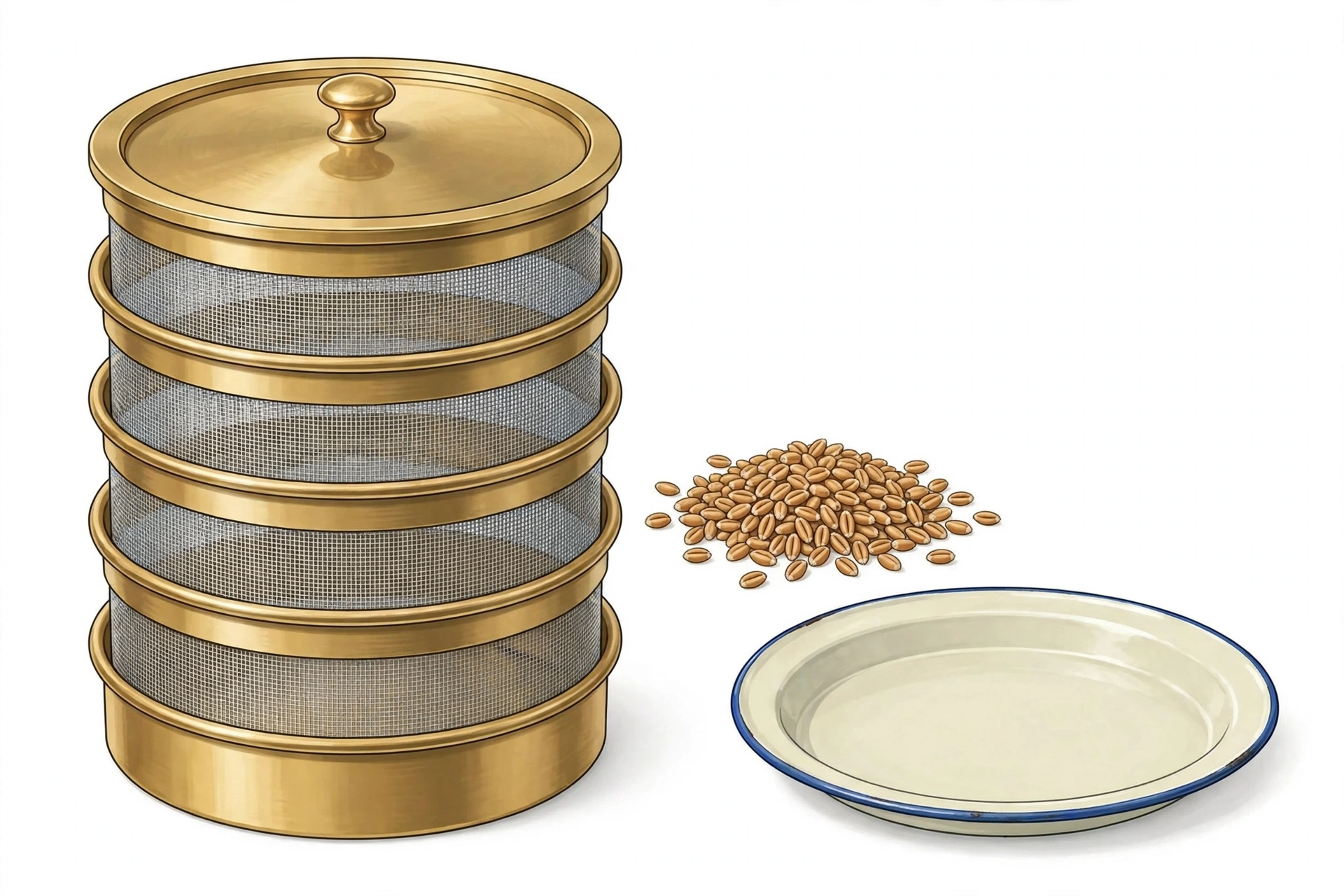
b. Sieves with round holes of the following aperture sizes, with a solid bottom pan used at the bottom:
| Position | Sieve size |
|---|---|
| Top | 4.00 mm |
| Second from top | 3.35 mm |
| Third from top | 1.70 mm |
| Fourth from top | 1.00 mm |
c. Enameled trays — flat type, 30 cm diameter, with raised rims
d. Small scoop — with handle, of mild steel, any size
e. Forceps
f. Magnifying glass — handle of about 7.5 cm, magnification 10X
3. Sampling quantity
- Bolder grains such as wheat, maize, barley, whole pulses: 500 g
- Smaller grains such as rice, split pulses, millets: 250 g
To reduce the quantity of the test sample: spread the entire sample in a tray, divide it into four equal portions, collect two opposite quarters, and repeat this process until the required quantity of sample is collected.
4. Procedure
Examine the test sample for its general condition — appearance, freedom from molds, insect infestation, off odor, and poisonous and deleterious matter
↓
Transfer the required quantity of sample (500 g or 250 g, as above) onto the set of sieves, arranged with the largest perforation at the top, the smaller perforations in descending order below, and the solid pan at the bottom
↓
Agitate the sample thoroughly to strain out the foreign matter at the various levels — bold grains, big pieces of clay and other big-sized foreign matter remain on the top sieves; smaller, shriveled and badly insect-damaged grains and smaller foreign matter pass to the lower sieves
↓
Separate the sieves after straining and pick up all foreign matter from each sieve, adding it to the foreign matter collected in the bottom pan
↓
Separate by hand any foreign material that could not be separated mechanically — such as seeds and other grains similar in size and weight to the grain — and add it to the bottom pan
↓
Weigh the total foreign matter collected in the bottom pan and calculate the percentage
5. Calculation
Total foreign matter (%) = (Weight of total foreign matter collected ÷ Weight of sample taken) × 100
References
FSSAI Manual of Methods of Analysis of Foods, Cereal and Cereal Products (2016), part 1.2.