SOP: Thermoduric Count and Heat Resistance Measurements (D-value and z-value)
GIFSQ — Global Institute for Food Safety & Quality
1. Principle
This SOP covers the thermoduric count and heat resistance measurements following the APHA Compendium of Methods for the Microbiological Examination of Foods (CMMEF), Chapter 14, 4th Edition. Thermoduric microorganisms are non-sporing bacteria (for example Enterococcus, Microbacterium, Micrococcus, coryneform bacteria, Lactobacillus, and related spore formers such as Bacillus and Clostridium) that survive heating in a food substrate at 60 to 80 °C and hence can survive pasteurization. The thermoduric (laboratory pasteurization) count heats the product at the time and temperature of low temperature long time pasteurization (62.8 °C for 30 minutes) and counts the survivors by the aerobic plate count. Heat resistance of a specific organism is measured as the D-value, the decimal reduction time: the time required at a specific temperature for a 10-fold (90%) reduction of the surviving population in a given menstruum; and the z-value, the change in temperature required to change the decimal reduction time by a factor of 10.
2. Apparatus required
For the thermoduric count (LTLT method)
- Sterile test tubes, 20 x 125 mm, screw-capped with rubber or plastic lined caps
- Sterile graduated pipettes, for 5 or 11 mL delivery
- Thermometer with 0.1 °C graduations covering the critical pasteurization temperature range, checked at least biennially against a reference thermometer certified by the National Institute of Standards and Technology
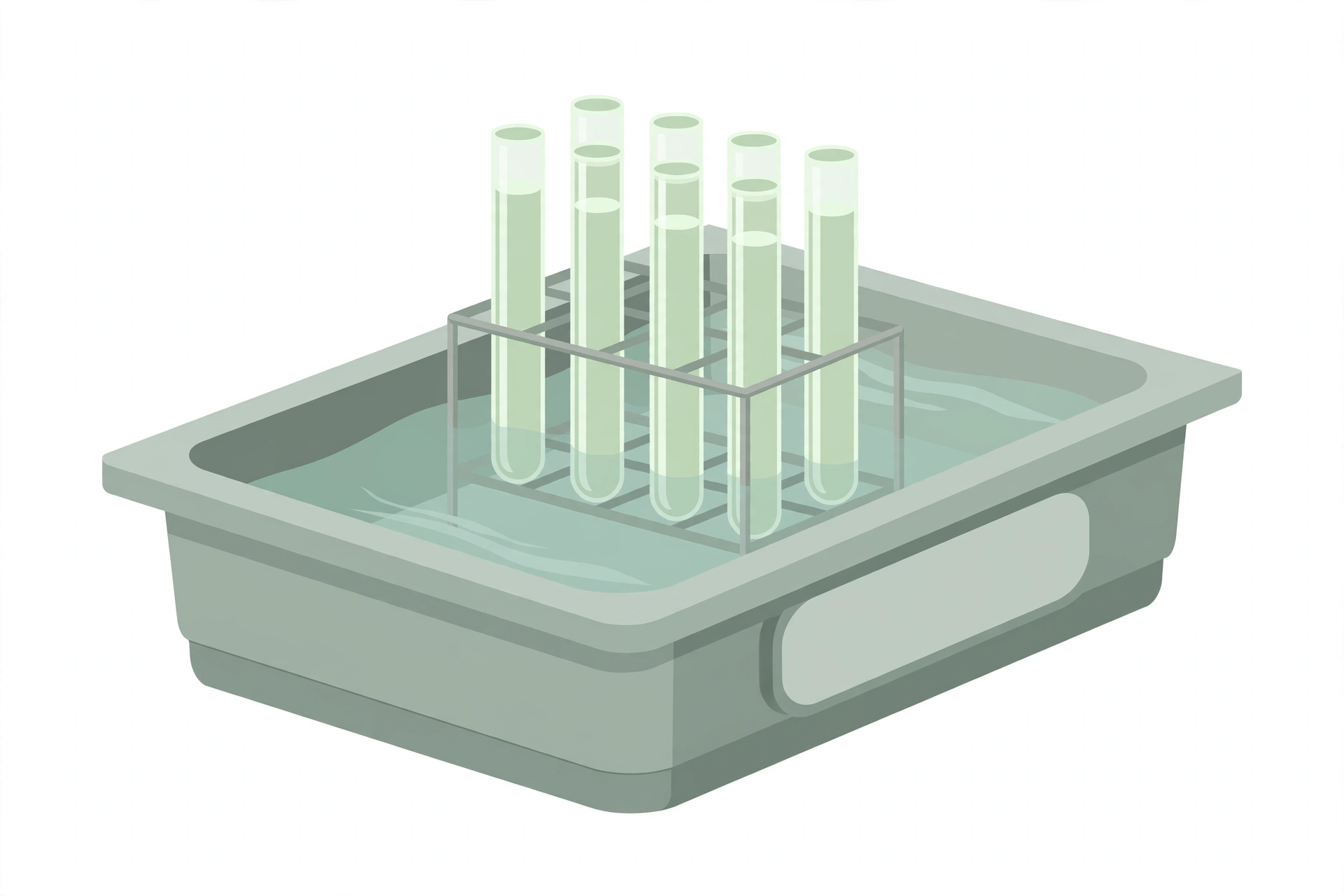
- Electrically heated, thermostatically controlled water bath maintained at 62.8 °C ± 0.5 °C, with a sufficient volume of water that the temperature drop when tubes are placed into the bath does not exceed 0.5 °C
- Metal, plastic, or wire test tube rack
- Ice water bath
For the immersed sealed-tube (IST) method
- Sterile sample vessels: test tubes 7 to 10 mm in diameter, or 2 mL glass vials crimp-sealable with metal caps containing Teflon-lined seals
- Sterile graduated pipettes, for 1, 5, 10, or 11 mL delivery
- Thermometer with 0.1 °C graduations, checked as above
- Thermostatically controlled water bath maintained at 62.8 °C ± 0.5 °C
- Digital timer
- Ice water bath
For heat resistance measurements
- Water bath or heating equipment for the test temperature
- Centrifuge, for preparing the inoculum
- Ice water bath, for cooling heated samples
3. Reagents
- A. Rich, non-selective recovery medium (selective media may not allow the growth of heat-injured cells)
- B. Heating menstruum (for example sterile whole milk: UHT pasteurized, or autoclaved at 121 °C for 10 to 15 minutes and rapidly cooled to 4 °C so that caramelization does not occur; or heated at a lower temperature for sufficient time, such as 85 °C for 1 hour, to inactivate competitive organisms)
- C. Glass beads in a sterile flask, pre-cooled to -20 °C, for receiving heated product samples
4. Sample preparation
- Prepare a 1 in 10 dilution of the food and further decimal dilutions. The method may also be applied to pasteurized liquid products and to well-blended 1:10 dilutions of pasteurized foods.
5. Procedure
5a. Thermoduric count — low temperature long time (LTLT) method
Thoroughly mix the liquid or diluted product and aseptically transfer 5.0 mL into sterile test tubes, taking care not to deposit sample on the lip or upper portion of the tube (organisms above the liquid surface may receive uneven or dry heating)
↓
Maintain the product samples and filled tubes at 0 to 4.4 °C during the filling process
↓
Seal the tubes with the sterile rubber or plastic lined caps
↓
Construct a reference (pilot) tube containing a thermometer immersed in an equal volume (5.0 mL) of the product under evaluation; use it to monitor the product temperature during heating and cooling
↓
Place the sample tubes and the reference tube into the rack and immerse the rack in the water bath preheated to 62.8 °C; the water level must be at least 4 cm above the level of the sample in the tubes
↓
The samples should reach the target temperature within 5 minutes
↓
Heat the sample tubes for 30 minutes; bubbles arising from the product during heating are undesirable, since contaminants may be drawn into the tubes during cooling
↓
Immediately immerse the rack into the ice water bath and cool to below 10 °C
↓
Determine the number of surviving organisms by the aerobic plate count
↓
Report the count as the Thermoduric Count per mL (or g), or as the Laboratory Pasteurization Count per mL (or g)
Prepare sufficient replicate tubes of each product to account for variability between samples. Where products or processes other than LTLT pasteurization are being evaluated, modify the temperatures and times as appropriate to the process under evaluation. This method should not be used for the evaluation of high temperature short time (HTST) pasteurization processes.
5b. Immersed sealed-tube (IST) method
Transfer the product sample or inoculated sample into small-volume vessels with minimal headspace and seal them
↓
Construct a reference tube with identical sample volume, sealed with a rubber stopper through which a thermometer or calibrated thermocouple is inserted so that it sits in the geometric center of the sample volume; use it to monitor the time needed to reach the target temperature or to determine heating and cooling lag correction factors
↓
Fully immerse the sample and reference tubes in the thermostatically controlled water bath preheated to 62.8 °C ± 0.5 °C; the water level must be at least 4 cm above the top of the sample vessels
↓
The samples should reach the target temperature in less than 5 minutes
↓
Heat the samples for 30 minutes
↓
At the end of the heating period, immediately plunge the tubes or vials into the ice water bath until the temperature reaches below 10 °C
↓
Determine the number of surviving organisms by the aerobic plate count
↓
Report the count as the Thermoduric Count per mL (or g), or as the Laboratory Pasteurization Count per mL (or g)
The immersed sealed-tube method avoids uneven heating from open headspace and gives a shorter come-up time. It is the preferred method for determining a thermoduric count or the survival of an inoculum during low temperature long time pasteurization, and for successive sampling schemes to determine survivor curves and D-values.
5c. Heat resistance measurement — preparation of the inoculum
Grow fresh cultures from refrigerated stock cultures on solid media to stationary phase at the organism’s optimal growth temperature
↓
Spin the cells in a centrifuge and decant the supernatant from the pellet
↓
Wash the pellet to remove debris and culture medium residue that may influence heat resistance
↓
Resuspend the culture in the heating menstruum
↓
Equilibrate the inoculated menstruum before thermal processing to a temperature similar to that encountered in commercial production
5d. Heat resistance measurement — successive sampling and the D-value
Preheat the substrate to the specified heating temperature
↓
Inoculate a small volume of the microbial suspension into the larger volume of preheated substrate and agitate continuously during heating
↓
At established heating intervals, aseptically remove an aliquot of the inoculated substrate and dispense it into a sterile tube immersed in ice water
↓
Enumerate the survivors and plot the logarithm of survivors against heating time to establish the semilogarithmic survival curve
↓
Determine D_T from the linear portion of the survival curve: D_T is the absolute reciprocal of the slope of that linear portion (slope = change in number of survivors / change in heating time)
For a qualitative determination, score heated replicate units for presence or absence of growth in enrichment broths: establish holding times that bracket the endpoint of survival, from all-positive to all-negative results, with at least three replicate tests at each holding time. Determine the 50% endpoint, the heating time at a constant temperature at which 50% of the samples are positive for growth, and calculate D_T by the Spearman-Karber estimation (see Calculation). For multiple-replicate-unit sampling, prepare sufficient tubes or vials for two to three replicate units at each heating period, with at least four heating periods in addition to the initial (time zero) samples.
5e. The z-value
Plot the D_T values determined at three or more temperatures as a thermal death time curve: the logarithm of D_T against temperature
↓
The z-value is the absolute reciprocal of the slope of the linear portion of this curve
↓
The z-value is the change in temperature required to change the decimal reduction time by a factor of 10, and is relatively constant for a given organism under various test conditions; it is used to determine equivalent thermal processes over a range of temperatures
6. Calculation
D_T = t_50 / (log N_0 + 0.251)
Where,
- D_T = decimal reduction time at temperature T, in minutes
- t_50 = the 50% time estimated from the Spearman-Karber procedure, the time at which 50% of the analytical units are positive for growth
- N_0 = the concentration of bacteria measured by plate count at heating time zero
It is assumed that the detection method recovers a viable microorganism when one is present.
7. Precautions
- The relatively large sample tubes of the LTLT method do not minimize headspace; organisms adhering to the sides or top of the tubes may receive uneven heating.
- The capacity to survive pasteurization depends not only on the microorganism but also on the initial microbial load, the product composition (nutrients, fat content, water activity, pH), the age of the product, and the method of heat treatment.
- Culture conditions influence heat resistance: populations in stationary phase are more heat resistant than those in logarithmic phase, and cultures grown at higher temperatures are generally more resistant. Equilibrate the inoculum to the menstruum before heating.
- Survivor curves are frequently linear but may also be concave, convex, or sigmoidal, with initial shoulders, declines, or tailing. Apply linear regression to the most linear portion, excluding initial declines or shoulders; for non-logarithmic survivor data, thermal death point measurements (F-values) may be a more appropriate tool than D-values.
- A rich, non-selective recovery medium should be used in thermal process studies, since selective media may not allow the growth of injured cells.
8. References
- APHA, Compendium of Methods for the Microbiological Examination of Foods (CMMEF), Chapter 14, 4th Edition.