SOP: Determination of Moisture by Immiscible Solvent Distillation (Bidwell-Sterling)
GIFSQ — Global Institute for Food Safety & Quality
Principle
Moisture is determined by reflux distillation of the food with an immiscible solvent that has a higher boiling point and a lower specific gravity than water (for example toluene, heptane or xylene). The distilled water settles in the graduated collecting tube while the solvent floats, and the water is measured by volume. The method is rapid and fairly accurate for relatively small quantities of moisture, needs little attention once set up, and is of special value where water must be distinguished from volatile matter — for example in spices containing volatile oils, since volatile oils distil over and mix with the solvent and are not measured. Low values may at times be obtained with this method.
Apparatus required
- Bidwell-Sterling tube with graduated collecting tube and side arm
- Reflux condenser
- 300 ml flask
- Burette brush
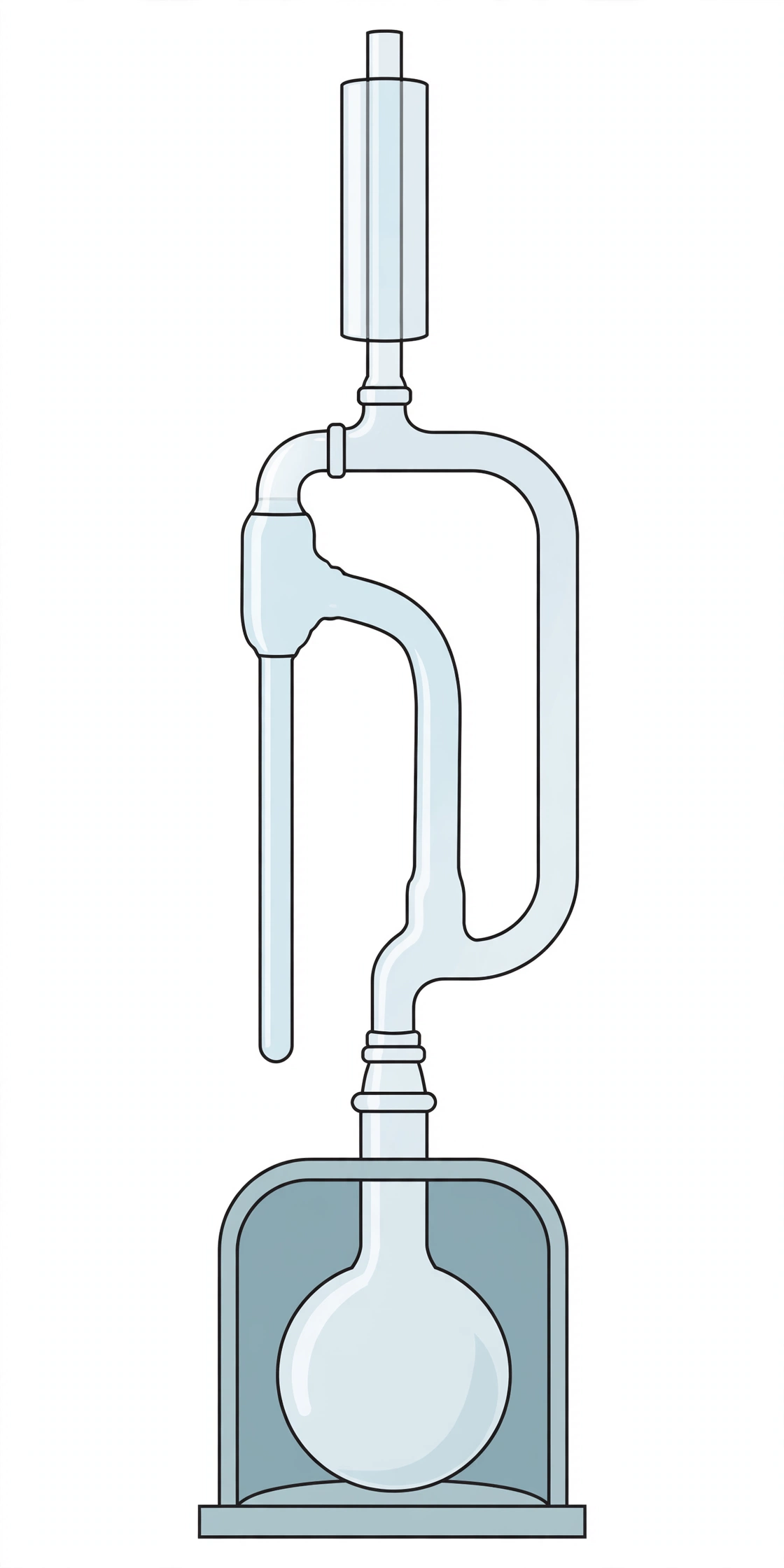
Reagents
a. Toluene (heptane or xylene may be used): sufficient to cover the sample completely — 75 ml or more.
b. Dry sand: place at the bottom of the flask before adding the sample, if bumping is likely to occur.
Procedure
Set up the apparatus; weigh into a 300 ml flask a sample that will give 2–5 ml of water
↓
If bumping is likely to occur, place dry sand at the bottom of the flask before adding the sample
↓
Add sufficient toluene to cover the sample completely (75 ml or more)
↓
Connect the flask to the side arm of the Bidwell-Sterling tube
↓
Pour toluene through the condenser until the collecting tube is filled
↓
Heat the flask to boiling and distil slowly (about 2 drops/sec) until most of the water has distilled over
↓
Increase the distillation rate to 4 drops/sec until no more water distils
↓
Wash down the condenser with toluene; if water droplets adhere to the condenser, brush them down with a burette brush saturated with toluene
↓
Continue the distillation until no more water distils over, and repeat the washing process
↓
Discontinue heating and allow the collecting tube to attain room temperature
↓
Read the volume of water distilled
Calculation
Water (moisture) % = (Volume of water distilled × 1.0 × 100) ÷ Weight of sample taken
Where,
- Volume of water distilled = volume of water read in the graduated collecting tube (ml), assuming its specific gravity to be 1.0
- Weight of sample taken = weight of the sample weighed into the 300 ml flask (g)
Precautions
- Choose a sample size that will yield 2–5 ml of water.
- Brush down any water droplets adhering to the condenser with a burette brush saturated with toluene, and repeat the washing until no more water distils.
- Allow the collecting tube to reach room temperature before reading the volume of water.
References
Ranganna, S., Handbook of Analysis and Quality Control for Fruit and Vegetable Products, 2nd edition.