SOP: Determination of Fat Content in Raw and Pasteurized Milk by Gerber Method
GIFSQ — Global Institute for Food Safety & Quality
Scope
This method prescribes the procedure for the determination of fat in whole milk, evaporated milk, and standardized milk, toned milk, double toned milk, separated milk, skimmed milk, buttermilk, condensed milk and homogenized milk by the Gerber method.
Sampling and sample preparation
If the sample is fresh, warm it to approximately 27°C and mix thoroughly, but do not shake it so vigorously as to cause undue frothing or churning of the fat. Pour the sample into another clean dry vessel and back to the original. Repeat the process of pouring back and forth until a homogeneous mixture is obtained. Allow the sample to stand for three or four minutes after mixing to allow air bubbles to rise; invert the sample bottle three or four times immediately prior to taking milk for the test.
Note:
a. If the sample has aged and there is difficulty in dispersing the cream layer by the above method, warming the milk to 30°C may be necessary for adequate mixing.
b. If the sample shows evidence of slight churning shown by the presence of white flakes, it should be slowly warmed to 34 to 40°C before mixing during the preparation of sample. If after this treatment a sample appears not to be homogeneous, it should be rejected.
1. Principle
The milk is mixed with sulphuric acid and iso-amyl alcohol in a specially shaped, calibrated glass tube, called a butyrometer, permitting dissolution of the protein and release of fat. The tubes are centrifuged and the fat rising into the calibrated part of the tube is measured as a percentage of the fat content of the milk sample. The method is suitable as a routine or screening test. It is an empirical method and reproducible results can be obtained if the procedure is followed correctly.
2. Apparatus
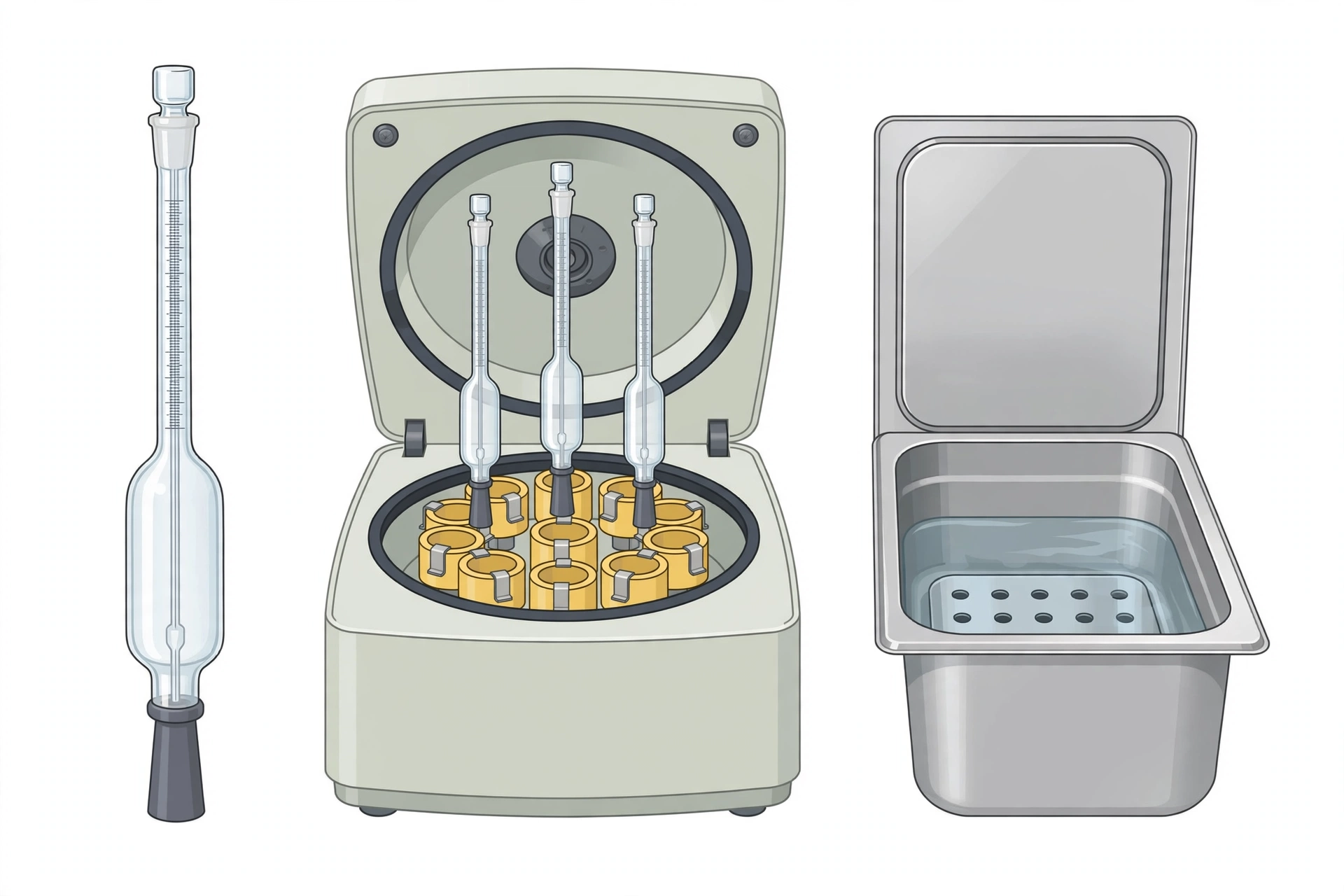
a. Gerber butyrometer, 10% (ISI marked)
b. Lock stoppers and key
c. Gerber centrifuge
d. Milk pipette, 10.75 mL (ISI marked)
e. Water bath with temperature control
f. Dispenser for delivering 1 mL iso-amyl alcohol
g. Dispenser for delivering 10 mL of sulphuric acid
3. Reagents
a. Sulphuric acid with a density of 1.807 to 1.812 g/mL at 27°C, corresponding to a concentration of sulphuric acid from 90–91% by weight
b. Amyl alcohol for milk testing (furfural free)
4. Procedure
Measure 10 mL of sulphuric acid into a butyrometer tube (preferably by using an automatic dispenser), without wetting the neck of the tube
↓
Add 10.75 mL of milk sample in the butyrometer, taking care not to wet the neck of the butyrometer
↓
Add 1 mL of amyl alcohol, taking care not to wet the neck of the tube
↓
Close the neck of the butyrometer firmly with a lock stopper
↓
Shake until homogeneous, inverting it for complete admixture of the acid, taking care to have casein particles, if any, dissolve fully
↓
Keep in a water bath for 5 minutes at 65 ± 2°C
↓
Take the butyrometer out of the water, dry it with a cloth and transfer it to the centrifuge, placing two butyrometers diametrically opposite so as to balance the rotating disc
↓
Centrifuge for 4 minutes at 1100 rpm
↓
Remove the butyrometer tubes and place in a water bath for 5 minutes at 65 ± 2°C
↓
Read the percentage of fat after adjusting the height in the tubes as necessary by movements of the lock stopper with the key
Reading: Note the scale reading corresponding to the lowest point of the fat meniscus and the surface of separation of the fat and acid. When readings are being taken, hold the butyrometer with the graduated portion vertical, keep the point being read in level with the eye, and then read the butyrometer to the nearest half of the smallest scale division.
5. Expression of results
Record the fat in percentage.
6. Precautions (notes from the source method)
a. The butyrometer must always be emptied without delay and the highly acidic waste disposed of appropriately. The tubes may be cleaned with chromic acid.
b. In homogenized milk, fat separates with more difficulty and centrifuging more than once may be required. On the other hand, holding the tubes too long at 65°C or above results in esterification of the amyl alcohol, with a consequent increase in the volume of the fat layer.
c. In case of old samples, if necessary, the concentration of sulphuric acid may be increased from 90–91% to 92–93% to facilitate better dissolution.
d. If a fluffy layer is observed at the base of the fat column of the butyrometer, reject the test. Examine the stopper to see if it is in good condition, repeat the test and take greater care to ensure that the curd is completely dissolved.
e. If the fat column is so dark as to make reading difficult, reject the test and check the strength of the sulphuric acid.
f. If a large number of samples has to be tested, it is preferable to use automatic measures for measuring the sulphuric acid and amyl alcohol, especially the latter; otherwise there is a possibility of injurious effects to health arising from the inhalation of amyl alcohol.
References
IS 1224 (Part I): 1977, RA 2008.