SOP: Detection of Listeria spp. in Environmental Samples Using the FoodChek Listeria spp. Method
GIFSQ — Global Institute for Food Safety & Quality
Principle
This method is applicable to the rapid detection of Listeria spp. to determine compliance with the requirements of Sections 4 and 7 of the Food and Drugs Act and/or other relevant federal regulations. This method has been validated for a variety of environmental surfaces.
The FoodChek Listeria spp. assay is an immunomagnetic lateral flow assay for the rapid detection of Listeria spp. (except for L. grayi) on environmental surfaces. The test kit uses a proprietary ACTERO Listeria Enrichment Media for a single-step microbiological enrichment, followed by detection of Listeria spp. on a lateral flow cassette using a magnetic reader.
The assay cassette is composed of a sample/conjugate pad which contains nano-sized magnetic particles conjugated to the antibody that will bind the complementary antigen, and a second antibody present in a narrow capture zone. Capillary flow takes the liquid loaded through the sample pad to the conjugate pad, where the target bacteria bind to the antibody-coated particles. This immune complex flows into the test strip to the capture zone, where a second fixed antibody specifically binds the target antigen. The result is an accumulation of magnetic particles in the capture zone, and the result is positive. If the target pathogen is absent, immune complexes do not form, particles do not accumulate at the capture line, and the test result is negative. Further downstream, a control line verifies that the test was performed correctly and that the reagents are still active. The cassette is read in an instrument capable of detecting low concentrations of magnetic particles. The instrument compares the detection signal with a positive threshold value encoded in a data matrix on the individual cassette, and then reports a positive or negative result. The results are displayed on the instrument’s liquid crystal display (LCD) screen and printed. In addition to all analysis parameters, the barcode also encodes the test name, lot number and expiry date, which are printed along with the test result.
Apparatus
- FoodChek MICT v2 Reader (cat. # FCR-004)
- Dey-Engley (D/E) neutralizing broth
- Vortex mixer
- Disposable transfer pipettes
- Non-bactericidal sterile cellulose sampling sponges (e.g. 8 × 4 × 0.3 cm)
- Polypropylene tubes with cap
- Graduated cylinder with a capacity of 100 mL
- Sterile stomacher bags
- Micropipette able to dispense 150 µL and corresponding sterile disposable tips
- Refrigerator
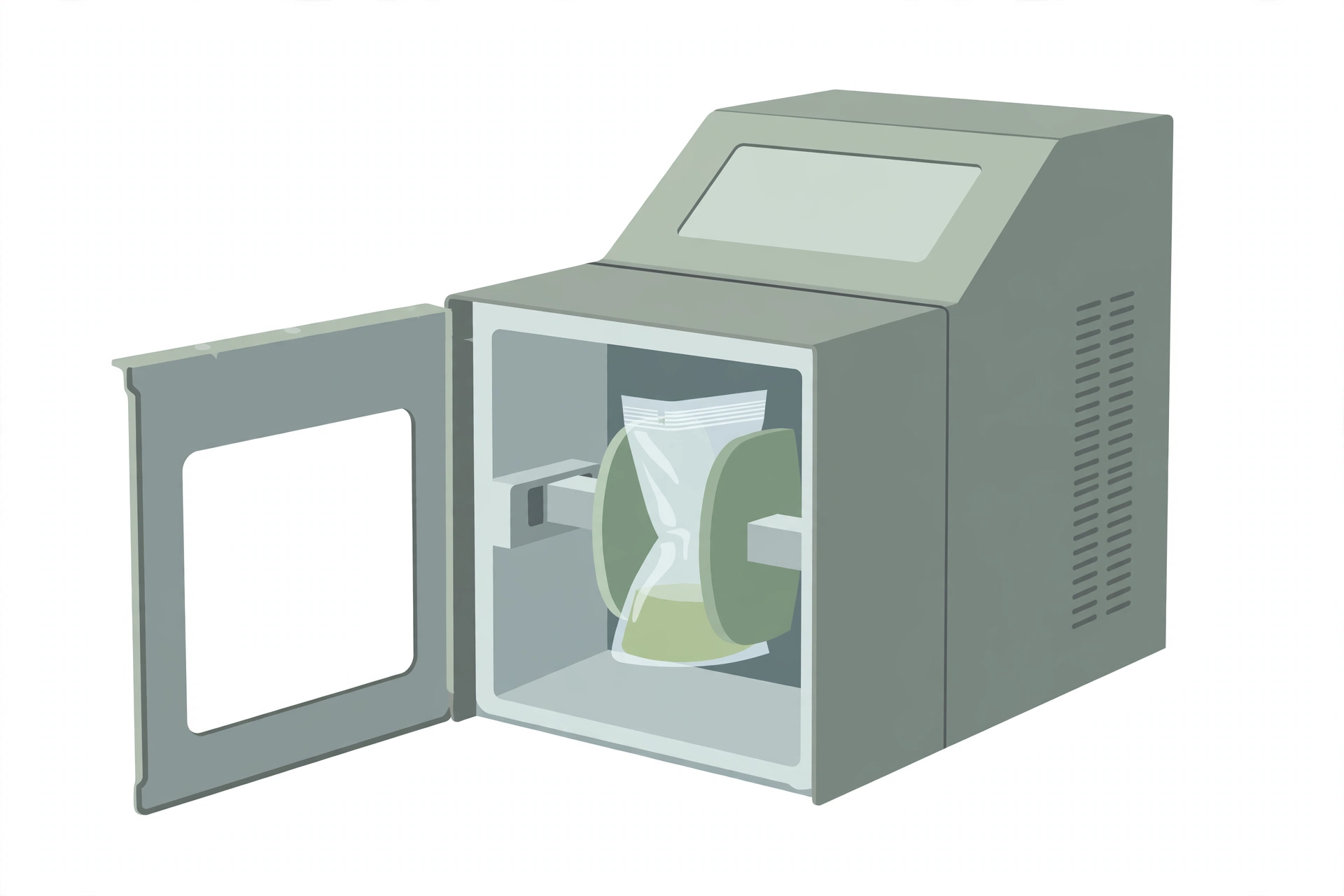
- Stomacher or equivalent
- Incubator capable of maintaining 32 ± 0.5°C
- Boiling water bath
Reagents
The method formulates no media itself; the media listed are commercially available and are to be prepared and sterilized according to the manufacturer’s instructions. The following are used as named:
- FoodChek Listeria spp. kit (cat. # FCLS-003; pack of 20 assay cassettes)
- ACTERO Listeria Enrichment Media (ACTERO Listeria) (cat. # FCM-011; 500g bottle of dehydrated media)
- Dey-Engley (D/E) neutralizing broth
- Distilled/deionized sterile water
Sample preparation
- The protocol of MFLP-41 should be followed for environmental sampling using sterile sponges moistened with 10 mL of D/E neutralising broth.
- In the laboratory prior to analysis keep sample units refrigerated.
- Analyze sample units as soon as possible after their reception in the laboratory.
Procedure
Each sample unit shall be analyzed individually.
Preparation for analysis
- Have sterile ACTERO Listeria Enrichment Media pre-warmed to 32 ± 2°C before use.
- Clean the surface of the working area with a suitable disinfectant.
↓
Preparation of samples
- Add 90 mL of ACTERO Listeria Enrichment Media pre-warmed to 32 ± 2°C to each environmental sponge sample in a stomacher bag.
- Mix the sample for 30 seconds in a stomacher. Hand mixing is an acceptable alternative to stomaching; to hand mix, massage each sponge for approximately one minute.
↓
Enrichment
- Close bag loosely and incubate the sample for 26–28 h at 32 ± 0.5°C.
↓
Analysis
- Turn on the FoodChek MICT Reader. Initialization will take a few minutes; when the instrument is ready for use, the screen will show four pictograms. Select the pictogram representing a cassette by touching the screen.
- Note: for improved accuracy, warm the reader for 2 h. It is recommended to leave the MICT reader ON at all times.
- Allow the required number of the FoodChek Listeria spp. cassettes to equilibrate to room temperature prior to use (at least 30 min). One cassette per sample is required.
- Following the enrichment, label a 15 mL tube for each sample, place it in a tube rack, and remove the cap of the tube.
- Mix the sample thoroughly, and transfer 5.0 ± 0.2 mL of the enriched culture sample from the bag to the tube. Cap the tube.
- Keep the incubated enrichment in the refrigerator for cultural confirmation of any positive result obtained with the FoodChek Listeria spp. assay.
- Using a boiling water bath (100°C), heat the tube containing the enriched sample for 15 min. Allow the sample to cool down to room temperature.
- Mix cooled sample thoroughly using a vortex.
- When processing a large number of samples, proceed per batch of 10 cassettes.
- Using a micropipette, transfer 150 µL of the cooled heat-treated sample directly into the sample port of the FoodChek Listeria spp. cassette. Change pipette tips between each sample.
- Allow the assay to develop for 30 ± 5 minutes at room temperature before reading in the FoodChek MICT Reader.
- Open the front door of the reader, and insert the cassette. Ensure that the barcode is on the up side. Close the door of the reader; closing the reader door will initiate the reading process.
Interpretation of test results
- Results Output. The results are indicated on both the instrument LCD display and the instrument printout, and are reported as being either “Positive” or “Negative”. If an “Invalid” or “Indeterminate” result is obtained, see the FoodChek Instrument User Manual for further instructions/troubleshooting.
- Negative Result. L. monocytogenes, L. innocua, L. ivanovii, L. seeligeri, and L. welshimeri were not detected in the sample.
- Positive Result. L. monocytogenes, L. innocua, L. ivanovii, L. seeligeri, and/or L. welshimeri was (were) detected in the sample.
Confirmation
Presumptive positive results may be confirmed by immediately proceeding with the plating and confirmation steps of a cultural method — MFHPB-07: The Isolation of Listeria monocytogenes and other Listeria spp. from Foods and Environmental Samples using Palcam Broth or MFHPB-30: Isolation of Listeria monocytogenes and other Listeria spp. from foods and environmental samples — using the refrigerated enrichment broth, as appropriate.
Precautions
- The laboratory Supervisor must ensure that completion of the analysis described in this method is done in accordance with the International Standards reference “ISO/IEC 17025:2005 (or latest version): General Requirements for the Competence of Testing and Calibration Laboratories”.
- It is the responsibility of the laboratory to ensure equivalency if any variations of the media formulations listed here are used (either product that is commercially available or made from scratch).
References
- Health Canada. MFLP-99: Detection of Listeria spp. in Environmental Samples Using the FoodChek Listeria spp. Method. Compendium of Analytical Methods, Volume 3, December 2018. Health Products and Food Branch.
- FoodChek Systems Inc. 2012. User Manual for FoodChek Instrument.
- Microbiological Methods Committee. 2010. Environmental Sampling for the Detection of Microorganisms (MFLP-41). In: Volume 3. The Compendium of Analytical Methods.
- Pagotto, F., Hébert, K., J. Farber. 2011. Isolation of Listeria monocytogenes and other Listeria spp. from foods and environmental samples (MFHPB-30). In: Volume 2. The Compendium of Analytical Methods.
- Warburton, D., Boville, A., Pagotto, F., Daley, E. and Chow, C. 2012. The Isolation of Listeria monocytogenes and other Listeria spp. from foods and environmental samples using Palcam broth (MFHPB-07). In: Volume 2. The Compendium of Analytical Methods.