SOP: Detection of Listeria Species in Environmental Surface Samples Using the RapidChek Listeria NextDay System
GIFSQ — Global Institute for Food Safety & Quality
Principle
This method is applicable to the detection of Listeria species (spp.) for determining compliance with the requirements of Sections 4 and 7 of the Food and Drugs Act and/or other relevant federal regulations. It is validated for use on a variety of environmental surface samples. Presumptive results can be obtained after a minimum 27 h enrichment of the environmental surface sample.
The RapidChek Listeria NextDay media supports the growth of Listeria species. The immunoassay uses a double antibody “sandwich” format: an antibody specific to Listeria is sprayed and immobilized in a line on a membrane (the “test line”), while a second antibody reagent that also recognizes Listeria and is labelled with colloidal gold sits in a reagent pad upstream of the test line. As the sample moves by capillary action from the filter pad into the antibody–gold pad, the antibody–gold reagent specifically binds Listeria and moves with the liquid into the test membrane, where the immobilized Listeria antibody captures the Listeria–antibody–gold complex, forming an antibody–Listeria “sandwich” that develops red color at the test line. With no Listeria present, no sandwiches form and no red color develops at the test line. Reagents immobilized at the control line capture excess gold reagent passing through the test line; red color at the control line shows the strip flowed correctly. A single line (control line only) indicates a negative sample; two lines indicate a positive sample.
Apparatus
- RapidChek Listeria kit (45 tests), including transfer tubes and graduated pipettes (10001695), or RapidChek Listeria NextDay Environmental System (4x 45 tests) with media (10001723)
- RapidChek Listeria Test Combs, 384 Tests — includes 8 desiccated foil bags containing 6 combs of 8-strips each (10001721)
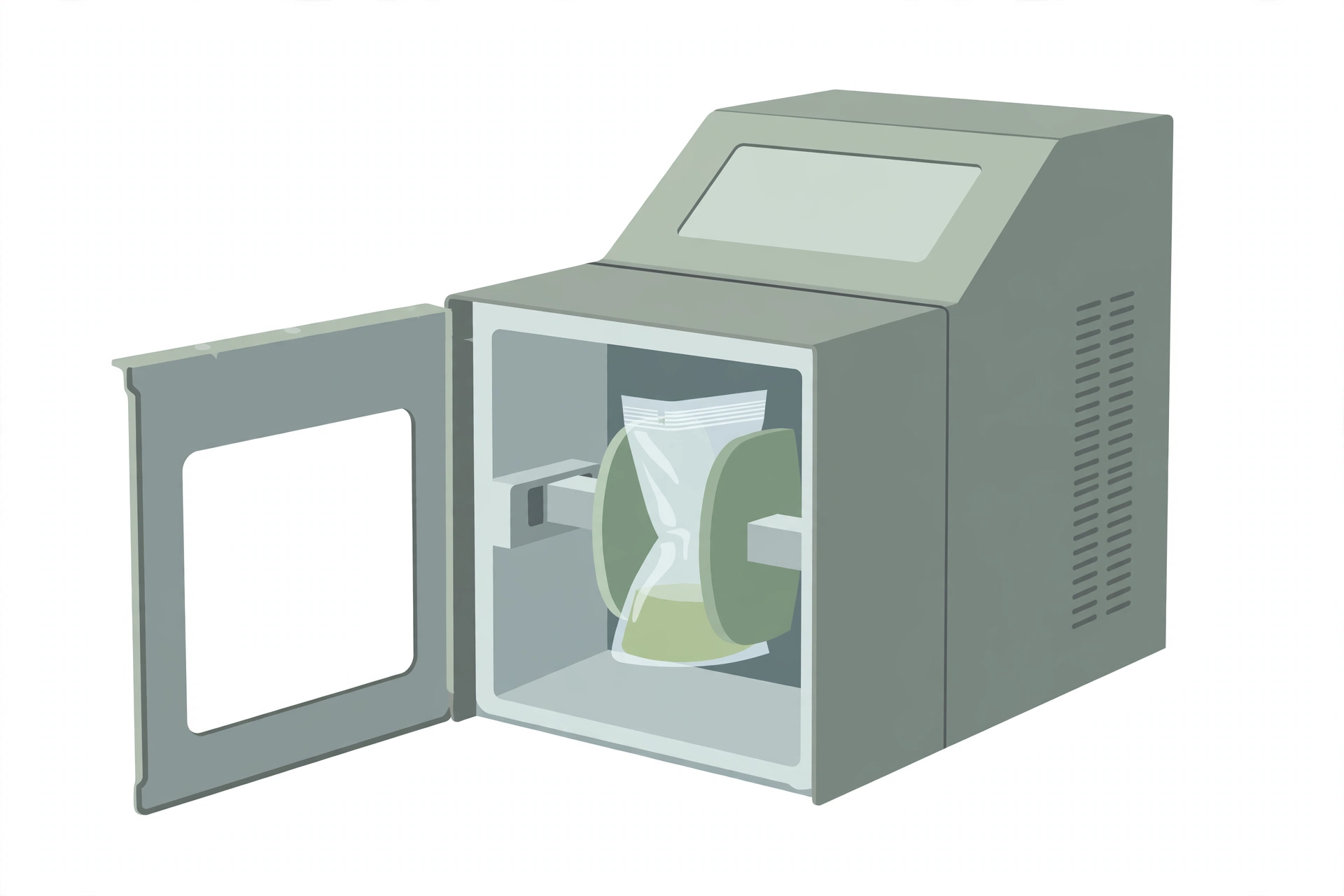
- Stomacher or equivalent
- Stomacher bags
- Incubator capable of maintaining 30°C
- Waterbath or heat block capable of maintaining 95 -100°C
Note: the laboratory must ensure that incubator and water-bath temperatures are maintained at the recommended temperatures. This applies to the growth steps of the method. Where a temperature of ≤ 37°C is recommended in the text of the method, the temperature may be ± 1. 0°C, e. g., 35 ± 1. 0°C; where higher temperatures are recommended, incubators or water baths must be maintained within 0. 5°C because of potential lethality of the higher temperatures on the microorganism(s) being isolated.
Reagents
The method formulates no media or reagents itself; the following are used as named, prepared and sterilized according to the manufacturer’s instructions:
- RapidChek Listeria NextDay media (500g 10001409) (5 kg 10001410)
- D/E Neutralizing broth
- Modified Fraser broth (MFB) — for confirmation, per MFHPB-30
- Selective agars as described in MFHPB-30 — for confirmation
- Control cultures: positive controls Listeria monocytogenes (e.g. ATCC 19115) and Listeria innocua (e.g. ATCC 33090); negative control e.g. Enterococcus faecalis (ATCC 19433)
Sample preparation
- Collect and transport environmental surface samples following MFLP-41; moisten the environmental collection device (cellulose sponge) with 10 mL D/E Neutralizing broth
- Keep sample units refrigerated in the laboratory prior to analysis
- Analyze sample units as soon as possible after their receipt in the laboratory
- Have sterile medium prepared in advance and acclimatized to room temperature before use
- Clean the surface of the working area with a suitable disinfectant
Procedure
Preparation of sample
- Add 60 mL of prepared RapidChek Listeria NextDay Media to the environmental sponge (or 600 mL of medium for a composite sample of 10 sponges); completely cover the sponge(s) with medium
↓ - Stomach or hand massage as required for thorough mixing
↓ - Close the bag loosely and incubate for 27 – 40 h at 30°C
Detection procedure
- Transfer 400 µL of the enrichment to a supplied transfer tube; place the remaining enrichment back into the incubator for use in confirmation as required (up to a maximum of 48 h incubation of primary enrichment for use in confirmation)
↓ - Place the transfer tube into a boiling water bath or heat block (95 – 100°C) for 5 to 15 minutes
↓ - Remove the tube after boiling and cool to room temperature prior to testing
↓ - Insert a test strip with arrows facing down into the transfer tube
↓ - Allow the strip to develop for 10 minutes in the tube, remove the strip, and read and interpret the results
Interpretation
- The test is working correctly if a distinct red line appears on the control line within 10 min. If the control line does not appear, discard the test device and repeat with a new test kit. If the control line does not appear with the second test kit, the sample must be treated as presumptive positive and confirmed as described below
- A sample can be considered presumptive positive if, at or prior to the read time, a red line appears on the test line zone and control line
- A sample can be considered negative if no red line appears on the test line but a red line appears distinctly on the control line within 10 min of sample application (the source illustrates these line patterns in its figure)
Confirmation of presumptive positive results
- Presumptive positive results may be confirmed according to the confirmation procedure outlined in MFHPB-30, Isolation of Listeria monocytogenes and other Listeria spp. from foods and environmental samples
- Proceed with direct plating of the unboiled 27 h enrichment broth onto the selective agars as described in MFHPB-30, while concurrently transferring an aliquot of the same primary enrichment into modified Fraser broth (MFB) as per MFHPB-30
- If the direct plating results confirm the presumptive positive result, the selective secondary enrichment can be discontinued
- If the direct plating results are negative, continue with incubation of the enrichments, plating, isolation, and confirmation as described in MFHPB-30
Precautions
- The laboratory supervisor must ensure that the analysis is carried out in accordance with the International Standards reference ISO/IEC 17025 (latest version): “General Requirements for the Competence of Testing and Calibration Laboratories”
- The laboratory is responsible for ensuring equivalency if any variations of the media formulations listed here are used (either commercially available product or made from scratch)
References
- Health Canada. 2020. MFLP-104: RapidChek Listeria NextDay System for the Detection of Listeria Species in a Variety of Environmental Surface Samples. Volume 3. Compendium of Analytical Methods. This edition replaces MFLP-104, dated December 2017. Health Products and Food Branch
- Microbiological Methods Committee Evaluation Division, Bureau of Microbial Hazards, Food Directorate, Health Products and Food Branch, Sir Frederick G. Banting Research Centre. 2010. MFLP-41: Environmental Sampling for the Detection of Microorganisms. Volume 3. Compendium of Analytical Methods
- Pagotto, F., Hébert, K., and Farber, J. 2011. MFHPB-30: Isolation of Listeria monocytogenes and other Listeria spp. from Foods and Environmental Samples. Volume 2. Compendium of Analytical Methods