SOP: Detection of Listeria monocytogenes and other Listeria spp. in food products and environmental samples by the VIDAS Listeria species Xpress (LSX) method
GIFSQ — Global Institute for Food Safety & Quality
Principle
This method is applicable to the rapid detection of Listeria monocytogenes and other Listeria spp. to determine compliance with the requirements of Sections 4 and 7 of the Food and Drugs Act. The method has been validated for use in raw meats, dairy products, fruits and vegetables, fish and seafood, environmental samples, and the food type heat processed ready-to-eat (RTE) meat and poultry.
- While this method is only approved for certain food products, as listed above, it is assumed that this method could be used with other foods. To ensure the method is fit for purpose for commodities outside the application, other commodities must be properly validated following the criteria in the Compendium of Analytical Methods.
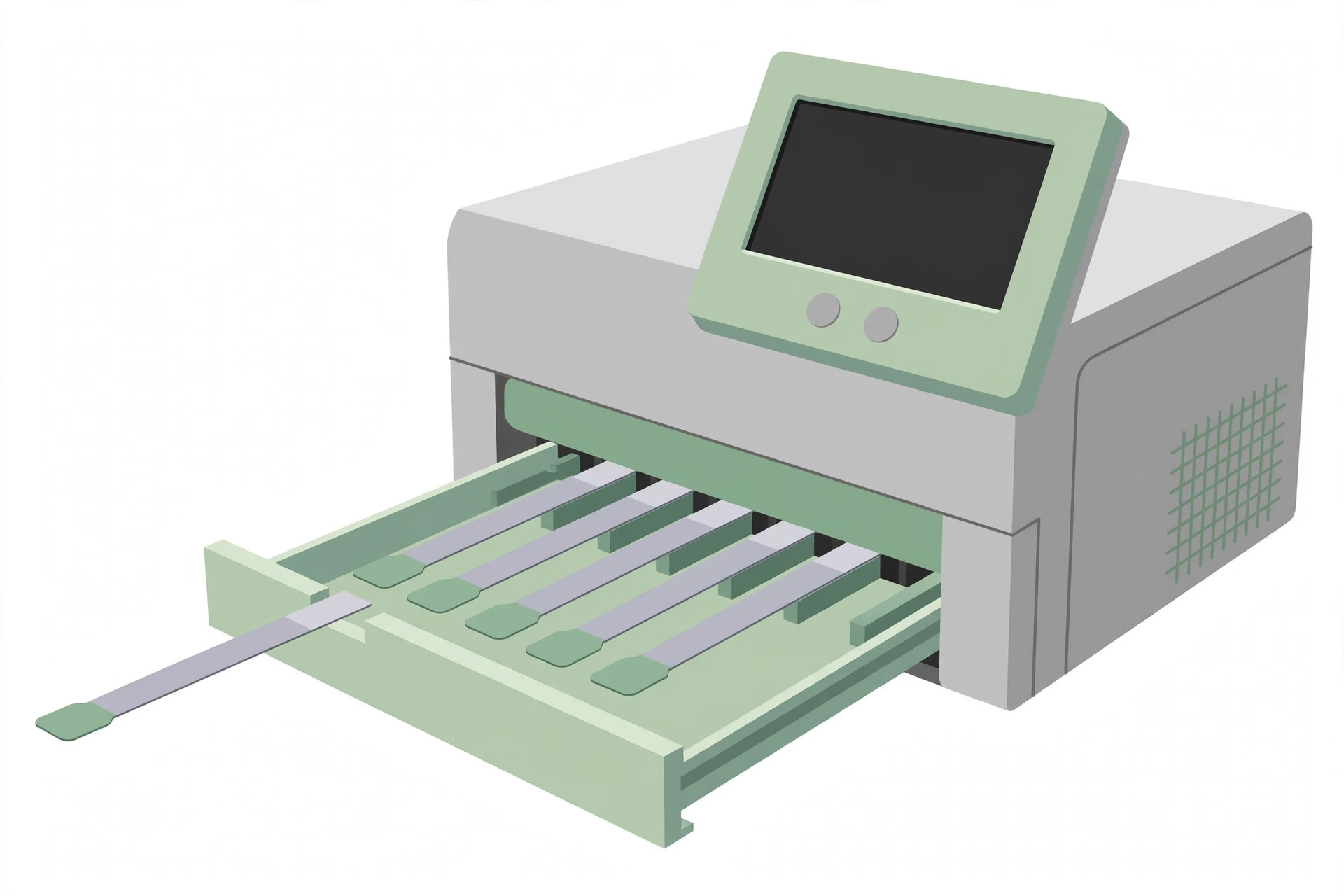
VIDAS LSX is an enzyme-linked fluorescent immunoassay (ELFA) for use on the VIDAS instrument for the detection of Listeria antigens using the ELFA technique. The internal surface of the Solid Phase Receptacle (SPR), a pipette-tip-like disposable device, is pre-coated during kit production with anti-Listeria antibodies. Reagents for an assay are ready-to-use and held in a sealed multi-chambered strip.
All assay steps are performed automatically and sequentially by the VIDAS instrument. The sample is inoculated into the reagent strip and cycled in and out of the SPR several times. Listeria antigens present in the sample will bind to the anti-Listeria antibodies coating the interior of the SPR. Unbound sample material is washed away. Antibodies conjugated with alkaline phosphatase are then cycled in and out of the SPR and will bind with the Listeria antigen–antibody complexes already adsorbed to the SPR wall. Unbound conjugate is removed by further wash steps.
The fluorescent substrate, 4-methyl-umbelliferyl-phosphate, is cycled in and out of the SPR. The conjugate enzyme catalyzes the hydrolysis of this substrate into a fluorescent product (4-methyl-umbelliferone), the fluorescence of which is measured at 450 nm. A test value is generated for each sample, and this value is compared to internal references (thresholds), and each result is interpreted (positive, negative).
Apparatus
- VIDAS family instrument (mini-VIDAS or VIDAS 30)
- VIDAS Heat and Go, or water bath (95 – 100 °C), or equivalent system
- Stomacher and stomacher bags with filter, blender, or equivalent
- Pipette calibrated to dispense 500 µL, and disposable tips
- Incubators capable of maintaining 30 °C
Reagents
- LX broths (bags, bottles, or tubes)
- VIDAS LSX kit (ref. 30224) — contains the necessary reagents including standards and controls for the analysis of 60 test samples
(The source obtains the mandatory media and equipment from bioMerieux Canada, Inc.; the supplier’s telephone number is not carried here.)
Sample preparation
- During storage and transport, with the exception of shelf-stable products, keep the sample units refrigerated. Keep sample units of frozen products frozen. Thaw frozen samples in a refrigerator, or under time and temperature conditions which prevent microbial growth or death.
- Analyze the sample units as soon as possible after receipt at the laboratory.
- Have sterile LX broth available, pre-warmed to 30 ± 2 °C before use.
- Clean the surface of the working area with a suitable disinfectant.
- To ensure a representative analytical unit, agitate liquids or free-flowing materials until the contents are homogeneous. If the sample unit is a solid, obtain the analytical unit by taking a portion from several locations within the sample unit.
Procedure
Primary enrichment
- Food samples: aseptically add 25 g or mL of sample (the analytical unit) to 225 mL of LX broth in a stomacher bag
- ↓
- Blend, stomach, or vortex as required for thorough mixing
- ↓
- Environmental samples: aseptically add 10 mL of LX broth for each swab, or 100 mL of LX broth for each sponge, or prepare a 1/10 ratio sample with LX broth for other sample types
- ↓
- Stomach, vortex, or homogenize as required for thorough mixing
- ↓
- For composited samples, maintain a ratio of 1 part sample material to 9 parts of LX broth
- ↓
- Incubate at 30 ± 1 °C for 22 – 24 hours for food samples, or 24 – 26 hours for environmental samples
Secondary enrichment (food samples only)
- After incubation, mix the suspension and transfer 3 mL of the suspension into 6 mL of LX broth
- ↓
- Incubate for 6 – 24 hours at 30 ± 1 °C
Analysis
- Remove the VIDAS LSX kit from the refrigerator. Only remove the required reagents needed and allow them to come to room temperature
- ↓
- Use one LSX strip and one LSX SPR for each sample, control, or standard to be tested. Make sure the storage pouch has been carefully resealed after the required SPRs have been removed
- ↓
- Note: Components of different lots cannot be mixed and cannot be used past the expiry date. When a new kit lot is being used, specifications (i.e., the factory master calibration curve data) must first be entered into the system using the master lot entry card included with each kit. Calibration, using the standard provided in the kit, must be performed for each lot of reagents upon opening, and every 14 days thereafter. Refer to the package insert for the VIDAS PTC protocol data entry, master lot data entry and calibration instructions.
- ↓
- After incubation, homogenize the LX broth
- ↓
- Prepare the sample for the VIDAS assay by either using a water bath or the VIDAS Heat and Go device:
- Water bath: transfer 1 – 2 mL of LX broth into a tube and seal. Heat for 15 ± 1 minutes at 95 – 100 °C. Cool the tube. Mix the boiled broth and transfer 0.5 mL into the sample well on the VIDAS strip. In the space provided, label the strip with the appropriate sample identification number.
- VIDAS Heat and Go device: transfer 0.5 mL of the LX broth into the sample well on the strip. Label the strip and heat for 15 ± 1 minutes (refer to the user’s manual). Remove the strip and allow it to come to room temperature.
- ↓
- Note: Do not heat the standard or the controls.
- ↓
- Initiate the assay as directed in the VIDAS operator’s manual. Insert the SPR and strips into the positions that corresponds to the VIDAS section indicated by the work list. Check to make sure the color labels with the assay code on the SPR and the reagent strips match.
Interpretation of results
- Once the assay is completed, the computer analyzes results automatically.
- Immunoassays producing relative fluorescence values (RFV) of 0.1 indicate the presumptive presence of Listeria spp. in the test sample.
Confirmation
- Using the unheated secondary enrichment broth, presumptive positive results for Listeria spp. may be confirmed by proceeding with the plating and confirmation steps of a cultural method (i.e., MFHPB-07 or MFHPB-30), as appropriate.
- For confirmation of the presence of L. monocytogenes, or to confirm the absence of L. monocytogenes in the presence of other Listeria species, a chromogenic medium (as per MFHPB-30) that differentiates L. monocytogenes from other Listeria spp. must be used with the plating and confirmation steps of a cultural method (i.e., MFHPB-07 or MFHPB-30).
Precautions
- The Laboratory Supervisor must ensure that the analysis described in this method is carried out in accordance with the International Standard referred to as “ISO/IEC 17025:2005 (or latest version): General Requirements for the Competence of Testing and Calibration Laboratories”.
- It is the responsibility of the laboratory to ensure equivalency if any variations of the media formulations listed here are used (either product that is commercially available or made from scratch).
- It is the responsibility of each laboratory to ensure that the temperatures of the incubators or water baths are maintained at the recommended temperatures. Where 35°C is recommended in text of the method the incubator may be at 35 ± 1.0 °C. Similarly, lower temperatures of 30 or 25 may be ± 1.0 °C. However, where higher temperatures are recommended, such as 43 or 45.5 °C, it is imperative that the incubators or water baths be maintained within 0.5 °C due to potential lethality of the higher temperatures on the microorganism(s) being isolated.
References
- Health Canada. Compendium of Analytical Methods, Volume 3 — Laboratory Procedure MFLP-77, October 2012 (replaces MFLP-77, dated June 2012). Health Products and Food Branch.
- EN ISO 11290-1/A1 – 2005. Microbiology of food and animal feeding stuffs — Horizontal method for the detection and enumeration of Listeria monocytogenes – Part 1: Detection method.
- EN ISO 16140 – 2003. Microbiology of food and animal feeding stuffs — Protocol for the validation of alternative methods.
- ISO/IEC 17025:2005. General requirements for the competence of testing and calibration laboratories.
- Johnson R., Jechorek R. 2011. Evaluation of VIDAS Listeria species Xpress (LSX) Immunoassay Method for the Detection of Listeria species in Foods: Collaborative Study. J of AOAC INTERNATIONAL Vol. 04, no. 1, pp. 159–171.
- Pagotto, F., K. Hébert, and J. Farber. 2011. Isolation of Listeria monocytogenes and other Listeria spp. from foods and environmental samples (MFHPB-30). The Compendium of Analytical Methods, Volume 2.