SOP: Detection and Enumeration of Heat-Resistant Moulds
GIFSQ — Global Institute for Food Safety & Quality
1. Principle
This SOP detects and enumerates heat-resistant moulds in fruits and fruit products following the APHA Compendium of Methods for the Microbiological Examination of Foods (CMMEF), Chapter 21, 4th Edition. Heat-resistant moulds produce ascospores (or similar structures) with a heat resistance in some cases comparable to bacterial spores, so they can survive the thermal processes given to fruit products and later germinate into visible mycelial growth; the moulds most frequently encountered are Byssochlamys fulva, B. nivea, Neosartorya fischeri, Talaromyces macrosporus, T. bacillisporus and Eupenicillium brefeldianum. Detection and enumeration rely on a selective heat treatment that inactivates vegetative cells of fungi and bacteria as well as less heat-resistant spores, followed by a long incubation of large sample portions so that the surviving ascospores — usually fewer than 1 to 10 per 100 g or mL of processed product — can germinate and form visible colonies.
2. Apparatus required
- Sterile blender jars, tared, or stomacher bags
- Blender or stomacher
- Polyethylene bags, for enclosing the blender jars
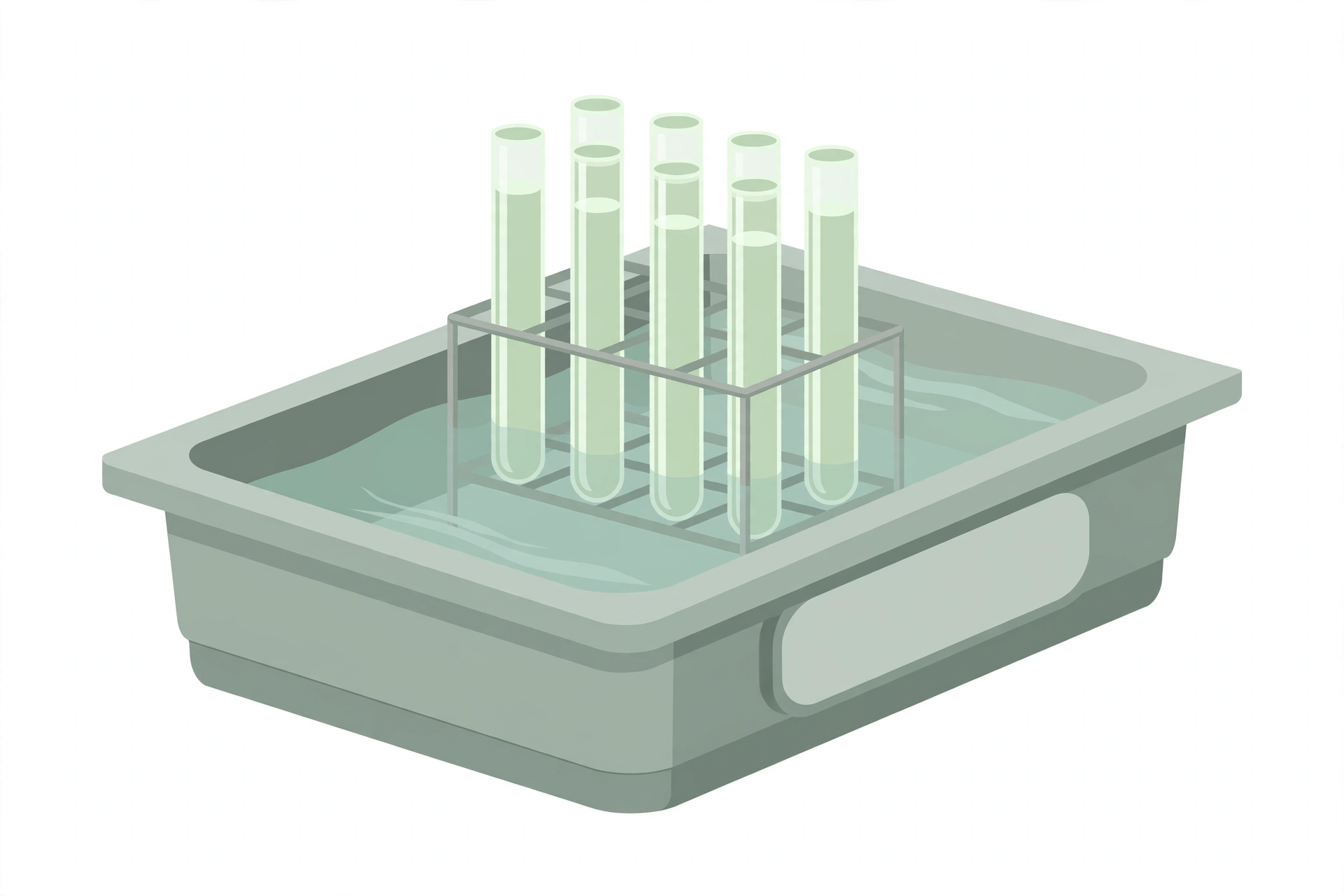
- Water bath capable of maintaining 75 °C to 80 °C, with a lid
- Sterile test tubes, 200 × 30 mm
- Flat-sided bottles, such as 100-mL medicine flats
- Sterile Petri dishes, 150 mm diameter, for the petri dish method
- Sterile Petri dishes, 90 mm diameter, for identification
- Incubator capable of maintaining 25 °C
- Incubator capable of maintaining 30 °C
- Ruler, for measuring colony diameters
- Compound microscope
3. Reagents
- A. Potato dextrose agar: potatoes — 200.0 g; dextrose — 20.0 g; agar — 20.0 g; distilled water — 1.0 L
- To prepare: boil 200 g of sliced, unpeeled potatoes in 1.0 L of distilled water for 30 min ↓ filter through cheesecloth, saving the effluent ↓ add the dextrose and the agar to the potato infusion and boil to dissolve completely
- Or: suspend 39 g of commercially available dehydrated medium and 5.0 g of agar in 1.0 L of distilled water; heat to boiling to dissolve completely; autoclave at 121 °C for 15 min and dispense into sterile Petri dishes
- Final pH 5.6 ± 0.2; the medium should not be remelted more than once
- For the petri dish method, prepare the agar at 1.5 times the above strength (1.5-strength agar)
- B. Malt extract agar: malt extract — 20.0 g; dextrose — 20.0 g; peptone (bacteriological) — 1.0 g; agar — 20.0 g; distilled water — 1.0 L
- To prepare: suspend the ingredients in the distilled water and heat the mixture to boiling while stirring to dissolve completely ↓ autoclave at 121 °C for 15 min
- C. Czapek yeast autolysate agar, for identification: yeast extract — 5.0 g; sucrose — 30.0 g; sodium nitrate (NaNO₃) — 3.0 g; potassium chloride — 0.5 g; dipotassium phosphate (K₂HPO₄) — 1.0 g; magnesium sulfate heptahydrate (MgSO₄·7H₂O) — 0.5 g; ferrous sulfate pentahydrate (FeSO₄·5H₂O) — 0.01 g; agar — 15.0 g; distilled water — 1.0 L
- To prepare: suspend the ingredients in the distilled water and heat the mixture to boiling while stirring to dissolve completely ↓ autoclave at 121 °C for 15 min
- D. Sterile distilled water, for sample dilution
4. Sample preparation
- Fruits and products containing pieces of fruit must be blended or homogenized before analysis.
- To a tared sterile blender jar, add 100 g of fruit or fruit product plus 100 mL of sterile water and blend for 5 minutes or until the mixture appears homogeneous.
- Alternatively, homogenize 100 g of sample plus 100 mL of sterile water with a stomacher for 2 to 4 minutes.
- Fruit juices of 35 °Brix or less are analysed as above. Fruit juice products above 35 °Brix and fruit juice concentrates are diluted 1:2 with sterile water and thoroughly mixed before the heat treatment.
- Since the viability of ascospores is not appreciably affected by freezing and thawing, food samples may be stored frozen before analysis.
5. Procedure
Variant 1 — Petri dish method
Enclose the blender jar in a polyethylene bag to safeguard against leakage through the bottom bushing
↓
Place the jar in a closed water bath at 75 °C to 80 °C for 1.5 hours; this holding time ensures the homogenate is at 75 °C for at least 30 minutes
↓
Alternatively, transfer two 50-mL portions of the stomacher homogenate to sterile 200 × 30 mm test tubes and place them in the closed 75 °C to 80 °C water bath for 30 minutes; the surface of the sample in the jars or tubes must stay well below the surface of the water in the bath throughout the heat treatment
↓
After heating, take duplicate 50-mL portions of the thoroughly mixed homogenate (the entire contents of the duplicate tubes for stomacher-homogenized samples)
↓
Distribute each 50-mL sample equally over four 150-mm diameter Petri dishes and mix thoroughly with 10 mL of 1.5-strength potato dextrose or malt extract agar per dish
↓
Loosely seal the Petri dishes in a plastic bag to prevent drying
↓
Incubate at 30 °C for up to 30 days and examine the plates weekly; most viable ascospores germinate and form visible colonies within 7 to 10 days, while heat-injured and other debilitated ascospores may need additional time
Variant 2 — Direct incubation method (avoids aerial contamination)
Heat the homogenized 50-mL samples in flat-sided bottles, such as 100-mL medicine flats, in an upright position in a water bath at 80 °C for 30 minutes
↓
Incubate the bottles on their sides, allowing as large a surface area as possible, at 30 °C for up to 30 days
↓
Colonies develop on the surface of the homogenate; pick the colonies and grow them on suitable media for identification
↓
Larger samples, such as 100-mL portions in 200-mL bottles, can be handled by this method
Identification of isolates
Inoculate each isolate onto two 90-mm plates of Czapek yeast autolysate agar and two of malt extract agar, each plate at three equally spaced points
↓
Incubate one plate of each medium at 25 °C and the others at 30 °C
↓
After 7 days, examine the plates by eye, measure the colony diameters with a ruler, and make wet mounts to examine small pieces of mould under the compound microscope
6. Calculation and reporting
Each 50-mL portion of homogenate corresponds to 25 g of the food (100 g of food made up to 200 mL of homogenate).
Ascospores per 100 g (or per 100 mL) = colonies counted on the four dishes of one 50-mL portion × 4
Where,
- the colonies counted are those developing within the 30-day incubation
- the result is reported as ascospores per 100 g (or per 100 mL) of product
A count of 5 ascospores per 100 g (mL) of product at a stage just before the retort or heat exchanger indicates a serious problem. For ultra-high temperature processed fruit juice blends without a preservative, even a lower level of contamination is unacceptable.
7. Precautions
- Pour the plates in clean, still air or use a laminar flow hood; aerial contamination is a problem with the petri dish method. The appearance of green Penicillium colonies or colonies of common Aspergillus species such as A. flavus and A. niger is a clear indication of contamination, since these moulds are not heat resistant; use the direct incubation method instead.
- Since ascospores may be stressed by the heating process, highly acidic media are not recommended; when culturing low-acid foods heavily contaminated with bacterial spores, acidification or the addition of chloramphenicol to the plating medium may be required to inhibit the bacteria.
- Some Byssochlamys species produce patulin, byssotoxin A and byssochlamic acid, and Neosartorya fischeri produces fumitremorgins, terrein and verruculogen; heat-resistant moulds may therefore be a public health hazard as well as a spoilage problem — handle the cultures carefully and autoclave all plates before disposal.
- The composition of the heating menstruum influences the rate and extent of ascospore activation; keep the stated sample-to-water ratios.
8. References
- APHA, Compendium of Methods for the Microbiological Examination of Foods (CMMEF), Chapter 21, 4th Edition.