SOP: Determination of Crude Protein (Kjeldahl Method)
GIFSQ — Global Institute for Food Safety & Quality
1. Principle
The sample is digested in H₂SO₄, using CuSO₄ as catalyst, converting the protein nitrogen to (NH₄)₂SO₄. Ammonia is liberated by alkaline steam distillation, trapped in dilute boric acid and titrated with standardized acid to a colorimetric endpoint.
2. Apparatus
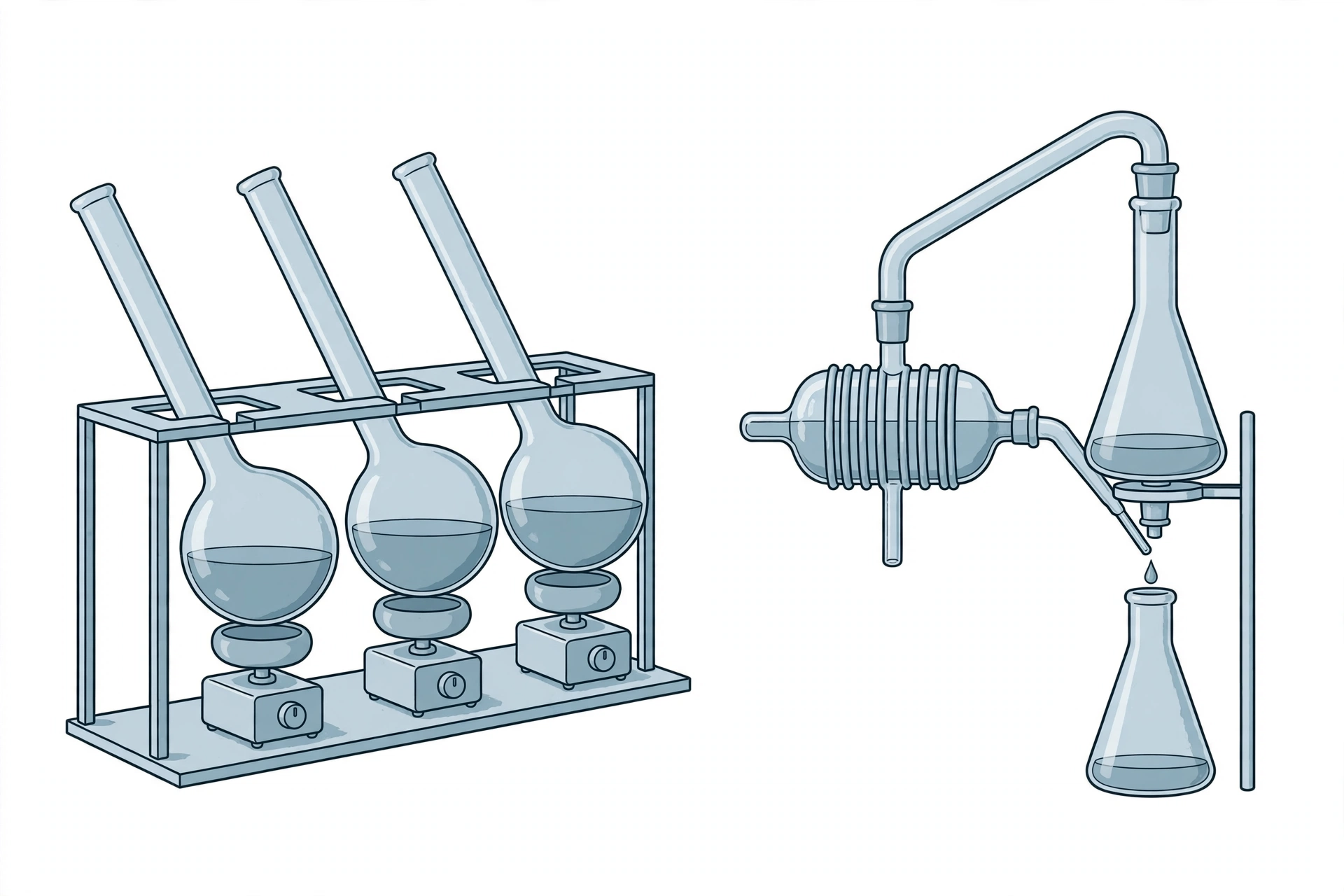
a. Kjeldahl digestion set
b. Distillation unit
c. Burette, measuring cylinder
d. Conical flask
e. Pipetting dispenser — 50 mL, adjustable volume, attached to acid bottle
3. Reagents
a. Digestion catalyst mixture: 100 g K₂SO₄ + 20 g CuSO₄·5H₂O
b. Sulfuric acid — concentrated 95–98% H₂SO₄, reagent grade
c. Sodium hydroxide solution — 40% (w/w) NaOH, low N (≤ 5 µg N/g)
d. Methyl red indicator (0.1%) — dissolve 0.1 g of methyl red indicator in 100 mL rectified spirit (95% ethanol)
e. Bromocresol green indicator (0.1%) — dissolve 0.1 g of bromocresol green indicator in 100 mL rectified spirit
f. Boric acid solution (4%): dissolve 40 g of boric acid (H₃BO₃), analytical grade, in a 1000 mL volumetric flask with 400 mL of hot distilled water. Mix and add more hot water to a volume of 900 mL. Cool the solution to room temperature and add 12 mL of bromocresol green indicator and 8 mL of methyl red indicator. Add distilled water to make up the volume.
g. H₂SO₄ standard solution (0.1 N): dilute about 2.7 mL of analytical grade H₂SO₄ (sp. gr. 1.84) to 1 L with distilled water. Shake well and standardize with standard sodium carbonate (CRM grade), using a mixture of methyl red and bromocresol green indicator.
h. Reference standards — sodium carbonate (Na₂CO₃), ammonium sulfate, tryptophan, glycine p-toluenesulfonic acid, of high purity
4. Standardization of sulphuric acid
Accurately weigh 50–60 mg of anhydrous sodium carbonate (CRM grade), previously dried at 110°C in an oven for 1 hour, transfer to a 250 mL Erlenmeyer flask and dissolve in 20 mL distilled water. Add 2–4 drops of each of methyl red and bromocresol green indicator. Titrate to pink with the acid to be standardized and note the volume used (A1). Boil the solution gently for 2 minutes — the solution will turn green — and cool at room temperature under tap water. Continue the titration until the next pink color change occurs and note this volume (A2). Boil the solution again for a few minutes, cool rapidly to room temperature under tap water, and continue the titration until the next pink color occurs; note this volume (A3).
Strength of H₂SO₄ = mg of Na₂CO₃ ÷ (mL of H₂SO₄ × 52.9946)
5. Procedure — Digestion
Weigh 0.5–1 g of finely ground sample to the nearest mg and quantitatively transfer it into a numbered Kjeldahl tube
↓
Add about 2.5 g of digestion mixture and add 12 mL of concentrated H₂SO₄ slowly, and mix
↓
Place the tube in the tube rack and put it into the digestion well of the digestor
↓
Put the exhaust manifold to the scrubber on top
↓
Start the program in the digester for temperature and time (400°C for 1 hour 30 minutes), until the solutions become clear light blue
↓
After completion of digestion (the solution will turn a green/light bluish color), remove the whole system from the digester with the exhaust still in place and put it in the stand to cool for 10–20 minutes
6. Procedure — Distillation and titration
Set up the automatic distillation set
↓
Place the digestion tube with the digested sample in the distillation unit
↓
Take 25 mL of 4% boric acid in a 250 mL conical flask and place it in the receiver tube of the distillation unit
↓
Set up the distillation program to add 50 mL of 40% NaOH and 80 mL water. Set SAFE (steam addition for equilibration) mode steam capacity
↓
After completion of distillation — the pink color of the receiver boric acid solution turns green — titrate the distillate with standardized H₂SO₄ solution until the faint pink color appears, and note the volume consumed
↓
Carry out the blank without sample and note the volume of acid consumed
7. Verification of nitrogen recovery
Run nitrogen recovery occasionally to check the accuracy of the procedure and equipment:
a. Nitrogen loss — use 0.12 g (NH₄)₂SO₄ and 0.67 g sucrose per flask and distill under the same conditions as used for sample determination. Recoveries must be ≥ 99%.
b. Distillation and titration efficiency — distill 0.12 g (NH₄)₂SO₄, omitting digestion. Recoveries must be ≥ 99.5%.
c. Digestion efficiency — use 0.3 g acetanilide or 0.18 g tryptophan, with 0.67 g sucrose per flask. Digest and distill under the same conditions as used for sample determination. Recoveries must be ≥ 98%.
8. Calculation
Total (%) Nitrogen = [14.01 × (V1 − V2) × N] ÷ (W × 10)
= [1.4 × (V1 − V2) × N × 100] ÷ [W × (100 − M)] (dry weight basis)
Protein (%) = % nitrogen × F
Where,
– V1 = volume of standard acid used to neutralize the distillate
– V2 = volume of standard acid used to neutralize the blank
– N = normality of standard acid
– W = weight of sample taken for digestion
– 10 = factor to convert mg/g to percent
– M = moisture percentage
– F = factor to convert N to protein
F factors are 5.70 for wheat, 6.38 for dairy products and 6.25 for other food material.
References
AOAC Official Methods, 21st edition, 2019; 2001.11.