SOP: Determination of Crude Fibre
GIFSQ — Global Institute for Food Safety & Quality
Principle
Crude fibre is the organic residue which remains after the food sample has been treated under standardized conditions with petroleum spirit, boiling dilute sulphuric acid, boiling dilute sodium hydroxide solution and alcohol. The crude fibre consists largely of cellulose together with a little lignin. As the recovery of cellulose using the specified procedure seldom exceeds four-fifths of that actually present, the crude fibre content does not represent a measure of a specific group of substances. Also, as the figure obtained tends to vary with the conditions employed, it is important to adopt a standardized procedure in order to obtain consistent results.
Apparatus required
- Liebig condenser
- Digestion flasks: 700–750 ml capacity conical flasks
- Filtering cloth of such character that no solid matter passes through when filtering is rapid — butcher’s linen or dress linen with approximately 45 threads per inch may be used
- Fluted funnel
- Gooch crucible
- Electric muffle furnace or burner
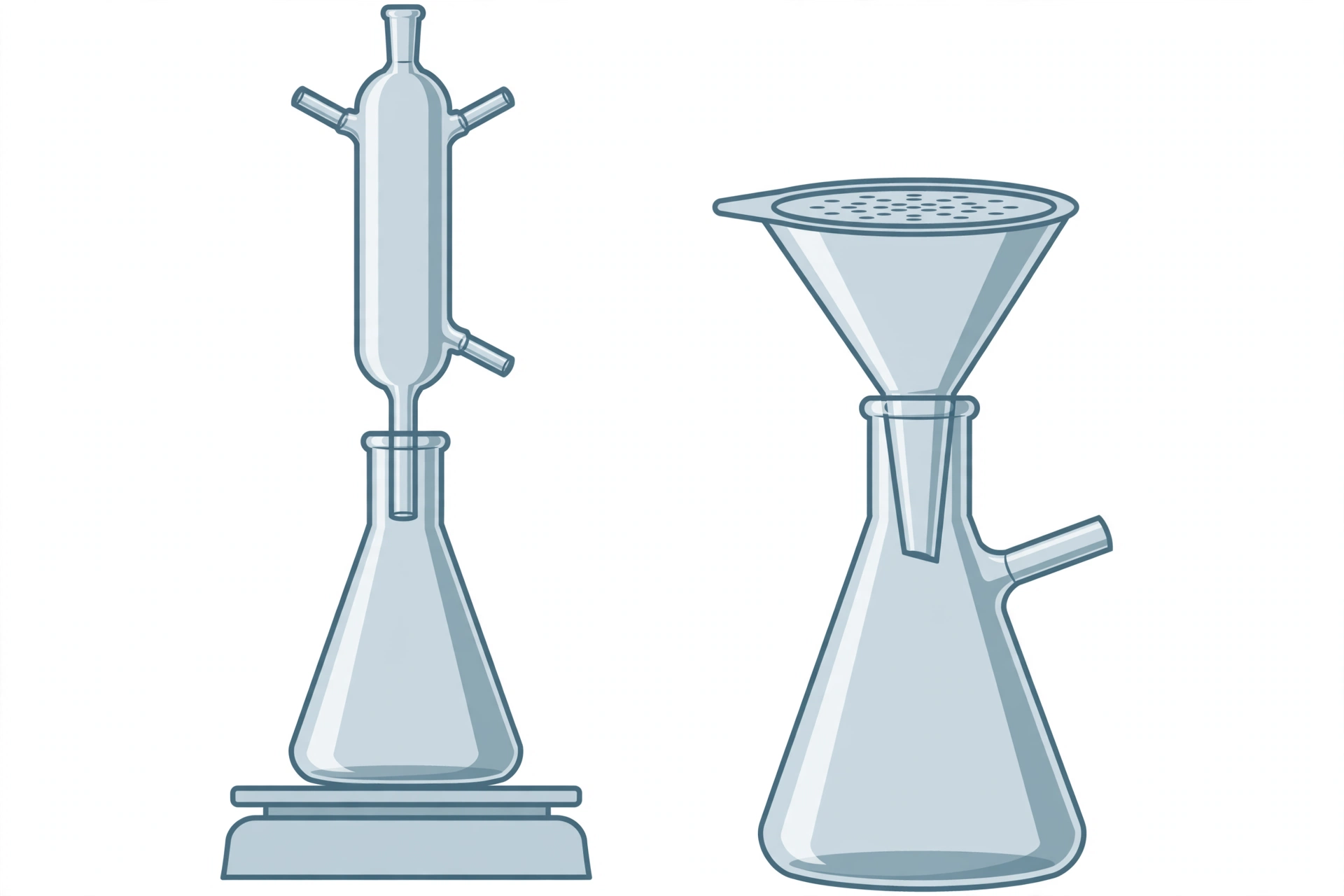
Reagents
a. 0.255 N sulphuric acid solution (1.25 g H₂SO₄ per 100 ml).
b. 0.313 N sodium hydroxide solution (1.25 g NaOH per 100 ml), free or nearly free from sodium carbonate. Check the concentration of solutions (a) and (b) by titration and adjust, if necessary, accurately to the stated concentrations.
c. Asbestos: Gooch grade, medium fibre, acid-washed and ignited.
d. 10% potassium sulphate (K₂SO₄) solution: dissolve 10 g in water and make up to 100 ml.
Procedure
Extract 2 g of dry material with ether, or use the residue from the crude fat determination; transfer the residue and approximately 0.5 g of asbestos to the digestion flask
↓
Add 200 ml of the boiling sulphuric acid solution and immediately connect the digestion flask with the condenser
↓
Heat so that the contents of the flask come to boiling within 1 min, and continue brisk boiling for exactly 30 min — rotate the flask frequently until the sample is thoroughly wetted, and take care to keep the material from remaining on the sides of the digestion flask without contact with the solution
↓
After 30 min, remove the flask and filter through the linen in a fluted funnel; wash with boiling water until the washings are no longer acid
↓
Heat the sodium hydroxide solution to boiling under a reflux condenser; wash the residue from the acid digestion back into the flask with 200 ml of the boiling sodium hydroxide solution
↓
Connect the flask with the reflux condenser and boil for exactly 30 min
↓
After 30 min of boiling, remove the flask and immediately filter through the filtering cloth in a fluted funnel; wash with water — for materials difficult to filter, filter through the filtering cloth in a fluted funnel using vacuum and wash with hot 10% potassium sulphate solution, adding the potassium sulphate solution during filtration whenever filtration becomes difficult
↓
Return the residue to the digestion flask, thoroughly washing all the residue off the cloth with hot water
↓
Filter into a Gooch crucible prepared with a thin but packed layer of ignited asbestos
↓
After thorough washing of the residue in the Gooch crucible with boiling water, wash with approximately 15 ml of alcohol
↓
Dry the crucible and the contents at 110°C to constant weight; cool in a desiccator and weigh
↓
Ignite the contents of the crucible in an electric muffle furnace or over a burner at dull red heat until the carbonaceous matter is destroyed (approximately 20 min); cool in a desiccator and weigh
↓
The loss in weight represents the crude fibre
Calculation
Crude fibre % = (Loss in weight × 100) ÷ Wt. of sample taken
Where,
- Loss in weight = weight of the dried crucible and residue minus weight of the ignited crucible and residue (g)
- Wt. of sample taken = weight of the dry material taken (g)
Precautions
- The contents of the flask must come to boiling within 1 min, and the boiling must continue briskly for exactly 30 min in both the acid and the alkali digestions.
- Rotate the flask frequently so that no material remains on the sides of the flask without contact with the solution.
- For materials that are difficult to filter, use vacuum with hot 10% potassium sulphate solution during the filtration.
- Wash the residue with boiling water until the washings are no longer acid after the acid digestion.
References
Ranganna, S., Handbook of Analysis and Quality Control for Fruit and Vegetable Products, 2nd edition.
Ass. Offic. Anal. Chem., Official Methods of Analysis, 11th edn., p. 129 (1970) — cited in the book.
Bidwell, G.L. & Bopst, L.E., J. Assoc. Offic. Agric. Chem., 5, 58 (1922) — cited in the book.