SOP: Determination of Crude Fat or Ether Extract
GIFSQ — Global Institute for Food Safety & Quality
1. Principle
The solvent dissolves fats, oils, pigments and other soluble substances, collectively termed crude fat. The finely ground sample, held in a thimble, is extracted by a continuous flow of solvent; the solvent is evaporated and recovered by condensation, and the resulting crude fat residue is determined gravimetrically after drying. Because the solubility characteristics of different solvents may give slightly different crude fat results, the report should state the solvent used.
2. Apparatus required
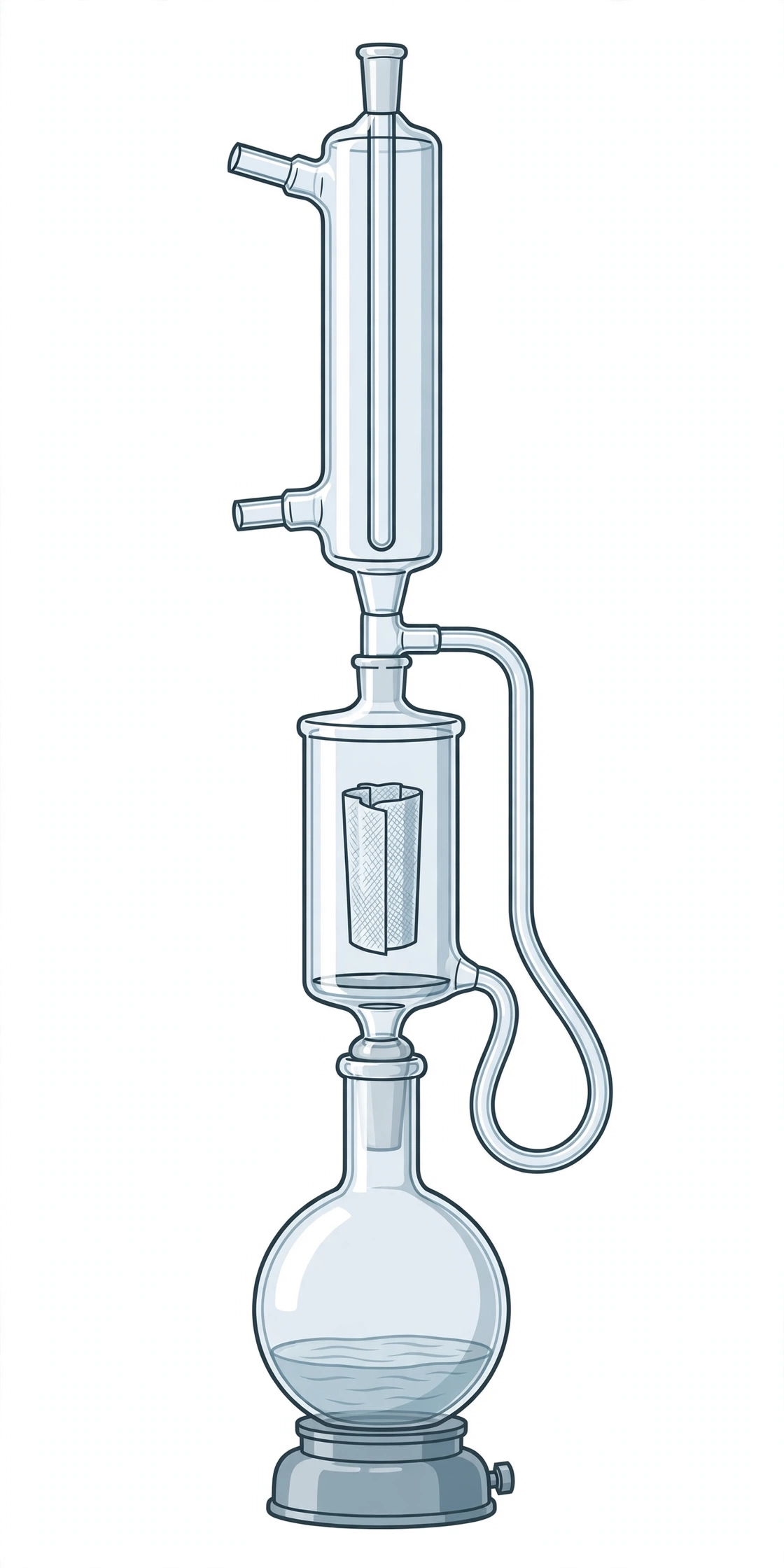
a. Soxhlet apparatus
b. Heating mantle
c. Condenser
d. Cellulose thimble
e. Stands and clamps
f. Flat bottom flask
3. Chemicals and reagents
a. Petroleum ether
b. Defatted cotton — soak medical grade cotton in petroleum ether or hexane for 24 hours, agitating several times during this period; remove and air dry
c. Sand — acid washed and ashed
4. Preparation of sample
Reduce the particle size of the sample to a fineness of 0.75 to 1 mm. If the sample contains large amounts of urea salts (>5%) or soluble carbohydrates (>15%), glycerol, lactic acid, amino acid salts (>10%) or other water-soluble components, remove them by water extraction: weigh the test portion onto filter paper and extract with five 20 mL portions of water, allowing each portion to drain. Place the filter paper containing the test portion into the thimble and dry at 102 ± 2°C for 2 hours. To facilitate filtration, add 1–2 g of ashed, acid-washed sand to the mix before water extraction.
5. Procedure
Weigh 1–5 g of sample, containing about 100–200 mg fat, directly into a tared cellulose thimble
↓
Dry the thimbles containing the test portions at 102 ± 2°C for 2 hours
↓
Place a defatted cotton plug on top of the test portion in the thimble to prevent loss
↓
Place 3–4 glass boiling beads into each flat bottom flask, and dry the flask for at least 30 minutes at 102 ± 2°C
↓
Transfer to a desiccator, cool to room temperature and record the weight to the nearest 0.1 mg
↓
Put the thimbles containing the dried samples into the extraction column
↓
Fit the flasks under the extraction columns properly and add sufficient petroleum ether to cover the thimbles when boiling
↓
Preheat the Soxhlet extractor and turn on the condenser cooling water
↓
Extract the sample for 8 hours, with the speed of distillation not less than 5 drops per second, ensuring complete extraction
↓
Evaporate as much solvent as possible and collect it for reuse
↓
Dry the flasks with the fat residue at 102 ± 2°C for 30 minutes to remove moisture
↓
Remove the flask from the extractor and place it in a fume hood to evaporate solvent at low temperature
↓
Cool in a desiccator to room temperature and weigh to the nearest 0.1 mg
6. Calculation
% Crude fat (petroleum ether extracts) = [(X − Y) ÷ W] × 100
Where,
– X = weight of flask with fat residue
– Y = weight of empty flask
– W = weight of sample
7. Precautions
- Both the solvent and the test material should be made moisture free, to avoid extraction of water-soluble components, which would give false high values.
- Avoid excessive drying of the flask with fat residue, as it may oxidize the fat and give high results.
- With very fine flour, addition of an equal weight of clean dry sand is necessary.
References
AOAC Official Methods, 21st edition, 2019; 920.39C.
IS 12711:1989, Bakery products — Methods of analysis, part 10.