SOP: Determination of Alcoholic Acidity
GIFSQ — Global Institute for Food Safety & Quality
Definition
Alcoholic acidity is defined as the mg of H₂SO₄ required for 100 g of the sample to have the same alcohol soluble acids. Grains or their milled products, on storage, undergo physical as well as chemical changes. Acid phosphates, amino acids and free fatty acids of flours, under certain conditions, increase considerably due to the enzymatic hydrolysis of phytin, protein and fat respectively. Milled products deteriorate faster than their parent grains. The amino acids and acid phosphates and free fatty acids are soluble in strong alcohol.
1. Principle
Alcoholic acidity refers to the combined acidity produced by hydrolysis of fats by lipases into free fatty acids, hydrolysis of protein into amino acids by proteolytic enzymes, and acidity due to the presence of certain acid salts. An alcoholic extract is titrated with dilute alcoholic sodium hydroxide solution, and the acidity is expressed as mL of NaOH consumed per 100 g of sample, or as % H₂SO₄. Alcoholic acidity is an index of deterioration of flour during storage.
2. Apparatus required
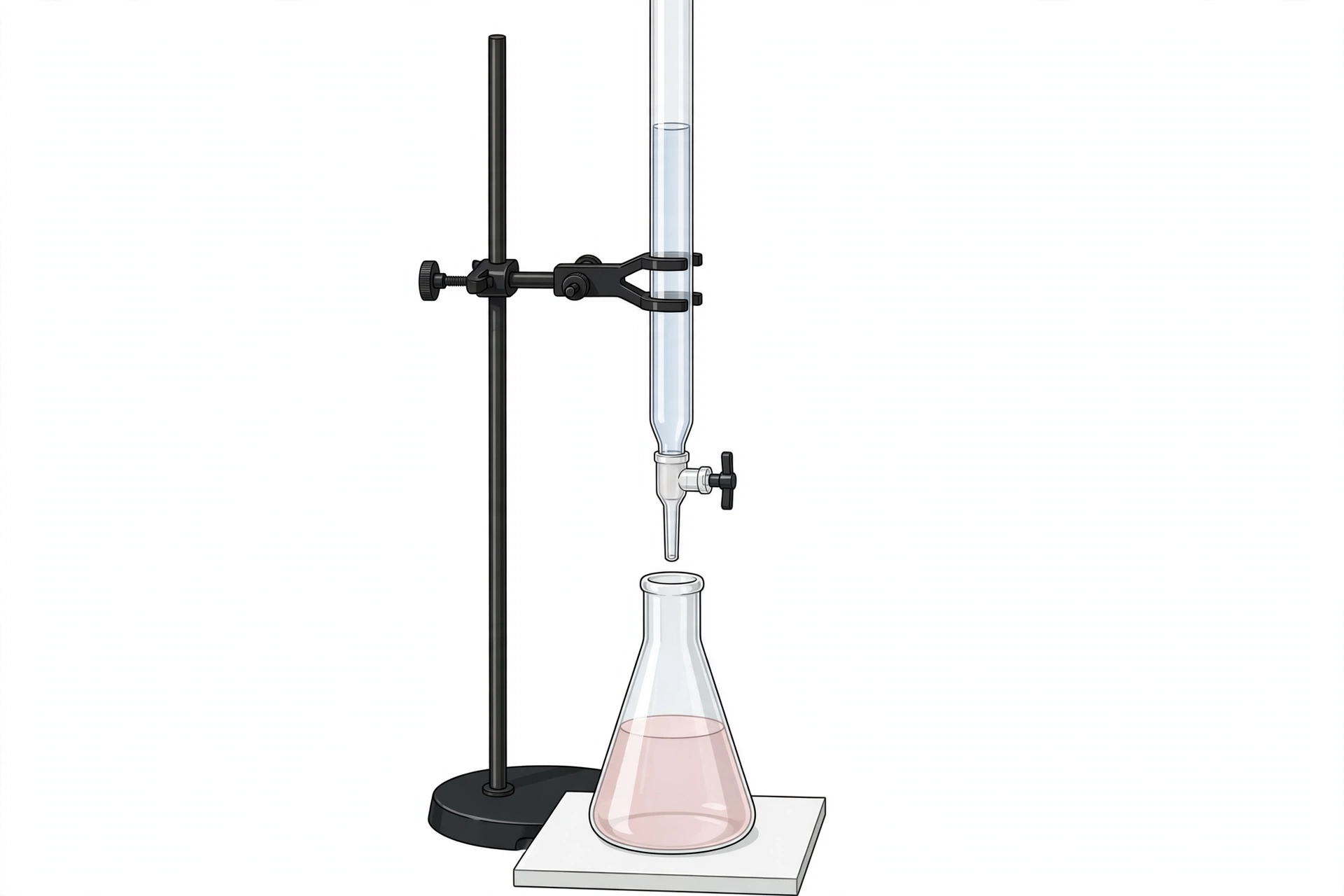
- Pipette, burette, measuring cylinder, funnel
- Stand clamp, wash bottle, common filter paper
- Conical flask with stopper, volumetric flask
3. Reagents
a. Neutralized alcohol solution (90%): prepare a 90% alcoholic solution, add a few drops of phenolphthalein, and titrate with standard alcoholic NaOH solution.
b. Phenolphthalein solution (0.1%): take 0.1 g of phenolphthalein and dissolve well in 100 mL of alcohol–water solvent (1:1).
c. Alcoholic NaOH solution (0.05 N): dissolve 0.5 g of NaOH in 250 mL distilled water and standardize with standard potassium hydrogen phthalate (see Standardization of sodium hydroxide below).
4. Standardization of sodium hydroxide
Weigh accurately 0.05 g potassium hydrogen phthalate (pre-dried at 105°C for 1 hour) in a 150 mL conical flask
↓
Add 50 mL of CO₂-free distilled water and swirl gently to dissolve it
↓
Add 40 mL more CO₂-free distilled water
↓
Titrate with the NaOH solution being standardized, using 3 drops of phenolphthalein, until pinkish coloration at the end point
Calculation — Normality of NaOH = (g weight of KHC₈H₄O₄ × 1000) ÷ (mL of NaOH × 204.229)
5. Procedure
Weigh about 5 grams of sample in the dried Erlenmeyer flask with stopper
↓
Add 50 mL of neutral alcohol solution
↓
Shake well for 30 minutes
↓
Allow to stand for 24 hours with occasional shaking
↓
Filter through coarse filter paper (Whatman filter paper No. 1)
↓
Take 10 mL of filtrate in a conical flask and titrate with standard alcoholic NaOH solution
↓
Note the volume consumed of base
↓
Note the titer value of blank alcohol
6. Calculation
Alcoholic acidity (% as H₂SO₄) = [(V1 − V2) × N × 100 ÷ W] × [Volume made up ÷ Volume of filtrate] × [100 ÷ (100 − M)] × [49.04 ÷ 1000] (dry weight)
= [24.52 × (V1 − V2) × N ÷ W] × [100 ÷ (100 − M)]
Alcoholic acidity (mL of 1 N NaOH / 100 g sample) = [(V1 − V2) × N × 100 ÷ W] × [Volume made up ÷ Volume of filtrate] × [100 ÷ (100 − M)]
Where,
– V1 = titre value for sample
– V2 = titre value for blank
– N = normality of the alcoholic NaOH solution
– W = weight of the sample taken
– M = moisture content (%) of the sample (dry-weight correction)
– 49.04 = equivalent weight of sulphuric acid
References
IS 12711:1989, Bakery products — Methods of Analysis, part 14.
FSSAI Manual of Methods of Analysis of Foods, Cereal and Cereal Products (2016), part 8.6.