Watch the lesson video: The Four Hazard Groups Every Food Handler Must Know (1:40)
Every food hazard fits into one of four groups. Know these four and you will start spotting risks anywhere you work: what could go wrong, where it comes from, and what stops it.
Biological hazards \u2014 the biggest cause of illness
Biological hazards are living organisms or the toxins some of them produce: Salmonella, Campylobacter, Listeria monocytogenes, E. coli O157:H7, norovirus, hepatitis A. They cause far more illness than the other three groups combined. They need warmth, moisture, food, and time to multiply \u2014 trainers often shorten this to FAT TOM: Food, Acidity, Time, Temperature, Oxygen, Moisture. Take away any one of these and growth stops.
The main ones to know:
- Salmonella \u2014 raw poultry, eggs, and foods containing them. Killed by thorough cooking.
- Campylobacter \u2014 raw poultry above all. One of the most common causes of food poisoning worldwide, spread by tiny amounts of raw chicken juice.
- Listeria monocytogenes \u2014 chilled ready-to-eat foods like deli meats, soft cheeses, smoked fish, and pre-cut fruit. Unlike most bacteria, it grows at refrigerator temperatures, which is why chilled foods still have use-by dates.
- E. coli O157:H7 \u2014 undercooked ground beef and unwashed produce. The grinding process mixes surface contamination all through the meat, which is why burgers need a higher cook temperature than steaks.
- Norovirus \u2014 spread by ill food workers and contaminated water or shellfish. Extremely contagious; tiny doses infect.
- Staphylococcus aureus toxin \u2014 produced by bacteria from skin and noses when protein-rich foods (cooked meats, cream-filled products, salads) sit warm. The toxin survives reheating, so prevention \u2014 not cooking \u2014 is the control.
Some bacteria also form spores that survive cooking \u2014 Clostridium perfringens in slowly cooled meats and Bacillus cereus in cooked rice. Spores wake up and grow when cooked food cools too slowly. This is why rapid cooling matters as much as cooking.
The controls for biological hazards: temperature control, time limits, thorough cooking, and keeping raw food away from ready-to-eat food.
Chemical hazards
Chemical hazards include cleaning chemicals used at the wrong concentration or stored near food, pesticides, heavy metals, and naturally occurring toxins such as histamine in spoiled fish (scombroid poisoning) and mycotoxins in mouldy grains and nuts. Controls: buy from approved suppliers, store chemicals in a separate locked area away from food, follow label dilutions exactly, and check concentrations with test strips.
Physical hazards
Physical hazards are foreign objects: glass shards, metal fragments, plastic pieces, wood splinters, stones in produce, jewellery, bandage strips. They injure people directly \u2014 chipped teeth, cut mouths, choking. Controls: keep glass out of production areas where possible (or use a glass register and breakage procedure), maintain equipment so bolts and blades do not shed, use sieves, magnets, metal detectors or X-ray where the risk justifies it, and enforce protective rules \u2014 no jewellery, beard nets, and blue detectable plasters that stand out in food.
Allergens \u2014 tiny doses, deadly reactions
Allergens need special attention: it takes only a tiny amount to trigger a reaction, and that reaction can kill within minutes. In the United States, nine major allergens must be declared on labels: milk, eggs, fish, shellfish, tree nuts, peanuts, wheat, soybeans, and sesame (added by the FASTER Act, effective January 2023). The EU lists fourteen under Regulation (EU) No 1169/2011. Controls: separation at every step \u2014 separate storage, separate utensils, cleaning between product runs, careful rework control, and label checks before packing. A full course on allergen management is available separately; the rule to remember here is separation at every step.
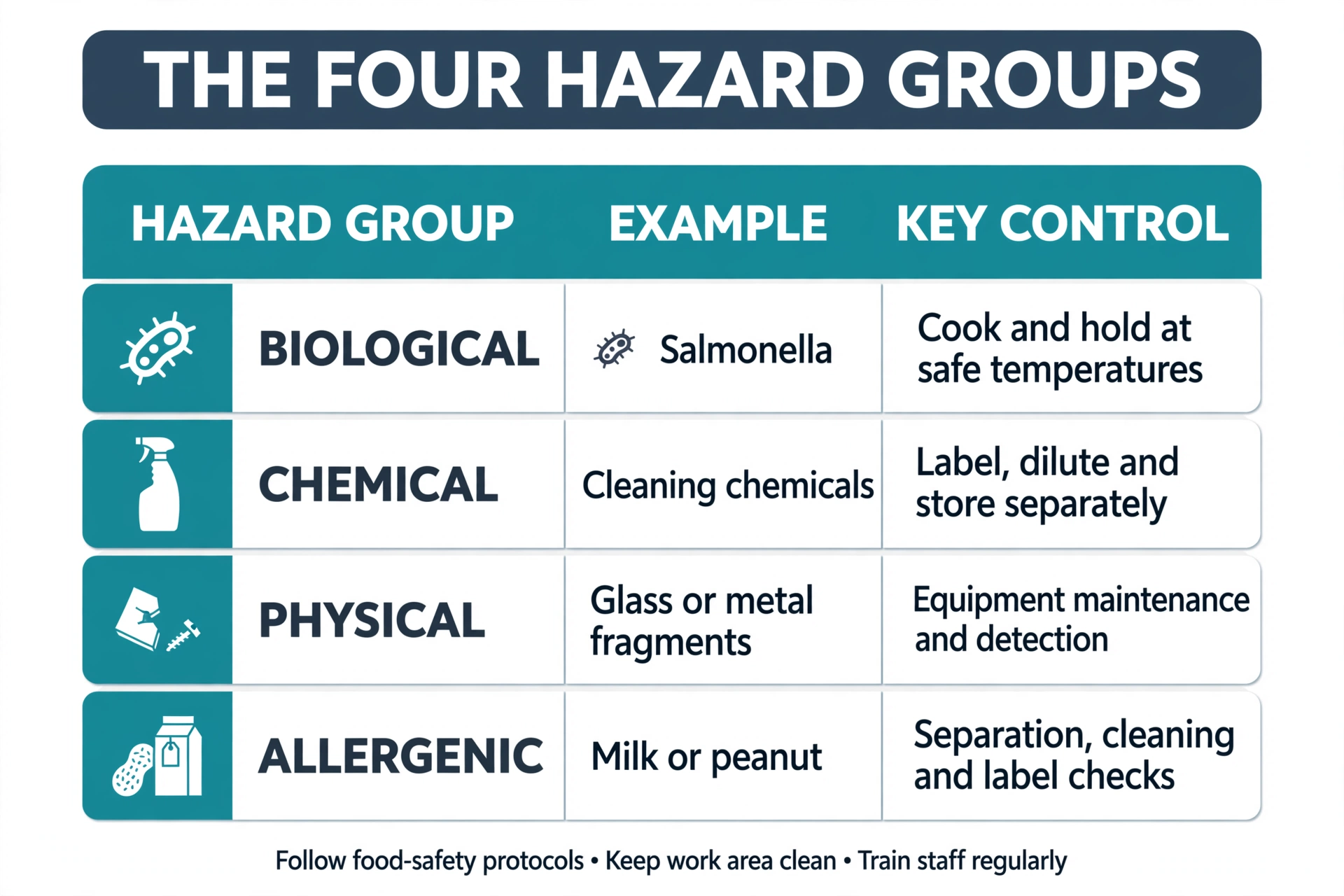
Hazard groups at a glance
| Hazard group | Examples | Key control |
|---|---|---|
| Biological | Salmonella, Listeria, norovirus, toxins | Temperature, time, cooking, separation |
| Chemical | Cleaners, pesticides, histamine, heavy metals | Label dilutions, separate storage, approved suppliers |
| Physical | Glass, metal, plastic, jewellery | Maintenance, detection, protective rules |
| Allergen | Milk, egg, peanut, sesame, and others | Separation, cleaning, label verification |