
What Is GMP? Good Manufacturing Practices Explained
Watch the lesson video: What Is GMP? Good Manufacturing Practices Explained (1:44)
What Is GMP? The Foundation of Every Safe Food Plant
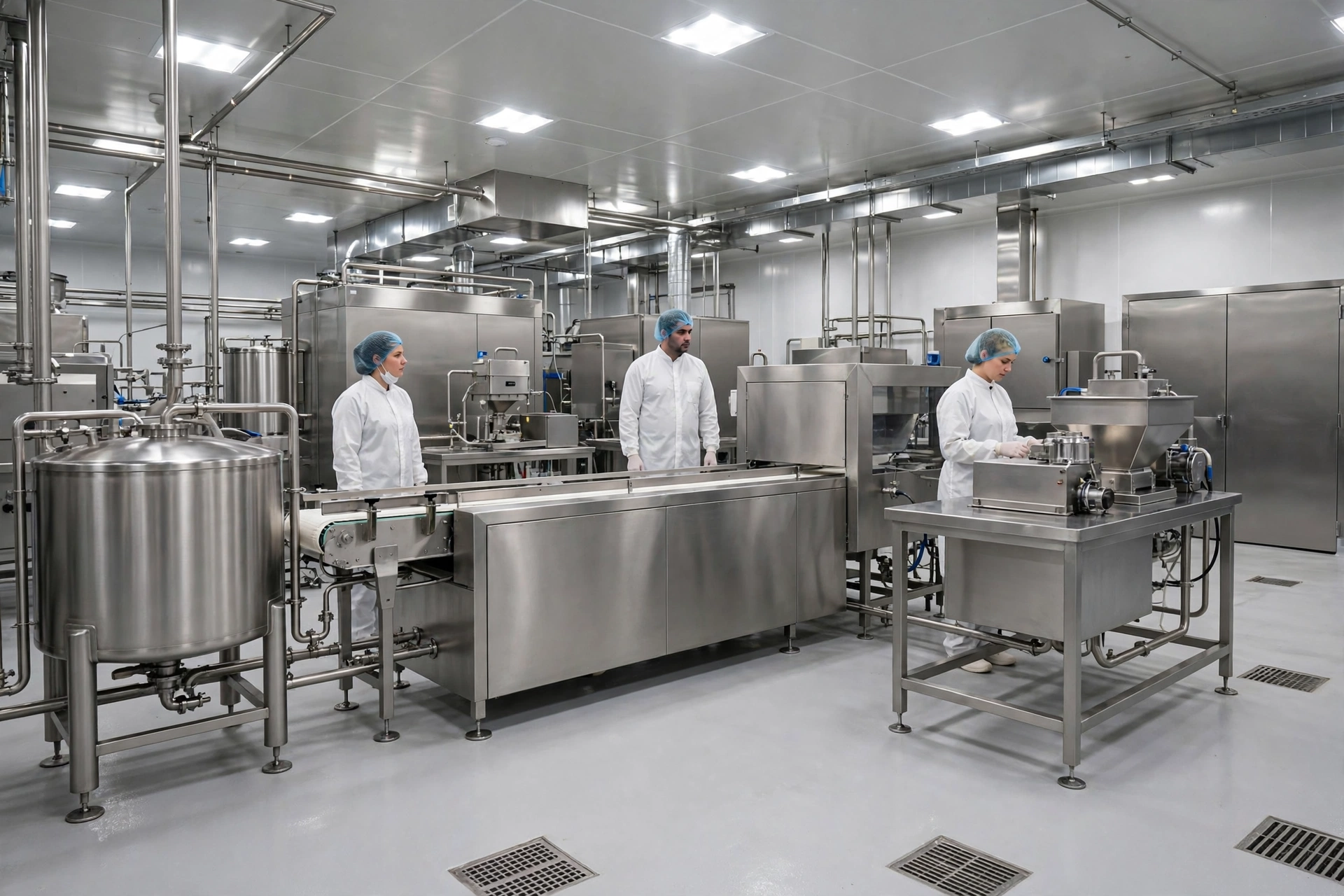
Picture this: an FDA inspector walks your production floor tomorrow morning. She doesn’t ask for your HACCP plan first. She looks at the floor drains, watches a worker wash hands, checks whether raw chicken shares a cooler with ready-to-eat sandwiches, and reads the cleaning log from last Friday. Every one of those checks comes from the same rulebook: Good Manufacturing Practices — GMP. This lesson explains what GMP is, which regulations create it, and how it differs from HACCP and preventive controls.
GMP in one paragraph
Good Manufacturing Practices are the baseline sanitary conditions and operating practices every food plant must follow. They cover the people, the building, the equipment, the cleaning program, and the day-to-day production controls that keep food safe. Think of GMP as the foundation of a house: HACCP plans, food-safety certifications, and audit schemes all sit on top of it, and none of them work if the foundation is cracked.
One useful way to see the difference: HACCP asks “what could go wrong with this specific product, and where do we control it?” GMP asks “are the basic conditions right in the first place?” A plant that cannot keep pests out of the building or hands washed at the sink has no business writing a HACCP plan yet.
The three regulatory pillars
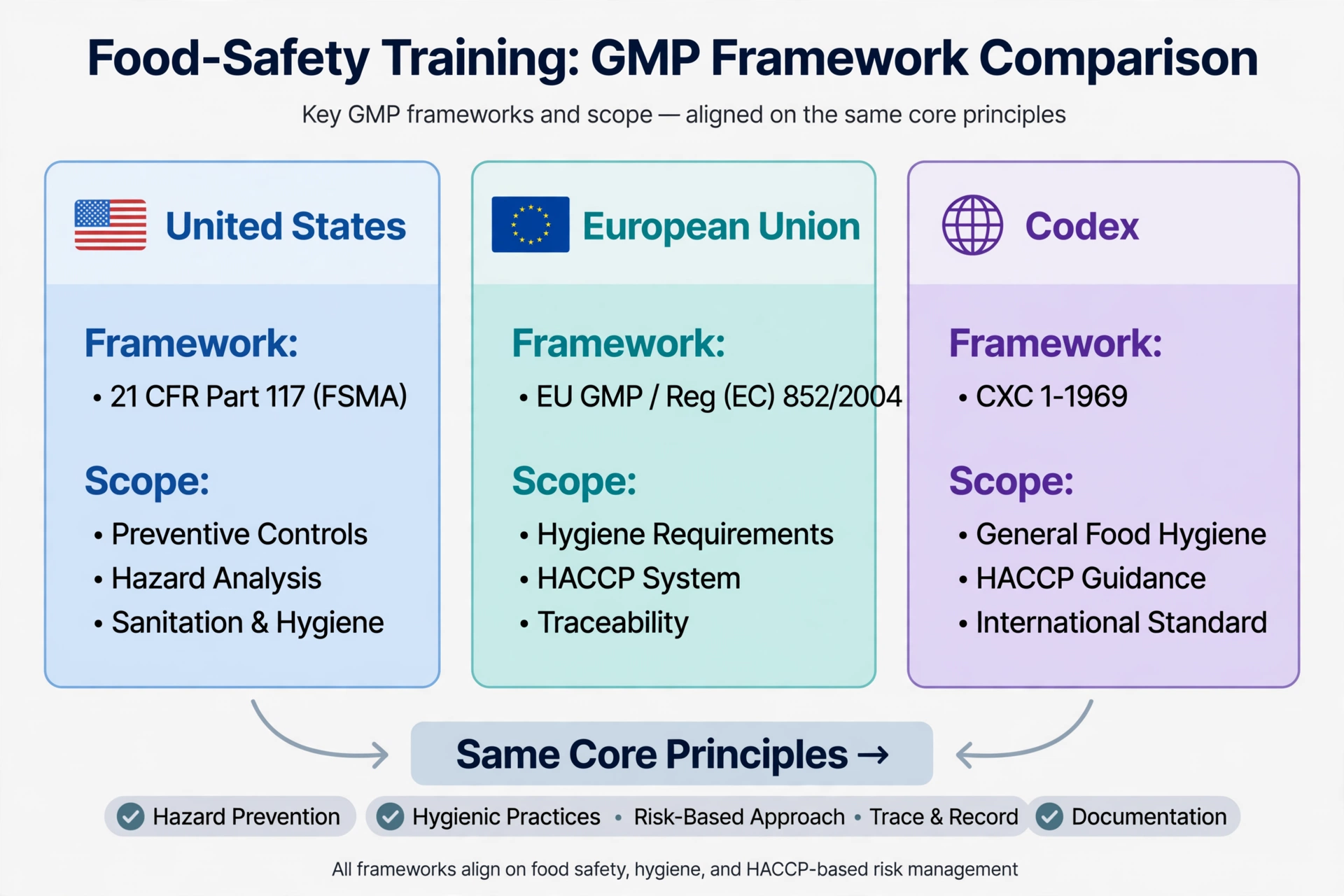
Depending on where you sell food, GMP arrives under different names. The principles overlap heavily; the citations differ. Learn the one that governs your market, and recognize the others.
1. United States — 21 CFR Part 117
The US rule is 21 CFR Part 117: Current Good Manufacturing Practice, Hazard Analysis, and Risk-Based Preventive Controls for Human Food. FDA’s 2015 FSMA rule modernized the older Part 110 GMPs and folded them into this single part. Its structure matters, because students constantly confuse the two halves:
Subpart B (§§117.10–117.110)
Covers: Current Good Manufacturing Practice — personnel, plant, sanitation, equipment, production controls
Who follows it: Nearly every human-food facility; this is the GMP core
Subpart C (§§117.126–117.190)
Covers: Preventive controls — hazard analysis, process controls, supply-chain program, recall plan
Who follows it: Facilities required to have a food safety plan (with exemptions)
Subpart D (§§117.201, 117.206)
Covers: Modified requirements
Who follows it: Qualified facilities (§117.201) and warehouses storing only unexposed packaged food (§117.206)
Subpart F (§§117.301–117.330)
Covers: Records
Who follows it: Facilities keeping records under this part
Subpart G (§§117.405–117.475)
Covers: Supply-chain program
Who follows it: Receiving facilities with supplier-applied controls
This course teaches Subpart B — the GMP everyone follows. Subpart C is HACCP-like preventive-controls territory and gets its own course.
2. European Union — Regulation (EC) 852/2004
The EU’s food-hygiene framework is Regulation (EC) No 852/2004. Its Annex II sets hygiene requirements for premises and equipment in chapters: Chapter I covers premises (clean, well maintained; layout and design; lavatories that do not open directly into food rooms; washbasins with hot and cold water, soap, and hygienic drying; ventilation; temperature control). Chapter V covers equipment (effectively cleaned and disinfected; corrosion-resistant, smooth, washable, non-toxic materials; installed to allow adequate cleaning). Chapter III sets lighter requirements for movable or temporary premises such as market stalls and food trucks.
3. Codex Alimentarius — CXC 1-1969
Codex CXC 1-1969, General Principles of Food Hygiene (2023 revision), is the international reference most countries align with. Its Chapter 1 lays out Good Hygiene Practices (GHP) — the global cousin of GMP — covering primary production, facility design, control of operations, maintenance and sanitation, personal hygiene, transport, product information, and training.
Why the law cares: adulteration
GMP is not a suggestion. Under the US Federal Food, Drug, and Cosmetic Act, section 402(a)(4), food is legally adulterated if it has been prepared, packed, or held under insanitary conditions whereby it may have become contaminated. In plain terms: FDA does not have to prove your product made someone sick. If the conditions were insanitary, the food is adulterated and subject to enforcement — seizure, injunction, or recall.
The EU and Codex frameworks work the same way in principle: businesses bear legal responsibility for placing only safe food on the market, and the hygiene rules are the measurable standard inspectors judge you against.
Who must comply
In the US, Part 117 applies to facilities that manufacture, process, pack, or hold human food and are required to register with FDA. Some operations sit outside it — farms growing raw agricultural commodities, for example, and retail food establishments. Very small businesses are not off the hook entirely: qualified facilities follow modified requirements under §117.201, which means submitting attestations to FDA (that hazards have been identified with preventive controls in place and monitored, or that the facility complies with applicable non-federal food-safety law) instead of the full Subpart C program. Subpart B’s GMP still applies to them.
In the EU, Regulation 852/2004 applies to food business operators at every stage from primary production onward, with flexibility built in for small and traditional businesses. Under Codex, national governments adopt the principles into their own laws.
What GMP actually controls: the five blocks
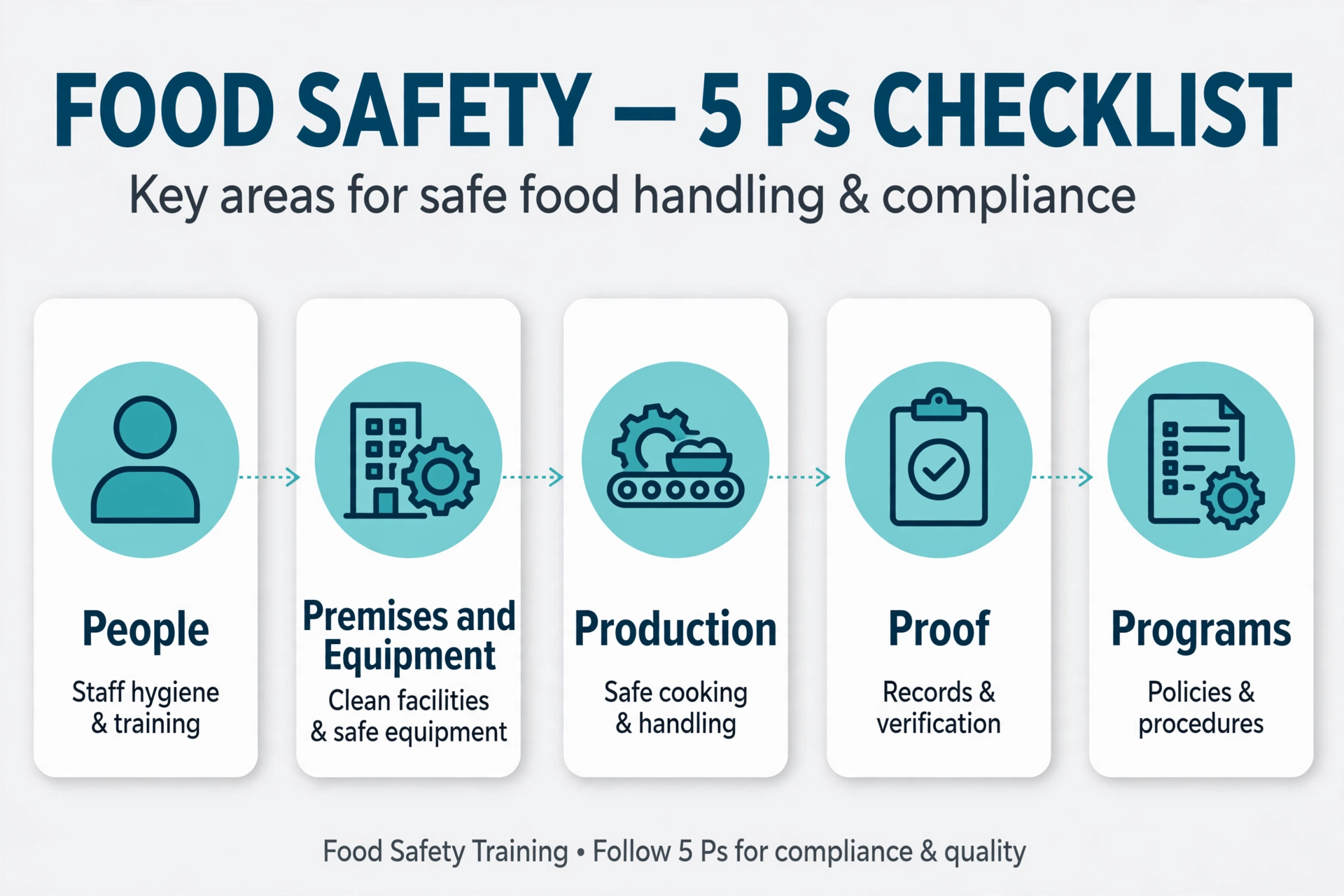
Every GMP rule in every framework falls into five blocks. They map directly to the remaining lessons of this course:
- People — health, hygiene, training (Lesson 2; 21 CFR 117.10, 117.4)
- Premises and equipment — building, grounds, sanitation, utilities (Lesson 3; 21 CFR 117.20, 117.35, 117.37, 117.40)
- Production — receiving, storage, processing, allergens, distribution (Lesson 4; 21 CFR 117.80, 117.93, 117.95, 117.110)
- Proof — records, traceability, self-inspection (Lesson 5; 21 CFR 117.305, 117.315, 117.320)
- Programs behind them — pest control, water safety, waste handling, maintenance (woven through Lessons 3–4)
Notice what’s missing: GMP does not tell you which specific hazards your product has or where your critical control points are. That’s the job of HACCP or preventive controls — which is exactly why GMP comes first in every food-safety curriculum.
Monday-morning checklist
Walk your facility (or your mental model of one) and answer honestly:
- Can every worker explain, in their own words, when to wash hands and why?
- Are toilets and handwash stations adequate, clean, and not a contamination risk?
- Is any equipment pitted, cracked, or impossible to clean?
- Do raw materials get inspected and separated from finished product?
- Could you show an inspector last week’s cleaning, temperature, and receiving records?
A “no” anywhere above is a GMP gap — and the rest of this course gives you the regulation-by-regulation detail to close it.
Key takeaways
- GMP = the baseline. Sanitary conditions and operating practices every food plant must maintain; HACCP and preventive controls build on top of it.
- US rule: 21 CFR Part 117. Subpart B (§§117.10–117.110) is the GMP core; Subpart C adds preventive controls; Subpart D gives qualified facilities modified requirements (§117.201).
- EU rule: Regulation (EC) 852/2004, Annex II. Premises (Chapter I) and equipment (Chapter V) hygiene requirements.
- International reference: Codex CXC 1-1969 (2023). Chapter 1 Good Hygiene Practices — the principles most national laws mirror.
- Insanitary conditions = adulterated food. Under FD&C Act §402(a)(4), FDA needs no proof of illness — bad conditions alone make food legally adulterated.
- Five blocks, five lessons. People, premises and equipment, production, proof, and the programs (pest, water, waste) running underneath.